Afsluitende woorden in het hoger beroep
Shells slotverklaring in het hoger beroep in de Klimaatzaak door de president-directeur van Shell Nederland Frans Everts.
For English, click here or scroll further down
Allereerst wil ik u danken voor de gelegenheid om mij afsluitend tot u te richten. Ik ben zowel hoopvol als bezorgd. Ik ben hoopvol over de rol die Shell speelt en zal blijven spelen in de energietransitie. Ik hoop dat de uitkomst van deze procedure Shell in staat stelt te blijven bijdragen aan de nodige verandering in ons energiesysteem. En ik hoop dat de uitkomst Shell de leverancier laat blijven van betrouwbare energie waarmee we mensen al decennia thuis en onderweg bedienen, ze warm en in beweging houden en talloze bedrijven laten draaien.
Tegelijkertijd maak ik mij zorgen over de mogelijke onbedoelde gevolgen van deze rechtszaak. Want mocht deze zaak de kant van Milieudefensie opgaan, dan is dat niet alleen schadelijk voor Shell, maar ook voor de wereldwijde energietransitie en voor Nederland.
Milieudefensie hoopt het klimaat te helpen door het aanbod van de producten die Shell verkoopt te beperken, eigenlijk voordat die klanten zelf in staat, bereid of klaar zijn om de overstap naar minder fossiel überhaupt te kunnen maken. Zolang de vraag naar deze producten niet verandert – en mensen gewoon bij de concurrent terecht kunnen – gaat er geen koolstofmolecuul minder de lucht in. En zonder schoon alternatief voor olie- en gasproducten, schiet de energietransitie er ook niets mee op.
Shell helpt op dit moment klanten in sectoren die niet eenvoudig kunnen overstappen op hernieuwbare elektriciteit zoals de luchtvaart, scheepvaart en zware industrie. Shell wil deze sectoren ook in de toekomst blijven helpen verduurzamen. Maar dat kan niet zonder onze bestaande klantrelaties en bestaande infrastructuur die nu juist de basis vormen voor onze nieuwe activiteiten zoals duurzame biobrandstoffen en waterstof. De eis van Milieudefensie staat in mijn ogen haaks op wat voor de energietransitie nodig is.
Daarnaast kan de eis van Milieudefensie vele andere bedrijven in Nederland benadelen. Bedrijven die ieder koploper zijn in hun sector. Daar maak ik mij zorgen over, omdat Nederland alles in huis heeft om een leidende rol te spelen in de energietransitie door onze kennis, infrastructuur en strategische ligging aan de Noordzee.
Milieudefensie kan dus met de beste intenties het slechtste resultaat bereiken. Geen stap vooruit in de energietransitie. Een zwakkere Nederlandse economie. En een onwenselijke afhankelijkheid van het buitenland voor cruciale producten en diensten.
Shell ziet het liever anders. Daarom stelt Shell een andere, gebalanceerde route naar een schoon energiesysteem voor, waarin energie naast duurzaam ook betaalbaar en beschikbaar blijft voor iedereen. Zeker, dit betekent voor nu ook nog steeds olie en gas. Maar zoals we tijdens deze zaak hebben gehoord, brengen we de uitstoot van deze brandstoffen – die nog steeds broodnodig zijn voor vrijwel alle cruciale onderdelen van ons bestaan – met succes omlaag. En daar willen we ook mee doorgaan.
Er is discussie geweest en er is enige verwarring geweest tussen het investeringsniveau, de productie en de verkoop van Shell. Wat Shell produceert en wat Shell verkoopt zijn heel verschillende dingen. Wat er echt toe doet in termen van onze uitstoot is de verkoop. Dus laat me glashelder zijn dat Shell verwacht dat onze verkoop van olieproducten tussen nu en 2030 zal dalen, maar dat onze verkoop van gas – om alle redenen die we hebben uitgelegd – zal stijgen. Daarom verwachten we dat de totale uitstoot van Shell vanaf nu tot 2030 ongeveer gelijk zal blijven.
Tot zover olie en gas. Zoals u heeft gehoord investeren we wereldwijd ook in het energiesysteem van de toekomst. Onze relaties met klanten en onze bestaande infrastructuur vormen daarvoor een belangrijke basis.
Neem bijvoorbeeld de luchtvaart. Shell werkt al decennia samen met luchtvaartmaatschappijen en vliegvelden over de hele wereld. Die klantrelaties zetten we nu in om “sustainable aviation fuel” – of “SAF” – te produceren en te verkopen. Dat doen we in Amerika en Azië maar ook hier om de hoek bij The Hague Rotterdam Airport. Vanaf volgend jaar mengen we daar SAF bij voor alle vliegtuigen, zodat de luchthaven in 2030 kan voldoen aan het ambitieuze Nederlandse doel van 14% SAF-bijmenging. En daarmee doet de luchthaven meer dan Europa dat op 6% zit in 2030.
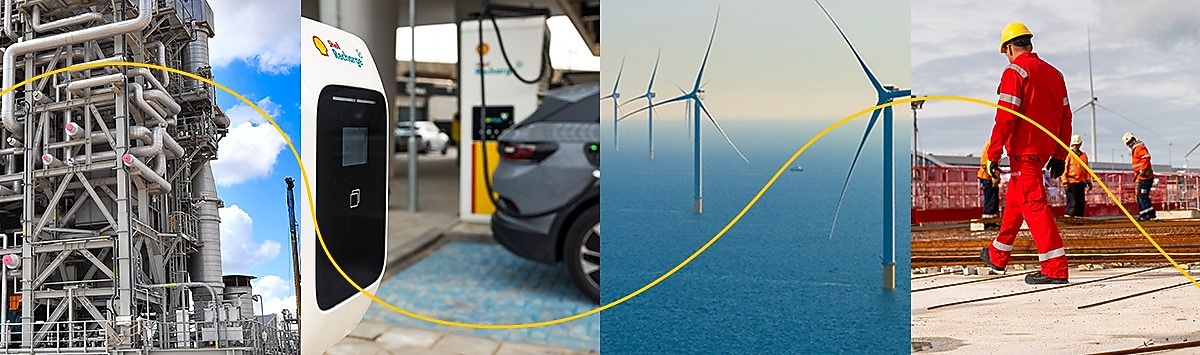
Een mooi voorbeeld van infrastructuur is Shells energiepark in Pernis, waar we onze raffinaderij integreren met projecten van wereldschaal op het gebied van groene waterstof, wind op zee, biobrandstoffen gemaakt van afval en manieren om CO2 af te vangen en op te slaan om onze eigen uitstoot en de uitstoot van de zware industrie omlaag te helpen. Ik denk dat de bouw van het energiesysteem van de toekomst en het mogelijke nieuwe ecosysteem nergens anders al zo zichtbaar is. Het gebeurt dit decennium, op grote schaal, hier in Nederland.
Dit laat ook zien dat Nederland nog steeds een van de belangrijkste landen is in de wereldwijde Shell-groep. Met 9100 medewerkers verspreid over 5 locaties. En met investeringen van 6,5 miljard euro zijn we de grootste private investeerder in de Nederlandse energietransitie.
Neem de fabriek voor groene waterstof in de Rotterdamse haven die ik net noemde. Voor die waterstof hebben we nog geen enkele klant. Dat is niet gek, want groene waterstof is veel duurder dan andere brandstoffen voor de industrie of zwaar transport. Maar we bouwen die fabriek toch. Totdat de eerste klant zich meldt, gebruiken we de groene waterstof zelf. Als de waterstofmarkt zich ontwikkelt zoals gedacht, wordt deze fabriek levensvatbaar en dan kunnen we er meer bouwen. Maar dat heeft tijd nodig.
Lossen we dus morgen klimaatverandering op met deze groene waterstof en onze andere initiatieven, zoals duizenden laadpalen voor elektrische auto’s, biodiesel en manieren om CO2 op te slaan? Nee, maar we werken aan tastbare, concrete projecten en resultaten. Samen met overheden die, ieder op hun eigen manier, ambitieuze doelen stellen en met wetten, infrastructuur en beleid de uiteindelijke kaders van de energietransitie bepalen. Samen met partners die mee-investeren in projecten. En samen met onze klanten die langzaam maar zeker overstappen op duurzame producten. En we willen doorgaan met het boeken van resultaten. Want die zijn essentieel om de energietransitie wél te laten slagen. Dank u.
Closing words in the Climate Case appeal
12 April 2024
Closing words by President Director of Shell in the Netherlands Frans Everts in the Climate Case appeal.
Dear Members of the Court,
First of all, I would like to thank you for the opportunity to address you in conclusion. I am both hopeful and worried. I am hopeful about the role Shell is playing and will continue to play in the energy transition. I hope that the outcome of this procedure will enable Shell to continue to contribute to the necessary change in our energy system. And I hope that the outcome will allow Shell to remain the supplier of reliable energy with which we have been serving people at home and on the go for decades, keeping them warm and moving, and keeping countless businesses running.
At the same time, I am concerned about the possible unintended consequences of this lawsuit. Because if this case goes Milieudefensie's way, it will not only be detrimental to Shell, but also to the global energy transition and to the Netherlands.
Friends of the Earth Netherlands hopes to help the climate by limiting the supply of the products that Shell sells... before those customers themselves, are able, willing or ready to make the switch to less fossil fuels at all. As long as the demand for these products doesn't change - and people can just go to the competitor - there is not one less carbon molecule in the air. And without a clean alternative to oil and gas products, the energy transition will not benefit either.
Shell is currently helping customers in sectors that cannot easily switch to renewable electricity, such as aviation, shipping and heavy industry. Shell wants to help these sectors become more sustainable in the future. But this is not possible without our existing customer relationships and existing infrastructure, which form the basis for our new activities, such as sustainable biofuels and hydrogen. In my view, Milieudefensie's demand is at odds with what is needed for the energy transition.
In addition, Milieudefensie's demand may disadvantage many other companies in the Netherlands. Companies that are each frontrunners in their sector. I am concerned about this, because the Netherlands has everything it takes to play a leading role in the energy transition thanks to our knowledge, infrastructure and strategic location on the North Sea.
Milieudefensie can therefore achieve the worst result with the best of intentions. Not a step forward in the energy transition. A weaker Dutch economy. And an undesirable dependence on foreign countries for crucial products and services.
Shell prefers to see things differently. That is why Shell is proposing a different, balanced route to a clean energy system, in which energy remains affordable and available to everyone in addition to being sustainable. Certainly, this still means oil and gas for now. But as we have heard during this case, we are successfully bringing down the emissions of these fuels - which are still desperately needed for almost all crucial parts of our existence. And we want to continue to do so.
There has been discussion and some confusion between Shell's level of investment, production and sales. What Shell produces and what Shell sells are very different things. What really matters in terms of our emissions is sales. So let me be crystal clear that Shell expects our sales of oil products to fall between now and 2030, but that our sales of gas – for all the reasons we have explained – will increase. Therefore, we expect Shell's total emissions to remain roughly the same from now until 2030.
So much for oil and gas. As you have heard, we are also investing globally in the energy system of the future. Our relationships with customers and our existing infrastructure form an important basis for this.
Take aviation, for example. Shell has been working with airlines and airports around the world for decades. We now use these customer relationships to produce and sell "sustainable aviation fuel" – or "SAF". We do this in America and Asia, but also near this court at The Hague Rotterdam Airport. Starting next year, we will mix SAF for all planes, so the airport can meet the ambitious Dutch target of 14% SAF blending by 2030. And with that, the airport is doing more than Europe, which is at 6% in 2030.
A good example of infrastructure is Shell's energy park in Pernis, where we are integrating our refinery with world-scale projects in the field of green hydrogen, offshore wind, biofuels made from waste, and ways to capture and store CO2 to help reduce our own emissions and emissions from heavy industry. I don't think the construction of the energy system of the future and the possible new ecosystem is so visible anywhere else. It's happening this decade, on a large scale, here in the Netherlands.
This also shows that the Netherlands is still one of the most important countries in the global Shell group. With 9100 employees spread over 5 locations. And with investments of 6.5 billion euros, we are the largest private investor in the Dutch energy transition.
Take the green hydrogen plant in the port of Rotterdam that I just mentioned. We don't have a single customer for that hydrogen yet. This is not surprising, because green hydrogen is much more expensive than other fuels for industry or heavy transport. But we're building that factory anyway. Until the first customer comes forward, we use the green hydrogen ourselves. If the hydrogen market develops as expected, this plant will become viable and then we can build more. But that takes time.
So will we solve climate change tomorrow with this green hydrogen and our other initiatives, such as thousands of charging stations for electric cars, biodiesel and ways to store CO2? No, but we are working on tangible projects and results. Together with governments that each set ambitious goals in their own way and determine the ultimate frameworks of the energy transition with laws, infrastructure and policy. Together with partners who co-invest in projects. And together with our customers who are slowly but surely switching to sustainable products. And we want to continue to achieve results. Because they are essential for the energy transition to succeed.
Thank you.