Shell maakt afspraken met overheid om uitstoot versneld te verlagen
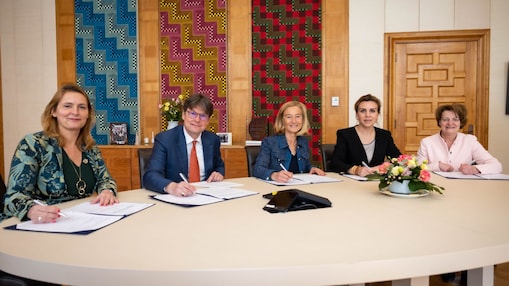
Shell wil in Nederland in 2030 3,9 megaton minder CO2 uitstoten ten opzichte van 2020. Dit is opgenomen in een Expression of Principles die vandaag door de provincies Zuid-Holland en Noord-Brabant, het ministerie van Infrastructuur en Waterstaat, het Ministerie van Economische Zaken en Klimaat en Shell is ondertekend als onderdeel van de zogenoemde Maatwerkafspraken. Dit komt neer op een verlaging van Shells uitstoot in Nederland met bijna 60% in tien jaar. De betrokken partijen zouden hiermee zo’n 20% realiseren van de totale industriële ambitie in Nederland voor 2030.
De CO2-verlaging is mogelijk dankzij een reeks aan maatregelen. Sommige daarvan zijn al aangekondigd of in aanbouw, zoals een groot efficiencyproject als Skyline op Shell Chemicals Park Moerdijk, het CO2-opvang en opslag project Porthos, een biobrandstoffenfabriek op Shell Energy and Chemicals Park Rotterdam en de aanleg van Europa's grootste groene waterstoffabriek Holland Hydrogen 1 op de Tweede Maasvlakte.
Tweederde van de CO2-verlaging (2,6 Mt) moet uit nieuwe projecten komen. Voorbeelden van projecten waar Shell naar kijkt zijn elektrificatie met bijvoorbeeld een grote e-boiler om stoom te produceren, vergroting van de CO2-opvang en opslag en innovaties als synthetische brandstoffen (brandstoffen gemaakt van CO2 en waterstof).
Duurzaam beleid
Voor alle duurzaamheidsprojecten is samenwerking met de overheid nodig. De juiste regelgeving is een essentiële voorwaarde voor succes. Denk daarbij aan regelgeving op het gebied van biobrandstoffen, de inzet van groene waterstof en regels om circulariteit daadwerkelijk mogelijk te maken.
De overheid heeft de ambitie om vergunningverlening voor duurzame projecten en de realisatie van de energie-infrastructuur te versnellen. Zo zijn bijvoorbeeld pijpleidingen nodig om groene waterstof te transporteren en een stroomnet dat de extra benodigde elektriciteit aan kan. Ook heeft de overheid toegezegd te onderzoeken hoe de vraag van klanten naar duurzame producten kan worden gestimuleerd.
Minister Adriaansens van Economische Zaken en Klimaat:
“De meeste mensen kennen Shell van het pompstation. Maar Shell doet veel meer. Het bedrijf maakt grondstoffen voor producten die we dagelijks nodig hebben, denk aan medicijnen, wasmiddel, isolatiemateriaal, latexverf. Het bedrijf is belangrijk voor de Nederlandse economie, onder meer voor werkgelegenheid. Bovendien speelt het bedrijf als toekomstig producent en leverancier van groene waterstof een belangrijke rol in de verduurzaming van de industrie. Ik ben blij dat wij met elkaar ambitieuze afspraken hebben gemaakt en dat Shell hier zelf in investeert. Ik help graag bij de randvoorwaarden.”
Frans Everts, president-directeur Shell Nederland:
“Vandaag hebben we ons met de overheid verbonden aan een mega-ambitie om de uitstoot van Shell in Nederland te verminderen. Shell heeft de kennis, de expertise en zeker ook de ambitie om te zorgen dat veelbelovende innovaties op dit vlak worden uitgerold. Niet voor niets kondigden we de afgelopen jaren dan ook voor miljarden euro’s aan investeringen aan in de Nederlandse energietranstie. De aankondiging van vandaag sluit aan bij onze wereldwijde ambitie om onze eigen uitstoot te halveren tegen 2030. We gaan nu met elkaar aan de slag om deze maatwerkafspraken verder uit te werken. ”
Uitstoot van klanten verlagen
Zowel de overheid als Shell Nederland zien ook bij klanten mogelijkheden om de CO2-uitstoot te verlagen, bijvoorbeeld met biobrandstoffen en groene waterstof. Shell bouwt in Nederland al fabrieken op wereldschaal op dit gebied. De biobrandstoffenfabriek maakt straks 820 kiltoton brandstoffen om bijvoorbeeld de luchtvaart te helpen verduurzamen; gelijk aan een verlaging van de uitstoot van meer dan 1 miljoen auto’s in Europa.
Ook voor chemische producten ziet Shell mogelijkheden tot verduurzaming. Zo werkt het op Moerdijk aan manieren om moeilijk te recyclen plastic om te werken tot nieuwe grondstoffen.
De Expression of Principles is richtinggevend en dient als raamwerk voor verdere maatwerkafspraken tussen de overheid en Shell.
English translation
Shell makes agreements with government to accelerate emissions reduction
Shell wants to reduce its CO2 emissions in the Netherlands in 2030 by 3.9 megatons, compared to 2020. This is included in an Expression of Principles signed today by the provinces of Zuid-Holland and Noord-Brabant, the Ministry of Infrastructure and Water Management, the Ministry of Economic Affairs and Climate and Shell as part of the so-called Maatwerkafspraken (Tailor-made Agreements). This amounts to a reduction of Shell's emissions in the Netherlands by almost 60% in ten years. The parties involved would achieve about 20% of the total reduction ambition set for industries in the Netherlands, by 2030.
The CO2-reduction is possible thanks to a series of measures. Some of these have already been announced or are under construction, such as a large efficiency project like Skyline at Shell Chemicals Park Moerdijk, the CO2-capture and storage project Porthos, a biofuels facility at Shell Energy and Chemicals Park Rotterdam and the construction of Europe's largest green hydrogen plant Holland Hydrogen 1 on the Tweede Maasvlakte area near Rotterdam.
Two-thirds of the CO2 emissions reduction (2.6 Mt) should come from new projects. Examples of projects that Shell is looking at are electrification with, for example, a large e-boiler to produce steam, higher CO2 capture and storage, and innovations such as synthetic fuels (fuels made from CO2 and hydrogen).
Sustainable policy
All sustainability projects require cooperation with the government. The right regulation is an essential prerequisite for success. Think of regulations in the field of biofuels, for the use of green hydrogen and for making circularity possible.
The government has the ambition to accelerate the granting of permits for sustainable projects and the realization of the energy infrastructure. For example, pipelines are needed to transport green hydrogen as well as a power grid that can handle the extra electricity needed. The government has also agreed to investigate how customer demand for sustainable products can be stimulated.
Micky Adriaansens, Minister of Economic Affairs and Climate of the Netherlands:
"Most people know Shell from the retail stations. But Shell does much more. The company makes raw materials for products that we need every day, such as medicines, detergent, insulation material, latex paint. The company is important for the Dutch economy, including employment. Moreover, as a future producer and supplier of green hydrogen, the company plays an important role in making the industry more sustainable. I am pleased that we have made ambitious agreements with each other and that Shell itself is investing in them. I am happy to help with shaping the preconditions."
Frans Everts, President-Director Shell Netherlands:
"Today we have committed ourselves to a mega-ambition, together with the government to reduce Shell's emissions in the Netherlands. Shell has the knowledge, the expertise and certainly also the ambition to ensure that promising innovations in this area are rolled out. It is not without reason that we have announced billions of euros in investments in Dutch energy transition in recent years. Today's announcement is in line with our global ambition to halve our own emissions by 2030. We will now work together to develop these Tailor-made Agreements further."
Reducing customer emissions
The governments and Shell Netherlands also see opportunities for customers to reduce their CO2 emissions, for example with biofuels and green hydrogen. Shell is already building factories in this field on a global scale in the Netherlands. The biofuels plant will soon produce 820 kilotons of fuels annually to support the aviation sector in becoming more sustainable, representing a reduction in emissions of more than 1 million European cars.
Shell also sees opportunities to make chemical products sustainable. For example, Shell Chemicals Park Moerdijk is working on ways to convert hard-to-recycle plastics back into raw materials for making new, circular plastics.
The Expression of Principles is guiding and serves as a framework for further Tailor-made Agreements between the government and Shell.
Cautionary Note
Cautionary Note
The companies in which Shell plc directly and indirectly owns investments are separate legal entities. In this news article “Shell”, “Shell Group” and “Group” are sometimes used for convenience where references are made to Shell plc and its subsidiaries in general. Likewise, the words “we”, “us” and “our” are also used to refer to Shell plc and its subsidiaries in general or to those who work for them. These terms are also used where no useful purpose is served by identifying the particular entity or entities. ‘‘Subsidiaries’’, “Shell subsidiaries” and “Shell companies” as used in this news article refer to entities over which Shell plc either directly or indirectly has control. Entities and unincorporated arrangements over which Shell has joint control are generally referred to as “joint ventures” and “joint operations”, respectively. “Joint ventures” and “joint operations” are collectively referred to as “joint arrangements”. Entities over which Shell has significant influence but neither control nor joint control are referred to as “associates”. The term “Shell interest” is used for convenience to indicate the direct and/or indirect ownership interest held by Shell in an entity or unincorporated joint arrangement, after exclusion of all third-party interest.
Forward-Looking Statements
This news article contains forward-looking statements (within the meaning of the U.S. Private Securities Litigation Reform Act of 1995) concerning the financial condition, results of operations and businesses of Shell. All statements other than statements of historical fact are, or may be deemed to be, forward-looking statements. Forward-looking statements are statements of future expectations that are based on management’s current expectations and assumptions and involve known and unknown risks and uncertainties that could cause actual results, performance or events to differ materially from those expressed or implied in these statements. Forward-looking statements include, among other things, statements concerning the potential exposure of Shell to market risks and statements expressing management’s expectations, beliefs, estimates, forecasts, projections and assumptions. These forward-looking statements are identified by their use of terms and phrases such as “aim”, “ambition”, ‘‘anticipate’’, ‘‘believe’’, ‘‘could’’, ‘‘estimate’’, ‘‘expect’’, ‘‘goals’’, ‘‘intend’’, ‘‘may’’, “milestones”, ‘‘objectives’’, ‘‘outlook’’, ‘‘plan’’, ‘‘probably’’, ‘‘project’’, ‘‘risks’’, “schedule”, ‘‘seek’’, ‘‘should’’, ‘‘target’’, ‘‘will’’ and similar terms and phrases. There are a number of factors that could affect the future operations of Shell and could cause those results to differ materially from those expressed in the forward-looking statements included in this news article, including (without limitation): (a) price fluctuations in crude oil and natural gas; (b) changes in demand for Shell’s products; (c) currency fluctuations; (d) drilling and production results; (e) reserves estimates; (f) loss of market share and industry competition; (g) environmental and physical risks; (h) risks associated with the identification of suitable potential acquisition properties and targets, and successful negotiation and completion of such transactions; (i) the risk of doing business in developing countries and countries subject to international sanctions; (j) legislative, judicial, fiscal and regulatory developments including regulatory measures addressing climate change; (k) economic and financial market conditions in various countries and regions; (l) political risks, including the risks of expropriation and renegotiation of the terms of contracts with governmental entities, delays or advancements in the approval of projects and delays in the reimbursement for shared costs; (m) risks associated with the impact of pandemics, such as the COVID-19 (coronavirus) outbreak; and (n) changes in trading conditions. No assurance is provided that future dividend payments will match or exceed previous dividend payments. All forward-looking statements contained in this news article are expressly qualified in their entirety by the cautionary statements contained or referred to in this section. Readers should not place undue reliance on forward-looking statements. Additional risk factors that may affect future results are contained in Shell plc’s Form 20-F for the year ended December 31, 2022 (available at www.shell.com/investor and www.sec.gov). These risk factors also expressly qualify all forward-looking statements contained in this news article and should be considered by the reader. Each forward-looking statement speaks only as of the date of this news article, 13th April 2023. Neither Shell plc nor any of its subsidiaries undertake any obligation to publicly update or revise any forward-looking statement as a result of new information, future events or other information. In light of these risks, results could differ materially from those stated, implied or inferred from the forward-looking statements contained in this news article.
Shell’s net carbon intensity
Also, in this news article we may refer to Shell’s “Net Carbon Intensity”, which include Shell’s carbon emissions from the production of our energy products, our suppliers’ carbon emissions in supplying energy for that production and our customers’ carbon emissions associated with their use of the energy products we sell. Shell only controls its own emissions. The use of the term Shell’s “Net Carbon Intensity” is for convenience only and not intended to suggest these emissions are those of Shell plc or its subsidiaries.
Shell’s net-Zero Emissions Target
Shell’s operating plan, outlook and budgets are forecasted for a ten-year period and are updated every year. They reflect the current economic environment and what we can reasonably expect to see over the next ten years. Accordingly, they reflect our Scope 1, Scope 2 and Net Carbon Intensity (NCI) targets over the next ten years. However, Shell’s operating plans cannot reflect our 2050 net-zero emissions target and 2035 NCI target, as these targets are currently outside our planning period. In the future, as society moves towards net-zero emissions, we expect Shell’s operating plans to reflect this movement. However, if society is not net zero in 2050, as of today, there would be significant risk that Shell may not meet this target.
Forwad Looking Non-GAAP measures
This news article may contain certain forward-looking non-GAAP measures such as cash capital expenditure and divestments. We are unable to provide a reconciliation of these forward-looking Non-GAAP measures to the most comparable GAAP financial measures because certain information needed to reconcile those Non-GAAP measures to the most comparable GAAP financial measures is dependent on future events some of which are outside the control of Shell, such as oil and gas prices, interest rates and exchange rates. Moreover, estimating such GAAP measures with the required precision necessary to provide a meaningful reconciliation is extremely difficult and could not be accomplished without unreasonable effort. Non-GAAP measures in respect of future periods which cannot be reconciled to the most comparable GAAP financial measure are calculated in a manner which is consistent with the accounting policies applied in Shell plc’s consolidated financial statements.
The contents of websites referred to in this news article do not form part of this news article.
We may have used certain terms, such as resources, in this news article that the United States Securities and Exchange Commission (SEC) strictly prohibits us from including in our filings with the SEC. Investors are urged to consider closely the disclosure in our Form 20-F, File No 1-32575, available on the SEC website www.sec.gov.