Peristaltiek
Bronnen van beweging. Wat in Nederland verzet evenveel grond als alle met tractoren ploegende boeren bij elkaar? Precies: de regenworm. Deze tunnelbouwer, bodemverbeteraar en afvalverwerker staat te boek als ‘ingenieur van de bodem’.

Tekst: Monika Jak. Beeld: Getty Images.
For English, click here or scroll further down
Charles Darwin wist het al. Hij wijdde in 1881 een heel boek – zijn laatste – aan het belang van de worm. Voor hem typeerde Aristoteles wormen als ‘de darmen van de ondergrond’. Daarover gesproken, en niet toevallig: worm en darmen hebben iets gemeen, en dat is de manier van bewegen. Het komt neer op gecoördineerde samentrekkingen van kring- en lengtespieren. In het geval van de worm zorgt het voor verplaatsing van het diertje zelf, bij de darm beweegt de inhoud. Peristaltiek heet dat.
Extra slim
Het lichaam van een regenworm telt tussen de 110 en 180 segmenten. Wil hij vooruit dan trekt hij één zo’n deeltje samen, terwijl hij de deeltjes ervoor en -achter uitrekt. Extra slim is dat de worm met elke beweging ook de grond tegen de wanden van de gang drukt, een soort zijwaarts aanstampen. Die stort daarom niet in.
Elk hapje
Bij mensen verplaatst de darm zich niet, maar wel – via hetzelfde bewegingsprincipe – de voedselbrij daarbinnen. Resultaat is dat je, terwijl je ondersteboven aan een rekstok hangt, evengoed een krentenbol kunt eten. En dat bovendien brood en krenten de maag bereiken. De peristaltische contractiegolf brengt elk hapje tot onder in de slokdarm alwaar de onderste sluitspier even opent en het hapje in de maag belandt.
Robotworm
Het is van een verbluffende eenvoud, deze voortbewegingsmechanica. En dat is altijd voer voor de nieuwsgierige mens. Onderzoekers van het Massachusetts Institute of Technology (MIT) hebben een prototype wormrobot ontwikkeld, gemaakt van een buis van polymeergaas. Daaromheen zijn draden van geheugenmetaal gewikkeld, een nikkel-titanium-legering. Die vormen de kunstmatige spieren om de worm te laten samentrekken.
In de robot zit een klein accupakketje dat elektrische stroompjes door de draden schiet. Door afwisselend de draad te verwarmen en weer af te laten koelen, ‘golft’ de kunstmatige worm vooruit. Een ingebouwd printplaatje met een regelalgoritme zorgt voor route en richting.
Wormvormige 007
Het Pentagon financierde het project. Logisch, want een dergelijk prototype kan zich ontpoppen tot een wormvormige 007. Of een maanwandelaar. De ingenieurs zien ook mogelijkheden bij zoek- en reddingsoperaties en in medische toepassingen, zoals endoscopen, implantaten en protheses.
Man is but a worm
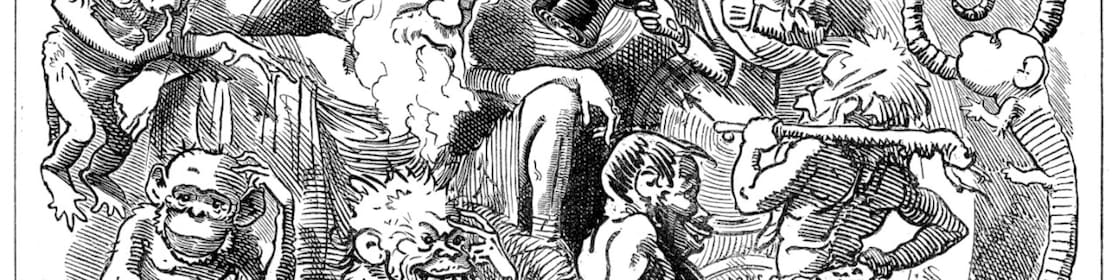
Nakomelingen, zo voorspellen de onderzoekers, zullen in alledaagse producten terechtkomen, bijvoorbeeld mobiele telefoons, draagbare computers en auto’s. De lofzang van Darwin op de regenworm werd destijds weggehoond in de vorm van een cartoon. Het onderschrift luidt: man is but a worm. Inmiddels blijkt dit ogenschijnlijk eenvoudige schepsel een ecosysteemingenieur met een superslim bewegingsapparaat, en een bron van kennis en innovatie bovendien. Een vrolijke gedachte bij een volgende krentenbol.
Lees ook in deze serie
"Peristaltiek" is het derde deel in een driedelige miniserie met het thema Bronnen van beweging. Het eerste en tweede deel, "Paardenkracht" en "De scheepschroef" verschenen eerder online. De serie staat ook in Venster #1-2024.
Meer nieuws uit Shell Venster

Forces of movement - from a series of three stories published in Shell Venster Magazine #1-2024Peristaltis
17 April 2024
Sources of movement. What moves as much land in the Netherlands as all the tractor ploughing farmers combined? That's right: the earthworm. This tunnel builder, soil improver and waste processor is known as a 'soil engineer'.
Text: Monika Jak. Illustration: Getty Images
Charles Darwin already knew this. In 1881 he devoted an entire book – his last – to the importance of the worm. For him, Aristotle characterized worms as "the intestines of the subsoil." Speaking of which, and not coincidentally, worm and intestines have something in common, and that is the way they move. It comes down to coordinated contractions of sphincter and length muscles. In the case of the worm, it causes the animal itself to move, while the contents of the intestine move. This is called peristalsis.
Extra smart
The body of an earthworm has between 110 and 180 segments. If it wants to move forward, it pulls one such particle together, while stretching the particles in front and behind. What is extra clever is that the worm also presses the soil against the walls of the corridor with every movement, a kind of sideways tamping. That's why the tunnel doesn't collapse.
Every bite
In humans, the intestine does not move, but – by the same principle of movement – the food slurry does move within it. The result is that, while hanging upside down on a horizontal bar, you might as well eat a cinnamon bun. Bread and currants still reach the stomach. The peristaltic contraction wave brings each bite to the bottom of the esophagus, where the lower sphincter opens briefly and the bite ends up in the stomach.
Robot worm
It is of a stunning simplicity, these locomotion mechanics. And that is always food for the curious person. Researchers at the Massachusetts Institute of Technology (MIT) have developed a prototype worm robot made from a polymer mesh tube. Wrapped around it are wires of memory metal, a nickel-titanium alloy. These form the artificial muscles to make the worm contract.
A small battery pack inside the robot sends electrical currents through the wires. By alternating between heating and cooling the thread, the artificial worm 'undulates' forward. A built-in circuit board with a control algorithm provides route and direction.
Worm-shaped 007
The Pentagon funded the project. This makes sense, because such a prototype can turn out to be a worm-shaped 007. Or a moonwalker. The engineers also see opportunities in search and rescue operations and in medical applications, such as endoscopes, implants and prosthetics.
Man is but a worm
Spin-offs of the robot worm, researchers predict, will end up in everyday products, such as cell phones, wearable computers, and cars. Darwin's ode to the earthworm was ridiculed in the form of a cartoon at the time. The caption reads: man is but a worm. In the meantime, this seemingly simple creature has turned out to be an ecosystem engineer with a super-smart musculoskeletal system, and is a source of knowledge and innovation. A cheerful thought when you eat your next cinnamon bun.
Also in these series
"Peristaltis" is the third publication in a miniseries themed around Forces of movement. The first and second parts, "Horsepower" and "The ship's propeller", have been published as well. The series is also featured in Venster #1-2024.