Aan het roer van de plek waar innovatieve energieoplossingen vandaan komen
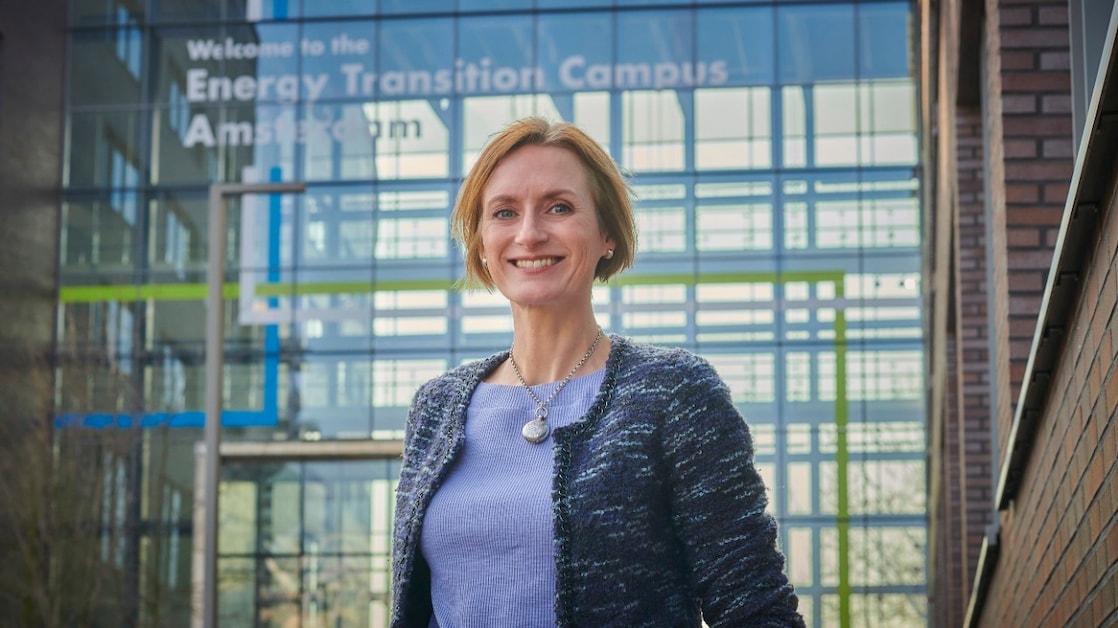
“Dankbaarheid” en “een buitengewoon geschenk”. Zo beschrijft Sarah Street in dit 100-dageninterview haar gevoelens toen zij op 1 maart benoemd werd tot directeur van de Energy Transition Campus Amsterdam (ETCA). Ze staat aan het roer van de plek waar energieoplossingen voor vandaag en morgen samenkomen. Ze is in die rol niet de dirigent, maar de verbindende schakel in een tijd van transformatie.

Tekst: Marcel Burger. Beeld: Michel Campfens.
For English, scroll down or click here
Deze verandering van STCA, een onderzoeks- en ontwikkelcentrum exclusief voor Shell, naar ETCA, een open samenwerkingscampus, was al ingezet door haar voorganger Ferry Winter. In juni 2022 opende Shell zijn historische laboratorium in Amsterdam – dat al sinds 1914 bestaat – voor anderen. De achterliggende gedachte: de energietransitie kan één partij niet volbrengen; het vraagt om een collectieve inspanning van velen. Op de ETCA werkt Shell op eigen initiatief samen met tientallen start-ups, scale-ups, toonaangevende bedrijven en kennisinstellingen.
34 members op het terrein
“Het is een periode van verandering geweest, waarin we hebben gezocht naar manieren om voort te bouwen op onze rijke ervaring,” blikt Street terug op de afgelopen drie jaar. “We zijn overgestapt van de ‘Shell-manier van werken’ naar een meer diverse manier van samenwerken. Als open campus zijn we sneller gegroeid dan we aanvankelijk hadden verwacht, met inmiddels 34 members. We blijven groeien. Al draait het niet alleen om het aantal members, maar vooral om samen impact te maken op de energietransitie.”
Samenwerking aan duurzame vloeibare gasvormen
Door critici is de nauwe samenwerking wel eens ter discussie gesteld. Daadwerkelijke onderzoekssamenwerking bleek namelijk tijd te kosten om zich te ontwikkelen. Street benadrukt dat het een open campus is, waar members met iedereen kunnen samenwerken, niet alleen met Shell. Ze noemt daarbij enkele voorbeelden van samenwerkingen tussen Shell en andere ETCA-members.
“Een voorbeeld is het gezamenlijke initiatief met TNO om de productie van hernieuwbare DME te verkennen. Shell leverde hierbij ondersteuning voor de infrastructuur, wat beide partijen waardevolle inzichten opleverde. DME, dimethylether, is een duurzaam onder druk vloeibaar gemaakt gas vergelijkbaar met LPG. In dit project wordt het geproduceerd uit CO₂ en hernieuwbare waterstof. En zo wordt het omgezet in een hernieuwbare en recyclebare energiebron.”
Oplossingen voor CO₂-afvang
Street noemt nog een ander voorbeeld. “Samen met de gemeente Amsterdam hebben we vorig jaar een open innovatieprogramma gelanceerd. Een van de bekroonde start-ups uit het programma is CarbonOrO, dat werkt aan een haalbaarheidsstudie naar CO₂-afvangoplossingen voor bouwmaterialen en hoe deze passen in de waardeketen.”
CarbonOrO is een start-up. Het bedrijf gebruikt een aminesolvent, een oplossingsmiddel, dat CO₂ op een zeer efficiënte en energiezuinige manier absorbeert. Daarmee helpt het bedrijf emissies in moeilijk te verduurzamen sectoren, zoals de metaalindustrie, te verlagen. CarbonOrO kreeg haar ETCA-lidmaatschap nadat het Leapsprong 2024 won. Dat is een open innovatieprogramma dat energieoplossingen helpt sneller de markt te bereiken. De wedstrijd werd georganiseerd door de Gemeente Amsterdam, de ETCA en Rockstart, een organisatie die wereldwijd start-ups ondersteunt. De 2025-editie van Leapsprong is overigens zojuist geopend.
CV Sarah Street
- Sinds maart 2025: Directeur Energy Transition Campus Amsterdam
- 2021 – 2025: General manager Opportunity Evaluation & Intake bij Shell – leidinggeven aan een technisch-commercieel team om onderzoek en ontwikkeling te richten op problemen die het waard zijn om op te lossen
- 2017 – 2021: Teamleider Process Evaluations bij Shell – gericht op chemicaliën, nieuwe energiebronnen en CO₂-reductie
- 2011 – 2016: Senior ingenieur Process Evaluations bij Shell – technische en economische evaluaties van nieuwe technologieën en ondersteuning bij de ontwikkeling van de chemiesector
- 2010 – 2011: Technoloog Primaire Processen bij Shell – gericht op technologie-licenties aan externe klanten
- 2006 – 2010: Technoloog Thermische Conversie bij Shell
- 2001 – 2006: Technoloog Destillatie bij Shell
- 1997 – 2001: Ontwerpingenieur bij UOP Ltd. (nu onderdeel van Honeywell)
- 1994 – 1997: Procesingenieur bij MW Kellogg Ltd. (nu KBR)
- 1990 – 1994: Master in Chemische Technologie met Frans, aan de Universiteit van Manchester, Groot-Brittannië, en ENSIGC in Toulouse, Frankrijk
Technoloog in hart en nieren
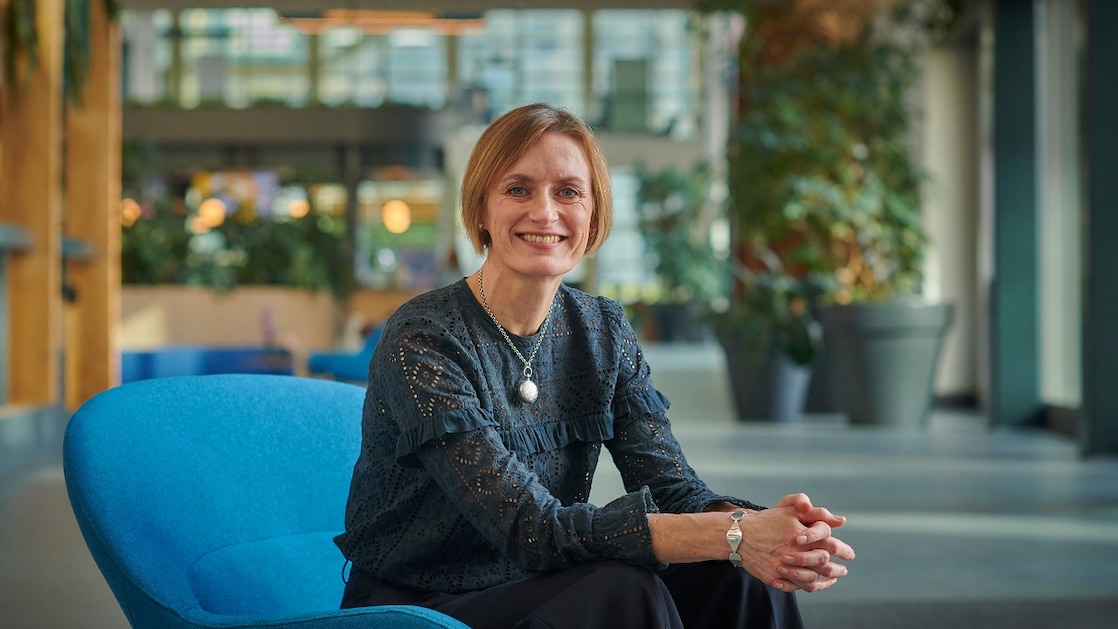
Sarah Street is nu directeur van de Energy Transition Campus, maar in hart en nieren is ze een technoloog. “Dat helpt me zeker”, zegt ze. “Ik kan deze rol beter vervullen dankzij mijn achtergrond als procestechnisch ingenieur. Het geeft me een breed begrip van de technologie en innovatie die nodig zijn om dingen elke dag veilig en efficiënt te laten verlopen, en ideeën om te zetten in iets dat echt werkt.”
Ze ziet een mooie toekomst voor ETCA. “We maken ons hard voor de waarde van onderzoek en ontwikkeling, en de campus helpt Shell om haar concurrentiepositie als energiebedrijf te versterken. We zijn een open campus die de versnelling van de energietransitie ondersteunt. Dat vraagt om samenwerking tussen meerdere partijen en innovatieve onderzoeksprojecten. De ETCA versterkt de energietransitie met haar trotse, unieke karakter en biedt een ontmoetingsplek waar samenwerking centraal staat bij het oplossen van de complexe uitdagingen die deze transitie met zich meebrengt.
Op het dak, in een notendop
Op de Energy Transition Campus Amsterdam worden ideeën tastbaar gemaakt, zegt Street. Op het dak liggen zonnepanelen, er is een eigen stroomnet met een waterstofelektrolyser die draait op hernieuwbare energie, een energieopslagsysteem (een grote batterij) van de Duitse producent Sonnen en er zijn laadpalen voor medewerkers waar ook elektrische rijders uit de buurt gebruik van kunnen maken.
In zekere zin fungeert het microgrid van de campus als een model voor het energiesysteem van de toekomst; een systeem waarin waardeketens met groene moleculen en elektronen samenkomen. In een notendop laat het zien hoe de energietransitie er op kleinere schaal uit kan zien.
Het biedt de mogelijkheid om aanpassingen en veranderingen veilig uit te proberen voordat ze op grotere schaal worden uitgerold. “Het helpt dat we in Amsterdam zitten,” zegt Street. “Het is een stad die ver buiten de landsgrenzen bekend is, en bovendien goed ligt in Europa.”
Sarah Street, directeur Energy Transition Campus Amsterdam"De campus helpt Shell om haar positie als energiebedrijf te versterken"
Wonen in Amsterdam
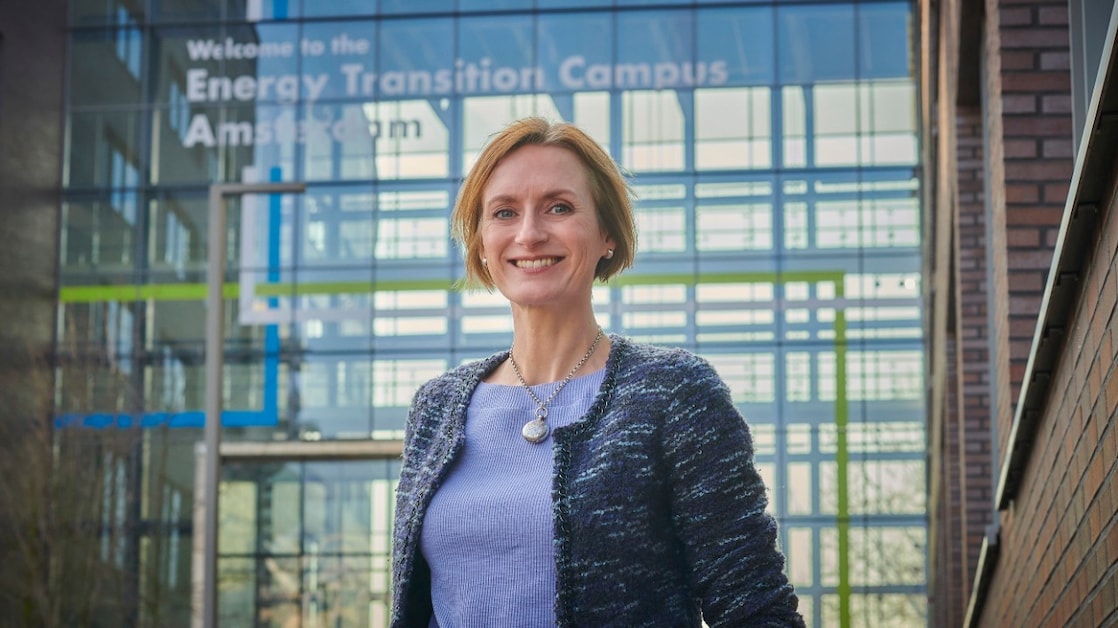
Sarah Street is geboren en getogen aan de rand van het continent, in Noord-Ierland. Ze studeerde in Manchester en verhuisde 25 jaar geleden met haar man naar Nederland. “Toen ik eenmaal gewend was aan de directe manier van communiceren in Nederland – wat voor een Brit best even wennen is – ben ik het leven in Nederland enorm gaan waarderen. Onze zoon en dochter zijn naar Nederlandse openbare scholen gegaan, en samen zijn we goed geïntegreerd,” zegt Street, die naast haar moedertaal Engels ook Nederlands spreekt.
“Ik mis wel de groene heuvels van het Ierse platteland,” zegt ze desgevraagd. “Aan de andere kant houd ik van het gemak waarmee je in Nederland overal naartoe kunt fietsen. En hoewel ik geen Brits eten mis, mis ik als ik weg ben van huis wel de Nederlandse kazen en het brood.”
Wandelen in het bos
Na bijna een kwart eeuw bij Shell moet Street wel wat tips hebben over hoe je werk en privé in balans houdt. “Voor mijn nieuwe rol als directeur ben ik van een parttime naar een fulltime functie gegaan, dus ja – balans is voor mij erg belangrijk. Ik doe graag aan yoga en houd ervan om in het bos te wandelen. Ik ben geen boomknuffelaar, maar het besef dat een boom op mijn pad misschien al honderd jaar leeft, brengt wel een bepaald perspectief in zaken. Verbinding zoeken met de natuur is mijn favoriete ontsnapping aan de dagelijkse routine. Het inspireert me, en het helpt om mentaal tot rust te komen. Oh, en slapen mag nooit worden onderschat.”
Drie maanden in haar nieuwe rol als campusdirecteur komt Sarah Street over als scherp en gefocust op de koers van de Energy Transition Campus Amsterdam richting de toekomst. Street is erg positief over waar het naartoe gaat: “We zijn bezig met een spannende reis. Die is nooit saai.”
Sarah Street, directeur Energy Transition Campus Amsterdam"Ik ben het leven in Nederland enorm gaan waarderen"
Cautionary note
Cautionary note
The companies in which Shell plc directly and indirectly owns investments are separate legal entities. In this announcement “Shell”, “Shell Group” and “Group” are sometimes used for convenience where references are made to Shell plc and its subsidiaries in general. Likewise, the words “we”, “us” and “our” are also used to refer to Shell plc and its subsidiaries in general or to those who work for them. These terms are also used where no useful purpose is served by identifying the particular entity or entities. ‘‘Subsidiaries’’, “Shell subsidiaries” and “Shell companies” as used in this announcement refer to entities over which Shell plc either directly or indirectly has control. The term “joint venture”, “joint operations”, “joint arrangements”, and “associates” may also be used to refer to a commercial arrangement in which Shell has a direct or indirect ownership interest with one or more parties. The term “Shell interest” is used for convenience to indicate the direct and/or indirect ownership interest held by Shell in an entity or unincorporated joint arrangement, after exclusion of all third-party interest.
Forward-looking Statements
This announcement contains forward-looking statements (within the meaning of the U.S. Private Securities Litigation Reform Act of 1995) concerning the financial condition, results of operations and businesses of Shell. All statements other than statements of historical fact are, or may be deemed to be, forward-looking statements. Forward-looking statements are statements of future expectations that are based on management’s current expectations and assumptions and involve known and unknown risks and uncertainties that could cause actual results, performance or events to differ materially from those expressed or implied in these statements. Forward-looking statements include, among other things, statements concerning the potential exposure of Shell to market risks and statements expressing management’s expectations, beliefs, estimates, forecasts, projections and assumptions. These forward-looking statements are identified by their use of terms and phrases such as “aim”; “ambition”; ‘‘anticipate’’; ‘‘believe’’; “commit”; “commitment”; ‘‘could’’; ‘‘estimate’’; ‘‘expect’’; ‘‘goals’’; ‘‘intend’’; ‘‘may’’; “milestones”; ‘‘objectives’’; ‘‘outlook’’; ‘‘plan’’; ‘‘probably’’; ‘‘project’’; ‘‘risks’’; “schedule”; ‘‘seek’’; ‘‘should’’; ‘‘target’’; ‘‘will’’; “would” and similar terms and phrases. There are a number of factors that could affect the future operations of Shell and could cause those results to differ materially from those expressed in the forward-looking statements included in this announcement, including (without limitation): (a) price fluctuations in crude oil and natural gas; (b) changes in demand for Shell’s products; (c) currency fluctuations; (d) drilling and production results; (e) reserves estimates; (f) loss of market share and industry competition; (g) environmental and physical risks; (h) risks associated with the identification of suitable potential acquisition properties and targets, and successful negotiation and completion of such transactions; (i) the risk of doing business in developing countries and countries subject to international sanctions; (j) legislative, judicial, fiscal and regulatory developments including regulatory measures addressing climate change; (k) economic and financial market conditions in various countries and regions; (l) political risks, including the risks of expropriation and renegotiation of the terms of contracts with governmental entities, delays or advancements in the approval of projects and delays in the reimbursement for shared costs; (m) risks associated with the impact of pandemics, such as the COVID-19 (coronavirus) outbreak, regional conflicts, such as the Russia-Ukraine war, and a significant cybersecurity breach; and (n) changes in trading conditions. No assurance is provided that future dividend payments will match or exceed previous dividend payments. All forward-looking statements contained in this announcement are expressly qualified in their entirety by the cautionary statements contained or referred to in this section. Readers should not place undue reliance on forward-looking statements. Additional risk factors that may affect future results are contained in Shell plc’s Form 20-F for the year ended December 31, 2024 (available at www.shell.com/investors/news-and-filings/sec-filings.html and www.sec.gov). These risk factors also expressly qualify all forward-looking statements contained in this announcement and should be considered by the reader. Each forward-looking statement speaks only as of the date of this announcement, June 18, 2025. Neither Shell plc nor any of its subsidiaries undertake any obligation to publicly update or revise any forward-looking statement as a result of new information, future events or other information. In light of these risks, results could differ materially from those stated, implied or inferred from the forward-looking statements contained in this announcement.
Shell’s Net Carbon Intensity
Also, in this announcement we may refer to Shell’s “Net Carbon Intensity” (NCI), which includes Shell’s carbon emissions from the production of our energy products, our suppliers’ carbon emissions in supplying energy for that production and our customers’ carbon emissions associated with their use of the energy products we sell. Shell’s NCI also includes the emissions associated with the production and use of energy products produced by others which Shell purchases for resale. Shell only controls its own emissions. The use of the terms Shell’s “Net Carbon Intensity” or NCI are for convenience only and not intended to suggest these emissions are those of Shell plc or its subsidiaries.
Shell’s net-zero emissions target
Shell’s operating plan, outlook and budgets are forecasted for a ten-year period and are updated every year. They reflect the current economic environment and what we can reasonably expect to see over the next ten years. Accordingly, they reflect our Scope 1, Scope 2 and NCI targets over the next ten years. However, Shell’s operating plans cannot reflect our 2050 net-zero emissions target, as this target is currently outside our planning period. In the future, as society moves towards net-zero emissions, we expect Shell’s operating plans to reflect this movement. However, if society is not net zero in 2050, as of today, there would be significant risk that Shell may not meet this target.
Forward-looking non-GAAP measures
This announcement may contain certain forward-looking non-GAAP measures such as cash capital expenditure and divestments. We are unable to provide a reconciliation of these forward-looking non-GAAP measures to the most comparable GAAP financial measures because certain information needed to reconcile those non-GAAP measures to the most comparable GAAP financial measures is dependent on future events some of which are outside the control of Shell, such as oil and gas prices, interest rates and exchange rates. Moreover, estimating such GAAP measures with the required precision necessary to provide a meaningful reconciliation is extremely difficult and could not be accomplished without unreasonable effort. Non-GAAP measures in respect of future periods which cannot be reconciled to the most comparable GAAP financial measure are calculated in a manner which is consistent with the accounting policies applied in Shell plc’s consolidated financial statements.
The contents of websites referred to in this announcement do not form part of this announcement.
We may have used certain terms, such as resources, in this announcement that the United States Securities and Exchange Commission (SEC) strictly prohibits us from including in our filings with the SEC. Investors are urged to consider closely the disclosure in our Form 20-F, File No 1-32575, available on the SEC website www.sec.gov
100-days interview with Sarah Street, Director Energy Transition Campus Amsterdam
At the helm of where innovative energy solutions come from
18 June 2025
”Gratitude” and ”an extraordinary gift”. This is how Sarah Street describes her feelings when she became Director of the Energy Transition Campus Amsterdam (ETCA), on 1 March. Here, Shell works together with dozens of start-ups, scale-ups, leading companies, and knowledge institutes – to provide energy solutions for today and tomorrow. Sarah's new job requires her to be a steering liaison rather than a conductor, in a time of transformation. This is her 100-days interview.

Text: Marcel Burger. Photography: Michel Campfens.
The change from STCA, a Shell-only R&D centre, to ETCA, an open collaboration campus, had already started under Street's predecessor Ferry Winter. In June 2022, Shell opened its legacy laboratory it had in Amsterdam since 1914 for others. The general thinking behind this decision: the energy transition is not something one party can do by itself; it requires collective effort of many.
34 members on the premises
”It has been a period of change, and one in which we have been looking for a way to build on our rich experience,” Street reflects on the past three years. ”We have moved from the ”Shell way of doing” into a more diverse way of working. As an open campus we have grown more rapidly than we initially might have thought, with now 34 members on the premises. And we continue to grow. Although, it is not just about the number of members but about having an impact on the energy transition together.”
That ”togetherness” has been questioned. Actual research collaboration took time to develop. Street says it is an open campus where members can collaborate with all, not just Shell. She names a few examples of cooperation between Shell and other ETCA members.
Collaboration on sustainable liquid gas
”One is the joint initiative with TNO to explore renewable DME production, where Shell contributed with infrastructure support, and which has brought rich learnings for both parties. DME is dimethyl ether, a sustainable gas liquefied under pressure and similar to LPG. In this project DME has been produced from CO2 and renewable hydrogen – turning it into a renewable and recyclable energy source."
TNO is the Netherlands Organisation for Applied Scientific Research, to support companies and governments with its research and has almost 4,000 employees.
Carbon capture solutions
Sarah continues with another example: “With the municipality of Amsterdam we launched an open innovation programme last year. One of the awarded startups during the programme is CarbonOrO, which is currently working on a feasibility study into carbon capture solutions for construction materials and how these would fit in the value chain.”
CarbonOro is a start-up. The company uses an amine solvent that absorbs CO2 when emitted in a highly efficient and low-energy way, helping hard to abate sectors – including the steel industry – to lower their emissions. CarbonOro was awarded ETCA membership after it won Leapsprong 2024, an open programme to help innovative energy solutions reach the market faster. The contest was organised by the Municipality of Amsterdam, the ETCA and international start-up support organisation Rockstart. The 2025 edition of Leapsprong has just been opened for solutions for a future-proof industry and anyone with a great concept can apply here (opens at Leapsprong.com).
CV Sarah Street
- Since March 2025: Director Energy Transition Campus Amsterdam
- 2021 – 2025: General Manager Opportunity Evaluation & Intake at Shell – leading a techno-commercial team to focus R&D on the right problems worth solving
- 2017 – 2021: Team Lead Process Evaluations at Shell – focused on chemicals, new energies and CO2 abatement
- 2011-2016: Senior Engineer Process Evaluations at Shell - technical and economic evaluations of new technologies and support to chemicals business development
- 2010 – 2011: Primary Processes Technologist at Shell – focused on technology licensing to third party customers
- 2006 – 2010: Thermal Conversion Technologist at Shell
- 2001 – 2006: Distillation Technologist at Shell
- 1997 – 2001: Design Engineer at UOP Ltd. (now part of Honeywell)
- 1994 – 1997: Process Engineer at MW Kellogg Ltd. (now KBR)
- 1990 – 1994: Master in Chemical Engineering with French, at the University of Manchester, England, United Kingdom and ENSIGC, Toulouse, France.
Technologist at heart
Street is now Campus Director of the Energy Transition Campus, but at heart she is a technologist. “That certainly helps me. I can do this role better because of my background as a process engineer. It gives me a broad understanding of the technology and innovation required to make things work safely and efficiently every day and translate ideas into reality.”
She sees a bright future for the ETCA. “We make a strong case for the value of research and development, and the campus helps Shell to increase its competitiveness as an energy company. We are an open campus supporting the acceleration of the energy transition. It involves multiple parties and innovative research. The ETCA adds a proud, industry-first identity to the energy transition, and the complex challenges involved in this transformation.”
On the roof, in a nutshell
The Energy Transition Campus Amsterdam is a place of ideation, of events, of showing the digital side of the energy transition and of providing a proof of concepts, Street says. There are solar panels on the roof, there is a microgrid including a hydrogen electrolyser running on renewable energy, an energy battery storage pack by German-based Sonnen and there are EV chargers for staff and EV drivers who live in the neighbourhood of the campus. In a way, it is the potential energy system of the future, showcasing value chains with green molecules and electrons in a nutshell. It offers the possibility to safely try out adaptions and changes before implementing them on a larger scale. “It helps being in Amsterdam,” Street says. “It is a city known way beyond the borders of the country, and well-situated in Europe.”
Sarah Street, Director Energy Transition Campus Amsterdam"The ETCA adds a proud, industry-first identity to the energy transition"
Living in Amsterdam
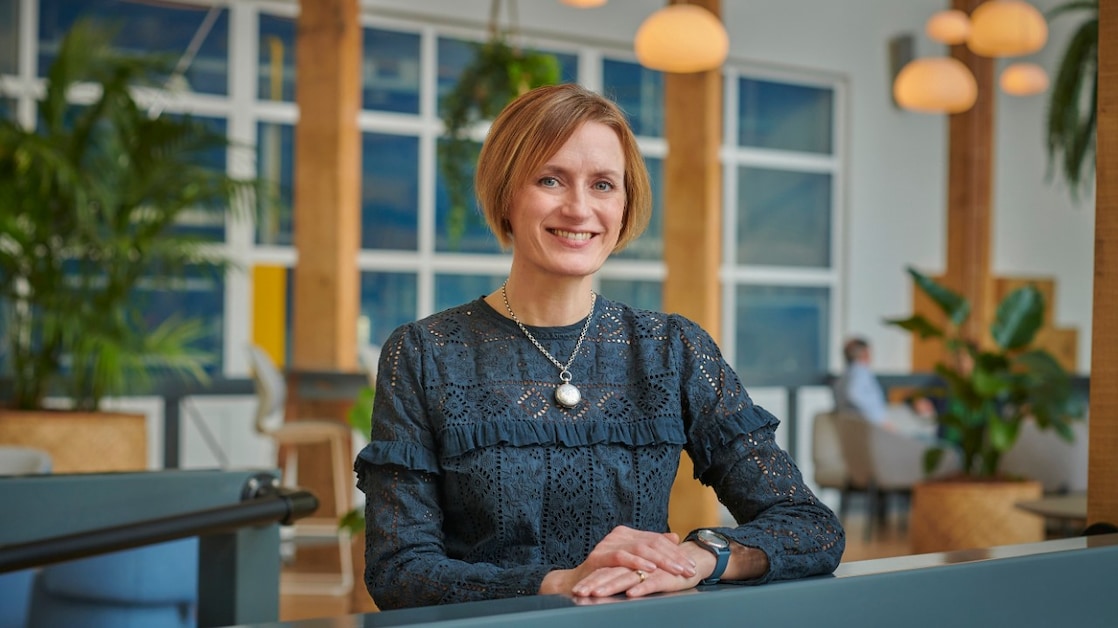
Sarah Street was born and raised on the outskirts of Europe - in Northern Ireland. She studied in Manchester and moved with her husband to the Netherlands 25 years ago. “After I initially got used to the Dutch directness in communications – which is a bit of a challenge for a British person – I have greatly enjoyed living in The Netherlands. Our son and daughter went to Dutch public schools, and together we are very much integrated,” Street says. She now speaks Dutch, apart from her native English.
“I do miss the green hills of the countryside of Ireland,” she says when asked. “On the other hand, I love the ease of cycling around everywhere in the Netherlands. And although I do not miss any British food, when away from home I do miss the Dutch cheeses and the bread.”
Walking through the woods
With almost a quarter of century in Shell, Street must have some best practices on how to balance work and life outside the office. “I went from a part-time to a full-time job for my new role as Campus Director, so yes – balance is very important to me. I enjoy yoga and walking through the woods. I am not a tree-hugger. But realising that a tree you pass must have lived there for 100 years, does bring some perspective to things. Connecting to nature is my favourite escape from daily routine, it is inspiring and helps my brain. Oh, and sleep should never be underrated.”
Three months in her new role as its Campus Director, Sarah Street comes across as sharp and focused on the course of the Energy Transition Campus Amsterdam towards the future. Street is very positive about where it will lead: ”We are on an exciting journey, with never a dull moment.”
Sarah Street, Director Energy Transition Campus Amsterdam"I have greatly enjoyed living in Amterdam"
Cautionary note
Cautionary note
The companies in which Shell plc directly and indirectly owns investments are separate legal entities. In this announcement “Shell”, “Shell Group” and “Group” are sometimes used for convenience where references are made to Shell plc and its subsidiaries in general. Likewise, the words “we”, “us” and “our” are also used to refer to Shell plc and its subsidiaries in general or to those who work for them. These terms are also used where no useful purpose is served by identifying the particular entity or entities. ‘‘Subsidiaries’’, “Shell subsidiaries” and “Shell companies” as used in this announcement refer to entities over which Shell plc either directly or indirectly has control. The term “joint venture”, “joint operations”, “joint arrangements”, and “associates” may also be used to refer to a commercial arrangement in which Shell has a direct or indirect ownership interest with one or more parties. The term “Shell interest” is used for convenience to indicate the direct and/or indirect ownership interest held by Shell in an entity or unincorporated joint arrangement, after exclusion of all third-party interest.
Forward-looking Statements
This announcement contains forward-looking statements (within the meaning of the U.S. Private Securities Litigation Reform Act of 1995) concerning the financial condition, results of operations and businesses of Shell. All statements other than statements of historical fact are, or may be deemed to be, forward-looking statements. Forward-looking statements are statements of future expectations that are based on management’s current expectations and assumptions and involve known and unknown risks and uncertainties that could cause actual results, performance or events to differ materially from those expressed or implied in these statements. Forward-looking statements include, among other things, statements concerning the potential exposure of Shell to market risks and statements expressing management’s expectations, beliefs, estimates, forecasts, projections and assumptions. These forward-looking statements are identified by their use of terms and phrases such as “aim”; “ambition”; ‘‘anticipate’’; ‘‘believe’’; “commit”; “commitment”; ‘‘could’’; ‘‘estimate’’; ‘‘expect’’; ‘‘goals’’; ‘‘intend’’; ‘‘may’’; “milestones”; ‘‘objectives’’; ‘‘outlook’’; ‘‘plan’’; ‘‘probably’’; ‘‘project’’; ‘‘risks’’; “schedule”; ‘‘seek’’; ‘‘should’’; ‘‘target’’; ‘‘will’’; “would” and similar terms and phrases. There are a number of factors that could affect the future operations of Shell and could cause those results to differ materially from those expressed in the forward-looking statements included in this announcement, including (without limitation): (a) price fluctuations in crude oil and natural gas; (b) changes in demand for Shell’s products; (c) currency fluctuations; (d) drilling and production results; (e) reserves estimates; (f) loss of market share and industry competition; (g) environmental and physical risks; (h) risks associated with the identification of suitable potential acquisition properties and targets, and successful negotiation and completion of such transactions; (i) the risk of doing business in developing countries and countries subject to international sanctions; (j) legislative, judicial, fiscal and regulatory developments including regulatory measures addressing climate change; (k) economic and financial market conditions in various countries and regions; (l) political risks, including the risks of expropriation and renegotiation of the terms of contracts with governmental entities, delays or advancements in the approval of projects and delays in the reimbursement for shared costs; (m) risks associated with the impact of pandemics, such as the COVID-19 (coronavirus) outbreak, regional conflicts, such as the Russia-Ukraine war, and a significant cybersecurity breach; and (n) changes in trading conditions. No assurance is provided that future dividend payments will match or exceed previous dividend payments. All forward-looking statements contained in this announcement are expressly qualified in their entirety by the cautionary statements contained or referred to in this section. Readers should not place undue reliance on forward-looking statements. Additional risk factors that may affect future results are contained in Shell plc’s Form 20-F for the year ended December 31, 2024 (available at www.shell.com/investors/news-and-filings/sec-filings.html and www.sec.gov). These risk factors also expressly qualify all forward-looking statements contained in this announcement and should be considered by the reader. Each forward-looking statement speaks only as of the date of this announcement, June 18, 2024. Neither Shell plc nor any of its subsidiaries undertake any obligation to publicly update or revise any forward-looking statement as a result of new information, future events or other information. In light of these risks, results could differ materially from those stated, implied or inferred from the forward-looking statements contained in this announcement.
Shell’s Net Carbon Intensity
Also, in this announcement we may refer to Shell’s “Net Carbon Intensity” (NCI), which includes Shell’s carbon emissions from the production of our energy products, our suppliers’ carbon emissions in supplying energy for that production and our customers’ carbon emissions associated with their use of the energy products we sell. Shell’s NCI also includes the emissions associated with the production and use of energy products produced by others which Shell purchases for resale. Shell only controls its own emissions. The use of the terms Shell’s “Net Carbon Intensity” or NCI are for convenience only and not intended to suggest these emissions are those of Shell plc or its subsidiaries.
Shell’s net-zero emissions target
Shell’s operating plan, outlook and budgets are forecasted for a ten-year period and are updated every year. They reflect the current economic environment and what we can reasonably expect to see over the next ten years. Accordingly, they reflect our Scope 1, Scope 2 and NCI targets over the next ten years. However, Shell’s operating plans cannot reflect our 2050 net-zero emissions target, as this target is currently outside our planning period. In the future, as society moves towards net-zero emissions, we expect Shell’s operating plans to reflect this movement. However, if society is not net zero in 2050, as of today, there would be significant risk that Shell may not meet this target.
Forward-looking non-GAAP measures
This announcement may contain certain forward-looking non-GAAP measures such as cash capital expenditure and divestments. We are unable to provide a reconciliation of these forward-looking non-GAAP measures to the most comparable GAAP financial measures because certain information needed to reconcile those non-GAAP measures to the most comparable GAAP financial measures is dependent on future events some of which are outside the control of Shell, such as oil and gas prices, interest rates and exchange rates. Moreover, estimating such GAAP measures with the required precision necessary to provide a meaningful reconciliation is extremely difficult and could not be accomplished without unreasonable effort. Non-GAAP measures in respect of future periods which cannot be reconciled to the most comparable GAAP financial measure are calculated in a manner which is consistent with the accounting policies applied in Shell plc’s consolidated financial statements.
The contents of websites referred to in this announcement do not form part of this announcement.
We may have used certain terms, such as resources, in this announcement that the United States Securities and Exchange Commission (SEC) strictly prohibits us from including in our filings with the SEC. Investors are urged to consider closely the disclosure in our Form 20-F, File No 1-32575, available on the SEC website www.sec.gov