Anno 1975: Kerend tij
Fotoverhaal Shell Venster. For text in English, click here or scroll down.
Beeld: Shell Historical Heritage & Archive. Tekst: Rob van 't Wel.
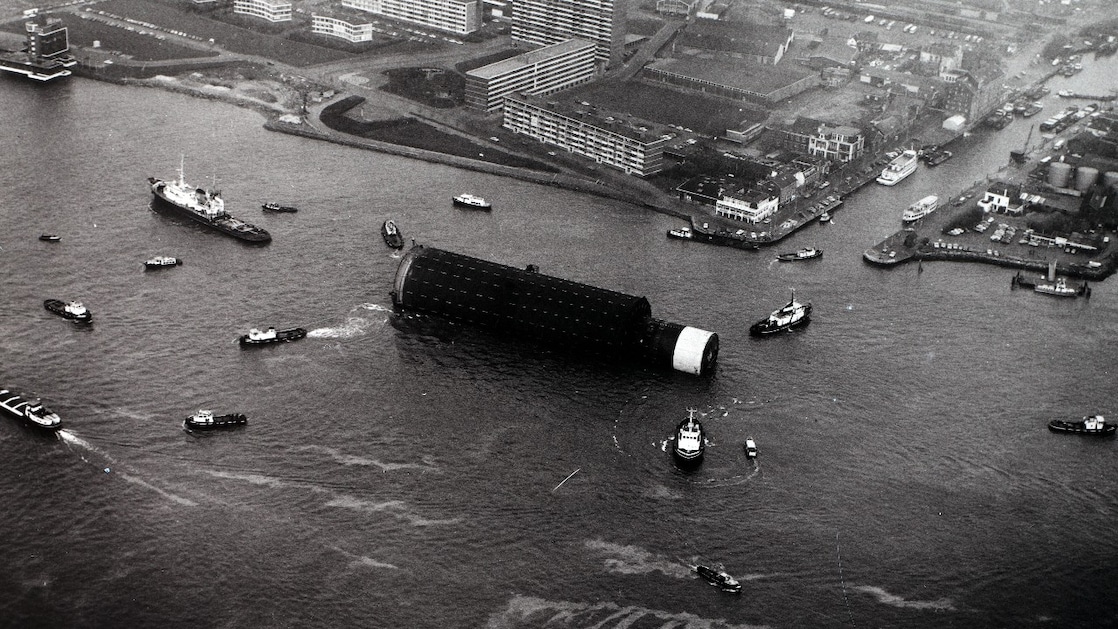
Hoger dan de Euromast. Eind januari 1975 staan de dagbladen vol van het staaltje Hollands Glorie dat zich die dagen in de Rijnmond zal voltrekken. In het bouwdok van de Schiedamse werf Wilton-Fijenoord dobbert dan al een dubbelwandige megafles van ruim 93 meter lengte en een doorsnede van 30 meter.
Het is het onderste deel van de Brent Spar, een opslagtank voor ruwe olie voor een samenwerkingsverband van Shell en Esso. De joint-venture gaat de spar – een soort paal in nautische termen – inzetten in het Britse Brent-veld, 150 kilometer ten noordoosten van de Shetland-eilanden. Het veld was in 1971 ontdekt.
Op 31 januari 1975 wordt het gevaarte de Nieuwe Waterweg op gesleept, waar zeesleper Zwarte Zee van Smit Internationale met de vracht de overtocht naar Noorwegen begint. Daar wordt de opslagtank als een dobber verticaal gezet. Bovenop komt een draaischijf waar tankers kunnen aanmeren om de Brent-olie aan boord te nemen. Dit topgedeelte inclusief helidek komt iets later ook uit de Rijnmond van de eveneens Schiedamse werf IHC-Gusto. In totaal heeft het offshore-bouwwerk dan een hoogte van 140 meter, hoger dan de oorspronkelijke Euromast.
Het gebruik van Brent Spar komt in 1991 ten einde als het olieveld een eigen pijpleiding krijgt. Na een spraakmakende bezetting door Greenpeace in 1995 gaat de opslagtank terug naar Noorwegen. De spar wordt ontmanteld en (grotendeels) gebruikt voor de aanleg van een haven.
It was higher than most viewing platforms at the time, including the local Euromast tower in Rotterdam. At the end of January 1975, the newspapers were filled with an example of Shell glory taking place in the Rotterdam region. In the construction dock of the Wilton-Fijenoord shipyard in Schiedam, a double-walled mega bottle of more than 93 metres (305 feet) in length and a diameter of 30 metres (98.4 feet) is already bobbing in the waters.
It is the lower part of the Brent Spar, a storage tank for crude oil for a joint venture of Shell and Esso. The joint venture will deploy the spar – a nautical term for a kind of pole – in the Brent field in the British economical zone of the North Sea. The field was discovered in 1971, and is located about 150 kilometres (93 miles) northeast of the Shetland Islands.
On 31 January 1975, the colossus was towed onto the Nieuwe Waterweg - the water way that connects the central harbours of Rotterdam with the sea. A black sea tug boat of Smit International started the crossing to Norway with the special cargo. Once in Norway, the storage tank is placed vertically like a float.
On top of it a turntable will be constructed, so that oil tankers can moor at it to take Brent oil on board. This top surface, including helideck, is shipped a little later from IHC-Gusto shipyard, also in Schiedam. In total, the offshore structure will be 140 metres (459 feet) tall. That is higher than the London Eye, the Clouds Heaven's Nest in Hamburg or about twice the height the Marina Bay Sands in Singapore.
The Brent Spar's operational life ends in 1991, when the oil field gets its own pipeline. After a high-profile occupation by Greenpeace in 1995, the storage tank is returned to Norway. There, the spar is dismantled and (largely) used for construction of new facilities in the harbour of Stavanger.