Groene waterstof in de Rotterdamse haven: het is maar hoe je het bekijkt
UPDATET 29 sep 2025 (kleine correcties) | Met de bouw van de Holland Hydrogen 1-fabriek wordt in de Rotterdamse haven een enorme stap gezet in de ontwikkeling van groene waterstof. En tegelijkertijd ook nog maar een zeer bescheiden. Het is maar hoe je het bekijkt. Lydia Boktor, hoofdbeleidsmedewerker waterstof bij Shell Nederland en programmamanager waterstof Randolf Weterings van Havenbedrijf Rotterdam over het halflege én halfvolle glas van de waterstoftransitie. “Koplopers bouwen de duurste fabrieken.”

Tekst: Matthijs Timmers.
Beeld: Shell Energy and Chemicals Park Rotterdam, Plotvis (computer rendering), Eric van Vuuren
For English, click here or scroll down
Lydia Boktor kwam deze zomer opgelucht terug van een wereldwijde conferentie over waterstof. Waarom? Ze proefde een gezonde dosis realiteitszin over de waterstoftransitie onder de aanwezigen. Hoe anders was dat een jaar of vier eerder, tijdens de opkomst ervan. “Waterstof werd de hemel in geprezen als het Zwitsers zakmes, het duizenddingendoekje, dé alles-in-één oplossing voor de energietransitie.”
Een hype, maar wel positief
Een hype, dat bevestigt ook Randolf Weterings, namens Havenbedrijf Rotterdam verantwoordelijk voor de ontwikkeling van groene waterstof in de Rotterdamse haven. Dat de destijds gestelde hoge ambities vooralsnog niet zijn gehaald, zou pessimistisch kunnen stemmen. Weterings bekijkt het liever positief: “Door die lat zo hoog te leggen, rek je de mogelijkheden wél op tot het maximale.” Bovendien, kijkend naar de feiten, dan is er wereldwijd bijna 3 GW aan groene waterstofcapaciteit in aanbouw. “Dat is lang niet slecht voor een startende markt”, stelt Boktor.
Productiecapaciteit bijna verdubbelen
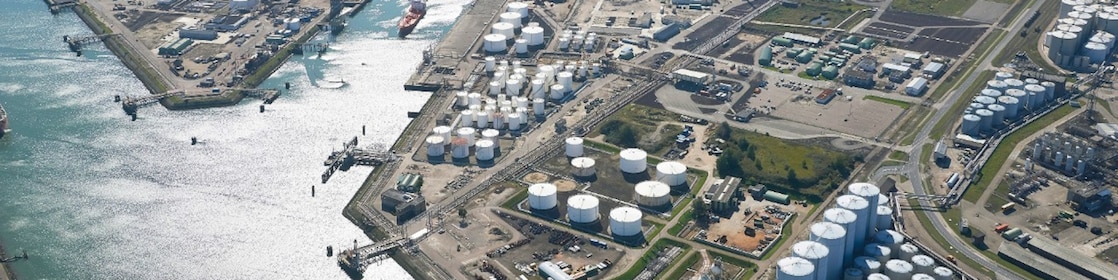
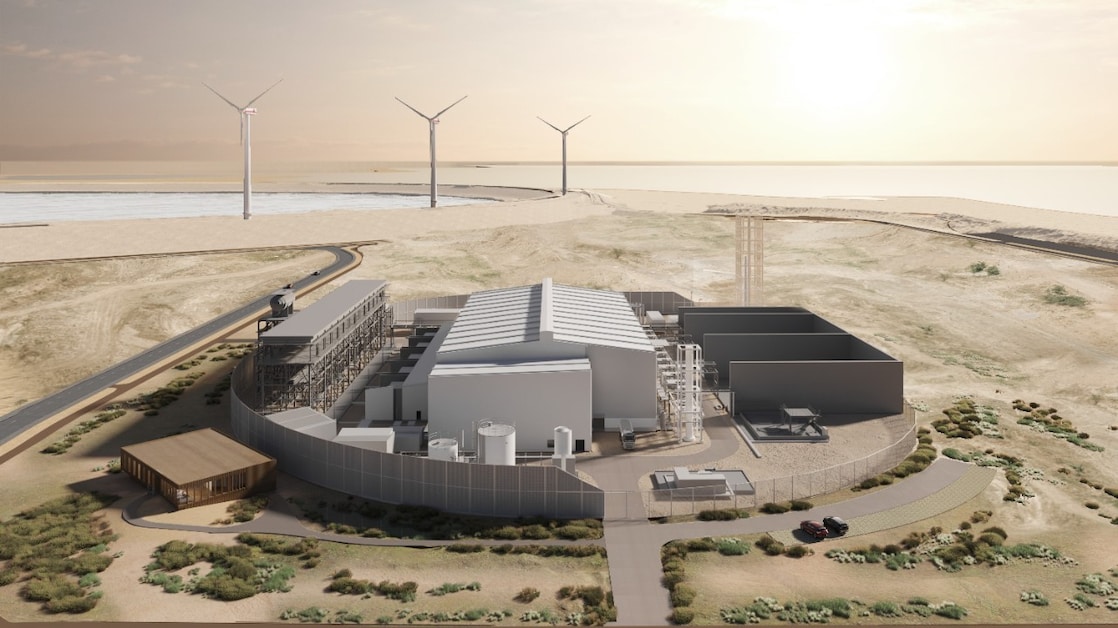
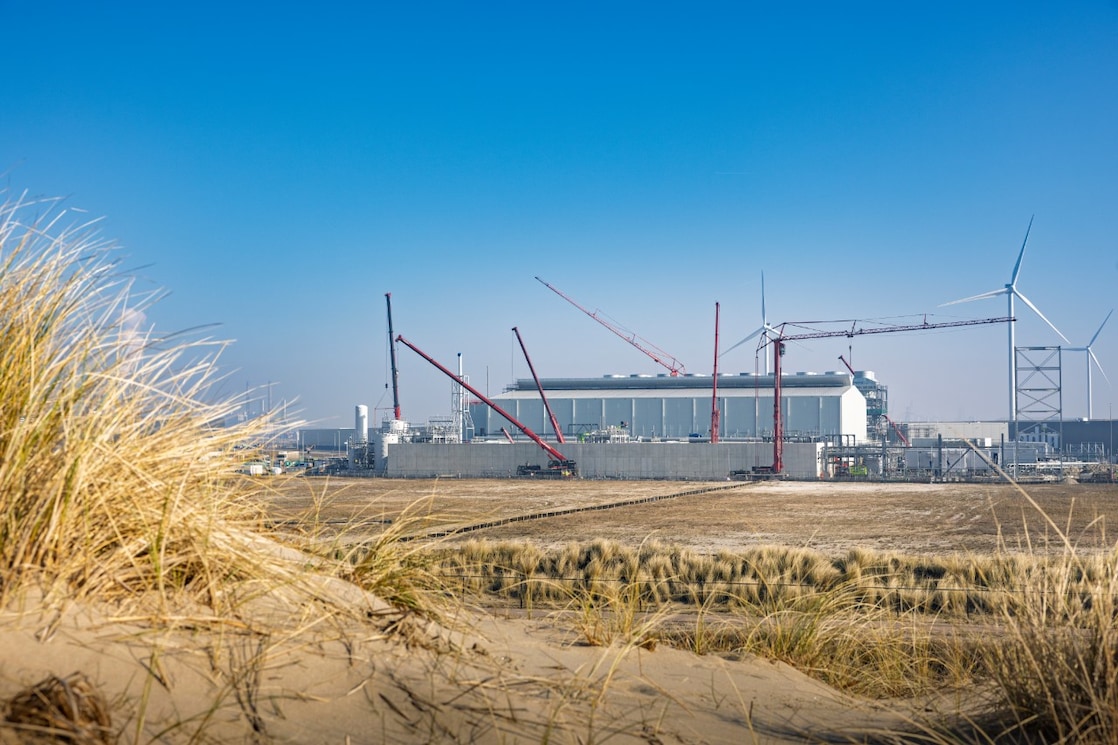
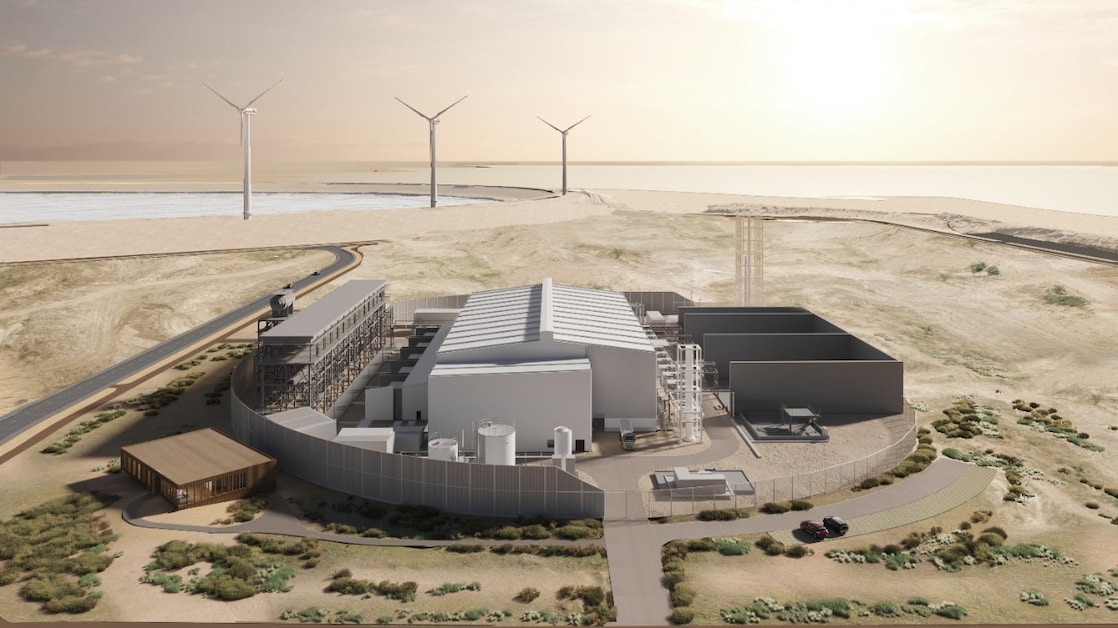
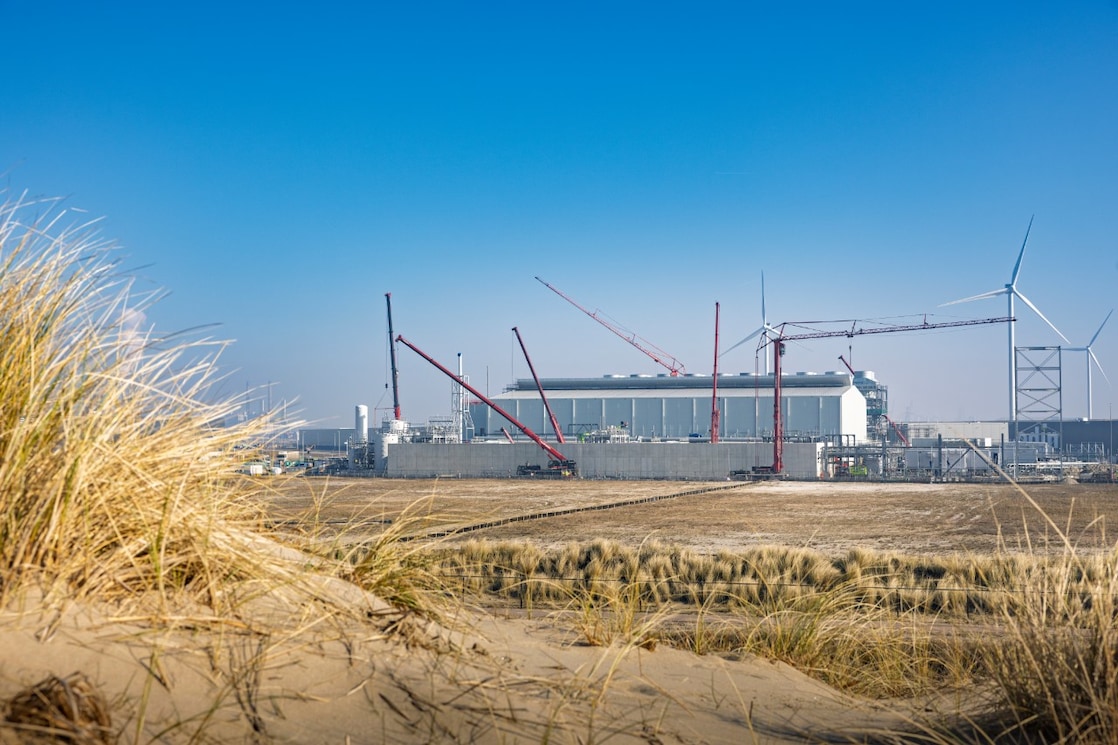
Inzoomend op de Rotterdamse haven: pal achter de duinen van het verstgelegen stukje Maasstad heeft Havenbedrijf Rotterdam een plek ingeruimd voor de ontwikkeling van vier groene waterstoffabrieken, samen goed voor een capaciteit van één gigawatt. Toen Shell ruim drie jaar geleden de knoop doorhakte om op dit zogenoemde conversiepark Holland Hydrogen 1 (capaciteit: 200 MW) te gaan bouwen, was de wereldwijde waterstofcapaciteit met elektryolyse niet meer dan 300 MW. Het project in Rotterdam zou daarmee zorgen voor bijna een verdubbeling van de totale wereldwijde productiecapaciteit van groene waterstof. “Je zou dat historisch kunnen noemen”, vertelt Boktor. “Een gigantische stap voorwaarts in de ontwikkeling van groene waterstof.”
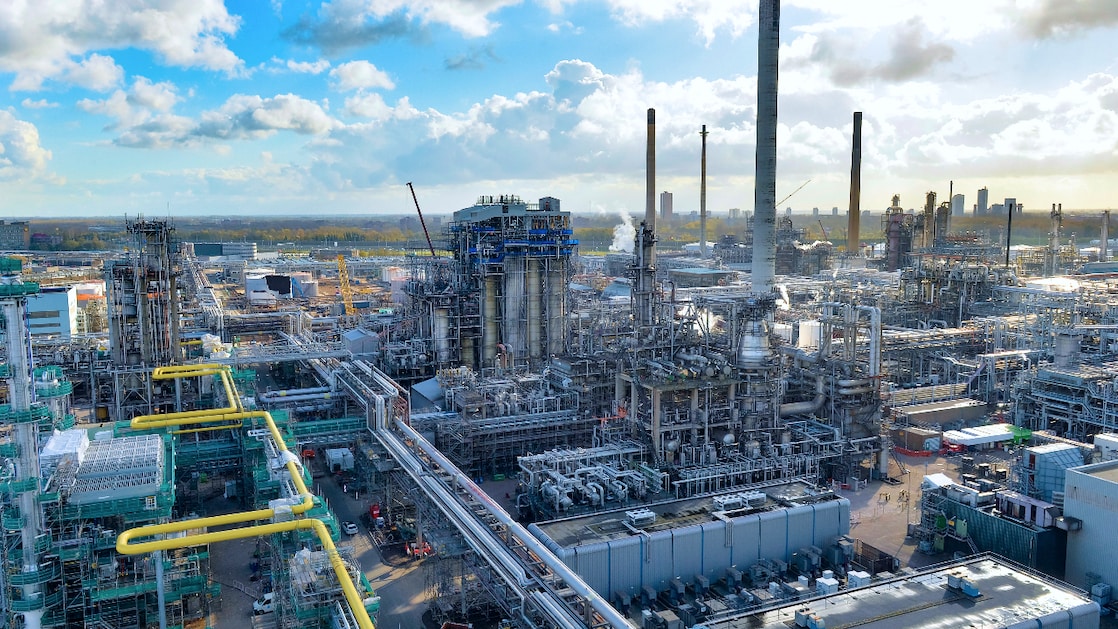
Tegelijkertijd vergroent Holland Hydrogen 1 slechts zo’n 5 tot 10% van de totale waterstofvraag van de Shell-raffinaderij in Pernis, waar de groene waterstof naartoe gaat. Terwijl deze raffinaderij niet eens de grootste waterstofafnemer van Nederland is. “In die zin is het project weer heel klein, en de CO2-reductie beperkt”, schetst Boktor de keerzijde van de medaille. “Er zijn nog een hoop groene waterstoffabrieken nodig om de industrie te verduurzamen.”
Wie zijn Lydia Boktor en Randolf Weterings?
Lydia Bokter is bij Shell Nederland Corporate Affairs Hydrogen Lead, ofwel de hoofdbeleidsmedewerker voor waterstof. Ze is een van de Shell-ers die het meest weet van de Holland Hydrogen 1 en hoe die past in het Nederlandse energiesysteem.
Randolf Weterings is programmanager Elektrificatie and Waterstof bij het Havenbedrijf Rotterdam, en zo verantwoordelijk voor de ontwikkeling van groene waterstof in de Rotterdamse haven.
Investeringsbeslissing en duurzame ambities
Randolf Weterings is blij dat Shell destijds de investeringsbeslissing nam, in het licht van de duurzame ambities van de Rotterdamse haven. Havenbedrijf Rotterdam, feitelijk de huisbaas en de ontwikkelaar van de haven, heeft een breed programma voor de energietransitie in de Rotterdamse haven. Groene waterstof speelt daarin een belangrijke rol. “Zonder groene waterstof kunnen we de energievoorziening van de industrie niet verduurzamen”, verheldert Weterings. Voor een duurzame toekomst voor het havengebied en het achterland is jaarlijks 20 miljoen ton duurzame waterstof nodig, groen of blauw. Een deel ervan moet worden geïmporteerd, een ander deel zelf gemaakt. Er is nog werk aan de winkel, want nu is de productie een half miljoen ton.
Bij Havenbedrijf Rotterdam zet hij zich in om de voorwaarden te creëren die de businesscase voor groene waterstof volwassen en sluitend maakt. Voor hem betekent dat het opvullen van alle ontbrekende schakels in de keten. Zorgen dat er plek is. Die is er, met de twee conversieparken. En de regie voeren op de ruimte, erop toezien dat de infrastructuur voor groene waterstof op logische wijze door de haven wordt gelegd, zonder te veel impact op de toch al schaarse ruimte.
Stap naar voren
“Ik ken geen ander project dan Holland Hydrogen 1 waarin nog zo veel onzeker was toen de knoop werd doorgehakt om te gaan bouwen”, herinnert Weterings zich nog. Hij doelt op regelgeving, de nieuwe techniek, de prijsontwikkeling van groene waterstof, het potentieel aan klanten. “Daarin heeft Shell een stap naar voren gedaan.”
Dat heeft voor beweging in de waterstoftransitie gezorgd. Door de investering in Holland Hydrogen 1 werd ook de basis voor de waterstofinfrastructuur aangelegd, van de aansluiting met het stroomnet (er is immers duurzame elektriciteit nodig om groene waterstof te maken) tot het waterstofleidingennetwerk richting de Rotterdamse haven. “Het hele systeem en de infrastructuur krijgt vorm”, stelt Weterings. En in het kielzog: “Shell is niet meer de enige bewoner van het conversiepark, een tweede fabriek van 200 MW is in aanbouw, van Air Liquide.” Daarbij zijn er ook ontwikkelingen op conversiepark twee, én de import van waterstof komt op gang. “Dat hadden we in 2020 toen we onze waterstofvisie opstelden, niet verwacht. Ten opzichte van toen, gaat het nu wel degelijk sneller”, zegt Weterings opgewekt.
De effecten
Lydia Boktor merkt op haar beurt de spin-off van het eerste grote groene waterstofproject in Europa. “De eerste slimme koppen binnen Shell worden al gepolst om andere fabrieken te helpen bouwen, en de aannemers met ervaring willen dolgraag werken aan een volgend project. Mind you, we werken samen met 150 partijen, die allemaal door een enorme leercurve zijn gegaan. Volgende initiatieven kunnen hier alleen maar van profiteren.” Boktor vindt de ontwikkeling goed voor het imago van de Rotterdamse haven. “Het Havenbedrijf heeft een mooi uithangbord. Iedere partner die de haven bezoekt, wil ook even langs Holland Hydrogen 1.”
Randolf Weterings, programmamanager Elektrificatie and Waterstof bij het Havenbedrijf Rotterdam"Zonder groene waterstof kunnen we de energievoorziening van de industrie niet verduurzamen"
De eerste fabriek is de duurste
“We bijten het spits af”, vervolgt Boktor. “Je weet, als je in de koplopersgroep zit, dat je de duurste fabriek bouwt. Het is allemaal handwerk, de techniek moet nog door de leercurve die hoort bij opschalen. Voor de elektrolysercellen, het hart van de fabriek, moeten 300.000 bouten worden aangedraaid, stuk voor stuk. Van deze ervaring gaan we pas profijt trekken bij de bouw van de tweede, misschien wel derde fabriek, wanneer technieken gestandaardiseerd zijn en bijvoorbeeld deze cellen eenvoudiger te installeren zijn.”
Grenzen in de transitie
Weterings ziet dat de waterstoftransitie in de haven nu op een aantal grenzen stuit. “Ik had gehoopt dat er wat meer investeringsbeslissingen waren genomen voor meer fabrieken.” Er zijn genoeg redenen waarom dat niet het geval is. Zoals gesteld, de techniek is complex en kostbaar. “We hebben een grote technologieopschaling nodig. Pas dan zullen de kosten voor de bouw gaan dalen.”
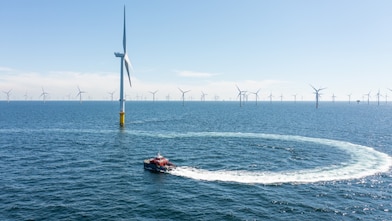
Daarbij zijn de aansluitkosten op het toch al overvolle stroomnet hoog. “In de afgelopen drie jaar vier keer zo duur geworden”, weet Boktor. Ook de regelgeving is strenger geworden. Zo moet er, om het predicaat groene waterstof te mogen dragen, een directe relatie zijn met opgewekte groene stroom, bijvoorbeeld van offshore windparken. Voor de waterstoffabriek van Shell is dat windpark Hollandse Kust Noord, maar voor andere waterstoffabrieken is dat uitdagender, vanwege de beperkte ruimte op de Noordzee en de het gegeven dat de offshore windsector is stilgevallen door turbulente marktontwikkelingen.
Prijs groene versus grijze waterstof
Dit alles maakt de prijs van groene waterstof op dit moment een stuk hoger dan die van grijze waterstof, meer dan 10 euro per kilo versus 2 tot 3 euro. “De klanten die dat kunnen en willen betalen zijn redelijk beperkt. Dat maakt het aan elkaar knopen van de gehele waterstofketen, vanaf wind, waterstof richting eindgebruikers, uitdagender”, concludeert Lydia Boktor.
Shell is klant van zichzelf
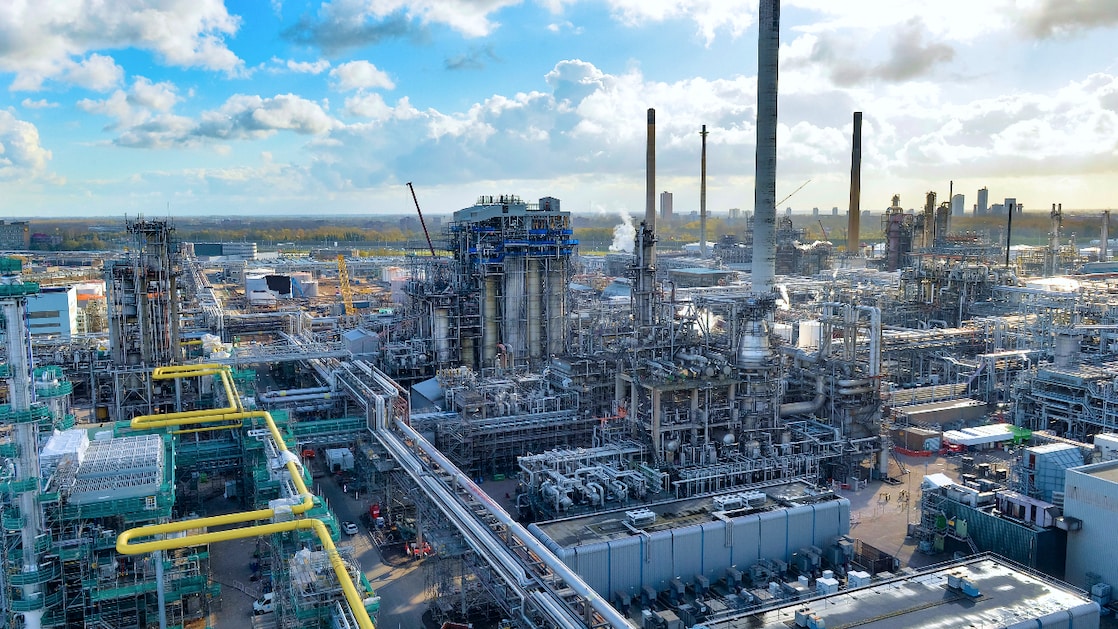
Aanvankelijk werd verwacht dat de transportsector een voorname afnemer van groene waterstof zou gaan worden: het transport over water en het zware vrachtvervoer. Op de groene waterstof uit de fabriek van Shell kunnen dagelijks 2.300 trucks rijden. Echter, die zijn nog niet op de markt. Vandaar dat Shell vooralsnog vooral haar eigen klant is: de waterstof van Holland Hydrogen 1 gaat naar de raffinaderij van Shell Energy and Chemicals Park Rotterdam in Pernis, waarmee de productie schoner wordt. “De consumptie van groene waterstof voor de productie van brandstoffen wordt omgezet in certificaten”, zegt Boktor. “Die certificaten hebben waarde en zijn te verhandelen. Zo werken we aan onze eigen reductiedoelstellingen en kunnen we afnemers van certificaten helpen om hun doelstellingen administratief waar te maken. Zodoende kan het uit.”
Het kloppend hart achter de grootste groene waterstoffabriek van Europa
Achter de duinenrij van de Tweede Maasvlakte, op steenworp afstand van de Noordzee, nadert Shell Holland Hydrogen 1 zijn voltooiing. Alle elektrolysers, het kloppend hart van de fabriek, zijn inmiddels aangekomen. Pascal van Eck is er de projectingenieur van en legt uit hoe er bij Rotterdam baanbrekend werk wordt verricht. En groen, want de hernieuwbare stroom voor de elektrolyser komt van Hollandse Kust (Noord), het windpark op zee dat deels eigendom is van Shell.
Van subsidie naar een businesscase
Vandaag de dag wordt de waterstoftransitie voor een groot deel ondersteund met subsidies. Zonder overheidssteun kan geen fabriek worden gebouwd. Gelukkig zien Randolf Weterings en Lydia Boktor dat in Europa en Den Haag het belang van groene waterstof wordt onderschreven. “Het gaat om serieus geld.” De waterstofsubsidie van het EU-fonds voor belangrijke projecten voor een gemeenschappelijke Europese interesse (Important Project of Common European Interest; IPCEI) maakt het mogelijk dat de groene waterstof als voeding voor de Shell-raffinaderij in Pernis kan worden gebruikt.
Ook de Nederlandse overheid draagt bij. Met de Subsidieregeling Waterstof in Mobiliteit (SWiM) krijgt de transportsector een stimulans om te investeren in waterstof. En vanuit Europa komt er met de nieuwe Richtlijn Hernieuwbare Energie (REDIII) een bijmengverplichting voor groene waterstof, waarmee de vraag naar groene waterstof wordt gestimuleerd.
Groene industrie is cruciaal voor de toekomst van Europa
Weterings: “Maar subsidies vormen geen constructie waarop private partijen hun toekomst bouwen”, weet de waterstofexpert van Havenbedrijf Rotterdam. “We moeten toewerken naar een systeem waarin subsidies niet meer nodig zijn.” Hij benadrukt de noodzaak: “De industrie in Nederland heeft het op dit moment best zwaar, terwijl die op het wereldtoneel heel belangrijk is. We zullen ervoor moeten waken dat we niet te afhankelijk worden van import van eindproducten en dat ook onze waardevolle kennis niet wegvloeit. De industrie, de groene industrie is cruciaal voor de toekomst van Europa.”
Havenbedrijf Rotterdam staat voor die groene toekomst. Lydia Boktor en haar collega’s willen daar een bijdrage aan leveren. Ze werkt nu vier jaar aan het project. “Het was een indrukwekkende reis. En nog steeds. Van een paar presentatiepagina’s met het eerste idee en de marktontwikkelingen, tot nu. Dat ik er gewoon heen kan rijden en de hele installatie opgebouwd zie worden: dat is kicken. Ook de mensen die aan Holland Hydrogen 1 werken, zijn allemaal zo doelgedreven. Iedereen wil er een succes van maken. Dat maakt het ook een inspirerende werkomgeving.”
En ook dit tijdsgewricht, nu de marktomstandigheden onstuimiger zijn en betaalbaarheid en energiezekerheid een belangrijkere rol spelen in de samenleving, zet het team van Holland Hydrogen 1 op scherp. “Wij willen niet alleen maar een inspirerend project zijn, we willen leveren, presteren. Dat moet ook, en is ook logisch”, stelt Boktor.
Ongelooflijk mooie techniek
Randolf Weterings bracht al verschillende keren een bezoek aan Holland Hydrogen 1. “Het is ongelooflijk mooie techniek.” Zijn hart als ingenieur elektrotechniek, wat Weterings van huis uit is, gaat er harder van kloppen. “Als je daar staat, zie je dat het indrukwekkend is. Het is ontzettend gaaf dat het in Nederland gebeurt, dat we koploper zijn.”
Groene of hernieuwbare waterstof
Hernieuwbare waterstof, het type waterstof dat we bij HH1 maken, wordt vervaardigd met behulp van een duurzame energiebron. Hernieuwbare energie wordt gebruikt om watermoleculen te splitsen in waterstof en zuurstof via het elektrolyseproces.
Grijze waterstof
Momenteel wordt de meeste waterstof geproduceerd uit fossiele bronnen zoals aardgas of steenkool. Dit productieproces heet reforming en hierbij komt koolstofdioxide (CO2) vrij in de atmosfeer.
Blauwe waterstof
Blauwe waterstof wordt net als grijze waterstof geproduceerd uit aardgas, maar de CO2 die vrijkomt bij de productie wordt afgevangen en opgeslagen. Dat heet Carbon Capture & Storage (CCS). De CO2 kan bijvoorbeeld worden opgeslagen in lege gasvelden onder de zee en komt dan dus niet in onze atmosfeer terecht.
Cautionary note
Cautionary note
The companies in which Shell plc directly and indirectly owns investments are separate legal entities. In this announcement “Shell”, “Shell Group” and “Group” are sometimes used for convenience where references are made to Shell plc and its subsidiaries in general. Likewise, the words “we”, “us” and “our” are also used to refer to Shell plc and its subsidiaries in general or to those who work for them. These terms are also used where no useful purpose is served by identifying the particular entity or entities. ‘‘Subsidiaries’’, “Shell subsidiaries” and “Shell companies” as used in this announcement refer to entities over which Shell plc either directly or indirectly has control. The term “joint venture”, “joint operations”, “joint arrangements”, and “associates” may also be used to refer to a commercial arrangement in which Shell has a direct or indirect ownership interest with one or more parties. The term “Shell interest” is used for convenience to indicate the direct and/or indirect ownership interest held by Shell in an entity or unincorporated joint arrangement, after exclusion of all third-party interest.
Forward-looking Statements
This announcement contains forward-looking statements (within the meaning of the U.S. Private Securities Litigation Reform Act of 1995) concerning the financial condition, results of operations and businesses of Shell. All statements other than statements of historical fact are, or may be deemed to be, forward-looking statements. Forward-looking statements are statements of future expectations that are based on management’s current expectations and assumptions and involve known and unknown risks and uncertainties that could cause actual results, performance or events to differ materially from those expressed or implied in these statements. Forward-looking statements include, among other things, statements concerning the potential exposure of Shell to market risks and statements expressing management’s expectations, beliefs, estimates, forecasts, projections and assumptions. These forward-looking statements are identified by their use of terms and phrases such as “aim”; “ambition”; ‘‘anticipate’’; ‘‘believe’’; “commit”; “commitment”; ‘‘could’’; ‘‘estimate’’; ‘‘expect’’; ‘‘goals’’; ‘‘intend’’; ‘‘may’’; “milestones”; ‘‘objectives’’; ‘‘outlook’’; ‘‘plan’’; ‘‘probably’’; ‘‘project’’; ‘‘risks’’; “schedule”; ‘‘seek’’; ‘‘should’’; ‘‘target’’; ‘‘will’’; “would” and similar terms and phrases. There are a number of factors that could affect the future operations of Shell and could cause those results to differ materially from those expressed in the forward-looking statements included in this announcement, including (without limitation): (a) price fluctuations in crude oil and natural gas; (b) changes in demand for Shell’s products; (c) currency fluctuations; (d) drilling and production results; (e) reserves estimates; (f) loss of market share and industry competition; (g) environmental and physical risks; (h) risks associated with the identification of suitable potential acquisition properties and targets, and successful negotiation and completion of such transactions; (i) the risk of doing business in developing countries and countries subject to international sanctions; (j) legislative, judicial, fiscal and regulatory developments including regulatory measures addressing climate change; (k) economic and financial market conditions in various countries and regions; (l) political risks, including the risks of expropriation and renegotiation of the terms of contracts with governmental entities, delays or advancements in the approval of projects and delays in the reimbursement for shared costs; (m) risks associated with the impact of pandemics, such as the COVID-19 (coronavirus) outbreak, regional conflicts, such as the Russia-Ukraine war, and a significant cybersecurity breach; and (n) changes in trading conditions. No assurance is provided that future dividend payments will match or exceed previous dividend payments. All forward-looking statements contained in this announcement are expressly qualified in their entirety by the cautionary statements contained or referred to in this section. Readers should not place undue reliance on forward-looking statements. Additional risk factors that may affect future results are contained in Shell plc’s Form 20-F for the year ended December 31, 2024 (available at www.shell.com/investors/news-and-filings/sec-filings.html and www.sec.gov). These risk factors also expressly qualify all forward-looking statements contained in this announcement and should be considered by the reader. Each forward-looking statement speaks only as of the date of this announcement, September 25, 2025. Neither Shell plc nor any of its subsidiaries undertake any obligation to publicly update or revise any forward-looking statement as a result of new information, future events or other information. In light of these risks, results could differ materially from those stated, implied or inferred from the forward-looking statements contained in this announcement.
Shell’s Net Carbon Intensity
Also, in this announcement we may refer to Shell’s “Net Carbon Intensity” (NCI), which includes Shell’s carbon emissions from the production of our energy products, our suppliers’ carbon emissions in supplying energy for that production and our customers’ carbon emissions associated with their use of the energy products we sell. Shell’s NCI also includes the emissions associated with the production and use of energy products produced by others which Shell purchases for resale. Shell only controls its own emissions. The use of the terms Shell’s “Net Carbon Intensity” or NCI are for convenience only and not intended to suggest these emissions are those of Shell plc or its subsidiaries.
Shell’s net-zero emissions target
Shell’s operating plan, outlook and budgets are forecasted for a ten-year period and are updated every year. They reflect the current economic environment and what we can reasonably expect to see over the next ten years. Accordingly, they reflect our Scope 1, Scope 2 and NCI targets over the next ten years. However, Shell’s operating plans cannot reflect our 2050 net-zero emissions target, as this target is currently outside our planning period. In the future, as society moves towards net-zero emissions, we expect Shell’s operating plans to reflect this movement. However, if society is not net zero in 2050, as of today, there would be significant risk that Shell may not meet this target.
Forward-looking non-GAAP measures
This announcement may contain certain forward-looking non-GAAP measures such as cash capital expenditure and divestments. We are unable to provide a reconciliation of these forward-looking non-GAAP measures to the most comparable GAAP financial measures because certain information needed to reconcile those non-GAAP measures to the most comparable GAAP financial measures is dependent on future events some of which are outside the control of Shell, such as oil and gas prices, interest rates and exchange rates. Moreover, estimating such GAAP measures with the required precision necessary to provide a meaningful reconciliation is extremely difficult and could not be accomplished without unreasonable effort. Non-GAAP measures in respect of future periods which cannot be reconciled to the most comparable GAAP financial measure are calculated in a manner which is consistent with the accounting policies applied in Shell plc’s consolidated financial statements.
The contents of websites referred to in this announcement do not form part of this announcement.
We may have used certain terms, such as resources, in this announcement that the United States Securities and Exchange Commission (SEC) strictly prohibits us from including in our filings with the SEC. Investors are urged to consider closely the disclosure in our Form 20-F, File No 1-32575, available on the SEC website www.sec.gov
Renewable hydrogen in the Port of Rotterdam in perspective
25 Sep. 2025 (updated 29 Sep. 2025 (minor details))
With the construction of the Holland Hydrogen 1 plant, a major step is being taken in the development of renewable hydrogen in the Port of Rotterdam, the Netherlands. Depending how you look at it, it’s still a very modest step. Lydia Boktor, Corporate Affairs Hydrogen Lead at Shell Netherlands, and Randolf Weterings, Hydrogen Programme Manager with the Port of Rotterdam Authority discuss the half-empty and half-full glass of the hydrogen transition.

Text: Matthijs Timmers.
Photography: Shell Energy and Chemicals Park Rotterdam, Plotvis (computer rendering), Eric van Vuuren
Lydia Boktor came back from a global conference on hydrogen with relieve this summer. Why? She sensed a healthy dose of realism about the hydrogen transition among the attendees. How different things were about four years ago, during the rise of hydrogen as an energy carrier.
“Hydrogen was praised to the skies as the Swiss army knife, the miracle cloth, the all-in-one solution for the energy transition.”
A hype, but a positive one
Randolf Weterings, responsible for the development of renewable hydrogen in the Port of Rotterdam, confirms it was a hype. The fact that the high ambitions set at the time have not yet been achieved could be seen as discouraging. But Weterings prefers a positive view: “By setting the bar high, one stretches the possibilities to the maximum.”
Moreover, looking at the facts, nearly 3 gigawatts of renewable hydrogen capacity is currently under construction worldwide. “That’s not bad at all for a market that’s just getting started,” Boktor says.
Nearly doubling production capacity
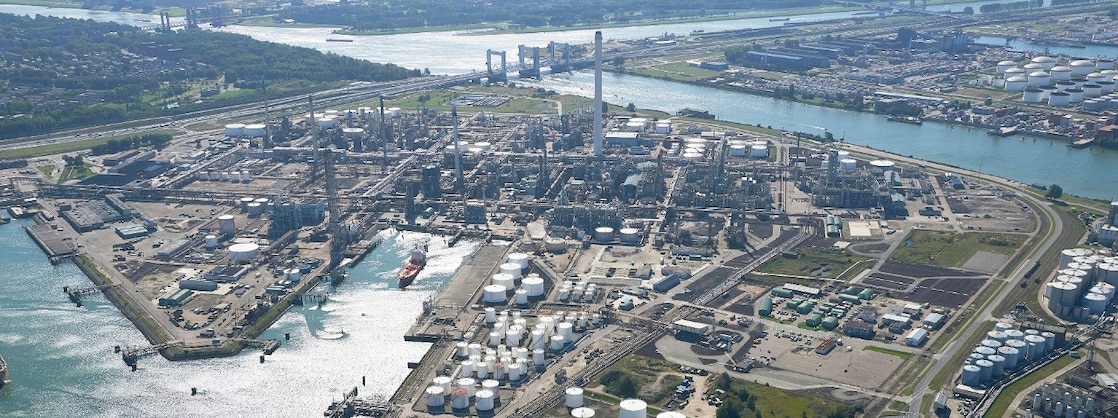
The Port of Rotterdam is the biggest in Europe, the biggest outside Asia and the 10th largest in the world. Zooming in on this harbour: right behind the dunes at the farthest edge of the city, the Port Authority has designated space for the development of four renewable hydrogen plants, together totaling a capacity of one gigawatt.
When Shell made the decision over three years ago to build the Holland Hydrogen 1 (capacity: 200 megawatts) at this so-called conversion park, the global hydrogen capacity by electrolysis was no more than 300 MW. The Rotterdam project would therefore nearly double the total global production capacity of green hydrogen.
“You could call that historic,” says Boktor. “A gigantic leap forward in the development of renewable hydrogen.” At the same time, the Holland Hydrogen 1 will only make about 5 to 10% of the total hydrogen demand of Shell’s refinery in Pernis renewable, as that is where it will be used. And that refinery isn’t even the largest hydrogen consumer in the Netherlands.
“In that sense, the project is actually quite small, and the CO₂ reduction limited,” Boktor points out the flip side. “There are still many renewable hydrogen plants needed to make the industry more sustainable.”
Who are Lydia Boktor and Randolf Weterings?
Lydia Bokter is the Corporate Affairs Hydrogen Lead at Shell Netherlands, making her the most senior policy advisor on the matter. She is one of the Shell employees who knows the most about the Holland Hydrogen 1 project and how it fits into the Dutch energy system.
Randolf Weterings is Programme Manager for Electrification and Hydrogen at the Port of Rotterdam Authority, and is therefore responsible for the development of renewable hydrogen in the harbour of Rotterdam. The harbour is Europe's largest, the biggest outside Asia and the 10th harbour of the world.
Investment decision and sustainability ambitions
Randolf Weterings is pleased that Shell made the investment decision back then, in light of the sustainability ambitions of the Port of Rotterdam. The Port of Rotterdam Authority—essentially the landlord and developer of the harbour—has a broad programme for the energy transition in the area, in which renewable hydrogen plays a key role.
“Without renewable hydrogen, we cannot make the industrial energy supply sustainable,” Weterings explains. For a sustainable future for the port area and its hinterland, 20 million tonnes of sustainable hydrogen—green or blue—are needed annually. Part of it must be imported, another part produced locally. There’s still a lot of work to do, as current production stands at just half a million tons.
At the Port Authority, Weterings works to create the conditions that make the business case for green hydrogen mature and viable. For him, that means filling in all the missing links in the chain: ensuring space is available (which it is, with the two conversion parks) and managing that space wisely—making sure the green hydrogen infrastructure is laid out logically across the port, with minimal impact on the already scarce space.
A step forward
“I don’t know of any other project like the Holland Hydrogen 1 where so much was still uncertain when the decision to build was made,” Weterings recalls. He refers to regulations, new technology, green hydrogen price developments, and the potential customer base. “In that perspective, Shell really took a step forward.”
That decision sparked movement in the hydrogen transition. Shell’s investment in the Holland Hydrogen 1 also laid the foundation for the hydrogen infrastructure—from the connection to the power grid (since renewable electricity is needed to produce renewable hydrogen) to the hydrogen pipeline network leading into the Port of Rotterdam.
“The whole system and infrastructure is taking shape,” says Weterings. And in its wake: “Shell is no longer the only resident of the conversion park. A second 200-MW plant is under construction, by Air Liquide.”
There are also developments at the second conversion park, and hydrogen imports are starting to pick up. “Back in 2020, we didn’t expect this when we drafted our hydrogen vision. Compared to then, things are definitely moving faster now,” Weterings says cheerfully.
The effects
Lydia Boktor, in turn, observes the spin-off from Europe’s first major green hydrogen project. “Smart minds within Shell are already being tapped to help build other plants, and contractors with experience are eager to work on the next project. Keep in mind, we’re working with 150 partners, all of whom have gone through a steep learning curve. Future initiatives can only benefit from this.”
Boktor believes the development is good for the image of the Port of Rotterdam.
“The Port Authority has a great showcase. Every partner visiting the harbour wants to stop by the Holland Hydrogen 1.”
Randolf Weterings, Programme Manager Electrification and Hydrogen, Port of Rotterdam Authority"Without renewable hydrogen, we cannot make the industrial energy supply sustainable"
The first plant Is the most expensive
“We’re breaking the ground,” Boktor continues. “You know that when you're part of the frontrunners, you're building the most expensive plant. Everything is manual; the technology still needs to go through the learning curve that comes with scaling up. For the electrolyser cells—the heart of the plant—300,000 bolts need to be tightened, one by one. We’ll only start benefiting from this experience when building the second, maybe even the third plant, once technologies are standardised and, for example, these cells become easier to install.”
Limits in the transition
Weterings sees that the hydrogen transition in the port is now hitting several limits. “I had hoped more investment decisions would have been made for additional plants.”
There are plenty of reasons why that has not happened. As mentioned, the technology is complex and expensive. “We need a major scale-up in technology. Only then will construction costs begin to fall.” Additionally, connection costs to the already overloaded power grid are high. “In the past three years, they’ve become four times more expensive,” Boktor notes.
Regulations have also become stricter. To earn the label of renewable hydrogen, there must be a direct link to generated renewable electricity—such as from offshore wind farms. For Shell’s hydrogen plant, that’s the Hollandse Kust Noord wind farm, run by Shell and Eneco through the joint venture CrossWind. But for other hydrogen plants, this is more challenging due to limited space in the North Sea and the fact that the offshore wind sector has stalled due to turbulent market developments.
Price of “green” versus “grey” hydrogen
All of this makes the price of renewable—aka “green”—hydrogen currently much higher than that of “grey” hydrogen—more than €10 per kilo versus €2 to €3. Grey hydrogen is produced with natural gas or coal, which is cheaper but not renewable.
“The number of customers who can and want to pay the difference is fairly limited. That makes connecting the entire hydrogen chain—from wind to hydrogen to end users—more challenging,” concludes Boktor.
Shell is her own customer
Initially, it was expected that the transport sector would be a major consumer of renewable hydrogen—for inland shipping and heavy-duty road transport. The renewable hydrogen from Shell’s plant could potentially power 2,300 trucks daily. However, those trucks are not yet on the market.
That’s why, for now, Shell is mainly her own customer: the hydrogen from Holland Hydrogen 1 goes to Shell’s Energy and Chemicals Park Rotterdam refinery in Pernis, making production cleaner.
“The consumption of renewable hydrogen for fuel production is converted into certificates,” says Boktor. “These certificates have value and can be traded. This way, we work toward our own reduction targets and can help certificate buyers meet their goals administratively. That makes it viable.”
The beating heart behind the largest renewable hydrogen plant in Europe
Behind the dunes of man-made land in the North Sea near Rotterdam, the Shell Holland Hydrogen 1 is nearing completion. All electrolysers, the beating heart of the factory, have now arrived. Pascal van Eck is the Project Engineer on site and explains the pioneering work is being done. Renewable as well, as the electricity that is needed comes from Hollandse Kust (Noord), the offshore wind farm that is partly owned by Shell.
From subsidies to business case
Today, the hydrogen transition is largely supported by subsidies. Without government support, no plant could be built. Fortunately, Randolf Weterings and Lydia Boktor see that both the European Union and Dutch government in The Hague recognise the importance of green hydrogen.
“We’re talking about serious money.” The hydrogen subsidy from the EU’s Important Project of Common European Interest (IPCEI) fund makes it possible for renewable hydrogen to be used as feedstock for Shell’s refinery in Pernis.
The Dutch government also contributes. Through the Hydrogen in Mobility Subsidy Scheme (abbreviation SWiM in Dutch), the transport sector is encouraged to invest in hydrogen. And from Europe, the new Renewable Energy Directive (RED III) introduces a blending obligation for renewable hydrogen, which stimulates demand.
Renewable industry is crucial for Europe’s future
Weterings: “But subsidies are not a structure on which private parties can build their future,” says the hydrogen expert from the Port of Rotterdam Authority. “We need to move toward a system where subsidies are no longer necessary.”
He emphasises the urgency: “Industries in the Netherlands are currently under pressure, even though they play a vital role on the global stage. We must ensure we don’t become too dependent on importing finished products, and that our valuable knowledge doesn’t drain away. Industries—especially the renewable ones—are crucial for Europe’s future.”
The Port of Rotterdam stands for that green future. Lydia Boktor and her colleagues want to contribute to it. She has been working on the project for four years. “It’s been an impressive journey. And it still is. From a few presentation slides with the first idea and market developments, to now. That I can just drive there and see the entire installation being built—that’s thrilling. Everyone working on the Holland Hydrogen 1 is so driven. Everyone wants to make it a success. That makes it an inspiring work environment.”
And in this current era, where market conditions are more turbulent—and affordability and energy security play a bigger role in society—the Holland Hydrogen 1 team is staying sharp. “We don’t just want to be an inspiring project—we want to deliver, perform. We have to, and it makes sense,” says Boktor.
Incredibly beautiful technology
Randolf Weterings has visited the Holland Hydrogen 1 several times. “It’s incredibly beautiful technology.” His heart, as an electrical engineer by training, beats faster when he sees it. “When you’re standing there, you see how impressive it is. It’s amazing that this is happening in the Netherlands—that we’re leading the way.”
Green of renewable hydrogen
Renewable hydrogen, the type of hydrogen produced at HH1, is made using a sustainable energy source. Renewable energy is used to split water molecules into hydrogen and oxygen through the electrolysis process.
Grey hydrogen
Currently, most hydrogen is produced from fossil sources such as natural gas or coal. This production process is called reforming, and it releases carbon dioxide (CO₂) into the atmosphere.
Blue hydrogen
Blue hydrogen is produced from natural gas just like grey hydrogen, but the CO₂ released during production is captured and stored. This is called Carbon Capture & Storage (CCS). For example, the CO₂ can be stored in empty gas fields beneath the sea, preventing it from entering our atmosphere.
Cautionary note
Cautionary note
The companies in which Shell plc directly and indirectly owns investments are separate legal entities. In this announcement “Shell”, “Shell Group” and “Group” are sometimes used for convenience where references are made to Shell plc and its subsidiaries in general. Likewise, the words “we”, “us” and “our” are also used to refer to Shell plc and its subsidiaries in general or to those who work for them. These terms are also used where no useful purpose is served by identifying the particular entity or entities. ‘‘Subsidiaries’’, “Shell subsidiaries” and “Shell companies” as used in this announcement refer to entities over which Shell plc either directly or indirectly has control. The term “joint venture”, “joint operations”, “joint arrangements”, and “associates” may also be used to refer to a commercial arrangement in which Shell has a direct or indirect ownership interest with one or more parties. The term “Shell interest” is used for convenience to indicate the direct and/or indirect ownership interest held by Shell in an entity or unincorporated joint arrangement, after exclusion of all third-party interest.
Forward-looking Statements
This announcement contains forward-looking statements (within the meaning of the U.S. Private Securities Litigation Reform Act of 1995) concerning the financial condition, results of operations and businesses of Shell. All statements other than statements of historical fact are, or may be deemed to be, forward-looking statements. Forward-looking statements are statements of future expectations that are based on management’s current expectations and assumptions and involve known and unknown risks and uncertainties that could cause actual results, performance or events to differ materially from those expressed or implied in these statements. Forward-looking statements include, among other things, statements concerning the potential exposure of Shell to market risks and statements expressing management’s expectations, beliefs, estimates, forecasts, projections and assumptions. These forward-looking statements are identified by their use of terms and phrases such as “aim”; “ambition”; ‘‘anticipate’’; ‘‘believe’’; “commit”; “commitment”; ‘‘could’’; ‘‘estimate’’; ‘‘expect’’; ‘‘goals’’; ‘‘intend’’; ‘‘may’’; “milestones”; ‘‘objectives’’; ‘‘outlook’’; ‘‘plan’’; ‘‘probably’’; ‘‘project’’; ‘‘risks’’; “schedule”; ‘‘seek’’; ‘‘should’’; ‘‘target’’; ‘‘will’’; “would” and similar terms and phrases. There are a number of factors that could affect the future operations of Shell and could cause those results to differ materially from those expressed in the forward-looking statements included in this announcement, including (without limitation): (a) price fluctuations in crude oil and natural gas; (b) changes in demand for Shell’s products; (c) currency fluctuations; (d) drilling and production results; (e) reserves estimates; (f) loss of market share and industry competition; (g) environmental and physical risks; (h) risks associated with the identification of suitable potential acquisition properties and targets, and successful negotiation and completion of such transactions; (i) the risk of doing business in developing countries and countries subject to international sanctions; (j) legislative, judicial, fiscal and regulatory developments including regulatory measures addressing climate change; (k) economic and financial market conditions in various countries and regions; (l) political risks, including the risks of expropriation and renegotiation of the terms of contracts with governmental entities, delays or advancements in the approval of projects and delays in the reimbursement for shared costs; (m) risks associated with the impact of pandemics, such as the COVID-19 (coronavirus) outbreak, regional conflicts, such as the Russia-Ukraine war, and a significant cybersecurity breach; and (n) changes in trading conditions. No assurance is provided that future dividend payments will match or exceed previous dividend payments. All forward-looking statements contained in this announcement are expressly qualified in their entirety by the cautionary statements contained or referred to in this section. Readers should not place undue reliance on forward-looking statements. Additional risk factors that may affect future results are contained in Shell plc’s Form 20-F for the year ended December 31, 2024 (available at www.shell.com/investors/news-and-filings/sec-filings.html and www.sec.gov). These risk factors also expressly qualify all forward-looking statements contained in this announcement and should be considered by the reader. Each forward-looking statement speaks only as of the date of this announcement, September 25, 2025. Neither Shell plc nor any of its subsidiaries undertake any obligation to publicly update or revise any forward-looking statement as a result of new information, future events or other information. In light of these risks, results could differ materially from those stated, implied or inferred from the forward-looking statements contained in this announcement.
Shell’s Net Carbon Intensity
Also, in this announcement we may refer to Shell’s “Net Carbon Intensity” (NCI), which includes Shell’s carbon emissions from the production of our energy products, our suppliers’ carbon emissions in supplying energy for that production and our customers’ carbon emissions associated with their use of the energy products we sell. Shell’s NCI also includes the emissions associated with the production and use of energy products produced by others which Shell purchases for resale. Shell only controls its own emissions. The use of the terms Shell’s “Net Carbon Intensity” or NCI are for convenience only and not intended to suggest these emissions are those of Shell plc or its subsidiaries.
Shell’s net-zero emissions target
Shell’s operating plan, outlook and budgets are forecasted for a ten-year period and are updated every year. They reflect the current economic environment and what we can reasonably expect to see over the next ten years. Accordingly, they reflect our Scope 1, Scope 2 and NCI targets over the next ten years. However, Shell’s operating plans cannot reflect our 2050 net-zero emissions target, as this target is currently outside our planning period. In the future, as society moves towards net-zero emissions, we expect Shell’s operating plans to reflect this movement. However, if society is not net zero in 2050, as of today, there would be significant risk that Shell may not meet this target.
Forward-looking non-GAAP measures
This announcement may contain certain forward-looking non-GAAP measures such as cash capital expenditure and divestments. We are unable to provide a reconciliation of these forward-looking non-GAAP measures to the most comparable GAAP financial measures because certain information needed to reconcile those non-GAAP measures to the most comparable GAAP financial measures is dependent on future events some of which are outside the control of Shell, such as oil and gas prices, interest rates and exchange rates. Moreover, estimating such GAAP measures with the required precision necessary to provide a meaningful reconciliation is extremely difficult and could not be accomplished without unreasonable effort. Non-GAAP measures in respect of future periods which cannot be reconciled to the most comparable GAAP financial measure are calculated in a manner which is consistent with the accounting policies applied in Shell plc’s consolidated financial statements.
The contents of websites referred to in this announcement do not form part of this announcement.
We may have used certain terms, such as resources, in this announcement that the United States Securities and Exchange Commission (SEC) strictly prohibits us from including in our filings with the SEC. Investors are urged to consider closely the disclosure in our Form 20-F, File No 1-32575, available on the SEC website www.sec.gov