Groningen: de grote schoonmaak
Na ruim 65 jaar sluit Nederland het boek van de grootschalige aardgaswinning in het Groningen gasveld. Daarbij komt veel meer kijken dan het dichtdraaien van de kraan. Buiten het zicht van het grote publiek is een van de grootste industriële opruimactiviteiten ooit gestart. Om alles in oude staat te herstellen moeten 800 productieputten, 350 locaties en 1.750 kilometer pijpleiding op de schop. De grote schoonmaak is begonnen.

Tekst: Fanta Voogd. Beeld: NAM.
Vanaf het NAM-hoofdkantoor in Assen loodst operatiemanager Robbert Kroes de auto naar het Annerveen-gasveld op de grens van Drenthe en Groningen. Onderweg zijn de winningslocaties moeilijk over het hoofd te zien. Toefjes opkrullende buizen in het uitgestrekte boerenland, deels afgeschermd door windsingels. Nu nog vormen ze het zichtbare bewijs dat Moeder Aarde de vorige eeuw royaal heeft bijgedragen aan de ongekende stijging van de Nederlandse welvaart.
Vanaf 1973 heeft de NAM uit het Annerveen-gasveld in totaal 71 miljard kubieke meter aardgas gewonnen. Dat is een fractie van de 2.300 miljard kubieke meter uit het Groningen-gasveld, het omvangrijkste gasveld van Europa. Toch was het Annerveen-veld in Nederland, op 'Slochteren' na, het grootste gasveld. Reden voor de stopzetting van de productie was dat het gasveld simpelweg was uitgeput.
Opruimoperatie verder gevorderd
In 2021 al is de gaswinning hier beëindigd. De opruimoperatie is dan ook verder gevorderd dan op het noordelijker gelegen Groningen-gasveld, waar in 2019 is begonnen met de ontmanteling van de eerste NAM-locaties.
Het Annerveen-veld is de aangewezen plek om een eerste indruk te krijgen van de immense en complexe operatie die de komende decennia moet worden volbracht. De NAM spreekt van 'een van de grootste industriële opruimactiviteiten ooit'. In totaal 800 productieputten, 350 locaties en 1.750 kilometer pijpleiding moeten worden opgeruimd. Een verplichting die is vastgesteld in de Mijnbouwwet.
Ontmantelen olie- en gasputten
Onderweg vertelt NAM-operatiemanager Robbert Kroes over het consortium dat dit alles tot een goed einde moet brengen. Onder de naam Siturn werkt de NAM samen met de voor haar vertrouwde partner Arcadis (ooit de Heidemaatschappij). En met Wellgear uit Westerbork, een bedrijf dat is gespecialiseerd in het wereldwijd ontmantelen van olie- en gasputten. Arcadis neemt het bovengrondse deel van de operatie voor zijn rekening. Wellgear draagt zorg voor het ondergrondse.
Het Siturn-consortium zal op zijn beurt een beroep doen op tientallen onderaannemers. Op dit moment onder meer industrieel schoonmaakbedrijf Reym, het Instituut voor Veiligheid en Milieu (IVM), hijskranenspecialist Mammoet en Kaefer-steigerbouw.
Voor aanvang van de werkzaamheden voert de NAM overleg met alle betrokkenen: het Staatstoezicht op de Mijnen, de grondeigenaren en vergunningverlenende instanties. Ook wordt er gesproken met de omwonenden, om de overlast zo veel mogelijk te beperken. “Dat zijn best intensieve contacten”, aldus Kroes die is geboren en getogen in Oosterhesselen, zo’n 35 kilometer van het gasveld. “In prachtige dorpjes gaan we soms huis-aan-huis langs bij de mensen. Je kunt je maar al te goed voorstellen dat die niet zitten te wachten op een vrachtwagen met lichtmasten door hun straat”, zegt Kroes.
Over de NAM
De Nederlandse Aardolie Maatschappij (NAM) werd in 1947 opgericht na de ontdekking van olie onder de grond bij Schoonebeek. Toen in 1948 bij Coevorden ook aardgas werd gevonden, ging de NAM zich ook daarop toeleggen. Olie- en gaswinning uit velden op de Noordzee volgde. In oktober 2024 werd de gaskraan van het Groningen-veld definitief dichtgedraaid.
De NAM is voor de helft eigendom van Shell en voor de helft van het Amerikanse ExxonMobil. Het hoofdkantoor van de NAM staat in Assen.
Fakkeltoren
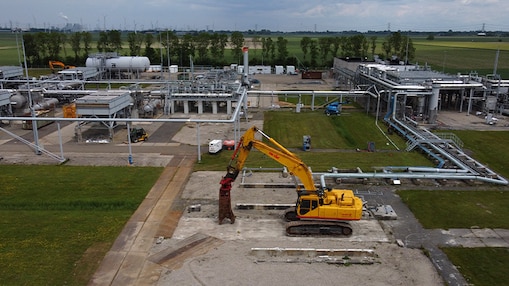
Met de auto rijden we de provinciegrens over, Groningen in. In de verte kondigt een fakkeltoren de ligging van NAM-locatie Wildervank aan. Dat is één van de gaswinlocaties van het Annerveen-veld, gelegen pal onder de rook van Veendam. Op dit zogeheten cluster is de eerste fase van het opruimingsproces voltooid. Het nog aanwezige gas in de leidingen en de behandelingsinstallaties is verbrand in de fakkeltoren. Waarna de gasputten konden worden losgekoppeld. De volgende stap is dat de bovengrondse installaties en leidingen zorgvuldig worden gereinigd.
Staal en apparatuur voor hergebruik
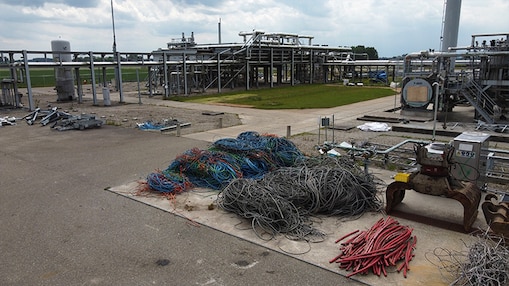
Na een omkleedbeurt met overall, bouwhelm, handschoenen, veiligheidsschoenen en beschermbril kan het terrein worden betreden. Daar staat alles in het teken van de grote schoonmaak, waarbij de NAM zoveel mogelijk staal en apparatuur geschikt wil maken voor hergebruik.
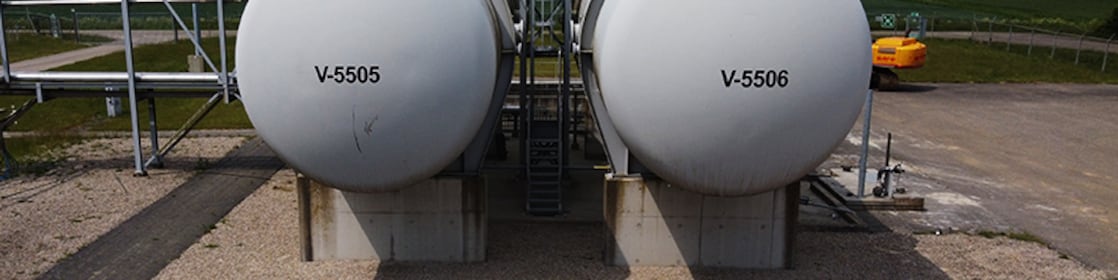
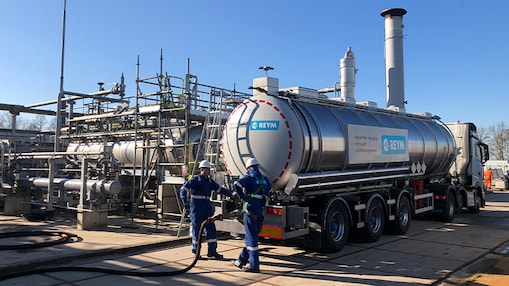
Het werk is niet zonder risico’s. Van nature zit er bijvoorbeeld een kleine hoeveelheid kwik in het Groningse aardgas. Tijdens de behandeling wordt het aardgas onder druk en met een temperatuur van min 12 graden Celsius ontdaan van verontreinigingen. Resten kwik zijn daarbij achtergebleven in de buizen en behandelingsinstallaties. Die worden onder zeer hoge druk (2500 bar) schoongespoten, waarna het spoelwater wordt opgevangen, hergebruikt en uiteindelijk afgevoerd naar de afvalstoffenterminal in Moerdijk (ATM). Dan volgt een chemische nabehandeling om ook de laatste resten verontreiniging te verwijderen.
Ademmasker
Het rubberen beschermingspak met ademmasker dat over een hek hangt, laat zien dat iemand daarmee zojuist aan de slag is geweest. Een zware klus, waarbij de werknemer vanuit een controlekamer voortdurend in de gaten wordt gehouden met camera's en medische apparatuur.
Wie het terrein weer wil verlaten moet door een teil met water, om eventuele restjes kwik van de veiligheidsschoenen te spoelen. Robbert Kroes: “Met die strenge veiligheidsmaatregelen is het risico op kwikvergiftiging wel bezworen.” Het grootse gevaar tijdens de werkzaamheden wordt veroorzaakt door de zwaartekracht in combinatie met de enorme stukken staal die moeten worden verplaatst.
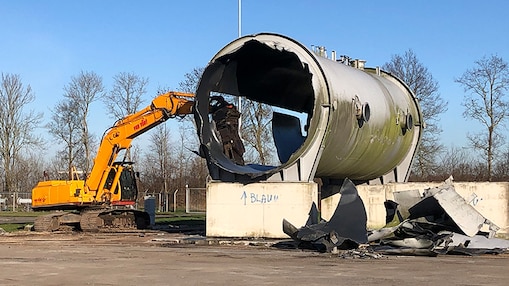
Na de reinigingsoperatie volgt de bovengrondse ontmanteling. Recyclebaar staal wordt met schrootscharen in stukken geknipt. De gigantische compressoren (23 megawatt) krijgen een tweede leven. Ze waren nodig om de in de loop der tijd de geslonken gasvoorraad onder druk te houden en het gas onder de juiste spanning in het transportnetwerk van Gasunie te krijgen.
Christmas tree in Kiel-Windeweer
Voor weer een volgende fase van de opruimoperatie leidt de rit, over het Annerveen-gasveld, zes kilometer noordwaarts naar NAM-locatie Kiel-Windeweer. Ook dit cluster wordt gemarkeerd door een toren. Geen fakkeltoren, maar een zogeheten plug-and-abandonment unit. Het is een mobiele opruimtoren, gebaseerd op de principes van een boortoren, maar met een tegengestelde taak. Je zou hem de naam 'vultoren' kunnen geven.
Het enige dat nog herinnert aan de voormalige functie van het terrein is het asfalt en de zogeheten christmas tree. Deze met enige fantasie op een kerstboom lijkende installatie, is het bovengrondse samenspel van buizen en klepwielen, waarmee de gasbron kan worden gereguleerd.
Grote schoonmaak gasvelden GroningenTijdens de behandeling wordt het aardgas onder druk en met een temperatuur van -12 °C ontdaan van vuil.
Door de gaswinning op gang gebracht
In deze fase speelt Wellgear de hoofdrol, een relatief kleine en nieuwe speler in deze specialistische bedrijfstak. Een multinationale onderneming, met vestigingen in Schotland, Abu Dhabi, de Verenigde Staten en Australië, maar met haar hoofdkantoor in het voormalige raadhuis van Westerbork ('t Aole Gemientehoes). Het bedrijf is een toonbeeld van de lokale en regionale business die door de gaswinning op gang werd gebracht, en daarna wereldwijd ging.
Bij aankomst op Kiel-Windeweer is de door Wellgear ontwikkelde opruimtoren in vol bedrijf. De productiebuis, of binnenbuis, waardoor het aardgas naar boven werd geleid, reikt hier tot een diepte van 3.190 meter. Nu wordt die in stukken van een meter of elf aan de lopende band uit de boorpunt gehesen. De medewerkers van Wellgear doen dit in ploegendiensten.
Binnenbuis hergebruik in de bouw
Opzichter Hiddo Schikker vertelt dat de aan de binnenkant verchroomde, stalen buizen – na grondige reiniging – in de bouw worden hergebruikt als funderingspaal. Na het verwijderen van de binnenbuis zal de zogeheten mantelbuis worden schoongemaakt en geïnspecteerd. Deze buitenbuis, in feite de wand van de gasput, zal in de grond achterblijven.
Robbert Kroes geeft met bewondering uitleg bij een door Wellgear ontwikkelde methode, die leunt op bestaande technieken, maar wordt toegepast in een nieuwe combinatie. Akoestische apparatuur wordt naar beneden geleid. Daarmee kan worden gedetecteerd of het cement, waarmee de buitenbuis in het gesteente is verankerd, wel goed aansluit. Als dat niet het geval is, kan er met explosieven een gat worden geperforeerd in de buis. Zo nodig op kilometers diepte. Vervolgens wordt dat gat gevuld met cement.
Gasput en cementpluggen
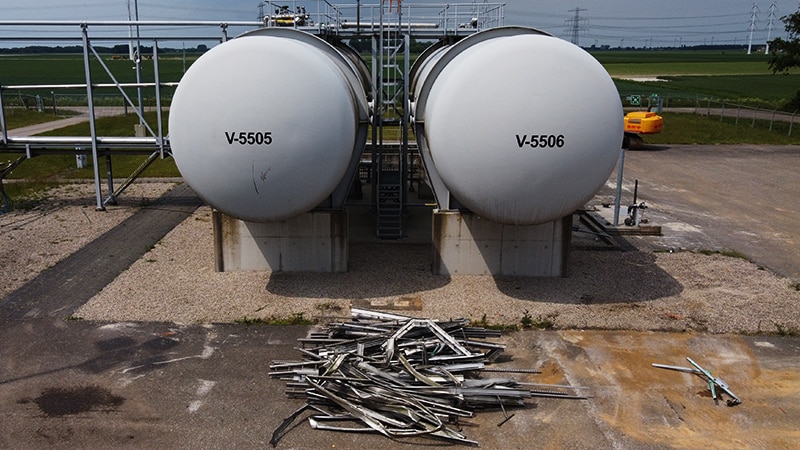
Pas als deze buitenbuis overal stevig is verankerd, wordt de gasput afgesloten. Er wordt een dikke laag cement onderin de put gestort. Zo kan het gas op drie kilometer diepte niet meer naar boven stromen. Maar ook halverwege de gasput kunnen nog reservoirs met koolwaterstofgassen zitten. De put krijgt daarom op diverse dieptes zogeheten cementpluggen.
Wellgear heeft één tot vier weken werk aan een gasput. Dan wordt de toren, bestaande uit gestapelde containers, afgebroken en weer opgebouwd boven een volgende put. De drukopbouw in de afgesloten put wordt nog minimaal drie maanden in de gaten gehouden. Om er zeker van te zijn dat er geen lekkages optreden. Als dat inderdaad niet het geval is, dan wordt de buitenbuis op drie meter onder het maaiveld afgezaagd. De put wordt dan afgedicht met een vijftig meter dikke cementlaag en een stalen plaat als definitieve afsluiting.
Grond waar nodig gesaneerd
Als alle putten op een locatie zijn gesloten, draagt Arcadis zorg voor de laatste fase van de operatie. De grond wordt onderzocht op verontreiniging en waar nodig gesaneerd. Het beton en asfalt wordt verwijderd door de NAM, hetzelfde geldt voor de pijpleidingen die de verschillende locaties met elkaar verbinden.
De terreinen worden pas teruggegeven aan de grondeigenaren, nadat ze zijn teruggebracht in de oorspronkelijke staat waarin ze ooit door de NAM zijn gehuurd. Dat gaat behoorlijk ver. Niet alleen wordt de originele grondsoort teruggestort, zelfs de windsingels rond het terrein en langs de oprijlaan worden gekapt. Hoewel daarvan, in overleg met de eigenaren, kan worden afgeweken. In de meeste gevallen wordt het terrein weer geschikt gemaakt voor landbouw.
Geen spoor meer te bekennen
Robbert Kroes doet een voorzichtige schatting van de totale duur van de schoonmaakoperatie. Hij verwacht dat er over vijftien of twintig jaar geen spoor meer te bekennen zal zijn van de gaswinning op het Groningen- en Annerveen-veld. Met de jaren zullen de samenwerkende partijen almaar meer ervaring krijgen met dit gespecialiseerde werk.
Kroes: “Een delegatie uit Oman die op bezoek kwam, was verbaasd dat we het met zo weinig mensen kunnen doen.” Hij verwacht dat de ervaring en expertise die de komende jaren worden opgedaan, zowel in Groningen als elders in de wereld nog goed van pas kan komen. “Het is werk met veel toekomst.”
Grote schoonmaak gasvelden GroningenEr wordt een dikke laag cement onderin de put gestort. Zo kan het gas op 3 kilometer diepte niet meer naar boven stromen.
Cautionary note
Cautionary note
The companies in which Shell plc directly and indirectly owns investments are separate legal entities. In this announcement “Shell”, “Shell Group” and “Group” are sometimes used for convenience where references are made to Shell plc and its subsidiaries in general. Likewise, the words “we”, “us” and “our” are also used to refer to Shell plc and its subsidiaries in general or to those who work for them. These terms are also used where no useful purpose is served by identifying the particular entity or entities. ‘‘Subsidiaries’’, “Shell subsidiaries” and “Shell companies” as used in this announcement refer to entities over which Shell plc either directly or indirectly has control. The term “joint venture”, “joint operations”, “joint arrangements”, and “associates” may also be used to refer to a commercial arrangement in which Shell has a direct or indirect ownership interest with one or more parties. The term “Shell interest” is used for convenience to indicate the direct and/or indirect ownership interest held by Shell in an entity or unincorporated joint arrangement, after exclusion of all third-party interest.
Forward-looking Statements
This announcement contains forward-looking statements (within the meaning of the U.S. Private Securities Litigation Reform Act of 1995) concerning the financial condition, results of operations and businesses of Shell. All statements other than statements of historical fact are, or may be deemed to be, forward-looking statements. Forward-looking statements are statements of future expectations that are based on management’s current expectations and assumptions and involve known and unknown risks and uncertainties that could cause actual results, performance or events to differ materially from those expressed or implied in these statements. Forward-looking statements include, among other things, statements concerning the potential exposure of Shell to market risks and statements expressing management’s expectations, beliefs, estimates, forecasts, projections and assumptions. These forward-looking statements are identified by their use of terms and phrases such as “aim”; “ambition”; ‘‘anticipate’’; ‘‘believe’’; “commit”; “commitment”; ‘‘could’’; ‘‘estimate’’; ‘‘expect’’; ‘‘goals’’; ‘‘intend’’; ‘‘may’’; “milestones”; ‘‘objectives’’; ‘‘outlook’’; ‘‘plan’’; ‘‘probably’’; ‘‘project’’; ‘‘risks’’; “schedule”; ‘‘seek’’; ‘‘should’’; ‘‘target’’; ‘‘will’’; “would” and similar terms and phrases. There are a number of factors that could affect the future operations of Shell and could cause those results to differ materially from those expressed in the forward-looking statements included in this announcement, including (without limitation): (a) price fluctuations in crude oil and natural gas; (b) changes in demand for Shell’s products; (c) currency fluctuations; (d) drilling and production results; (e) reserves estimates; (f) loss of market share and industry competition; (g) environmental and physical risks; (h) risks associated with the identification of suitable potential acquisition properties and targets, and successful negotiation and completion of such transactions; (i) the risk of doing business in developing countries and countries subject to international sanctions; (j) legislative, judicial, fiscal and regulatory developments including regulatory measures addressing climate change; (k) economic and financial market conditions in various countries and regions; (l) political risks, including the risks of expropriation and renegotiation of the terms of contracts with governmental entities, delays or advancements in the approval of projects and delays in the reimbursement for shared costs; (m) risks associated with the impact of pandemics, such as the COVID-19 (coronavirus) outbreak, regional conflicts, such as the Russia-Ukraine war, and a significant cybersecurity breach; and (n) changes in trading conditions. No assurance is provided that future dividend payments will match or exceed previous dividend payments. All forward-looking statements contained in this announcement are expressly qualified in their entirety by the cautionary statements contained or referred to in this section. Readers should not place undue reliance on forward-looking statements. Additional risk factors that may affect future results are contained in Shell plc’s Form 20-F for the year ended December 31, 2024 (available at www.shell.com/investors/news-and-filings/sec-filings.html and www.sec.gov). These risk factors also expressly qualify all forward-looking statements contained in this announcement and should be considered by the reader. Each forward-looking statement speaks only as of the date of this announcement, February 28, 2025. Neither Shell plc nor any of its subsidiaries undertake any obligation to publicly update or revise any forward-looking statement as a result of new information, future events or other information. In light of these risks, results could differ materially from those stated, implied or inferred from the forward-looking statements contained in this announcement.
Shell’s Net Carbon Intensity
Also, in this announcement we may refer to Shell’s “Net Carbon Intensity” (NCI), which includes Shell’s carbon emissions from the production of our energy products, our suppliers’ carbon emissions in supplying energy for that production and our customers’ carbon emissions associated with their use of the energy products we sell. Shell’s NCI also includes the emissions associated with the production and use of energy products produced by others which Shell purchases for resale. Shell only controls its own emissions. The use of the terms Shell’s “Net Carbon Intensity” or NCI are for convenience only and not intended to suggest these emissions are those of Shell plc or its subsidiaries.
Shell’s net-zero emissions target
Shell’s operating plan, outlook and budgets are forecasted for a ten-year period and are updated every year. They reflect the current economic environment and what we can reasonably expect to see over the next ten years. Accordingly, they reflect our Scope 1, Scope 2 and NCI targets over the next ten years. However, Shell’s operating plans cannot reflect our 2050 net-zero emissions target, as this target is currently outside our planning period. In the future, as society moves towards net-zero emissions, we expect Shell’s operating plans to reflect this movement. However, if society is not net zero in 2050, as of today, there would be significant risk that Shell may not meet this target.
Forward-looking non-GAAP measures
This announcement may contain certain forward-looking non-GAAP measures such as cash capital expenditure and divestments. We are unable to provide a reconciliation of these forward-looking non-GAAP measures to the most comparable GAAP financial measures because certain information needed to reconcile those non-GAAP measures to the most comparable GAAP financial measures is dependent on future events some of which are outside the control of Shell, such as oil and gas prices, interest rates and exchange rates. Moreover, estimating such GAAP measures with the required precision necessary to provide a meaningful reconciliation is extremely difficult and could not be accomplished without unreasonable effort. Non-GAAP measures in respect of future periods which cannot be reconciled to the most comparable GAAP financial measure are calculated in a manner which is consistent with the accounting policies applied in Shell plc’s consolidated financial statements.
The contents of websites referred to in this announcement do not form part of this announcement.
We may have used certain terms, such as resources, in this announcement that the United States Securities and Exchange Commission (SEC) strictly prohibits us from including in our filings with the SEC. Investors are urged to consider closely the disclosure in our Form 20-F, File No 1-32575, available on the SEC website www.sec.gov
Giant Dutch natural gas sites clean-up underway
28 Feb. 2025
After more than 65 years, the Netherlands is closing the chapter on large‑scale natural gas production from the Groningen gas field, that heated people’s homes in other parts of Europe as well. Closing means more than simply turning off the tap. Out of sight of the public, one of the largest industrial clean‑up operations ever has begun: 800 production wells, 350 sites and 1,750 kilometres (1,087 miles) of pipeline need to be dismantled.

Text: Fanta Voogd. Photography: NAM.
It is winter 2025. From the NAM headquarters in Assen, Operations Manager Robbert Kroes steers the car towards the Annerveen gas field, located on the border of the Dutch provinces of Drenthe and Groningen. Along the way, the production sites are hard to miss. Little clusters of curling pipes in the wide‑open farmland, partly shielded by shelterbelts—vegetational barriers of trees and bushes. For now, they stand as visible proof that Mother Earth contributed generously to the extraordinary rise in Dutch prosperity during the last century.
Since 1973, NAM has extracted a total of 71 billion cubic metres (BCM) of natural gas from the Annerveen field. That is a fraction of the 2,300 BCM drawn from the Groningen gas field, Europe’s largest. Annerveen was the second-biggest natural gas field in the Netherlands. The production was halted when the field became depleted.
Clean‑up operation more advanced
Gas extraction at Annerveen stopped in 2021. As a result, the clean‑up operation has progressed further than at the Groningen field to the north, where NAM began dismantling the first sites in 2019. The Annerveen field is the ideal place to get an initial impression of the immense and complex operation that must be carried out over the coming decades. The clean-up is an obligation embedded in the Mining Act of the Netherlands.
Dismantling oil and gas wells
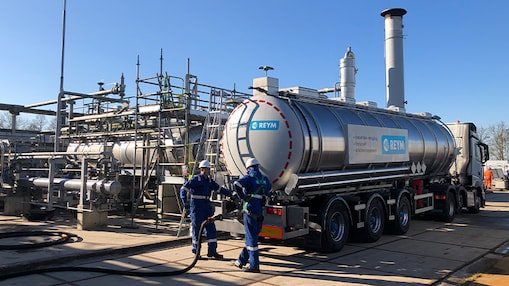
NAM is not doing the clean-up alone. Engineering company Arcadis is part of the team, as is Wellgear. The latter is specialised in the global decommissioning of oil and gas wells. Arcadis takes care of the work above ground, while Wellgear handles the underground activities. The three parties together are doing the work under the name Siturn. This consortium will in turn rely on dozens of subcontractors. Like industrial cleaning firm Reym, the Institute for Safety and Environment (IVM), heavy‑lifting specialist Mammoet and scaffolding company Kaefer.
Before work begins, NAM consults all stakeholders: the State Supervision of Mines, landowners and permitting authorities. Discussions are also held with local residents to minimise inconvenience as much as possible. “Those are quite intensive interactions,” says Robbert Kroes, who was born and raised in Oosterhesselen, about 35 kilometres (22 miles) from the gas field. “In beautiful little villages we sometimes go door‑to‑door. It’s easy to imagine that people aren’t waiting for a lorry with floodlights coming down their street,” Kroes says.
About NAM
The Dutch Petroleum Company (Nederlandse Aardolie Maatschappij; NAM) was founded in 1947 following the discovery of oil underground near the vilage of Schoonebeek, in the northeast of the Netherlands. In 1948, when natural gas was found near Coevorden, NAM began to focus on the exploration of natural gas as well. Oil and gas extraction from North Sea gas fields followed. In October 2024, the gas tap of the Groningen field was permanently closed.
NAM is a joint venture of Shell (50%) and ExxonMobil (50%). NAM’s head office is located in Assen, the Netherlands.
Flare tower
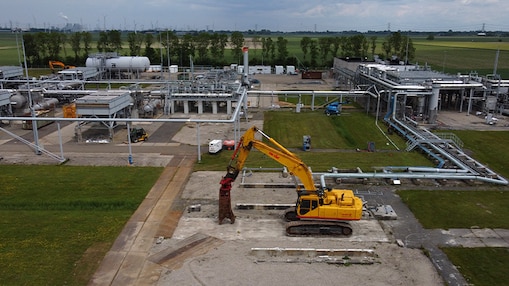
We drive across the provincial border, entering the province of Groningen. In the distance, a flare tower signals the location of NAM’s Wildervank site. This is one of the gas production locations of the Annerveen field, situated right on the outskirts of Veendam. At this so‑called cluster, the first phase of the clean‑up process has been completed. The remaining gas in the pipelines and processing installations has been burned off in the flare tower, after which the gas wells could be disconnected. The next step is the careful cleaning of the installations above ground and pipelines.
Steel and equipment for reuse
After changing into overalls, a hard hat, gloves, safety boots and protective goggles, we are allowed onto the site. Everything here revolves around the major clean‑up, with NAM aiming to prepare as much steel and equipment as possible for reuse.
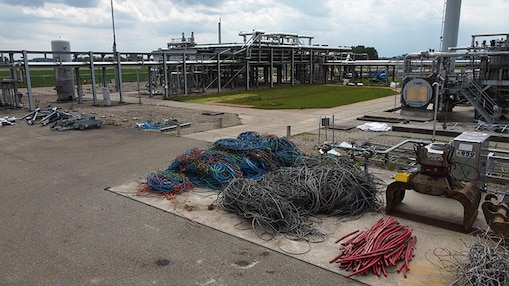
The clean-up work itself is not without risk. Naturally, Groningen natural gas contains small amounts of mercury. During processing, the gas is stripped of impurities under pressure and at a temperature of minus 12 degrees Celsius (+10.4 Fahrenheit). Traces of mercury that remain in the pipes and processing units are jet‑cleaned at extremely high pressure (2,500 bar). Then the rinse water is collected, reused and ultimately transported to the waste processing terminal in Moerdijk (ATM). Any remaining contamination is removed with a chemical treatment.
Respirator
A rubber protective suit with respirator hanging over a fence shows that someone has just been working with it. It is heavy work, with the worker continuously monitored from a control room via cameras and medical equipment.
Anyone leaving the site must step into a tray of water to rinse off any traces of mercury from their safety boots. Robbert Kroes: “With these strict safety measures, the risk of mercury poisoning is under control.” The greatest danger during the work, he adds, comes from gravity combined with the enormous steel components that need to be moved.
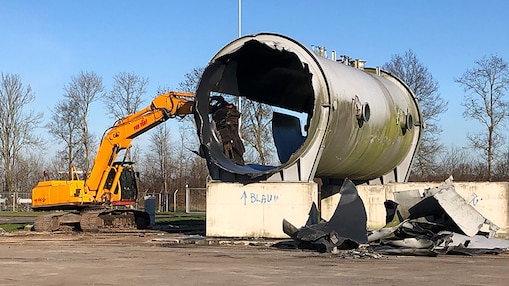
After the cleaning operation, the above‑ground dismantling begins. Recyclable steel is cut into pieces with scrap shears. The giant compressors (23 megawatts) are destined for a second life. They were needed to keep the steadily shrinking gas reserves under pressure over the years, and to get the gas into the Dutch transport network (run by Gasunie) at the correct pressure.
"Christmas tree" in Kiel‑Windeweer
For the next phase of the clean‑up operation, the journey continues over the Annerveen field, 6 kilometres (3.7 miles) northwards, to NAM’s Kiel‑Windeweer site. This cluster is also marked by a tower — not a flare tower, but a so‑called plug‑and‑abandonment unit. It is a mobile decommissioning tower, based on the principles of a drilling rig but with the opposite function. You could call it a “filling tower”.
The only things still hinting at the site’s former purpose are the asphalt and the so‑called “christmas tree”. This installation, which with a bit of imagination resembles a Christmas tree, is the above‑ground arrangement of pipes and valve wheels used to regulate the gas well.
Clean-up of Groningen gas fieldsDuring processing, the natural gas is cleaned of impurities under pressure and at a temperature of –12 °C.
Set in motion by gas production
In this phase, Wellgear plays the leading role — a relatively small and new player in this specialised industry. It is a multinational company with branches in Scotland, Abu Dhabi, the United States and Australia. Its headquarters is the former town hall of Westerbork (’t Aole Gemientehoes), a village of 4,700 inhabitants that was merged into the municipality of Midden-Drenthe in the year 2000. The company is a prime example of the local and regional businesses that were set in motion by gas production and later grew into global enterprises.
Upon arrival at Kiel‑Windeweer, the clean‑up tower developed by Wellgear is in full operation. The production tube, or inner tube, through which the natural gas was brought to the surface, reaches a depth of 3,190 metres here. Now, it is being hoisted out of the well in sections of about eleven metres, one after another. Wellgear’s employees work in shifts to carry out this task.
Inner tube reused in construction
Supervisor Hiddo Schikker explains that the steel pipes, chrome‑plated on the inside, are thoroughly cleaned and then reused in the construction industry as foundation piles. After the inner tube has been removed, the so‑called casing will be cleaned and inspected. This outer pipe — effectively the wall of the gas well — will remain in the ground.
Robbert Kroes gives an admiring explanation of a method developed by Wellgear, which relies on existing techniques but applies them in a new combination. Acoustic equipment is lowered into the well to detect whether the cement anchoring the outer pipe in the rock is properly bonded. If it is not, an explosive charge can be used to perforate the pipe — even kilometres underground if necessary. The hole is then filled with cement.
Gas well and cement plugs
Only once the outer pipe is firmly secured all the way down, the gas is well sealed. A thick layer of cement is poured at the bottom of the well to prevent gas from rising from a depth of three kilometres. But halfway up the well, there may still be reservoirs of hydrocarbons. The well therefore receives several so‑called cement plugs at different depths.
Wellgear needs between one and four weeks to complete a well. The tower — made of stacked containers — is then dismantled and reassembled on top of the next well. Pressure in the sealed well is monitored for at least three months afterwards to ensure that no leaks occur. If everything remains stable, the outer pipe is cut off three metres below ground level. The well is then sealed with a fifty‑metre‑thick layer of cement, with a steel plate as the final lock.
Soil remediated where necessary
Once all wells at a location have been closed, Arcadis takes charge of the final phase of the operation. The soil is examined for contamination and remediated where necessary. Concrete and asphalt are removed by NAM, as are the pipelines connecting the various sites.
The land is only returned to the owners once it has been restored to the original condition in which NAM once leased it. This goes quite far: not only is the original soil type reinstated, even the shelterbelts around the site and along the access road are removed — though this can be adjusted in consultation with the landowners. In most cases, the land is restored for agricultural use.
No trace left behind
Robbert Kroes gives a cautious estimate of the overall duration of the clean‑up operation. He expects that in fifteen to twenty years, no trace will remain of gas extraction in the Groningen and Annerveen fields. Over the years, the cooperating parties will gain increasing experience with this specialised work.
Kroes: “A delegation from Oman that visited us was amazed that we manage to do this with so few people.” He expects that the experience and expertise gained in the coming years will prove valuable not only in Groningen and the Netherlands, but also elsewhere in the world. “It’s work with a strong future.”
Clean-up Groningen gas fieldsA thick layer of cement is poured at the bottom of the well. This ensures that the gas at a depth of 3 kilometres can no longer flow upwards.
Cautionary note
Cautionary note
The companies in which Shell plc directly and indirectly owns investments are separate legal entities. In this announcement “Shell”, “Shell Group” and “Group” are sometimes used for convenience where references are made to Shell plc and its subsidiaries in general. Likewise, the words “we”, “us” and “our” are also used to refer to Shell plc and its subsidiaries in general or to those who work for them. These terms are also used where no useful purpose is served by identifying the particular entity or entities. ‘‘Subsidiaries’’, “Shell subsidiaries” and “Shell companies” as used in this announcement refer to entities over which Shell plc either directly or indirectly has control. The term “joint venture”, “joint operations”, “joint arrangements”, and “associates” may also be used to refer to a commercial arrangement in which Shell has a direct or indirect ownership interest with one or more parties. The term “Shell interest” is used for convenience to indicate the direct and/or indirect ownership interest held by Shell in an entity or unincorporated joint arrangement, after exclusion of all third-party interest.
Forward-looking Statements
This announcement contains forward-looking statements (within the meaning of the U.S. Private Securities Litigation Reform Act of 1995) concerning the financial condition, results of operations and businesses of Shell. All statements other than statements of historical fact are, or may be deemed to be, forward-looking statements. Forward-looking statements are statements of future expectations that are based on management’s current expectations and assumptions and involve known and unknown risks and uncertainties that could cause actual results, performance or events to differ materially from those expressed or implied in these statements. Forward-looking statements include, among other things, statements concerning the potential exposure of Shell to market risks and statements expressing management’s expectations, beliefs, estimates, forecasts, projections and assumptions. These forward-looking statements are identified by their use of terms and phrases such as “aim”; “ambition”; ‘‘anticipate’’; ‘‘believe’’; “commit”; “commitment”; ‘‘could’’; ‘‘estimate’’; ‘‘expect’’; ‘‘goals’’; ‘‘intend’’; ‘‘may’’; “milestones”; ‘‘objectives’’; ‘‘outlook’’; ‘‘plan’’; ‘‘probably’’; ‘‘project’’; ‘‘risks’’; “schedule”; ‘‘seek’’; ‘‘should’’; ‘‘target’’; ‘‘will’’; “would” and similar terms and phrases. There are a number of factors that could affect the future operations of Shell and could cause those results to differ materially from those expressed in the forward-looking statements included in this announcement, including (without limitation): (a) price fluctuations in crude oil and natural gas; (b) changes in demand for Shell’s products; (c) currency fluctuations; (d) drilling and production results; (e) reserves estimates; (f) loss of market share and industry competition; (g) environmental and physical risks; (h) risks associated with the identification of suitable potential acquisition properties and targets, and successful negotiation and completion of such transactions; (i) the risk of doing business in developing countries and countries subject to international sanctions; (j) legislative, judicial, fiscal and regulatory developments including regulatory measures addressing climate change; (k) economic and financial market conditions in various countries and regions; (l) political risks, including the risks of expropriation and renegotiation of the terms of contracts with governmental entities, delays or advancements in the approval of projects and delays in the reimbursement for shared costs; (m) risks associated with the impact of pandemics, such as the COVID-19 (coronavirus) outbreak, regional conflicts, such as the Russia-Ukraine war, and a significant cybersecurity breach; and (n) changes in trading conditions. No assurance is provided that future dividend payments will match or exceed previous dividend payments. All forward-looking statements contained in this announcement are expressly qualified in their entirety by the cautionary statements contained or referred to in this section. Readers should not place undue reliance on forward-looking statements. Additional risk factors that may affect future results are contained in Shell plc’s Form 20-F for the year ended December 31, 2024 (available at www.shell.com/investors/news-and-filings/sec-filings.html and www.sec.gov). These risk factors also expressly qualify all forward-looking statements contained in this announcement and should be considered by the reader. Each forward-looking statement speaks only as of the date of this announcement, February 28, 2025. Neither Shell plc nor any of its subsidiaries undertake any obligation to publicly update or revise any forward-looking statement as a result of new information, future events or other information. In light of these risks, results could differ materially from those stated, implied or inferred from the forward-looking statements contained in this announcement.
Shell’s Net Carbon Intensity
Also, in this announcement we may refer to Shell’s “Net Carbon Intensity” (NCI), which includes Shell’s carbon emissions from the production of our energy products, our suppliers’ carbon emissions in supplying energy for that production and our customers’ carbon emissions associated with their use of the energy products we sell. Shell’s NCI also includes the emissions associated with the production and use of energy products produced by others which Shell purchases for resale. Shell only controls its own emissions. The use of the terms Shell’s “Net Carbon Intensity” or NCI are for convenience only and not intended to suggest these emissions are those of Shell plc or its subsidiaries.
Shell’s net-zero emissions target
Shell’s operating plan, outlook and budgets are forecasted for a ten-year period and are updated every year. They reflect the current economic environment and what we can reasonably expect to see over the next ten years. Accordingly, they reflect our Scope 1, Scope 2 and NCI targets over the next ten years. However, Shell’s operating plans cannot reflect our 2050 net-zero emissions target, as this target is currently outside our planning period. In the future, as society moves towards net-zero emissions, we expect Shell’s operating plans to reflect this movement. However, if society is not net zero in 2050, as of today, there would be significant risk that Shell may not meet this target.
Forward-looking non-GAAP measures
This announcement may contain certain forward-looking non-GAAP measures such as cash capital expenditure and divestments. We are unable to provide a reconciliation of these forward-looking non-GAAP measures to the most comparable GAAP financial measures because certain information needed to reconcile those non-GAAP measures to the most comparable GAAP financial measures is dependent on future events some of which are outside the control of Shell, such as oil and gas prices, interest rates and exchange rates. Moreover, estimating such GAAP measures with the required precision necessary to provide a meaningful reconciliation is extremely difficult and could not be accomplished without unreasonable effort. Non-GAAP measures in respect of future periods which cannot be reconciled to the most comparable GAAP financial measure are calculated in a manner which is consistent with the accounting policies applied in Shell plc’s consolidated financial statements.
The contents of websites referred to in this announcement do not form part of this announcement.
We may have used certain terms, such as resources, in this announcement that the United States Securities and Exchange Commission (SEC) strictly prohibits us from including in our filings with the SEC. Investors are urged to consider closely the disclosure in our Form 20-F, File No 1-32575, available on the SEC website www.sec.gov