Het kloppend hart achter de grootste groene waterstoffabriek van Europa
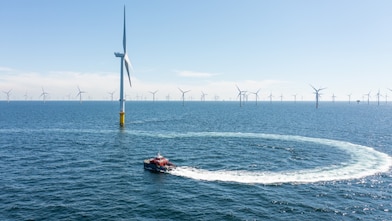
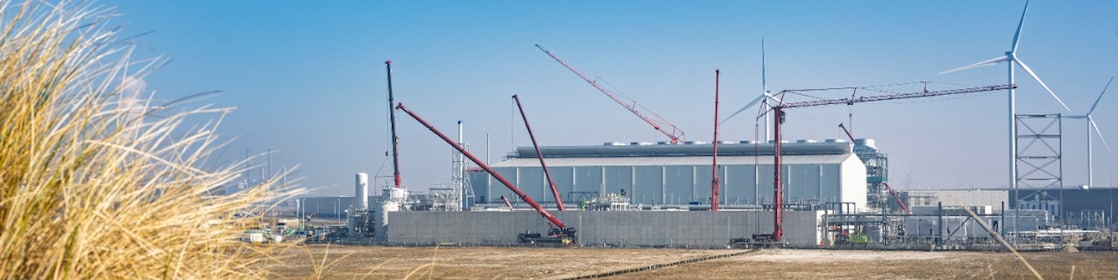
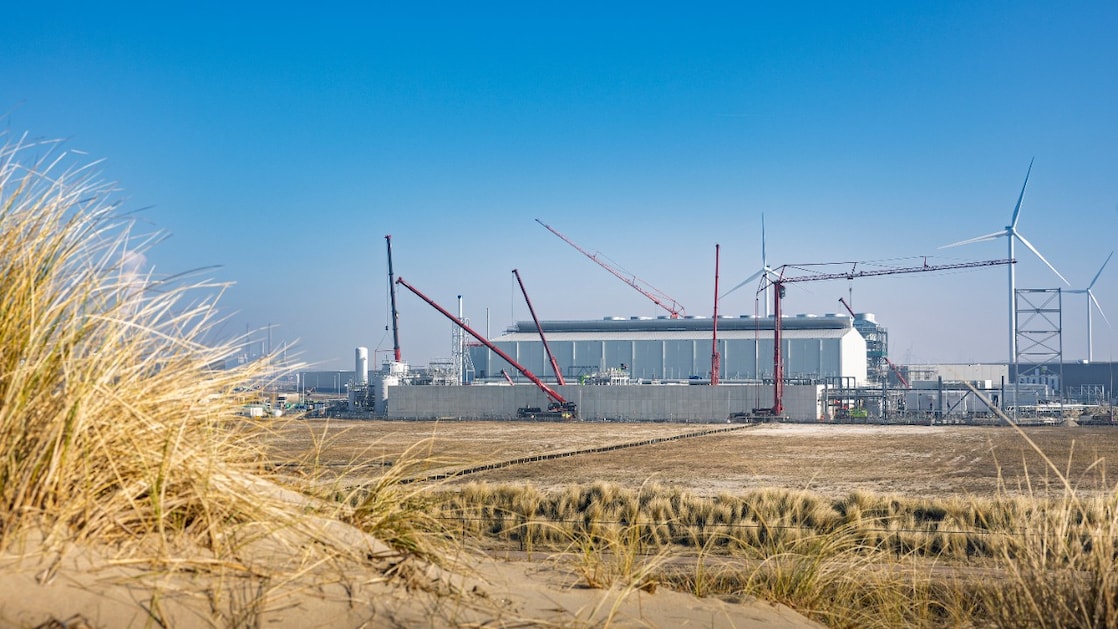
Achter de duinenrij van de Tweede Maasvlakte, op steenworp afstand van de Noordzee, nadert Shell Holland Hydrogen 1 zijn voltooiing. Alle elektrolysers, het kloppend hart van de fabriek, zijn inmiddels aangekomen. Pascal van Eck is er de projectingenieur van en legt uit hoe er bij Rotterdam baanbrekend werk wordt verricht. En groen, want de hernieuwbare stroom voor de elektrolyser komt van Hollandse Kust (Noord), het windpark op zee dat deels eigendom is van Shell.

Tekst: Marcel Burger. Beeld: Eric van Vuuren.
For English, scroll down or click here
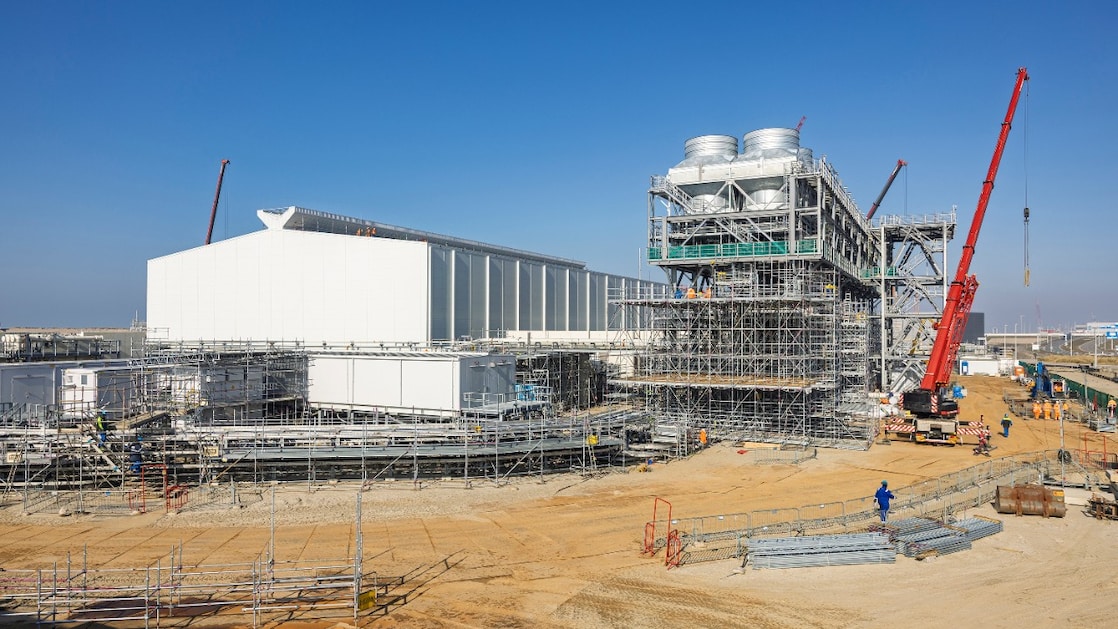
Shell is in Nederland de eerste die de daad bij het woord heeft gevoegd en daadwerkelijk een groene waterstoffabriek bouwt. Tien elektrolysers met elk 20 megawatt aan vermogen worden op de Tweede Maasvlakte aan elkaar gekoppeld. Met de gezamenlijke 200 megawatt aan vermogen is de Holland Hydrogen 1 straks bij opening de grootste in Europa. Die staat gepland voor eind 2026, en na volledige opwerking zal er tot 60.000 kilo groene waterstof per dag geproduceerd kunnen worden.
Het aanvoeren en installeren van de elektrolysers is een flinke logistieke operatie, stelt projectingenieur voor elektrolysers Pascal van Eck. “Het aanvoeren ging met circa 200 temperatuurgeregelde vrachtwagens, vanuit de fabriek in Spanje waar ze zijn gebouwd.”
Tien grote rechthoeken
Op het terrein van de Holland Hydrogen 1 nemen de elektrolysers een oppervlakte in van 80 bij 50 meter. “In feite zijn het tien grote rechthoeken bij elkaar, gekoppeld aan vijf transformatoren en een berg elektronica”, versimpelt Van Eck de opzet.
“De transformatoren en gelijkrichters zetten de aangevoerde elektriciteit van wind op zee om tot het juiste gelijkspanningsvoltage waarop de elektrolysers kunnen werken.” Dus eigenlijk niet veel anders dan thuis, waar je scheerapparaat of elektrische tandenborstel ook via transformatoren hun stroom krijgen van het hoofdelektriciteitsnet.
Al in 1839 waterstof voor energie
Het maken van waterstof met elektrolyse is niet nieuw. Elektrolyse is een chemische reactie, waarbij je stoffen kunt scheiden door ze onder stroom te zetten. Zout opbreken in losse stukjes (de chemische elementen) is zo’n beetje de oudste vorm van elektrolyse. En al in 1839 toonden de chemici Christian Friedrich Schönbein en Sir William Robert Groveaan dat je met elektrolyse waterstof voor energieopwekking kon maken. Gewoon door water (H2O) onder stroom te zetten. Dan houd je na elektrolyse waterstof (H) en zuurstof (O) over.
Pascal: “Waterstof wordt ook al lang gebruikt in de industrie, maar dan gemaakt met aardgas (dat heet het grijze waterstof, of blauwe waterstof als de CO2 wordt opgevangen zodat het niet in de atmosfeer belandt; red.). Waterstof maken met windenergie gebeurt ook al een tijdje, maar dan gaat het om relatief kleine fabrieken met een vermogen van 1 of 2 megawatt. De 200 megawatt van de Holland Hydrogen 1 is daarmee vergeleken een enorme sprong voorwaarts.”
World Hydrogen Summit op 20, 21 en 22 mei 2025
Op 20, 21 en 22 mei 2025 vond in Ahoy in Rotterdam de World Hydrogen Summit plaats. Hier ontmoetten 15.000 mensen uit het bedrijfsleven en de overheid elkaar. De waterstoftop werd georganiseerd door de Sustainable Energy Council and RX Global, in samenwerking met de Nederlandse Rijksoverheid, de Provincie Zuid-Holland, de Gemeente Rotterdam en het Havenbedrijf Rotterdam.
In een fietsband zit meer druk
De leek vraagt zich al snel af: stroom en het maken van waterstof op grote schaal, is dat wel veilig? Van Eck: “Uiteraard. We hebben geavanceerde beheerssystemen om het allemaal veilig te doen. Bovendien produceren we waterstof op lage druk van 0,4 bar. In de band van een stadsfiets zit zo’n 3 bar (in een racefiets zo'n 9 bar; red.), dus dit is aanzienlijk lager.”
Van Eck benadrukt dat de techniek voor het maken van waterstof bij de Holland Hydrogen 1 niet anders is dan bij het maken van waterstof in kleinere fabrieken. En al is de Shell-fabriek in Nederland straks in Europa met de Holland Hydrogen 1 van 200 megawatt de grootste, in Saudi-Arabië is de bouw van een groene waterstoffabriek met maar liefst 4 gigawatt vermogen al voor meer dan de helft gevorderd.
Raffinageroute en zware industrieën
Dichter bij huis zal de Holland Hydrogen 1 in eerste instantie de groene waterstof leveren aan de raffinaderij van Shell Energy and Chemicals Park Rotterdam in Pernis. Dit wordt de raffinageroute genoemd. Later zullen andere zware industrieën ook van groene waterstof kunnen worden voorzien, via een ondergrondse pijplijn die de Delta-Rijncorridor wordt genoemd.
“Elektrolyse om waterstof te maken is een techniek die harstikke goed schaalbaar is”, stelt Van Eck. “Maar het neerzetten van fabrieken van omvang met alle bijbehorende infrastructuur is wel nieuw. En daarmee is Shell in Nederland en Europa1 dus de eerste.”
1. In het hoge noorden van Zweden, bij Boden, bouwt Stegra een 360-megawattfabriek voor groene waterstof. Die gaat naar verwachting tegen 2030 open.
Pascal van Eck, projectingenieur Holland Hydrogen 1“Elektrolyse om waterstof te maken is een techniek die harstikke goed schaalbaar is”
De "kleuren" van waterstof
Hoewel waterstof kleurloos is, wordt er vaak gesproken over verschillende kleuren waterstof. Dat heeft niks te maken met de kleur van het chemische element, maar zegt iets over de productiemethode.
Groene of hernieuwbare waterstof
Hernieuwbare waterstof, het type waterstof dat we bij HH1 maken, wordt vervaardigd met behulp van een duurzame energiebron. Hernieuwbare energie wordt gebruikt om watermoleculen te splitsen in waterstof en zuurstof via het hierboven beschreven elektrolyseproces.
Grijze waterstof
Momenteel wordt de meeste waterstof geproduceerd uit fossiele bronnen zoals aardgas of steenkool. Dit productieproces heet reforming en hierbij komt koolstofdioxide (CO2) vrij in de atmosfeer.
Blauwe waterstof
Blauwe waterstof wordt net als grijze waterstof geproduceerd uit aardgas, maar de CO2 die vrijkomt bij de productie wordt afgevangen en opgeslagen. Dat heet Carbon Capture & Storage (CCS). De CO2 kan bijvoorbeeld worden opgeslagen in lege gasvelden onder de zee en komt dan dus niet in onze atmosfeer terecht.
Cautionary note
Cautionary note
The companies in which Shell plc directly and indirectly owns investments are separate legal entities. In this announcement “Shell”, “Shell Group” and “Group” are sometimes used for convenience where references are made to Shell plc and its subsidiaries in general. Likewise, the words “we”, “us” and “our” are also used to refer to Shell plc and its subsidiaries in general or to those who work for them. These terms are also used where no useful purpose is served by identifying the particular entity or entities. ‘‘Subsidiaries’’, “Shell subsidiaries” and “Shell companies” as used in this announcement refer to entities over which Shell plc either directly or indirectly has control. The term “joint venture”, “joint operations”, “joint arrangements”, and “associates” may also be used to refer to a commercial arrangement in which Shell has a direct or indirect ownership interest with one or more parties. The term “Shell interest” is used for convenience to indicate the direct and/or indirect ownership interest held by Shell in an entity or unincorporated joint arrangement, after exclusion of all third-party interest.
Forward-looking Statements
This announcement contains forward-looking statements (within the meaning of the U.S. Private Securities Litigation Reform Act of 1995) concerning the financial condition, results of operations and businesses of Shell. All statements other than statements of historical fact are, or may be deemed to be, forward-looking statements. Forward-looking statements are statements of future expectations that are based on management’s current expectations and assumptions and involve known and unknown risks and uncertainties that could cause actual results, performance or events to differ materially from those expressed or implied in these statements. Forward-looking statements include, among other things, statements concerning the potential exposure of Shell to market risks and statements expressing management’s expectations, beliefs, estimates, forecasts, projections and assumptions. These forward-looking statements are identified by their use of terms and phrases such as “aim”; “ambition”; ‘‘anticipate’’; ‘‘believe’’; “commit”; “commitment”; ‘‘could’’; ‘‘estimate’’; ‘‘expect’’; ‘‘goals’’; ‘‘intend’’; ‘‘may’’; “milestones”; ‘‘objectives’’; ‘‘outlook’’; ‘‘plan’’; ‘‘probably’’; ‘‘project’’; ‘‘risks’’; “schedule”; ‘‘seek’’; ‘‘should’’; ‘‘target’’; ‘‘will’’; “would” and similar terms and phrases. There are a number of factors that could affect the future operations of Shell and could cause those results to differ materially from those expressed in the forward-looking statements included in this announcement, including (without limitation): (a) price fluctuations in crude oil and natural gas; (b) changes in demand for Shell’s products; (c) currency fluctuations; (d) drilling and production results; (e) reserves estimates; (f) loss of market share and industry competition; (g) environmental and physical risks; (h) risks associated with the identification of suitable potential acquisition properties and targets, and successful negotiation and completion of such transactions; (i) the risk of doing business in developing countries and countries subject to international sanctions; (j) legislative, judicial, fiscal and regulatory developments including regulatory measures addressing climate change; (k) economic and financial market conditions in various countries and regions; (l) political risks, including the risks of expropriation and renegotiation of the terms of contracts with governmental entities, delays or advancements in the approval of projects and delays in the reimbursement for shared costs; (m) risks associated with the impact of pandemics, such as the COVID-19 (coronavirus) outbreak, regional conflicts, such as the Russia-Ukraine war, and a significant cybersecurity breach; and (n) changes in trading conditions. No assurance is provided that future dividend payments will match or exceed previous dividend payments. All forward-looking statements contained in this announcement are expressly qualified in their entirety by the cautionary statements contained or referred to in this section. Readers should not place undue reliance on forward-looking statements. Additional risk factors that may affect future results are contained in Shell plc’s Form 20-F for the year ended December 31, 2024 (available at www.shell.com/investors/news-and-filings/sec-filings.html and www.sec.gov). These risk factors also expressly qualify all forward-looking statements contained in this announcement and should be considered by the reader. Each forward-looking statement speaks only as of the date of this announcement, May 19, 2025. Neither Shell plc nor any of its subsidiaries undertake any obligation to publicly update or revise any forward-looking statement as a result of new information, future events or other information. In light of these risks, results could differ materially from those stated, implied or inferred from the forward-looking statements contained in this announcement.
Shell’s Net Carbon Intensity
Also, in this announcement we may refer to Shell’s “Net Carbon Intensity” (NCI), which includes Shell’s carbon emissions from the production of our energy products, our suppliers’ carbon emissions in supplying energy for that production and our customers’ carbon emissions associated with their use of the energy products we sell. Shell’s NCI also includes the emissions associated with the production and use of energy products produced by others which Shell purchases for resale. Shell only controls its own emissions. The use of the terms Shell’s “Net Carbon Intensity” or NCI are for convenience only and not intended to suggest these emissions are those of Shell plc or its subsidiaries.
Shell’s net-zero emissions target
Shell’s operating plan, outlook and budgets are forecasted for a ten-year period and are updated every year. They reflect the current economic environment and what we can reasonably expect to see over the next ten years. Accordingly, they reflect our Scope 1, Scope 2 and NCI targets over the next ten years. However, Shell’s operating plans cannot reflect our 2050 net-zero emissions target, as this target is currently outside our planning period. In the future, as society moves towards net-zero emissions, we expect Shell’s operating plans to reflect this movement. However, if society is not net zero in 2050, as of today, there would be significant risk that Shell may not meet this target.
Forward-looking non-GAAP measures
This announcement may contain certain forward-looking non-GAAP measures such as cash capital expenditure and divestments. We are unable to provide a reconciliation of these forward-looking non-GAAP measures to the most comparable GAAP financial measures because certain information needed to reconcile those non-GAAP measures to the most comparable GAAP financial measures is dependent on future events some of which are outside the control of Shell, such as oil and gas prices, interest rates and exchange rates. Moreover, estimating such GAAP measures with the required precision necessary to provide a meaningful reconciliation is extremely difficult and could not be accomplished without unreasonable effort. Non-GAAP measures in respect of future periods which cannot be reconciled to the most comparable GAAP financial measure are calculated in a manner which is consistent with the accounting policies applied in Shell plc’s consolidated financial statements.
The contents of websites referred to in this announcement do not form part of this announcement.
We may have used certain terms, such as resources, in this announcement that the United States Securities and Exchange Commission (SEC) strictly prohibits us from including in our filings with the SEC. Investors are urged to consider closely the disclosure in our Form 20-F, File No 1-32575, available on the SEC website www.sec.gov
The beating heart behind the largest renewable hydrogen plant in Europe
19 May 2025
Behind the dunes of man-made land in the North Sea near Rotterdam, the Shell Holland Hydrogen 1 is nearing completion. All electrolysers, the beating heart of the factory, have now arrived. Pascal van Eck is the Project Engineer on site and explains the pioneering work is being done. Renewable as well, as the electricity that is needed comes from Hollandse Kust (Noord), the offshore wind farm that is partly owned by Shell.

Tekst: Marcel Burger. Beeld: Eric van Vuuren.
Shell is first in the Netherlands with putting its money where its mouth is and actually builds a renewable hydrogen plant. Ten electrolysers, each with a capacity of 20 megawatts, will be connected to from the core of the Holland Hydrogen 1. With the combined 200 megawatts of capacity, the Holland Hydrogen 1 will be the largest renewable hydrogen plant in Europe when it opens, envisaged for late 2026. It will produce up to 60,000 kilos of renewable hydrogen once fully up to speed somewhere in 2027.
The supply and installation of the electrolysers is a major logistical operation, says Van Eck. "They came in about 200 temperature-controlled trucks, from the factory in Spain where they were built."
Ten large rectangles
On site, the electrolysers take up a surface area of 80 by 50 metres (262 by 164 feet). "In fact, it is ten large rectangles together, linked to five transformers and a mountain of electronics," Van Eck simplifies the set-up.
"The transformers and rectifiers convert the electricity supplied from offshore wind into the correct DC voltage on which the electrolysers can operate." In a way not much different from how things are done at your home, where your shaver or electric toothbrush also get their power from the main electricity grid via transformers.
Hydrogen for energy as early as 1839
Making hydrogen with electrolysis is not new. Electrolysis is a chemical reaction in which you can separate substances by electrifying them. Breaking down salt into its separate chemical elements is pretty much the oldest form of electrolysis. And as early as 1839, the chemists Christian Friedrich Schönbein and Sir William Robert Groveaan showed that you could use electrolyses to make hydrogen for generating an energy source. Simply by electrifying water (H2O). After electrolysis, the separate parts hydrogen (H) and oxygen (O) remain.
Van Eck: "Industries have been using hydrogen for a long time, but then made with natural gas (also called grey hydrogen, or blue hydrogen if the CO2 is captured and thus not released into the atmosphere; edit.). Making hydrogen with wind power has also been done for some time, but in relatively small factories with a capacity of 1 or 2 megawatts. The 200 megawatts of the Holland Hydrogen 1 is a huge leap forward."
World Hydrogen Summit: 20, 21 and 22 May 2025
On 20, 21 and 22 May 2025, the World Hydrogen Summit was held in Rotterdam. Here, 15,000 people from businesses and government met. The hydrogen summit was organised by the Sustainable Energy Council and RX Global, in collaboration with the Dutch government, the Province of South Holland, the Municipality of Rotterdam and the Port of Rotterdam Authority.
More pressure in a bicycle tyre
A question quickly arises: electricity and the production of hydrogen on a large scale, is that safe? Van Eck: "Of course. We have advanced management systems to do it all safely. In addition, we produce hydrogen at low pressure of 0.4 bar. The pressure in a a city bike tyre is about 3 bar (and up to 9 bar in racing bikes; edit.), so this is considerably lower."
Van Eck emphasizes that the technology for producing hydrogen in the Holland Hydrogen 1 is no different from that in smaller factories. And although the Shell plant in the Netherlands will soon be the largest in Europe, in Saudi Arabia the construction of a green hydrogen plant with no less than 4 gigawatts of capacity is already more than halfway.
Refining route and heavy industries
The Holland Hydrogen 1 will initially supply its renewable hydrogen to the refinery of Shell Energy and Chemicals Park Rotterdam in Pernis. This is called the refining route. Later, other heavy industries will also be able to get the renewable hydrogen, via an underground pipeline called the Delta-Rhine corridor.
"Electrolysis to produce hydrogen is a technique that is highly scalable," Van Eck says. "But constructing a sizable factory with all the associated infrastructure is new. And that makes Shell the first in the Netherlands and Europe."1
1. In the far north of Sweden, near Boden, Stegra is building a 360-megawatt plant for renewable hydrogen. It is expected to open by 2030.
Pascal van Eck, Project Engineer Holland Hydrogen 1"Electrolysis to produce hydrogen is a technique that is highly scalable"
Cautionary note
Cautionary note
The companies in which Shell plc directly and indirectly owns investments are separate legal entities. In this announcement “Shell”, “Shell Group” and “Group” are sometimes used for convenience where references are made to Shell plc and its subsidiaries in general. Likewise, the words “we”, “us” and “our” are also used to refer to Shell plc and its subsidiaries in general or to those who work for them. These terms are also used where no useful purpose is served by identifying the particular entity or entities. ‘‘Subsidiaries’’, “Shell subsidiaries” and “Shell companies” as used in this announcement refer to entities over which Shell plc either directly or indirectly has control. The term “joint venture”, “joint operations”, “joint arrangements”, and “associates” may also be used to refer to a commercial arrangement in which Shell has a direct or indirect ownership interest with one or more parties. The term “Shell interest” is used for convenience to indicate the direct and/or indirect ownership interest held by Shell in an entity or unincorporated joint arrangement, after exclusion of all third-party interest.
Forward-looking Statements
This announcement contains forward-looking statements (within the meaning of the U.S. Private Securities Litigation Reform Act of 1995) concerning the financial condition, results of operations and businesses of Shell. All statements other than statements of historical fact are, or may be deemed to be, forward-looking statements. Forward-looking statements are statements of future expectations that are based on management’s current expectations and assumptions and involve known and unknown risks and uncertainties that could cause actual results, performance or events to differ materially from those expressed or implied in these statements. Forward-looking statements include, among other things, statements concerning the potential exposure of Shell to market risks and statements expressing management’s expectations, beliefs, estimates, forecasts, projections and assumptions. These forward-looking statements are identified by their use of terms and phrases such as “aim”; “ambition”; ‘‘anticipate’’; ‘‘believe’’; “commit”; “commitment”; ‘‘could’’; ‘‘estimate’’; ‘‘expect’’; ‘‘goals’’; ‘‘intend’’; ‘‘may’’; “milestones”; ‘‘objectives’’; ‘‘outlook’’; ‘‘plan’’; ‘‘probably’’; ‘‘project’’; ‘‘risks’’; “schedule”; ‘‘seek’’; ‘‘should’’; ‘‘target’’; ‘‘will’’; “would” and similar terms and phrases. There are a number of factors that could affect the future operations of Shell and could cause those results to differ materially from those expressed in the forward-looking statements included in this announcement, including (without limitation): (a) price fluctuations in crude oil and natural gas; (b) changes in demand for Shell’s products; (c) currency fluctuations; (d) drilling and production results; (e) reserves estimates; (f) loss of market share and industry competition; (g) environmental and physical risks; (h) risks associated with the identification of suitable potential acquisition properties and targets, and successful negotiation and completion of such transactions; (i) the risk of doing business in developing countries and countries subject to international sanctions; (j) legislative, judicial, fiscal and regulatory developments including regulatory measures addressing climate change; (k) economic and financial market conditions in various countries and regions; (l) political risks, including the risks of expropriation and renegotiation of the terms of contracts with governmental entities, delays or advancements in the approval of projects and delays in the reimbursement for shared costs; (m) risks associated with the impact of pandemics, such as the COVID-19 (coronavirus) outbreak, regional conflicts, such as the Russia-Ukraine war, and a significant cybersecurity breach; and (n) changes in trading conditions. No assurance is provided that future dividend payments will match or exceed previous dividend payments. All forward-looking statements contained in this announcement are expressly qualified in their entirety by the cautionary statements contained or referred to in this section. Readers should not place undue reliance on forward-looking statements. Additional risk factors that may affect future results are contained in Shell plc’s Form 20-F for the year ended December 31, 2024 (available at www.shell.com/investors/news-and-filings/sec-filings.html and www.sec.gov). These risk factors also expressly qualify all forward-looking statements contained in this announcement and should be considered by the reader. Each forward-looking statement speaks only as of the date of this announcement, May 19, 2025. Neither Shell plc nor any of its subsidiaries undertake any obligation to publicly update or revise any forward-looking statement as a result of new information, future events or other information. In light of these risks, results could differ materially from those stated, implied or inferred from the forward-looking statements contained in this announcement.
Shell’s Net Carbon Intensity
Also, in this announcement we may refer to Shell’s “Net Carbon Intensity” (NCI), which includes Shell’s carbon emissions from the production of our energy products, our suppliers’ carbon emissions in supplying energy for that production and our customers’ carbon emissions associated with their use of the energy products we sell. Shell’s NCI also includes the emissions associated with the production and use of energy products produced by others which Shell purchases for resale. Shell only controls its own emissions. The use of the terms Shell’s “Net Carbon Intensity” or NCI are for convenience only and not intended to suggest these emissions are those of Shell plc or its subsidiaries.
Shell’s net-zero emissions target
Shell’s operating plan, outlook and budgets are forecasted for a ten-year period and are updated every year. They reflect the current economic environment and what we can reasonably expect to see over the next ten years. Accordingly, they reflect our Scope 1, Scope 2 and NCI targets over the next ten years. However, Shell’s operating plans cannot reflect our 2050 net-zero emissions target, as this target is currently outside our planning period. In the future, as society moves towards net-zero emissions, we expect Shell’s operating plans to reflect this movement. However, if society is not net zero in 2050, as of today, there would be significant risk that Shell may not meet this target.
Forward-looking non-GAAP measures
This announcement may contain certain forward-looking non-GAAP measures such as cash capital expenditure and divestments. We are unable to provide a reconciliation of these forward-looking non-GAAP measures to the most comparable GAAP financial measures because certain information needed to reconcile those non-GAAP measures to the most comparable GAAP financial measures is dependent on future events some of which are outside the control of Shell, such as oil and gas prices, interest rates and exchange rates. Moreover, estimating such GAAP measures with the required precision necessary to provide a meaningful reconciliation is extremely difficult and could not be accomplished without unreasonable effort. Non-GAAP measures in respect of future periods which cannot be reconciled to the most comparable GAAP financial measure are calculated in a manner which is consistent with the accounting policies applied in Shell plc’s consolidated financial statements.
The contents of websites referred to in this announcement do not form part of this announcement.
We may have used certain terms, such as resources, in this announcement that the United States Securities and Exchange Commission (SEC) strictly prohibits us from including in our filings with the SEC. Investors are urged to consider closely the disclosure in our Form 20-F, File No 1-32575, available on the SEC website www.sec.gov