Zonder netaansluiting geen groene waterstoffabriek
Waterstoffabriek Holland Hydrogen 1 is sinds dit jaar aangesloten op het elektriciteitsnet. Dat lijkt een formaliteit, maar ligt in werkelijkheid een stuk ingewikkelder dan thuis de stekker in het stopcontact stoppen, zo verzekert Priya Aryabhumi. Ze is als projectmanager namens Shell verantwoordelijk voor de complete aansluiting. “Het is, op deze schaal en voor dit doel, nog nooit eerder gedaan in Europa.”

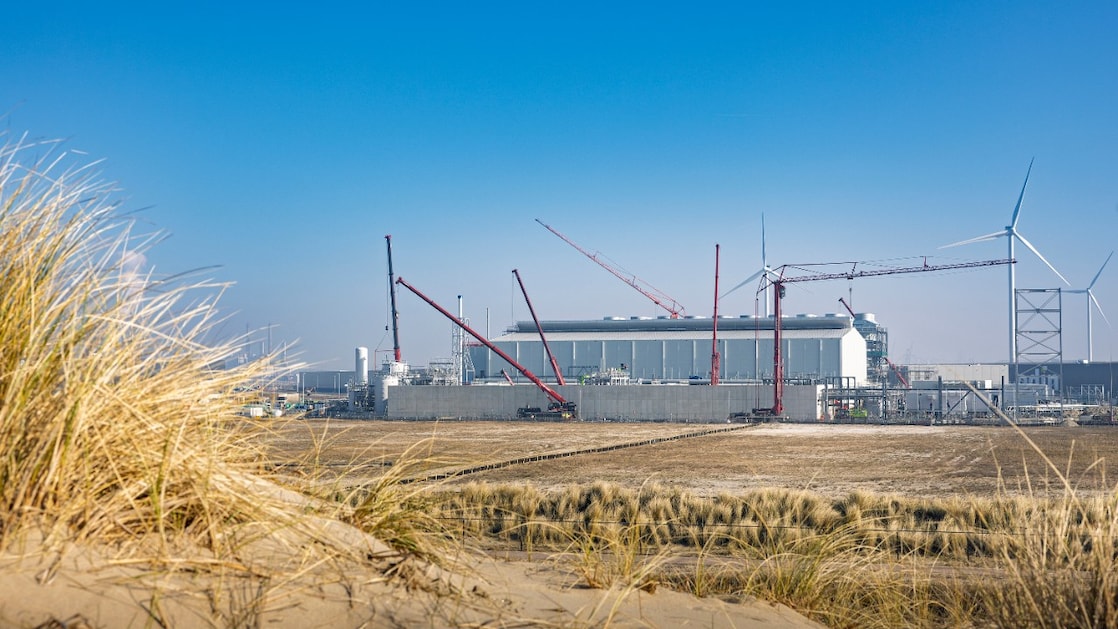
Tekst: Matthijs Timmers. Beeld: Eric van Vuuren (foto's Holland Hydrogen 1), Prya Aryabhumi (portret).
For English, click here or scroll down
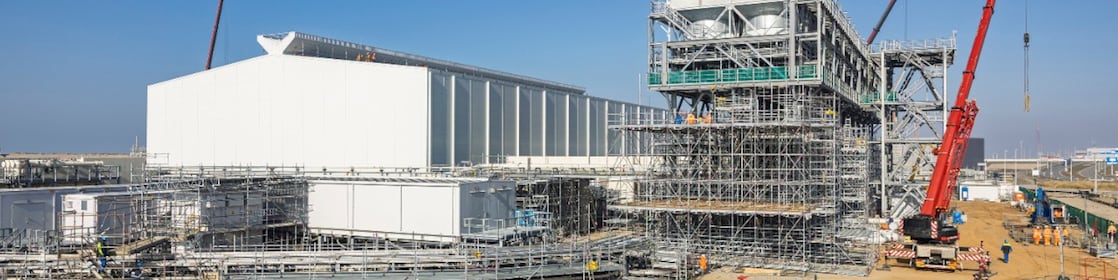
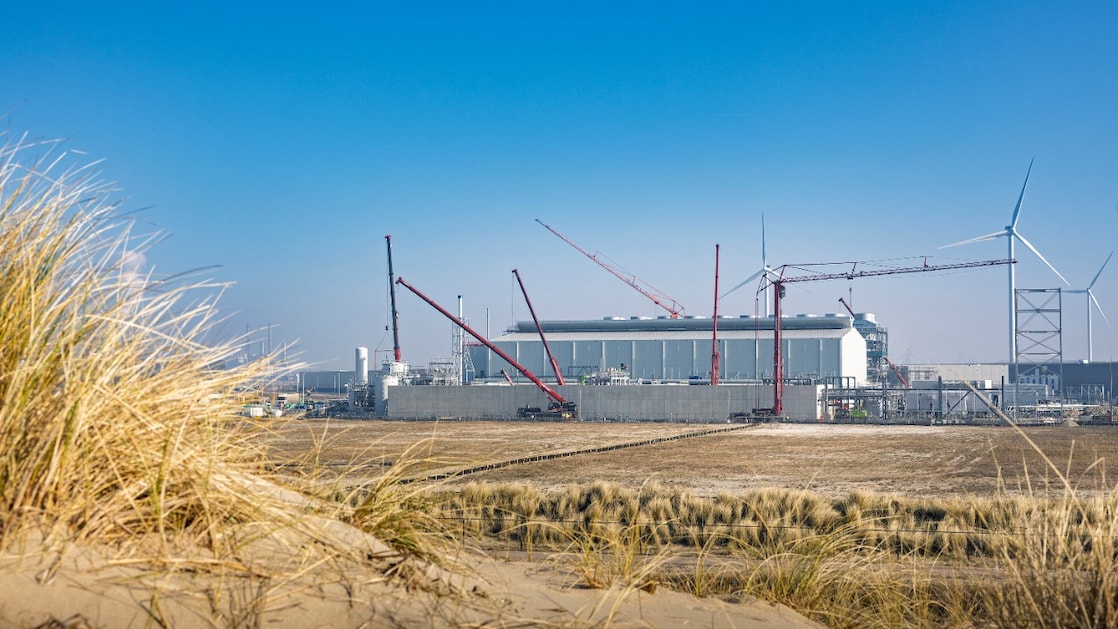
Om te beginnen: waar gaat het om? Shell bouwt op de Tweede Maasvlakte de grootste groene waterstoffabriek van Europa op dit moment: Holland Hydrogen 1. Maar om daadwerkelijk duurzame waterstof te kunnen maken, is naast water ook elektriciteit nodig. En daarmee een aansluiting op het elektriciteitsnet. De Indiase ingenieur zorgde er samen met haar collega’s én vele samenwerkingspartners voor dat deze aansluiting tot stand kwam. De eenvoudige versie: een dikke kabel vanaf de waterstoffabriek richting een 380kV-hoogspanningsstation op de Tweede Maasvlakte. Dit is een tijdelijke aansluiting. Daarover later meer.
Niet eerder van deze omvang
Het eerste wat Priya Aryabhumi te binnen schiet als ze terugblikt op de afgelopen periode is de prettige samenwerking met partners. “Zo hielp het Havenbedrijf Rotterdam ons uitstekend, met bijvoorbeeld de regelgeving en het bepalen van de route van de bekabeling door het havengebied. Ook netbeheerder Tennet is een geweldige partner, waarmee we op flexibele wijze naar de beste oplossing hebben gezocht. We hebben dit echt gezamenlijk voor elkaar gekregen.”
Betrouwbare en bekwame partners zijn voor Shell noodzakelijk in een nieuw project als dit, vindt de projectmanager: “We hebben niet eerder aan een connectie van deze omvang gebouwd. Ook zijn we niet eerder op deze manier onderdeel geweest van het elektriciteitsnet. Wat betekent dit? En hoe werkt dat precies? Om antwoord te krijgen op dit soort relevante vragen wilden we graag samenwerken met partijen die daar ervaring in hebben.”
Permanent of tijdelijk
De Shell-projectmanager raakt in het najaar van 2021 betrokken bij de ontwikkelingen rond Holland Hydrogen 1 en valt meteen met haar neus in de besprekingen met het Havenbedrijf Rotterdam, over de aansluiting van de te bouwen fabriek op het elektriciteitsnet. In eerste instantie is het plan een hoogspanningsstation te bouwen dat genoeg capaciteit biedt aan vier waterstoffabrieken die op de vier uitgegeven kavels op de Tweede Maasvlakte zijn beoogd. Holland Hydrogen 1 is de eerste die daadwerkelijk wordt gebouwd. Air Liquide maakte op 23 juli bekend dat ze het financiële eindbesluit heeft genomen om ook haar groene waterstoffabriek van 200 megawatt te gaan bouwen. De andere twee zijn niet meer dan een presentatieslide zonder beloften, in het beste geval.
Groene waterstof: stroom + water
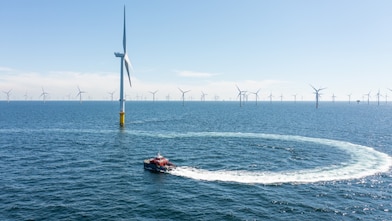
Bij Holland Hydrogen 1 gaat Shell hernieuwbare waterstof maken. Dat doen we door middel van een proces dat elektrolyse wordt genoemd. Met behulp van groene stroom, opgewekt door windpark op zee Hollandse Kust (Noord) en via de joint venture CrossWind, voor 79,9% eigendom van Shell, wordt in de tien elektrolysers van de fabriek het watermolecuul (H2O) gesplitst in zuurstof (O2) en waterstof. De fabriek zal in de toekomst gemiddeld 60.000 kilogram hernieuwbare waterstof per dag kunnen produceren.
Wachten is geen optie
Een permanente aansluiting voor vier waterstoffabrieken, op een definitieve plek, dat is uiteraard de meest ideale optie. Maar wat als de definitieve locatie voor het transformatorstation nog niet gereed is? En er nog niet genoeg andere partijen dan Shell zich hebben gemeld om een groene waterstoffabriek te bouwen en die aan te sluiten op het elektriciteitsnet? Is wachten dan een optie?
Aryabhumi schudt resoluut haar hoofd. “Voor ons was een aansluiting op het elektriciteitsnet een onmisbare schakel in het totale project. We zien waterstof als belangrijke energiedrager voor de toekomst en Holland Hydrogen 1 is een strategisch project voor Shell. Daarmee zetten we als koploper een belangrijke stap in de energietransitie. Elektriciteit is essentieel voor het produceren van waterstof, net als water. Zonder aansluiting, geen project.”
Holland Hydrogen 1 en de energietransitie
Ook in het licht van de Europese klimaatambities wil Shell vaart maken met de netaansluiting. Europa moet in 2050 klimaatneutraal zijn, als eerste continent op de wereld. Om die doelstelling te halen, is groene waterstof een van de schakels. Aryabhumi legt uit: “Op de langere termijn gaat groene waterstof een rol spelen in het verduurzamen van de mobiliteitssector. En vandaag en morgen kan groene waterstof grote uitstoters zoals de cement-, staal- en brandstoffenindustrie direct helpen om hun uitstoot terug te brengen.”
Amaliahaven
Dus komt er, met de medewerking van onder andere Tennet en het Havenbedrijf Rotterdam, de beheerder van het Rotterdamse havengebied, eind 2024 op de Tweede Maasvlakte een tijdelijke aansluiting op een 380 kV-hoogspanningsstation met een vermogen van 500 megawatt. Zodra de ruim één kilometer landinwaarts gelegen Amaliahaven helemaal is ingericht, wordt dáár de permanente aansluiting op het elektriciteitsnet gemaakt.
Niet alles is tijdelijk, benadrukt ze. “Er ligt ongeveer 5,2 kilometer kabel van de waterstoffabriek naar het station op de Tweede Maasvlakte. Deze bekabeling blijft uiteraard gewoon liggen. Het idee is om de laatste 1,2 kilometer kabel te hergebruiken richting het uiteindelijke hoogspanningsstation in de Amaliahaven, dat in 2027 klaar is. Op deze manier herbruiken we zo veel als we kunnen.”
Betaalbaarheid cruciaal
Holland Hydrogen 1, inclusief de aansluiting op het net, is meer dan alleen een proefproject, zo benadrukt de Shell-ingenieur. “Het is een project dat moet laten zien dat het mogelijk is om betaalbare groene energie te produceren.”
Ze is zich ervan bewust van het feit dat de energietransitie zich in ieder gebied in de wereld weer op een eigen manier en tempo voltrekt. In haar geboorteland India bijvoorbeeld wordt nog volop kolen gebruikt, terwijl West-Europa een andere energiemix heeft. Door haar achtergrond weet ze óók dat betaalbaarheid van groene energie een cruciale factor is. “Als we een schoon alternatief bieden, maar niemand wil of kan het betalen, dan lukt het niet. Betaalbaarheid speelt een sleutelrol, ook in dit project.”
Geen concessies aan veiligheid
“Het was zeer interessant en leerzaam om onderdeel te zijn van deze nieuwe ontwikkeling”, blikt ze terug. “Vooral omdat de verbinding bijna twee keer zo snel gerealiseerd moest worden als gebruikelijk is.”
Het is volgens de projectmanager ook interessant om een infrastructuur te ontwerpen en te bouwen die klaar moet zijn om uiteindelijk door vier elektrolyse-installaties gebruikt te worden. “Dat betekent dat je goed moet letten op de ontwerpbasis, de kosten én de veiligheid. We doen geen concessies aan onze hoge veiligheidsstandaard, ongeacht met welke partner we samenwerken. Tegelijkertijd werk ik aan de energietransitie en aan het betaalbaar maken van schone energie, wat mijn werk zeer waardevol voor me maakt."
Op naar de volgende fase
De eerste aansluiting is gemaakt, de volgende fase gaat beginnen: de voorbereidingen voor het definitieve hoogspanningsstation in de Amaliahaven. “Hopelijk werken we dan ook samen met andere partners die aan de slag gaan met de bouw van een groene waterstoffabriek, zoals wij dat nu doen. Dat kan de waterstoftransitie in de volgende versnelling zetten.”

Wie is Priya Aryabhumi?
Vishnupriya (Priya) Aryabhumi (31) studeerde aan de Indian Institute of Technology Madras en kwam na haar studie engineering in dienst bij Shell. Ze werkte als projectingenieur voor uiteenlopende projecten in onder meer in het Midden-Oosten, Brunei en Singapore. Daarna maakte ze deel uit van een wereldwijd team binnen Shell dat zich richt op het competitief op de markt brengen van projecten. Sinds 2021 is ze als projectmanager betrokken bij Holland Hydrogen 1. Hoe haar toekomst er na Holland Hydrogen 1 uitziet, weet ze nog niet. Over een aantal jaar verhuist de Indiase wellicht weer naar een ander project, elders in de wereld. Dat is het leven van een projectmanager bij Shell.
Cautionary note
Cautionary note
The companies in which Shell plc directly and indirectly owns investments are separate legal entities. In this announcement “Shell”, “Shell Group” and “Group” are sometimes used for convenience where references are made to Shell plc and its subsidiaries in general. Likewise, the words “we”, “us” and “our” are also used to refer to Shell plc and its subsidiaries in general or to those who work for them. These terms are also used where no useful purpose is served by identifying the particular entity or entities. ‘‘Subsidiaries’’, “Shell subsidiaries” and “Shell companies” as used in this announcement refer to entities over which Shell plc either directly or indirectly has control. The term “joint venture”, “joint operations”, “joint arrangements”, and “associates” may also be used to refer to a commercial arrangement in which Shell has a direct or indirect ownership interest with one or more parties. The term “Shell interest” is used for convenience to indicate the direct and/or indirect ownership interest held by Shell in an entity or unincorporated joint arrangement, after exclusion of all third-party interest.
Forward-looking Statements
This announcement contains forward-looking statements (within the meaning of the U.S. Private Securities Litigation Reform Act of 1995) concerning the financial condition, results of operations and businesses of Shell. All statements other than statements of historical fact are, or may be deemed to be, forward-looking statements. Forward-looking statements are statements of future expectations that are based on management’s current expectations and assumptions and involve known and unknown risks and uncertainties that could cause actual results, performance or events to differ materially from those expressed or implied in these statements. Forward-looking statements include, among other things, statements concerning the potential exposure of Shell to market risks and statements expressing management’s expectations, beliefs, estimates, forecasts, projections and assumptions. These forward-looking statements are identified by their use of terms and phrases such as “aim”; “ambition”; ‘‘anticipate’’; ‘‘believe’’; “commit”; “commitment”; ‘‘could’’; ‘‘estimate’’; ‘‘expect’’; ‘‘goals’’; ‘‘intend’’; ‘‘may’’; “milestones”; ‘‘objectives’’; ‘‘outlook’’; ‘‘plan’’; ‘‘probably’’; ‘‘project’’; ‘‘risks’’; “schedule”; ‘‘seek’’; ‘‘should’’; ‘‘target’’; ‘‘will’’; “would” and similar terms and phrases. There are a number of factors that could affect the future operations of Shell and could cause those results to differ materially from those expressed in the forward-looking statements included in this announcement, including (without limitation): (a) price fluctuations in crude oil and natural gas; (b) changes in demand for Shell’s products; (c) currency fluctuations; (d) drilling and production results; (e) reserves estimates; (f) loss of market share and industry competition; (g) environmental and physical risks; (h) risks associated with the identification of suitable potential acquisition properties and targets, and successful negotiation and completion of such transactions; (i) the risk of doing business in developing countries and countries subject to international sanctions; (j) legislative, judicial, fiscal and regulatory developments including regulatory measures addressing climate change; (k) economic and financial market conditions in various countries and regions; (l) political risks, including the risks of expropriation and renegotiation of the terms of contracts with governmental entities, delays or advancements in the approval of projects and delays in the reimbursement for shared costs; (m) risks associated with the impact of pandemics, such as the COVID-19 (coronavirus) outbreak, regional conflicts, such as the Russia-Ukraine war, and a significant cybersecurity breach; and (n) changes in trading conditions. No assurance is provided that future dividend payments will match or exceed previous dividend payments. All forward-looking statements contained in this announcement are expressly qualified in their entirety by the cautionary statements contained or referred to in this section. Readers should not place undue reliance on forward-looking statements. Additional risk factors that may affect future results are contained in Shell plc’s Form 20-F for the year ended December 31, 2024 (available at www.shell.com/investors/news-and-filings/sec-filings.html and www.sec.gov). These risk factors also expressly qualify all forward-looking statements contained in this announcement and should be considered by the reader. Each forward-looking statement speaks only as of the date of this announcement, July 31, 2025. Neither Shell plc nor any of its subsidiaries undertake any obligation to publicly update or revise any forward-looking statement as a result of new information, future events or other information. In light of these risks, results could differ materially from those stated, implied or inferred from the forward-looking statements contained in this announcement.
Shell’s Net Carbon Intensity
Also, in this announcement we may refer to Shell’s “Net Carbon Intensity” (NCI), which includes Shell’s carbon emissions from the production of our energy products, our suppliers’ carbon emissions in supplying energy for that production and our customers’ carbon emissions associated with their use of the energy products we sell. Shell’s NCI also includes the emissions associated with the production and use of energy products produced by others which Shell purchases for resale. Shell only controls its own emissions. The use of the terms Shell’s “Net Carbon Intensity” or NCI are for convenience only and not intended to suggest these emissions are those of Shell plc or its subsidiaries.
Shell’s net-zero emissions target
Shell’s operating plan, outlook and budgets are forecasted for a ten-year period and are updated every year. They reflect the current economic environment and what we can reasonably expect to see over the next ten years. Accordingly, they reflect our Scope 1, Scope 2 and NCI targets over the next ten years. However, Shell’s operating plans cannot reflect our 2050 net-zero emissions target, as this target is currently outside our planning period. In the future, as society moves towards net-zero emissions, we expect Shell’s operating plans to reflect this movement. However, if society is not net zero in 2050, as of today, there would be significant risk that Shell may not meet this target.
Forward-looking non-GAAP measures
This announcement may contain certain forward-looking non-GAAP measures such as cash capital expenditure and divestments. We are unable to provide a reconciliation of these forward-looking non-GAAP measures to the most comparable GAAP financial measures because certain information needed to reconcile those non-GAAP measures to the most comparable GAAP financial measures is dependent on future events some of which are outside the control of Shell, such as oil and gas prices, interest rates and exchange rates. Moreover, estimating such GAAP measures with the required precision necessary to provide a meaningful reconciliation is extremely difficult and could not be accomplished without unreasonable effort. Non-GAAP measures in respect of future periods which cannot be reconciled to the most comparable GAAP financial measure are calculated in a manner which is consistent with the accounting policies applied in Shell plc’s consolidated financial statements.
The contents of websites referred to in this announcement do not form part of this announcement.
We may have used certain terms, such as resources, in this announcement that the United States Securities and Exchange Commission (SEC) strictly prohibits us from including in our filings with the SEC. Investors are urged to consider closely the disclosure in our Form 20-F, File No 1-32575, available on the SEC website www.sec.gov
No renewable hydrogen plant without a grid connection
31 July 2025
The Holland Hydrogen 1 under construction at the North Sea coast near Rotterdam, the Netherlands, has been connected to the electricity grid. That might sound like a formality, but it is far more complex than simply plugging the plant into a power socket like at home, assures Priya Aryabhumi. As Shell’s Project Manager, she is responsible for the entire connection. “At this scale and for this purpose, it has never been done in Europe before.”

Text: Matthijs Timmers. Photography: Eric van Vuuren (Holland Hydrogen 1 photo), Prya Aryabhumi (portrait photo).
So, what is this all about? Shell is currently building the largest renewable hydrogen plant in Europe. But for this Holland Hydrogen 1 to actually produce sustainable hydrogen, we need water and power. And that means a connection to the electricity grid. As a engineer, Priya Aryabhumi works together with her colleagues and many partners to ensure that this connection was established. The simple version of this operation: connecting the hydrogen plant with a thick cable to a 380kV high-voltage power station. But this is only a temporary connection.
Never before at this scale
The first thing that comes to Aryabhumi’s mind when she looks back on the past period is the pleasant collaboration with partners. “The Port of Rotterdam Authority supported us excellently, for example with regulations and determining the cable’s route through the port area. Grid operator Tennet was also a fantastic partner, with whom we flexibly searched for the best solution. We really achieved this together.”
Reliable and competent partners are essential for Shell in a new project like this, says the project manager: “We’ve never built a connection of this scale before. Nor have we ever been part of the electricity grid in this way. What does that mean? And how does it work exactly? To get answers to these kinds of relevant questions, we wanted to collaborate with parties that have experience in this area.”
Permanent or temporary
The Shell project manager became involved in the development of the Holland Hydrogen 1 in autumn 2021. She was immediately immersed in discussions with the Port of Rotterdam Authority about connecting the planned factory to the electricity grid. Initially, the plan was to build a high-voltage station that would provide enough capacity for four hydrogen plants, intended for the four allocated plots on the Tweede Maasvlakte area, situated about 25 kilometres (16 miles) from Shell Energy and Chemicals Park Rotterdam (Pernis). The Holland Hydrogen 1 is the first plant that is being build. On 23 July, Air Liquide announced its final investment decision to build its 200-megawatt renewable hydrogen factory, but the first spade is not in the ground yet. The other two projects are, at best, just presentation slides without any commitments. For the grid connection, a temporary solution was chosen.
Renewable hydrogen: electricity + water
At Holland Hydrogen 1, Shell will produce renewable hydrogen. This is done through a process called electrolysis. Using renewable electricity generated by the offshore wind farm Hollandse Kust (Noord) and supplied via the joint venture CrossWind, which is 79.9% owned by Shell, the plant’s ten electrolyzers will split the water molecules (H₂O) into oxygen (O₂) and hydrogen (H₂). In the future, the plant will be able to produce an average of 60,000 kilograms (132,277 pounds) of renewable hydrogen per day.
Waiting is not an option
A permanent connection for four hydrogen plants at a definitive location is, of course, the ideal scenario. But what if the final projected location for the transformer station will not be ready in time? And what if not enough other parties besides Shell come forward to build their renewable hydrogen plant and connecting it to the power grid? Would waiting then be an option?
Aryabhumi shakes her head firmly. “For us, a connection to the power grid was an indispensable link in the overall project. We see hydrogen as an important energy carrier for the future, and Holland Hydrogen 1 is a strategic project for Shell. With it, we’re taking a major step forward as a frontrunner in the energy transition. Electricity is essential for producing hydrogen, just like water. Without a connection, there’s no project.”
Holland Hydrogen 1 and the energy transition
Shell wants to accelerate the grid connection considering European climate ambitions. The European Union aims to be climate-neutral by 2050 — the large chunk of the world to do so. To achieve that goal, renewable hydrogen is one of the key components. Aryabhumi explains: “In the long term, renewable hydrogen will play a role in making the mobility sector more sustainable. And today and tomorrow, renewable hydrogen can immediately help major emitters to reduce their footprint, including cement, steel, and fuel industries.”
The harbour
So, with the cooperation of Tennet and the Port of Rotterdam Authority, a temporary connection to a 380 kV high-voltage station with a capacity of 500 megawatts has been established on the Tweede Maasvlakte by the end of 2024. Once the Amalia harbour, located more than one kilometre (0.6 miles) inland, is fully developed, the permanent grid connection will be done there.
Not everything is temporary, Aryabhumi emphasizes. “There’s about 5.2 kilometres (2.2 miles; edit.) of power cable from the hydrogen plant to the power station on the Tweede Maasvlakte. That cabling will remain in place. The idea is to reuse the final 1.2 kilometres (0.75 miles; edit.) of cable for the eventual high-voltage station in Amalia harbour, which will be ready in 2027. In this way, we reuse as much as we can.”
Affordability is crucial
Holland Hydrogen 1, including the grid connection, is more than just a pilot project, the Shell engineer emphasizes. “It’s a project meant to demonstrate that it’s possible to produce affordable renewable energy.”
She is aware that the energy transition unfolds differently and at varying speeds across the world. In her home country of India, for example, coal is still widely used, while Western Europe has a different energy mix. Her background gives her insight into the importance of affordability. “If we offer a clean alternative but no one wants or can afford it, it won’t work. Affordability plays a key role, even in this project.”
No compromises on safety
“It was very interesting and educational to be part of this new development,” she reflects. “Especially because the connection had to be realised almost twice as fast as usual.”
According to the project manager, it’s also fascinating to design and build infrastructure that must eventually be ready for use by four electrolysis installations. “That means you must pay close attention to the design basis, the costs, and the safety. We make no compromises on our high safety standards, regardless of which partner we’re working with. At the same time, I’m contributing to the energy transition and making clean energy affordable, which makes my work very meaningful to me.”
On to the next phase
The first connection has been made, and the next phase is beginning: preparations for the permanent high-voltage station in Amalia harbour. “Hopefully, we’ll also be working with other partners who are starting to build green hydrogen plants, just like we are now. That could accelerate the hydrogen transition even further.”

Who is Priya Aryabhumi?
Vishnupriya (Priya) Aryabhumi (31) studied at the Indian Institute of Technology Madras and joined Shell after completing her engineering degree. She worked as a Project Engineer on various projects in the Southwest Asia (Middle East), Brunei, and Singapore. Later, she became part of a global team within Shell focused on bringing projects to market competitively. Since 2021, she has been involved as a Project Manager in Holland Hydrogen 1. What her future holds after Holland Hydrogen 1 is still uncertain. In a few years, the Indian national may move to another project elsewhere in the world. That’s the life of a project manager at Shell.
Cautionary note
Cautionary note
The companies in which Shell plc directly and indirectly owns investments are separate legal entities. In this announcement “Shell”, “Shell Group” and “Group” are sometimes used for convenience where references are made to Shell plc and its subsidiaries in general. Likewise, the words “we”, “us” and “our” are also used to refer to Shell plc and its subsidiaries in general or to those who work for them. These terms are also used where no useful purpose is served by identifying the particular entity or entities. ‘‘Subsidiaries’’, “Shell subsidiaries” and “Shell companies” as used in this announcement refer to entities over which Shell plc either directly or indirectly has control. The term “joint venture”, “joint operations”, “joint arrangements”, and “associates” may also be used to refer to a commercial arrangement in which Shell has a direct or indirect ownership interest with one or more parties. The term “Shell interest” is used for convenience to indicate the direct and/or indirect ownership interest held by Shell in an entity or unincorporated joint arrangement, after exclusion of all third-party interest.
Forward-looking Statements
This announcement contains forward-looking statements (within the meaning of the U.S. Private Securities Litigation Reform Act of 1995) concerning the financial condition, results of operations and businesses of Shell. All statements other than statements of historical fact are, or may be deemed to be, forward-looking statements. Forward-looking statements are statements of future expectations that are based on management’s current expectations and assumptions and involve known and unknown risks and uncertainties that could cause actual results, performance or events to differ materially from those expressed or implied in these statements. Forward-looking statements include, among other things, statements concerning the potential exposure of Shell to market risks and statements expressing management’s expectations, beliefs, estimates, forecasts, projections and assumptions. These forward-looking statements are identified by their use of terms and phrases such as “aim”; “ambition”; ‘‘anticipate’’; ‘‘believe’’; “commit”; “commitment”; ‘‘could’’; ‘‘estimate’’; ‘‘expect’’; ‘‘goals’’; ‘‘intend’’; ‘‘may’’; “milestones”; ‘‘objectives’’; ‘‘outlook’’; ‘‘plan’’; ‘‘probably’’; ‘‘project’’; ‘‘risks’’; “schedule”; ‘‘seek’’; ‘‘should’’; ‘‘target’’; ‘‘will’’; “would” and similar terms and phrases. There are a number of factors that could affect the future operations of Shell and could cause those results to differ materially from those expressed in the forward-looking statements included in this announcement, including (without limitation): (a) price fluctuations in crude oil and natural gas; (b) changes in demand for Shell’s products; (c) currency fluctuations; (d) drilling and production results; (e) reserves estimates; (f) loss of market share and industry competition; (g) environmental and physical risks; (h) risks associated with the identification of suitable potential acquisition properties and targets, and successful negotiation and completion of such transactions; (i) the risk of doing business in developing countries and countries subject to international sanctions; (j) legislative, judicial, fiscal and regulatory developments including regulatory measures addressing climate change; (k) economic and financial market conditions in various countries and regions; (l) political risks, including the risks of expropriation and renegotiation of the terms of contracts with governmental entities, delays or advancements in the approval of projects and delays in the reimbursement for shared costs; (m) risks associated with the impact of pandemics, such as the COVID-19 (coronavirus) outbreak, regional conflicts, such as the Russia-Ukraine war, and a significant cybersecurity breach; and (n) changes in trading conditions. No assurance is provided that future dividend payments will match or exceed previous dividend payments. All forward-looking statements contained in this announcement are expressly qualified in their entirety by the cautionary statements contained or referred to in this section. Readers should not place undue reliance on forward-looking statements. Additional risk factors that may affect future results are contained in Shell plc’s Form 20-F for the year ended December 31, 2024 (available at www.shell.com/investors/news-and-filings/sec-filings.html and www.sec.gov). These risk factors also expressly qualify all forward-looking statements contained in this announcement and should be considered by the reader. Each forward-looking statement speaks only as of the date of this announcement, July 31, 2025. Neither Shell plc nor any of its subsidiaries undertake any obligation to publicly update or revise any forward-looking statement as a result of new information, future events or other information. In light of these risks, results could differ materially from those stated, implied or inferred from the forward-looking statements contained in this announcement.
Shell’s Net Carbon Intensity
Also, in this announcement we may refer to Shell’s “Net Carbon Intensity” (NCI), which includes Shell’s carbon emissions from the production of our energy products, our suppliers’ carbon emissions in supplying energy for that production and our customers’ carbon emissions associated with their use of the energy products we sell. Shell’s NCI also includes the emissions associated with the production and use of energy products produced by others which Shell purchases for resale. Shell only controls its own emissions. The use of the terms Shell’s “Net Carbon Intensity” or NCI are for convenience only and not intended to suggest these emissions are those of Shell plc or its subsidiaries.
Shell’s net-zero emissions target
Shell’s operating plan, outlook and budgets are forecasted for a ten-year period and are updated every year. They reflect the current economic environment and what we can reasonably expect to see over the next ten years. Accordingly, they reflect our Scope 1, Scope 2 and NCI targets over the next ten years. However, Shell’s operating plans cannot reflect our 2050 net-zero emissions target, as this target is currently outside our planning period. In the future, as society moves towards net-zero emissions, we expect Shell’s operating plans to reflect this movement. However, if society is not net zero in 2050, as of today, there would be significant risk that Shell may not meet this target.
Forward-looking non-GAAP measures
This announcement may contain certain forward-looking non-GAAP measures such as cash capital expenditure and divestments. We are unable to provide a reconciliation of these forward-looking non-GAAP measures to the most comparable GAAP financial measures because certain information needed to reconcile those non-GAAP measures to the most comparable GAAP financial measures is dependent on future events some of which are outside the control of Shell, such as oil and gas prices, interest rates and exchange rates. Moreover, estimating such GAAP measures with the required precision necessary to provide a meaningful reconciliation is extremely difficult and could not be accomplished without unreasonable effort. Non-GAAP measures in respect of future periods which cannot be reconciled to the most comparable GAAP financial measure are calculated in a manner which is consistent with the accounting policies applied in Shell plc’s consolidated financial statements.
The contents of websites referred to in this announcement do not form part of this announcement.
We may have used certain terms, such as resources, in this announcement that the United States Securities and Exchange Commission (SEC) strictly prohibits us from including in our filings with the SEC. Investors are urged to consider closely the disclosure in our Form 20-F, File No 1-32575, available on the SEC website www.sec.gov