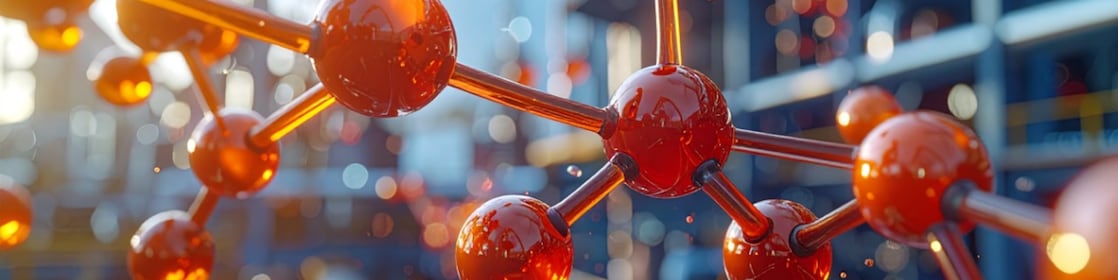
What is cracking?
There are all sorts of things you can crack. Codes, for example. Cryptocurrencies. Tough problems. And, of course, the odd tough nut. But cracking has another meaning in oil refining and the chemicals industry.

Text: Matthijs Timmers. Image: AI-generated using Adobe Firefly.
At a glance
- Cracking breaks down heavy hydrocarbons from crude oil into smaller, lighter molecules that can be used to make products including higher-value fuels, basic chemicals and plastics.
- There are several ways to crack oil, including steam cracking at temperatures above 800°C (1,472°F) and catalytic cracking, which uses a catalyst at temperatures above 500°C (932°F).
- Plastic waste can also be used as feedstock for cracking. Pyrolysis converts difficult-to-recycle plastic into oil, which can then be further treated and used to produce new plastics.
So, what exactly is cracking?
Cracking is one of the processes used to turn crude oil into products such as petrol or the basic building blocks for all kinds of plastics. To understand how it works, we need to dip briefly into the world of chemistry. Time to get the grey matter working. Don’t worry, we won’t go too far.
When crude oil comes out of the ground, it is usually a thick, black, viscous liquid. Zoom in to the molecular level and it is a mixture of hydrocarbons, some of them made up of long, heavy molecules. Through a chemical process, these molecules can be broken down into shorter, lighter ones. These lighter molecules are better suited to producing higher-value fuels and chemicals.
So is crude oil cracked as soon as it comes out of the ground?
No, not straight away. Simply heating crude oil already provides the first stage of separation. This process is called distillation. No chemical reaction takes place during distillation, so the molecules themselves do not change. Instead, the different boiling points of the components are used to separate the oil into fractions, including fuel oil for ships, kerosene, naphtha, petrol and gases. But there is much more that can be done with the oil after that. And that is where cracking comes in.
How exactly does cracking work?
There are several different cracking technologies. The first is steam cracking. In a cracking plant, or cracker, furnaces heat feedstocks such as naphtha to temperatures of more than 800°C (1,472°F), far hotter than during distillation. The combination of extremely high temperatures and a very short heating time triggers chemical reactions that break large hydrocarbon molecules into smaller ones. This type of cracking is used mainly to produce basic chemicals. Shell Moerdijk, for example, operates this type of cracker.
Another method is catalytic cracking. This uses a catalyst to speed up chemical reactions that convert heavy hydrocarbon molecules into smaller ones. Temperatures do not need to be as high as in a steam cracker, although they still exceed 500°C (500°F). This type of cracker mainly produces components used in petrol and LPG. The Shell Pernis refinery is home to such an installation.
It may have a simple name, but it sounds like a sophisticated piece of kit
It certainly is. A cracker is a finely tuned piece of engineering. It has to be: both temperature and the length of time the feedstock is heated need to be carefully controlled. There are also major differences between steam crackers and catalytic crackers. A steam cracker uses furnaces to generate the heat required for cracking, while a catalytic cracker relies on a system built around the catalyst.
At Shell Moerdijk, the furnaces in the cracker were recently replaced, reducing the site’s CO₂ emissions by around 10%. A further 10% reduction was achieved by replacing two steam turbines with electric drives.
Can you crack anything other than oil?
Yes. These days, plastic waste can also be used, including difficult-to-recycle materials from packaging, mattresses and car dashboards. The waste is first converted into pyrolysis oil. At Shell Moerdijk, a new plant then treats this oil so that it can be used as feedstock for the cracker. This means plastic waste can be turned into feedstock for making new plastic.
There are still relatively few facilities of this kind around the world, however. And before the technology can be deployed at much greater scale, there are still plenty of tough nuts to crack.
Cautionary note
Cautionary note
The companies in which Shell plc directly and indirectly owns investments are separate legal entities. In this publication “Shell”, “Shell Group” and “Group” are sometimes used for convenience to reference Shell plc and its subsidiaries in general. Likewise, the words “we”, “us” and “our” are also used to refer to Shell plc and its subsidiaries in general or to those who work for them. These terms are also used where no useful purpose is served by identifying the particular entity or entities. ‘‘Subsidiaries’’, “Shell subsidiaries” and “Shell companies” as used in this publication refer to entities over which Shell plc either directly or indirectly has control. The terms “joint venture”, “joint operations”, “joint arrangements”, and “associates” may also be used to refer to a commercial arrangement in which Shell has a direct or indirect ownership interest with one or more parties. The term “Shell interest” is used for convenience to indicate the direct and/or indirect ownership interest held by Shell in an entity or unincorporated joint arrangement, after exclusion of all third-party interest.
Forward-Looking statements
This publication contains forward-looking statements (within the meaning of the U.S. Private Securities Litigation Reform Act of 1995) concerning the financial condition, results of operations and businesses of Shell. All statements other than statements of historical fact are, or may be deemed to be, forward-looking statements. Forward-looking statements are statements of future expectations that are based on management’s current expectations and assumptions, including (without limitation) those concerning Shell’s strategy and operating plans, macroeconomic conditions, future energy demand, supply and product mix, commodity prices, demand for Shell’s products, production results and reserve estimates, development, execution and management of projects, energy transition and climate change, management of safety and environmental risks, costs, cash capital expenditures, technology advancements, legislative, judicial, fiscal and regulatory developments, regional conflicts and trading conditions, and involve known and unknown risks and uncertainties that could cause actual results, performance or events to differ materially from those expressed or implied in these statements. Forward-looking statements include, among other things, statements concerning the potential exposure of Shell to market risks and statements expressing management’s expectations, beliefs, estimates, forecasts, projections and assumptions. These forward-looking statements are identified by their use of terms and phrases such as “aim”; “ambition”; ‘‘anticipate’’; “aspire”, “aspiration”, ‘‘believe’’; “commit”; “commitment”; ‘‘could’’; “desire”; ‘‘estimate’’; ‘‘expect’’; ‘‘goals’’; ‘‘intend’’; ‘‘may’’; “milestones”; ‘‘objectives’’; ‘‘outlook’’; ‘‘plan’’; ‘‘probably’’; ‘‘project’’; ‘‘risks’’; “schedule”; ‘‘seek’’; ‘‘should’’; ‘‘target’’; “vision”; ‘‘will’’; “would” and similar terms and phrases. There are a number of factors that could affect the future operations of Shell and could cause those results to differ materially from those expressed in the forward-looking statements included in this publication, including (without limitation): (a) price fluctuations in crude oil and natural gas; (b) changes in demand for Shell’s products; (c) currency fluctuations; (d) drilling and production results; (e) reserves estimates; (f) loss of market share and industry competition; (g) environmental and physical risks, including climate change; (h) risks associated with the identification of suitable potential acquisition properties and targets, and successful negotiation and completion of such transactions; (i) the risk of doing business in developing countries and countries subject to international sanctions; (j) legislative, judicial, fiscal and regulatory developments including tariffs and regulatory measures addressing climate change; (k) economic and financial market conditions in various countries and regions; (l) political risks, including the risks of expropriation and renegotiation of the terms of contracts with governmental entities, delays or advancements in the approval of projects and delays in the reimbursement for shared costs; (m) risks associated with the impact of pandemics, regional conflicts, such as the Russia-Ukraine war and the conflict in the Middle East, and a significant cyber security, data privacy or IT incident; (n) the pace of the energy transition; and (o) changes in trading conditions. No assurance is provided that future dividend payments will match or exceed previous dividend payments. All forward-looking statements contained in this publication are expressly qualified in their entirety by the cautionary statements contained or referred to in this section. Readers should not place undue reliance on forward-looking statements. Additional risk factors that may affect future results are contained in Shell plc’s Form 20-F for the year ended December 31, 2025 (available at www.shell.com/investors/news-and-filings/sec-filings.html and www.sec.gov). These risk factors also expressly qualify all forward-looking statements contained in this publication and should be considered by the reader. Each forward-looking statement speaks only as of the date of this publication, November 26, 2026. Neither Shell plc nor any of its subsidiaries undertake any obligation to publicly update or revise any forward-looking statement as a result of new information, future events or other information. In light of these risks, results could differ materially from those stated, implied or inferred from the forward-looking statements contained in this publication.
Shell’s net carbon intensity and net-zero emissions target
In this publication we may refer to Shell’s “net carbon intensity” (NCI), which includes Shell’s carbon emissions from the production of our energy products, our suppliers’ carbon emissions in supplying energy for that production and our customers’ carbon emissions associated with their use of the energy products we sell. Shell’s NCI also includes the emissions associated with the production and use of energy products produced by others which Shell purchases for resale. Shell only controls its own emissions. The use of the terms Shell’s “net carbon intensity” or NCI is for convenience only and not intended to suggest these emissions are those of Shell plc or its subsidiaries.
Shell’s operating plan and outlook are forecasted for a three-year period and ten-year period, respectively, and are updated every year. They reflect the current economic environment and what we can reasonably expect to see over the next three and ten years. Accordingly, the outlook reflects our combined Scope 1 and 2 target, NCI target and our oil products ambition over the next ten years. However, Shell’s operating plan and outlook cannot reflect our 2050 net-zero emissions target, as this target is outside our planning period. Such future operating plans and outlooks could include changes to our portfolio, efficiency improvements and the use of carbon capture and storage and carbon credits. In the future, as society moves towards net-zero emissions, we expect Shell’s operating plans and outlooks to reflect this movement. However, if society is not net zero in 2050, as of today, there would be significant risk that Shell may not meet this target.
The information provided above regarding Shell’s NCI and net zero emissions target are not intended, nor should they be construed as introducing, suggesting or making any claim, target or representation thereof other than what is included in the publicaiton..
Forward-Looking non-GAAP measures
This publication may contain certain forward-looking non-GAAP measures such as free cash flow and underlying operating expenses. We are unable to provide a reconciliation of these forward-looking non-GAAP measures to the most comparable GAAP financial measures because certain information needed to reconcile those non-GAAP measures to the most comparable GAAP financial measures is dependent on future events some of which are outside the control of Shell, such as oil and gas prices, interest rates and exchange rates. Moreover, estimating such GAAP measures with the required precision necessary to provide a meaningful reconciliation is extremely difficult and could not be accomplished without unreasonable effort. Non-GAAP measures in respect of future periods which cannot be reconciled to the most comparable GAAP financial measure are calculated in a manner which is consistent with the accounting policies applied in Shell plc’s consolidated financial statements. These forward-looking non-GAAP measures are provided to assist readers in understanding management’s use and expectations of such measures and may not be appropriate for other purposes.
The contents of websites referred to in this publication do not form part of this publication.
We may have used certain terms, such as resources, in this publication that the United States Securities and Exchange Commission (SEC) strictly prohibits us from including in our filings with the SEC. Investors are urged to consider closely the disclosure in our Form 20-F, File No 1-32575, available on the SEC website www.sec.gov.