
Wetenschappelijke samenwerkingen met Nederlandse universiteiten en kennisinstituten
Op deze pagina vind je een overzicht van de kennisuitwisselingen en samenwerkingsverbanden tussen Shell Nederland en Nederlandse universiteiten en kennisinstellingen. Die variëren van het gezamenlijk onderzoek doen en medefinanciering van leerstoelen, tot het begeleiden van PhD-studenten en sponsoring van projecten.

Update van eerdere publicaties van 28 augustus 2023 en 8 maart 2024
Nederland loopt voorop met innovatie, zowel in Europa als wereldwijd. Volgens het Nederlands kabinet is ons kennisniveau van wereldklasse, maar niet de impact die dit heeft op de samenleving. Dat laatste komt doordat de samenwerking tussen onderzoekers, ondernemers en maatschappelijke organisaties nog beter kan. Het kabinet wil die samenwerking dan ook versterken.
Bij Shell werken mensen met kennis en technieken die kunnen bijdragen aan de omschakeling van fossiele energie naar schonere energie. Shell steunt de doelen van het akkoord van Parijs en is van mening dat die sneller en beter worden gehaald als het bedrijfsleven en de academische wereld samenwerken.
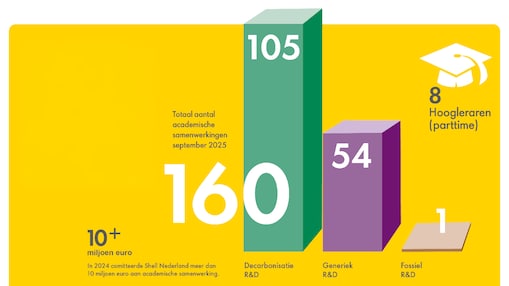
Ons uitgangspunt voor samenwerking is kennisdeling voor de energie van vandaag, van morgen en voor de toekomst. Uit ons ons meest actuele overzicht blijkt dat 98,8% van de projecten waar Shell Nederland bij betrokken is zich richt op duurzame energie, volledig circulaire chemie of generiek onderzoek dat van toepassing is op zowel het huidige of het toekomstige energiesysteem. Aan het begin van het academisch jaar in september 2025, was er nog slechts één project over met een puur fossiele toepassing. Namelijk voor het schoonmaken van het water in oliezanden.
Principes voor samenwerking met Nederlandse universiteiten
Er is veel gezegd en geschreven over de samenwerking tussen energiebedrijven zoals Shell en universiteiten. Het is belangrijk dat we met elkaar in gesprek blijven en kijken hoe we samenwerkingen nu, en in de toekomst vormgeven. Voor Shell zijn de volgende drie principes leidend voor samenwerkingen met Nederlandse universiteiten:
- Academische onafhankelijkheid: Wij onderschrijven de Nederlandse gedragscode wetenschappelijke integriteit | NWO in alle onderzoeksprojecten.
- Onderzoek naar duurzame oplossingen: Alle onderzoekssamenwerkingen van Shell Nederland en Nederlandse universiteiten zullen zich richten op kennis of oplossingen die bijdragen aan de energietransitie. Dat betekent dat Shell Nederland geen nieuwe onderzoekssamenwerkingen zal starten die zich alleen richten op fossiele energie. De twee lopende fossiele energie onderzoekssamenwerkingen zullen niet worden hernieuwd.
- Transparantie: Onderzoekssamenwerkingen zijn dynamisch. Daarom zullen we een regelmatig een overzicht van onze samenwerkingen delen zodat het duidelijk is waar we aan werken.
Shell onderschrijft het Nederlandse Klimaatakkoord en de doelen van het Klimaatakkoord van Parijs. We hebben ons tot doel gesteld om uiterlijk in 2050 een energiebedrijf te zijn met netto nul uitstoot, zoals te lezen is in ons Shell Annual report and accounts 2024 (PDF) en blijkt uit onze strategie, onze missie en ons doel.
Over ons overzicht
Onze samenwerkingen met de universiteiten zijn verdeeld in drie categorieën: Decarbonisatie, Generiek en Fossiel. In totaal zijn er – vastgesteld op 4 september 2025 – 160 samenwerkingsverbanden op academisch onderzoeksniveau. 105 van de samenwerkingen zijn direct gelieerd aan decarbonisatie, 54 aan generieke onderwerpen en één heeft een puur fossiele toepassing.
In vergelijking met de lijst gepubliceerd op 28 augustus 2023 staan er meer samenwerkingen in ons overzicht. Toen hadden we er 137. (PDF, 711 kB) In vergelijking met de lijst van februari 2024 (PDF, 980 kB), is het aantal samenwerkingen met zeven afgenomen. Deels is er een natuurlijk verloop van projecten die zijn afgerond, en/of zijn opgestart.
De lijst bevat samenwerkingen op academisch/onderzoeksniveau, inclusief de cofinanciering van acht (deeltijd)hoogleraren. De lijst bevat geen overzicht van contacten die zich buiten de onderzoekssfeer bevinden, zoals informatiebijeenkomsten voor studentenverenigingen of overleg met universiteitsbesturen. De lijst is dynamisch en zal regelmatig worden bijgewerkt. Mocht je iets missen in de lijst, stellen we het zeer op prijs als je ons dit laat weten via een e-mail.
Shells decarbonisatie-onderzoek in Nederland
In lijn met de criteria die we hanteren voor ons jaarlijkse Sustainability Report en ons Energy Transition Progress Report gebruiken we de term Decarbonisatie voor alle samenwerkingen die tot doel hebben de CO2-uitstoot van Shell en onze klanten te verkleinen. Het gaat om projecten en samenwerkingen die direct de omschakeling van traditionele gas en olie naar duurzamere vormen van energie ondersteunen of de omschakeling naar volledig circulaire chemie (volledig duurzaam hergebruik van chemische bestanddelen van onder meer plastic).
Vaak is uit de naam van een decarbonisatie-samenwerking het doel al te herleiden. Neem het BatteryNL-project dat onder meer Shell samen met de universiteiten van Delft, Twente, Groningen, Utrecht, Eindhoven en anderen doet. Het gaat hier om het bedenken en maken van de volgende generatie batterijen voor elektrische auto’s en andere toepassingen. Doel is om ze nog veiliger te maken, en de levensduur te verlengen.
Shells generiek onderzoek in Nederland
Generiek: 54 projecten over generiek onderzoek zoals kunstmatige intelligentie of nieuwe scheidingstechnieken die gebruikt kunnen worden voor het zuiveren van afvalwater in de productie van biobrandstoffen of olie, maar ook voor het scheiden van CO2 van biogas of het beter kunnen produceren van plastic. Een ander voorbeeld van generiek onderzoek is het AquaConnect-project, waarbij we samen met universiteiten, overheid en bedrijven onderzoek doen naar het hergebruik van water. Onder generiek onderzoek vallen vaak ook de leerstoelen die we meefinancieren, zoals de Co-Research Chair Fluid flow bij de TU Delft
Shells fossiel onderzoek vanuit Nederland
Op 4 september 2025 was er nog één lopende onderzoeksproject van Shell Nederland dat zich richt op fossiele energie. Het gaat om kennisuitwisseling en organisatorische ondersteuning voor een PhD-studie naar het opschonen van oliezanden. De PhD wordt uitgevoerd onder auspiciën van de leerstoel Faculteit Wetenschappen en Technologie (TNW), Anorganische membranen (IM), die Shell meefinancieert. Voor de PhD-studie van één Shell-onderzoeker naar het opschonen van oliezanden is geen geldstroom tussen Shell en de Universiteit Twente. Het project wordt uiterlijk op 31 december 2025 afgesloten.
Ook universiteiten publiceren hun overzicht
De lijst van samenwerkingen van Shell Nederland en de universiteiten is onze lijst, op basis van de gegevens uit onze systemen. Onderzoekssamenwerkingen zijn dynamisch. Daarom zullen we regelmatig het overzicht van al onze samenwerkingen met de Nederlandse universiteiten en kennisinstituten bijwerken.
Cautionary note
Cautionary note
The companies in which Shell plc directly and indirectly owns investments are separate legal entities. In this announcement “Shell”, “Shell Group” and “Group” are sometimes used for convenience where references are made to Shell plc and its subsidiaries in general. Likewise, the words “we”, “us” and “our” are also used to refer to Shell plc and its subsidiaries in general or to those who work for them. These terms are also used where no useful purpose is served by identifying the particular entity or entities. ‘‘Subsidiaries’’, “Shell subsidiaries” and “Shell companies” as used in this announcement refer to entities over which Shell plc either directly or indirectly has control. The term “joint venture”, “joint operations”, “joint arrangements”, and “associates” may also be used to refer to a commercial arrangement in which Shell has a direct or indirect ownership interest with one or more parties. The term “Shell interest” is used for convenience to indicate the direct and/or indirect ownership interest held by Shell in an entity or unincorporated joint arrangement, after exclusion of all third-party interest.
Forward-looking Statements
This announcement contains forward-looking statements (within the meaning of the U.S. Private Securities Litigation Reform Act of 1995) concerning the financial condition, results of operations and businesses of Shell. All statements other than statements of historical fact are, or may be deemed to be, forward-looking statements. Forward-looking statements are statements of future expectations that are based on management’s current expectations and assumptions and involve known and unknown risks and uncertainties that could cause actual results, performance or events to differ materially from those expressed or implied in these statements. Forward-looking statements include, among other things, statements concerning the potential exposure of Shell to market risks and statements expressing management’s expectations, beliefs, estimates, forecasts, projections and assumptions. These forward-looking statements are identified by their use of terms and phrases such as “aim”; “ambition”; ‘‘anticipate’’; ‘‘believe’’; “commit”; “commitment”; ‘‘could’’; ‘‘estimate’’; ‘‘expect’’; ‘‘goals’’; ‘‘intend’’; ‘‘may’’; “milestones”; ‘‘objectives’’; ‘‘outlook’’; ‘‘plan’’; ‘‘probably’’; ‘‘project’’; ‘‘risks’’; “schedule”; ‘‘seek’’; ‘‘should’’; ‘‘target’’; ‘‘will’’; “would” and similar terms and phrases. There are a number of factors that could affect the future operations of Shell and could cause those results to differ materially from those expressed in the forward-looking statements included in this announcement, including (without limitation): (a) price fluctuations in crude oil and natural gas; (b) changes in demand for Shell’s products; (c) currency fluctuations; (d) drilling and production results; (e) reserves estimates; (f) loss of market share and industry competition; (g) environmental and physical risks; (h) risks associated with the identification of suitable potential acquisition properties and targets, and successful negotiation and completion of such transactions; (i) the risk of doing business in developing countries and countries subject to international sanctions; (j) legislative, judicial, fiscal and regulatory developments including regulatory measures addressing climate change; (k) economic and financial market conditions in various countries and regions; (l) political risks, including the risks of expropriation and renegotiation of the terms of contracts with governmental entities, delays or advancements in the approval of projects and delays in the reimbursement for shared costs; (m) risks associated with the impact of pandemics, such as the COVID-19 (coronavirus) outbreak, regional conflicts, such as the Russia-Ukraine war, and a significant cybersecurity breach; and (n) changes in trading conditions. No assurance is provided that future dividend payments will match or exceed previous dividend payments. All forward-looking statements contained in this announcement are expressly qualified in their entirety by the cautionary statements contained or referred to in this section. Readers should not place undue reliance on forward-looking statements. Additional risk factors that may affect future results are contained in Shell plc’s Form 20-F for the year ended December 31, 2024 (available at www.shell.com/investors/news-and-filings/sec-filings.html and www.sec.gov). These risk factors also expressly qualify all forward-looking statements contained in this announcement and should be considered by the reader. Each forward-looking statement speaks only as of the date of this announcement, November 3, 2025. Neither Shell plc nor any of its subsidiaries undertake any obligation to publicly update or revise any forward-looking statement as a result of new information, future events or other information. In light of these risks, results could differ materially from those stated, implied or inferred from the forward-looking statements contained in this announcement.
Shell’s Net Carbon Intensity
Also, in this announcement we may refer to Shell’s “Net Carbon Intensity” (NCI), which includes Shell’s carbon emissions from the production of our energy products, our suppliers’ carbon emissions in supplying energy for that production and our customers’ carbon emissions associated with their use of the energy products we sell. Shell’s NCI also includes the emissions associated with the production and use of energy products produced by others which Shell purchases for resale. Shell only controls its own emissions. The use of the terms Shell’s “Net Carbon Intensity” or NCI are for convenience only and not intended to suggest these emissions are those of Shell plc or its subsidiaries.
Shell’s net-zero emissions target
Shell’s operating plan, outlook and budgets are forecasted for a ten-year period and are updated every year. They reflect the current economic environment and what we can reasonably expect to see over the next ten years. Accordingly, they reflect our Scope 1, Scope 2 and NCI targets over the next ten years. However, Shell’s operating plans cannot reflect our 2050 net-zero emissions target, as this target is currently outside our planning period. In the future, as society moves towards net-zero emissions, we expect Shell’s operating plans to reflect this movement. However, if society is not net zero in 2050, as of today, there would be significant risk that Shell may not meet this target.
Forward-looking non-GAAP measures
This announcement may contain certain forward-looking non-GAAP measures such as cash capital expenditure and divestments. We are unable to provide a reconciliation of these forward-looking non-GAAP measures to the most comparable GAAP financial measures because certain information needed to reconcile those non-GAAP measures to the most comparable GAAP financial measures is dependent on future events some of which are outside the control of Shell, such as oil and gas prices, interest rates and exchange rates. Moreover, estimating such GAAP measures with the required precision necessary to provide a meaningful reconciliation is extremely difficult and could not be accomplished without unreasonable effort. Non-GAAP measures in respect of future periods which cannot be reconciled to the most comparable GAAP financial measure are calculated in a manner which is consistent with the accounting policies applied in Shell plc’s consolidated financial statements.
The contents of websites referred to in this announcement do not form part of this announcement.
We may have used certain terms, such as resources, in this announcement that the United States Securities and Exchange Commission (SEC) strictly prohibits us from including in our filings with the SEC. Investors are urged to consider closely the disclosure in our Form 20-F, File No 1-32575, available on the SEC website www.sec.gov