Nu beschikbaar: Shell BioLNG voor wegtransport
English translation below
Vanaf dinsdag 15 februari kunnen klanten Shell BioLNG tanken en daarmee is Shell de eerste in Nederland die bio-LNG aan al haar klanten aanbiedt. De komende periode zal de bio-LNG in het Nederlands LNG-netwerk van Shell worden bijgemengd, waarmee wegtransporteurs circa 30% vermindering in de CO2-uitstoot bereiken. De komende jaren heeft Shell de ambitie om de productie op te schalen naar volledig zuivere bio-LNG.
Marjan van Loon, president-directeur Shell Nederland: “Shell wil met partners de logistieke sector een schoner alternatief bieden. Dit is een mooie stap in schoner wegtransport.”
Bio-LNG is een belangrijke stap in het verduurzamen van zwaar wegtransport, gevolgd door het binnenvaarttransport. Elektrificatie is op korte termijn lastig in deze sectoren en bio-LNG biedt dan als transitiebrandstof uitkomst. Shell levert bio-LNG in Nederland vanuit de installatie die het samen met partners Nordsol en Renewi in de herfst van 2021 in Amsterdam opende. Daar zal op termijn naar schatting 3,4 kiloton bio-LNG worden geproduceerd, waarmee een CO₂-uitstoot vergelijkbaar met die van 13 miljoen wegkilometers wordt voorkomen.
Shell heeft 46 LNG-stations in Europa, met de ambitie het Europese netwerken tot eind 2022 uit te bouwen tot 80 locaties. Er zijn op dit moment 7 LNG-tankstations in Nederland, 25 in Duitsland en verder zijn er LNG-stations in België (6), Polen (4), Frankrijk (2), Spanje (1) en Turkije (1). Medio 2023 verwacht Shell 100% BioLNG te kunnen leveren aan het gehele netwerk in zowel Duitsland als Nederland, mede dankzij de start begin februari van de bouw van Europa’s grootste BioLNG-productieinstallatie in het Duitse Godorf. Shell loopt daarmee voor op de concurrentie.
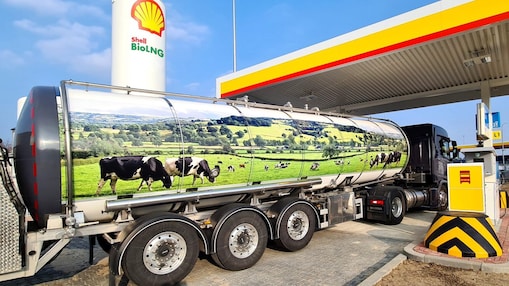
Shell BioLNG is vloeibaar gas uit organisch afval, denk aan landbouwresten, etensresten en voedsel waarvan de houdbaarheidsdatum is verstreken. Het kan in bestaande LNG-motoren en -tankstations worden gebruikt, zonder dat er aanpassingen nodig zijn.
In principe kunnen, bijvoorbeeld, supermarkten circulair opereren door hun winkels te bevoorraden met vrachtwagens die rijden op het eigen organische afval, van onder meer producten die over de datum zijn.
Hoe wordt Shell BioLNG gemaakt?
Bio-LNG is vloeibaar gemaakt gas. In een vergister wordt het organisch afval door bacteriën afgebroken, in zuurstofloze omstandigheden (an-aerobisch). Biogas bestaat voor 30% tot 45% uit CO₂, waterstofsulfide en andere componenten die worden verwijderd, waarna het gas wordt opgewaardeerd naar hoge kwaliteit biomethaan die vloeibaar wordt gemaakt door het af te koelen naar -162 graden Celsius.
Disclaimer
Disclaimer
Shell BioLNG bespaart circa 30% CO₂e*
- De CO₂e-besparing is berekend op basis van well-to-wheel en in vergelijking met fossiele diesel en wordt gewaarborgd door de optimalisatie van de blend van bio-LNG die aan het Nederlandse Shell LNG-netwerk wordt aangeboden.
- Shell rapporteert haar emissies in overeenstemming met ISO 14064–1:2006 – Specificatie met richtlijnen op organisatieniveau voor kwantificering en rapportage van broeikasgasemissies en -verwijderingen ('ISO 14064-1'); en het Greenhouse Gas Protocol van het World Resources Institute/World Business Council for Sustainable Development (WRI/WBCSD). CO₂e (CO₂-equivalent) verwijst naar CO₂, CH4, N₂O.
- Well-to-wheel-berekening: gasproductie, verwerking (zuivering + liquefactie), transport, distributie en gebruik op basis van koolstofintensiteitsfactoren (CI) die worden gebruikt in onze berekeningen in gr CO₂e / MJ: Fossiele brandstof Diesel 94 (REDII), Fossiele LNG 76.6 (NGVA), BioLNG CI kunnen variëren, omdat het afkomstig is van een verscheidenheid aan grondstoffen (overeenkomstig REDII-vereisten en ISSC-geaccrediteerd). Er wordt een kwartaalgemiddelde berekend om zeker te stellen dat 30% CO₂e-reductie kan worden gewaarborgd.
English translation
Available now: Shell BioLNG for road transport
Shell BioLNG will be available to customers in the Netherlands from Tuesday, 15 February, as a blend with regular LNG. Hereby Shell becomes the first in the Netherlands to offer bio-LNG to all of its customers, giving its customers reduction of CO2 emissions by approximately 30%. After gearing up production Shell plans to offer pure bio-LNG to its entire LNG network in the Netherlands within a few years.
Marjan van Loon, President-Director of Shell Netherlands: "Shell wants to offer the logistics sector a cleaner alternative, with partners. This is a great step towards cleaner road transport."
Bio-LNG is an important ingredient to make heavy-duty road transport, followed by inland waterway transport, more sustainable. Electrification is a challenge in these sectors in the short term and bio-LNG offers a solution as a transition fuel. In the Netherlands, Shell is supplying bio-LNG from its plant that opened in Amsterdam last autumn with partners Nordsol and Renewi. In due course, an estimated 3.4 kilotons of bio-LNG will be produced at the plant, preventing CO₂ emissions equivalent of 13 million kilometres (8 million miles) travelled on the road.
Shell has 46 LNG stations in Europe, with the ambition to expand the European network to 80 locations by the end of 2022. There are currently 7 LNG filling stations in the Netherlands and 25 in Germany. Other Shell LNG stations are in Belgium (6), Poland (4), France (2), Spain (1) and Turkey (1). By mid-2023, Shell expects to be able to supply 100% BioLNG to its entire network in both Germany and the Netherlands, partly thanks to construction of Europe's largest BioLNG production plant in Godorf, Germany, which started in early February.
Shell BioLNG is liquefied gas from organic waste, such as agricultural waste, food scraps and food products over their expiry date. It can be used in existing LNG engines and filling stations, without any need for modifications.
Bio-LNG, in principle, can help drive circularity. For example, supermarkets can operate in a circular manner by using trucks fuelled by their own organic waste, including the food products they can no longer sell.
What is Shell BioLNG?
Bio-LNG is a liquefied gas. Biogas is emitted when anaerobic digestion of organic waste takes place. Biogas consists of 30%-45% CO₂, hydrogen sulphide and other components that are removed, after which the gas is upgraded to high quality biomethane that is liquefied by cooling it to -162 degrees Celsius (-260 degrees Fahrenheit).
Disclaimer
Disclaimer
Shell BioLNG offers approx. 30% CO2e savings*
* This offer applies to all customers with Shell LNG card that refuel at any Shell LNG station in the Netherlands compared to diesel”.
*The CO2 savings is in comparison to regular diesel fuel and is guaranteed by the optimization of the blend of BioLNG offered to the network.
*Shell reports its emissions in conformance with ISO 14064–1:2006 – Specification with guidance at the organizational level for quantification and reporting of GHG emissions and removals (‘ISO 14064-1’); and World Resources Institute/World Business Council for Sustainable Development (WRI/WBCSD) Greenhouse Gas Protocol. CO2e (CO2 equivalent) refers to CO2, CH4, N2O.
*Well-to-wheel calculation: gas production, processing (purification + liquefaction), transport and distribution. Carbon Intensity factors used in our calculations in gr CO2e/MJ: Fossil Fuel Diesel 94 (REDII), Fossil LNG 76.6 (NGVA), BioLNG CI can vary, as it comes from a variety of feedstocks (REDII compliant and ISSC accredited). A quarterly average will be calculated to achieve 30% of CO2e reduction.

