The journey of CO₂: from chimney to seabed
Capture CO2 at an industrial plant, transport it by ship or pipeline and store it safely deep beneath the seabed. With projects such as Porthos and Aramis, this is starting to happen on an industrial scale in the Netherlands. The technology exists. But how do you get factories, pipelines and storage facilities working together at the same time, and who picks up the bill? Lex Backer, Shell’s Project Lead for Aramis CCS, explains the puzzle behind Carbon Capture and Storage (CCS).

Text: Anne Oosterveen. Images: NAM (main image), Jelle Hoogendam (CCS graphic), Piet Gispen (portrait).
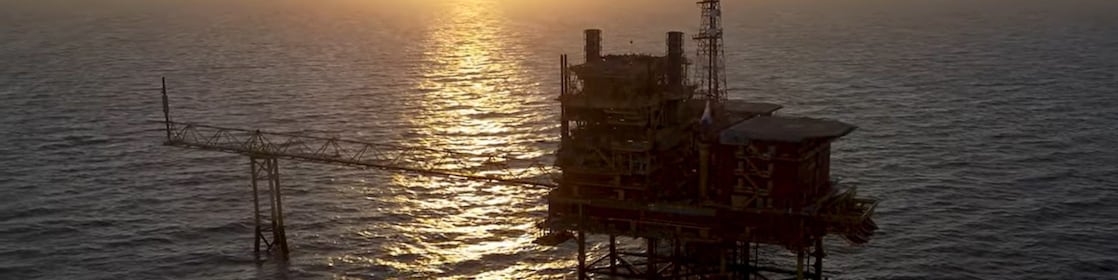
The main image shows NAM’s K14 platform, a proposed CO2 injection site for the Aramis CCS project.
Carbon Capture and Storage, or CCS, is the collective term for technologies used to capture CO2 and store it permanently. CO2 is a naturally occurring greenhouse gas.1 CCS focuses on CO2 from human activities and can be applied to industrial facilities, among other sources. That is where the process begins: CO2 must be captured before it leaves the plant through the chimney and enters the atmosphere.
Capturing industrial CO2
At industrial plants, captured CO2 is first purified and then transported by pipeline or ship to a central collection point. For the Porthos and Aramis projects, that hub is in Rotterdam. From there, the CO2 is pressurised and transported through an offshore pipeline to underground storage sites in former gas fields deep beneath the seabed.
For Porthos, those fields lie west of The Hague; for Aramis, they lie north-west of Den Helder. There, CO2 is injected into tiny pores in the rock beneath impermeable layers. These spaces once held natural gas. Now they can be used to store CO2. Sensors and computer systems monitor the storage sites to ensure that the CO2 remains safely and permanently contained.
CCS may be particularly valuable for industrial processes where switching to electricity, hydrogen or another lower-carbon alternative is not yet straightforward, says Lex Backer, Shell’s Aramis project lead. “Our focus is on heavy industries such as waste processing, cement, chemicals, refining, steel and biomass power generation: important sectors where the alternatives are limited.”
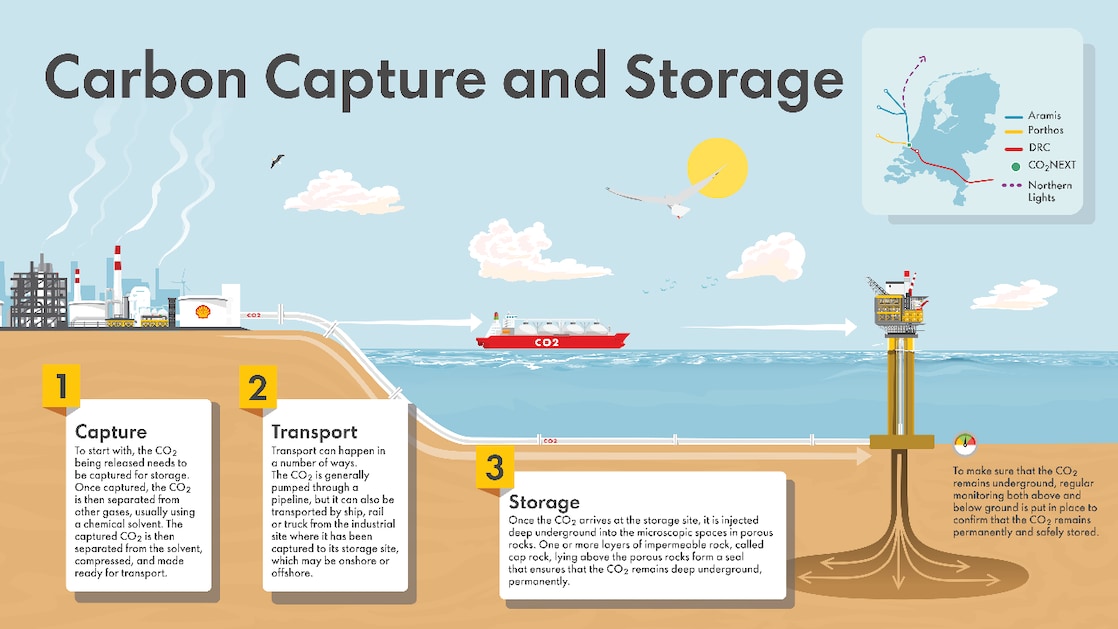
Graphic showing the journey of CO₂ explained in text
Graphic showing the journey of CO₂ explained in text
The image is a graphic showing how Carbon Capture and Storage (CCS) works in practice. On the left, an industrial complex can be seen onshore, with pipes and storage tanks. One of the tanks bears the Shell logo. The complex could be compared with Shell Pernis. It is marked 1, Capture. An explanation of each numbered stage follows below.
From the industrial complex, a pipeline runs along the seabed to what appears to be an offshore platform. A ship carrying CO2 in storage tanks is also shown heading towards the platform. This stage is marked 2, Transport.
From the offshore platform, pipes extend deep beneath the seabed, where arrows pointing in different directions show how the CO2 disperses through the underground rock formation. This stage is marked 3, Storage.
1. Capture
During CO2 capture, CO2 is separated from other gases before they are released into the atmosphere. The captured CO₂ is then compressed into either liquid or gaseous form for transport.
2. Transport
Once captured, the CO2 can be cooled, making it more compact than in its gaseous state, and transported by ship, train, lorry or pipeline.
3. Storage
The CO2 is injected deep underground into microscopic spaces in porous rock formations, for example in depleted reservoirs beneath the sea. A layer of impermeable rock, known as a cap rock, lies directly above the porous rock and prevents the CO2 from escaping, keeping it permanently stored underground.
Monitoring
Storage sites are monitored both within the storage reservoir and at the injection well, where sensors can detect small changes in pressure or CO₂ levels. This helps ensure that the CO₂ remains safely and permanently stored.
Map of the Netherlands
In the top-right corner of the graphic is a map of the Netherlands showing planned pipelines and connections for various CCS projects.
- A blue line represents Porthos CCS, with a pipeline running from Rotterdam to a location north-west of the city in the North Sea.
- A yellow line represents the Aramis pipeline, which extends further north to two locations west of Den Helder.
- A red line runs overland from Rotterdam, via Roermond, to Germany. This is the planned Delta Rhine Corridor, often abbreviated to DRC.
- A green dot marks the CO2next terminal in Rotterdam.
- A dark dotted line continues further north along the North Sea coast and points towards Norway. This represents the Northern Lights CCS project.
Why CCS in the Netherlands?
Rotterdam has a key role to play in the development of CCS in the Netherlands. Its port is home to a large concentration of industry and is connected to industrial clusters in countries including Germany and Belgium. Beneath the North Sea are depleted gas fields that could be used for permanent CO2 storage. Geography provides another advantage: the Dutch sector of the North Sea is relatively shallow.
“That makes developing offshore storage more cost-effective, while the gas fields themselves are relatively close to the sources of emissions,” says Backer. “Its port means Rotterdam can play a central role in transporting CO2 for the whole of north-west Europe. And no one can do this on their own. The Dutch tradition of consultation helps public and private-sector partners work together to find practical solutions.”
Who pays the bill?
Backer sees the public debate increasingly shifting towards the question of who should pay for CCS. “The question is becoming less about whether CCS is needed and more about whether it is worth the cost.” CCS is, after all, competing with alternatives such as improving energy efficiency, electrification, postponing CO2 capture or moving European industrial production to Asia. A large part of the challenge lies in building the infrastructure CCS requires. “We are building infrastructure for the future when, today, there are still relatively few customers,” Backer explains.
The Dutch government intends to minimise this risk for public-sector parties so they can make the necessary investments. For the first customers, however, choosing CCS remains a difficult financial decision. “A company currently pays around €80 to €90 per tonne for emissions allowances, while capturing, compressing, transporting and storing CO2 can cost around €200 to €300 per tonne in total. Without financial support, the sums simply don’t add up. In the short term, Dutch and European public funding is needed. In the longer term, the additional costs will have to be borne by the end users of industrial products, for example by requiring a minimum share of cement with a lower CO2 footprint.”
Lex Backer, Shell's Project Lead Aramis CCS"What we bring is technical expertise, international CCS experience, a long-term perspective"

Building the CO2 chain together
Shell sees opportunities in CO2 from two perspectives: as a customer, through its own industrial operations such as the Pernis refinery, and through its long-standing expertise in offshore gas fields. Depending on the project, Shell has different roles across the CCS value chain. Shell Pernis is a customer of Porthos, while in Aramis Shell is primarily an investor in offshore storage and sees itself as a co-developer of a new CO2 value chain.
“What we bring is technical expertise, international CCS experience,2 a long-term perspective3 and the ability to connect the different parts of the chain, from shipping and underground storage to project management and capture technology,” says Backer.
The technology exists. Now comes the investment
With Porthos and Aramis, CCS is gradually taking shape in the Netherlands. But, says Backer, putting all the pieces together is far from straightforward. “We’re bringing together different industries, onshore and offshore operations, and public and private-sector organisations with different interests. It’s complex, and we’re learning new things all the time.”
The technologies needed to capture, transport and store CO2 are available. The challenge is getting every part of the chain in place at the right time: from capture equipment at an industrial plant and transport by pipeline or ship to Rotterdam, through to permanent storage beneath the North Sea. That means emitters, transport operators and storage providers all need to take investment decisions at broadly the same time. “No single part of the chain can justify the investment on its own,” says Backer. “We will have to commit together, at the same time.”
LNG as a model for CCS
Backer describes Aramis as the most complex energy project he has ever worked on. Yet he is confident about what it could achieve. For a historical parallel, he looks to the development of liquefied natural gas, or LNG. “In Brunei, where I also worked, natural gas produced offshore was being flared in the 1960s because there was no market for it. Then someone at Shell realised that you could liquefy the gas and transport it by ship to Japan. LNG was barely known at the time: worldwide, there was one supplier and three customers.”
Today, LNG is traded on a global market, with the Netherlands among its customers. “My dream is that we can repeat that success with CO2 storage: creating more value with fewer emissions,” says Backer.
Northern Lights
One major CCS project is already operating in north-west Europe: Northern Lights in Norway. There, storage infrastructure was ready before there were customers. With Porthos in the Netherlands, the situation is reversed: the storage infrastructure is not yet ready, but Shell Pernis is already lined up as a major customer.
“If one link in the chain falls behind, you have two problems,” says Backer. “Investors have incurred costs without receiving any income, while the CO2 is still being released into the atmosphere.” According to Backer, the Netherlands can learn from Norway in another respect too. “Both the government and the public there strongly support CCS. In the Netherlands, that support is beginning to emerge too, but more cautiously.”
Footnotes
1. Climate Change Causes, NASA and Radiative Forcing of Climate Change, IPCC, accessed 16 November 2026.
2. Shell, Carbon Capture and Storage, accessed 16 November 2026.
3. Shell, The 2026 Energy Security Scenarios, accessed 16 November 2026
Shell’s CCS projects in north-west Europe
Porthos: infrastructure to transport and store CO2 captured from industry in Rotterdam. Planned capacity: 2.5 million tonnes a year.
Aramis: the next step, providing infrastructure to transport and store CO2 from Dutch and potentially international industrial sites. Planned capacity: 22 million tonnes a year.
CO2next: a terminal in the Port of Rotterdam where liquid CO2 can arrive by ship before being transported through the Aramis pipeline to storage sites beneath the North Sea.
Delta Rhine Corridor: a pipeline network intended to transport CO2 from industrial clusters in the Netherlands and the German state of North Rhine-Westphalia to storage sites beneath the North Sea. The corridor could also transport hydrogen from Rotterdam and elsewhere to those industrial clusters.
Delta Scheldt CO2nnection: a pipeline between Antwerp and Moerdijk intended to connect with the Delta Rhine Corridor. Shell operates its chemicals complex in Moerdijk.
Northern Lights: a CCS project in Norway. CO₂ from several European countries is transported by ship to an onshore terminal and then permanently stored beneath the seabed. Planned capacity: initially 1.5 million tonnes a year, rising to 5 million tonnes a year. CO2 from fertiliser producer Yara’s plant in Sluiskil, near Terneuzen in the Netherlands, is also destined for Northern Lights.
Acorn: a CCS project in north-east Scotland. Shell UK has a 30% interest. Planned capacity: 5 million tonnes a year.
Find out more
- Shell.nl/ccs (in Dutch)
- Shell.com/carbon-capture-and-storage
Cautionary note
Cautionary note
The companies in which Shell plc directly and indirectly owns investments are separate legal entities. In this publication “Shell”, “Shell Group” and “Group” are sometimes used for convenience to reference Shell plc and its subsidiaries in general. Likewise, the words “we”, “us” and “our” are also used to refer to Shell plc and its subsidiaries in general or to those who work for them. These terms are also used where no useful purpose is served by identifying the particular entity or entities. ‘‘Subsidiaries’’, “Shell subsidiaries” and “Shell companies” as used in this publication refer to entities over which Shell plc either directly or indirectly has control. The terms “joint venture”, “joint operations”, “joint arrangements”, and “associates” may also be used to refer to a commercial arrangement in which Shell has a direct or indirect ownership interest with one or more parties. The term “Shell interest” is used for convenience to indicate the direct and/or indirect ownership interest held by Shell in an entity or unincorporated joint arrangement, after exclusion of all third-party interest.
Forward-Looking statements
This publication contains forward-looking statements (within the meaning of the U.S. Private Securities Litigation Reform Act of 1995) concerning the financial condition, results of operations and businesses of Shell. All statements other than statements of historical fact are, or may be deemed to be, forward-looking statements. Forward-looking statements are statements of future expectations that are based on management’s current expectations and assumptions, including (without limitation) those concerning Shell’s strategy and operating plans, macroeconomic conditions, future energy demand, supply and product mix, commodity prices, demand for Shell’s products, production results and reserve estimates, development, execution and management of projects, energy transition and climate change, management of safety and environmental risks, costs, cash capital expenditures, technology advancements, legislative, judicial, fiscal and regulatory developments, regional conflicts and trading conditions, and involve known and unknown risks and uncertainties that could cause actual results, performance or events to differ materially from those expressed or implied in these statements. Forward-looking statements include, among other things, statements concerning the potential exposure of Shell to market risks and statements expressing management’s expectations, beliefs, estimates, forecasts, projections and assumptions. These forward-looking statements are identified by their use of terms and phrases such as “aim”; “ambition”; ‘‘anticipate’’; “aspire”, “aspiration”, ‘‘believe’’; “commit”; “commitment”; ‘‘could’’; “desire”; ‘‘estimate’’; ‘‘expect’’; ‘‘goals’’; ‘‘intend’’; ‘‘may’’; “milestones”; ‘‘objectives’’; ‘‘outlook’’; ‘‘plan’’; ‘‘probably’’; ‘‘project’’; ‘‘risks’’; “schedule”; ‘‘seek’’; ‘‘should’’; ‘‘target’’; “vision”; ‘‘will’’; “would” and similar terms and phrases. There are a number of factors that could affect the future operations of Shell and could cause those results to differ materially from those expressed in the forward-looking statements included in this publication, including (without limitation): (a) price fluctuations in crude oil and natural gas; (b) changes in demand for Shell’s products; (c) currency fluctuations; (d) drilling and production results; (e) reserves estimates; (f) loss of market share and industry competition; (g) environmental and physical risks, including climate change; (h) risks associated with the identification of suitable potential acquisition properties and targets, and successful negotiation and completion of such transactions; (i) the risk of doing business in developing countries and countries subject to international sanctions; (j) legislative, judicial, fiscal and regulatory developments including tariffs and regulatory measures addressing climate change; (k) economic and financial market conditions in various countries and regions; (l) political risks, including the risks of expropriation and renegotiation of the terms of contracts with governmental entities, delays or advancements in the approval of projects and delays in the reimbursement for shared costs; (m) risks associated with the impact of pandemics, regional conflicts, such as the Russia-Ukraine war and the conflict in the Middle East, and a significant cyber security, data privacy or IT incident; (n) the pace of the energy transition; and (o) changes in trading conditions. No assurance is provided that future dividend payments will match or exceed previous dividend payments. All forward-looking statements contained in this publication are expressly qualified in their entirety by the cautionary statements contained or referred to in this section. Readers should not place undue reliance on forward-looking statements. Additional risk factors that may affect future results are contained in Shell plc’s Form 20-F for the year ended December 31, 2025 (available at www.shell.com/investors/news-and-filings/sec-filings.html and www.sec.gov). These risk factors also expressly qualify all forward-looking statements contained in this publication and should be considered by the reader. Each forward-looking statement speaks only as of the date of this publication, November 26, 2026. Neither Shell plc nor any of its subsidiaries undertake any obligation to publicly update or revise any forward-looking statement as a result of new information, future events or other information. In light of these risks, results could differ materially from those stated, implied or inferred from the forward-looking statements contained in this publication.
Shell’s net carbon intensity and net-zero emissions target
In this publication we may refer to Shell’s “net carbon intensity” (NCI), which includes Shell’s carbon emissions from the production of our energy products, our suppliers’ carbon emissions in supplying energy for that production and our customers’ carbon emissions associated with their use of the energy products we sell. Shell’s NCI also includes the emissions associated with the production and use of energy products produced by others which Shell purchases for resale. Shell only controls its own emissions. The use of the terms Shell’s “net carbon intensity” or NCI is for convenience only and not intended to suggest these emissions are those of Shell plc or its subsidiaries.
Shell’s operating plan and outlook are forecasted for a three-year period and ten-year period, respectively, and are updated every year. They reflect the current economic environment and what we can reasonably expect to see over the next three and ten years. Accordingly, the outlook reflects our combined Scope 1 and 2 target, NCI target and our oil products ambition over the next ten years. However, Shell’s operating plan and outlook cannot reflect our 2050 net-zero emissions target, as this target is outside our planning period. Such future operating plans and outlooks could include changes to our portfolio, efficiency improvements and the use of carbon capture and storage and carbon credits. In the future, as society moves towards net-zero emissions, we expect Shell’s operating plans and outlooks to reflect this movement. However, if society is not net zero in 2050, as of today, there would be significant risk that Shell may not meet this target.
The information provided above regarding Shell’s NCI and net zero emissions target are not intended, nor should they be construed as introducing, suggesting or making any claim, target or representation thereof other than what is included in the publicaiton..
Forward-Looking non-GAAP measures
This publication may contain certain forward-looking non-GAAP measures such as free cash flow and underlying operating expenses. We are unable to provide a reconciliation of these forward-looking non-GAAP measures to the most comparable GAAP financial measures because certain information needed to reconcile those non-GAAP measures to the most comparable GAAP financial measures is dependent on future events some of which are outside the control of Shell, such as oil and gas prices, interest rates and exchange rates. Moreover, estimating such GAAP measures with the required precision necessary to provide a meaningful reconciliation is extremely difficult and could not be accomplished without unreasonable effort. Non-GAAP measures in respect of future periods which cannot be reconciled to the most comparable GAAP financial measure are calculated in a manner which is consistent with the accounting policies applied in Shell plc’s consolidated financial statements. These forward-looking non-GAAP measures are provided to assist readers in understanding management’s use and expectations of such measures and may not be appropriate for other purposes.
The contents of websites referred to in this publication do not form part of this publication.
We may have used certain terms, such as resources, in this publication that the United States Securities and Exchange Commission (SEC) strictly prohibits us from including in our filings with the SEC. Investors are urged to consider closely the disclosure in our Form 20-F, File No 1-32575, available on the SEC website www.sec.gov.