De reis van CO₂ — van schoorsteen naar zeebodem
CO2 afvangen bij een fabriek, per schip of pijpleiding naar zee brengen en veilig kilometers diep onder de zeebodem opslaan. Met projecten als Porthos en Aramis krijgt dat in Nederland op industriële schaal vorm. De techniek is er. Maar hoe krijg je fabrieken, pijpleidingen en opslag tegelijk aan de praat, en wie betaalt de rekening? Shell-projectleider Lex Backer over de puzzel achter Carbon Capture and Storage.

Tekst: Anne Oosterveen. Beeld: NAM (openingsbeeld), Jelle Hoogendam (grafische weergave CCS), Piet Gispen (portretfoto).
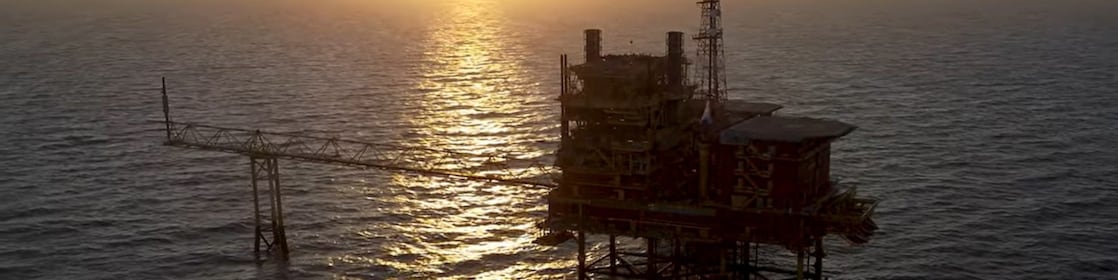
De openingsfoto toont NAM-platform K14, beoogde injectielocatie voor CO2 in het Aramis CCS-project
In dit verhaal:
- CO2 wordt bij fabrieken afgevangen voordat het de lucht in gaat. Per schip of pijpleiding gaat het naar Rotterdam en vervolgens diep onder de Noordzee, in leeggehaalde gasvelden, veilig en permanent opgeslagen.
- Porthos en Aramis zijn twee CCS-projecten in het Nederlands deel van de Noordzee.
- Een bedrijf betaalt nu zo'n €80 tot €90 per ton aan uitstootrechten, terwijl CCS €200 tot €300 per ton kan kosten. Op korte termijn is publieke steun nodig, op lange termijn moet de eindgebruiker de meerkosten dragen.
- Shell Pernis is klant van Porthos. Bij Aramis is Shell investeerder in de opslag onder zee en medeontwikkelaar van een nieuwe CO2-keten, met technische kennis, wereldwijde CCS-ervaring en een langetermijnvisie.
- De puzzel: de techniek is er, maar uitstoters, transporteurs en opslagbedrijven moeten tegelijk investeren.
Carbon Capture and Storage heet in het kort CCS. Het is een verzamelnaam van technieken voor het afvangen en permanent opslaan van CO2. Dit broeikasgas1 komt van nature voor. CCS richt zich op de onnatuurlijke bronnen. CCS is onder meer toepasbaar op industriële installaties. Want daar begint het: de CO2 moet worden afgevangen voordat het vanuit de fabriek via de schoorsteen in de atmosfeer komt.
CO₂ afvangen in de industrie
Bij industriële installaties wordt de afgevangen CO2 eerst gezuiverd en daarna per pijpleiding of per schip getransporteerd naar een centraal opslagpunt. Voor het Porthos- en Aramis-project is die centrale in Rotterdam. Daar wordt de CO2 onder hoge druk gebracht en via een buitengaatse pijpleiding getransporteerd naar ondergrondse opslaglocaties op zee, ofwel diep in de zeebodem in voormalige gasvelden.
Voor Porthos liggen die velden ten westen van Den Haag, voor Aramis ten noordwesten van Den Helder. Daar wordt de CO₂ in piepkleine poriën in het gesteente geïnjecteerd, onder ondoordringbare afsluitende lagen. In deze poriën zat ooit aardgas. Nu kunnen ze worden gebruikt voor de opslag van CO2. Met sensoren en computers wordt in de gaten gehouden dat het veilig en permanent opgeslagen blijft.
Vooral voor industriële processen die nog niet eenvoudig kunnen overstappen op elektriciteit, waterstof of een ander alternatief, kan CCS een uitkomst bieden, zegt Lex Backer, voor Shell projectleider van Aramis. “Onze focus ligt op zware industrie zoals afvalverwerking, cement, chemie, raffinage, staal en biomassacentrales: belangrijke sectoren met beperkte alternatieven.”
Eerder verschenen
Berte Simons, Havenbedrijf Rotterdam, over CCS:
"De schaalgrootte waar we nu aan werken is nieuw. We zullen echt nog zaken moeten leren."
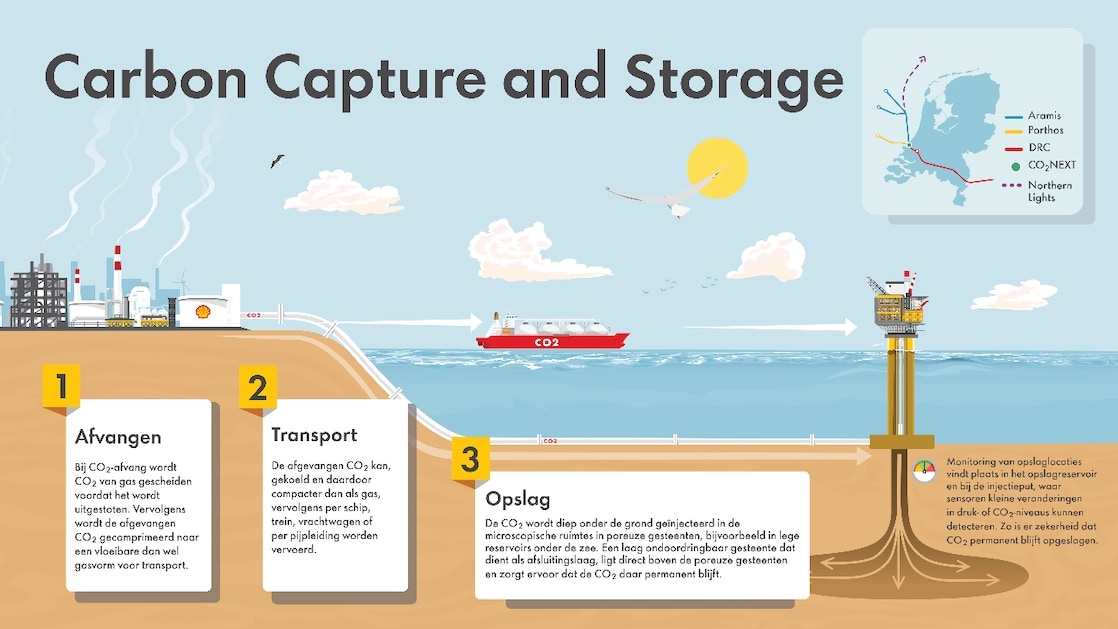
Grafische weergave Carbon Capture and Storage uitgelegd in tekst
Grafische weergave Carbon Capture and Storage uitgelegd in tekst
De afbeelding toont een grafische weergave van hoe Carbon Capture and Storage in de praktijk werkt. Aan de linkerkant is op de oever een fabriekscomplex te zien, met pijpen en opslagtanks. Een opslagtank heeft een Shell-logo. Dit complex zou je kunnen vergelijken met Shell Pernis. Hierbij staat cijfer 1, over Afvangen. De uitleg bij de getallen volgt hieronder.
Vanuit het fabriekscomplex gaat een pijpleiding over de zeebodem naar wat lijkt op een boorplatform op zee. Op zee vaart ook een schip met CO2-opslagtanks naar dat platform. Hierbij staat het cijfer 2, voor Transport.
Vanuit het platform op zee gaan pijpen diep de zeebodem in, waar pijlen in meerdere richtingen de verspreiding in de bodem aangeven. Hierbij staat cijfer 3, voor Opslag.
1. Afvangen
Bij CO2-afvang wordt CO2 van gas gescheiden voordat het wordt uitgestoten. Vervolgens wordt de afgevangen CO2 gecomprimeerd naar een vloeibare dan wel gasvorm voor transport.
2. Transport
De afgevangen CO2 kan, gekoeld en daardoor compacter dan als gas, vervolgens per schip, trein, vrachtwagen of per pijpleiding worden vervoerd.
3. Opslag
De CO2 wordt diep onder de grond geïnjecteerd in de microscopische ruimtes in poreuze gesteenten, bijvoorbeeld in lege reservoirs onder de zee. Een laag ondoordringbaar gesteente, dat dient als afslutingslaag, ligt direct boven de poreuze gesteenten en zorgt ervoor dat de CO2 daar permanent blijft.
Monitoring
Monitoring van opslaglocaties vindt plaats in het opslagreservoir en bij de injectieput, waar sensoren kleine verandereingen in druk- of CO2-niveaus kunnen detecteren. Zo is er zekerheid dat CO2 permanent blijft opgeslagen.
Kaartje van Nederland
Rechtsboven in de afbeelding staat een kaartje van Nederland, met daarin de geplande leidingen voor de verschillende CCS-projecten.
- Een blauwe lijn geeft Porthos CCS weer, een pijpleiding vanuit Rotterdam naar een punt ten noordwesten ervan in de Noordzee.
- Een gele lijn geeft de Aramis-leiding weer, die verder doorloopt naar het noorden, naar twee punten ergens ten westen van Den Helder.
- Een rode lijn loopt over land vanuit Rotterdam via Roermond naar Duitsland. Dit is de geplande Delta-Rijncorridor (dikwijls afgekort als DRC).
- Een groene stip geeft het CO2-opslagpunt van CO2next bij Rotterdam weer.
- Een donkere stippellijn loopt langs de Noordzeekust nog verder naar het noorden en wijst naar Noorwegen. Dit is het Northern Lights CCS-project.
Waarom CCS in Nederland?
Rotterdam speelt een sleutelrol bij de ontwikkeling van CCS in Nederland. De haven huisvest veel industrie en is verbonden met industrieclusters in onder meer Duitsland en België. Onder de Noordzee liggen uitgeproduceerde gasvelden die geschikt zijn om CO2 permanent op te slaan. Daar komt een geografisch voordeel bij: Het Nederlandse deel van de Noordzee is relatief ondiep.
“Dat maakt de aanleg van opslag op zee kostenefficiënt én de onderzeese gasvelden liggen relatief dicht bij de bronnen van uitstoot”, zegt Backer. “Met de haven kan Rotterdam een centrale rol spelen in het transport van CO2 voor heel Noordwest-Europa. Bovendien kan niemand dit alleen. De Nederlandse overlegcultuur helpt om samen met publieke en private partijen tot werkbare oplossingen te komen.”
Wie betaalt de rekening?
In het publieke debat ziet Backer een verschuiving over wie de rekening van CCS gaat betalen. “De vraag is steeds minder óf CCS nodig is, en steeds meer of het de kosten waard is.” CCS concurreert namelijk met alternatieven zoals energiebesparing, elektrificatie, uitstel van CO2-afvang en het verplaatsen van Europese industrieën naar Azië.
Een groot deel van de uitdaging zit in het bouwen van de benodigde infrastructuur. “Je bouwt die infrastructuur voor de toekomst, terwijl er nu nog weinig klanten zijn”, legt Backer uit. Het kabinet is van plan om dat risico voor de publieke partijen te minimaliseren, zodat zij de nodige investeringen kunnen doen. Voor de eerste klanten blijft het nog lastig om voor CCS te kiezen.
“Een bedrijf betaalt nu zo’n €80 tot €90 per ton aan uitstootrechten, terwijl CO2 afvangen, samenpersen, transporteren en opslaan in totaal ongeveer €200 tot €300 per ton kan kosten. Zonder financiële steun sluit die rekensom niet. Op korte termijn zijn Nederlandse en Europese publieke middelen nodig. Op lange termijn moeten de meerkosten door de eindgebruiker van industriële producten worden gedragen, bijvoorbeeld door een minimumaandeel cement met een lagere CO2-voetafdruk vast te leggen.”
Lex Backer, Shell-projectleider Aramis CCS"Wat we inbrengen is technische kennis, wereldwijde CCS-ervaring, langetermijnvisie"

Samen bouwen aan de keten
Shell is een van de partijen die brood ziet in CO2: als klant met eigen basisindustrie zoals de raffinaderij in Pernis, en als historisch expert in onderzeese gasvelden. Shell heeft, afhankelijk van het project, in de CCS-keten verschillende rollen: Shell Pernis is een klant van Porthos, bij Aramis is Shell primair een investeerder in de opslag onder zee en ziet het zichzelf als medeontwikkelaar van een nieuwe CO2-keten.
“Wat we inbrengen is technische kennis, wereldwijde CCS-ervaring2, langetermijnvisie3 en het vermogen om de schakels in de keten te verbinden: van scheepvaart en ondergrondse opslag tot projectmanagement en afvangtechnologie”, zegt Backer.
Technieken zijn beschikbaar, nu nog de investeringen
Met Porthos en Aramis krijgt CCS in Nederland stap voor stap vorm. Volgens Backer is dat geen eenvoudige opgave: “Je brengt verschillende industrieën, werkzaamheden op land en zee, en publieke en private partijen met uiteenlopende belangen samen. Dat is complex en levert voortdurend nieuwe inzichten op.”
De technieken voor afvang, transport en opslag zijn beschikbaar. De uitdaging is om alle onderdelen op het juiste moment bij elkaar te brengen: van de afvanginstallatie bij de fabriek, het vervoer per pijpleiding of schip naar Rotterdam, tot de opslag onder de Noordzee. Uitstoters, transportpartijen en opslagbedrijven moeten daarvoor tegelijk de knoop doorhakken om te investeren. “Geen enkele schakel kan de investering in zijn eentje rechtvaardigen”, zegt Backer. “Je moet er samen tegelijkertijd op inzetten.”
LNG als voorbeeld voor CCS
Backer zegt dat Aramis het meest complexe energieproject is waar hij ooit aan heeft gewerkt. Maar hij heeft vertrouwen in het beoogde resultaat en kijkt naar het vloeibaar maken van aardgas tot LNG als historisch voorbeeld. “In Brunei, waar ik ook heb gewerkt, werd in de jaren zestig aardgas op zee afgefakkeld, omdat er geen markt voor dat gas was. Tot iemand bij Shell bedacht dat je het gas ook vloeibaar kon maken en het zo per schip naar Japan kon brengen. LNG was toen nauwelijks bekend: wereldwijd was er één aanbieder, met drie klanten.”
Vandaag de dag is er een wereldmarkt voor LNG, met ook Nederland als belangrijke afnemer. “Mijn droom is dat we met CO2-opslag dat succes herhalen: meer waarde met minder emissies”, aldus Backer.
Northern Lights
Er is al wel één belangrijk CCS-project in Noordwest-Europa in bedrijf: Northern Lights in Noorwegen. Daar was de opslag al gereed voordat er klanten waren. Bij Porthos in Nederland is dat andersom, daar is de opslag nog niet gereed, maar is er met Shell Pernis wel een grote klant klaar om te leveren.
“Als één schakel achterloopt, heb je twee problemen”, zegt Backer. “Investeerders hebben kosten gemaakt zonder inkomsten, en de CO2 gaat nog steeds de lucht in.” Volgens Backer kan Nederland ook op een ander vlak van Noorwegen leren. “Daar staan zowel de overheid als de bevolking vol achter CCS. In Nederland zie je dat wel ontstaan, maar voorzichtiger.”
Voetnoten
1. Climate Change Causes, NASA.gov; Radiative forcing of Climate, IPCC, geraadpleegd 16 november 2026
2. Carbon Capture and Storage, Shell.com, geraadpleegd 16 november 2026
3. The 2026 Energy Security Scenarios, Shell.com, geraadpleegd 16 november 2026
Shells CCS-projecten in het noordwesten van Europa
Porthos: infrastructuur voor het afvangen, transporteren en opslaan van CO2 uit de Rotterdamse industrie. Beoogde capaciteit: jaarlijks 2,5 miljoen ton.
Aramis: de volgende stap, infrastructuur voor het afvangen, transporteren en opslaan van CO2 voor Nederlandse en wellicht buitenlandse industrieën. Beoogde capaciteit: jaarlijks 22 miljoen ton.
CO2next: een terminal in het Rotterdamse havengebied waar waar vloeibare CO2 per schip kan worden aangevoerd en verder via de Aramis-pijpleiding richting de opslaglocaties onder de Noordzee wordt vervoerd.
Delta-Rijncorridor: pijpleidingnetwerk voor het transporteren van CO2 van industrieclusters in Nederland en het Duitse Noordrijn-Westfalen naar opslaglocaties onder de Noordzee. De Delta-Rijncorridor zou ook waterstof vanuit onder meer Rotterdam kunnen vervoeren naar die industrieclusters.
Delta Schelde CO₂nnection: pijpleiding tussen Antwerpen en Moerdijk, voor aansluiting op de Delta-Rijncorridor. In Moerdijk heeft Shell haar chemiecomplex.
Northern Lights: CCS-project in Noorwegen. CO2 uit verschillende Europese landen wordt per schip aangevoerd naar een terminal op land en permanent onder de zeebodem opgeslagen. Beoogde capaciteit: eerst jaarlijks 1,5 miljoen ton, later jaarlijks 5 miljoen ton per jaar. Ook CO2 van kunstmestproducent Yara in het Nederlandse Sluiskil (Terneuzen) gaat naar Northern Lights.
Acorn: CCS-project in het noordoosten van Schotland. Shell UK is 30% partner. Beoogde capaciteit: jaarlijks 5 miljoen ton.
Meer weten?
Cautionary note
Cautionary note
The companies in which Shell plc directly and indirectly owns investments are separate legal entities. In this publication “Shell”, “Shell Group” and “Group” are sometimes used for convenience to reference Shell plc and its subsidiaries in general. Likewise, the words “we”, “us” and “our” are also used to refer to Shell plc and its subsidiaries in general or to those who work for them. These terms are also used where no useful purpose is served by identifying the particular entity or entities. ‘‘Subsidiaries’’, “Shell subsidiaries” and “Shell companies” as used in this publication refer to entities over which Shell plc either directly or indirectly has control. The terms “joint venture”, “joint operations”, “joint arrangements”, and “associates” may also be used to refer to a commercial arrangement in which Shell has a direct or indirect ownership interest with one or more parties. The term “Shell interest” is used for convenience to indicate the direct and/or indirect ownership interest held by Shell in an entity or unincorporated joint arrangement, after exclusion of all third-party interest.
Forward-Looking statements
This publication contains forward-looking statements (within the meaning of the U.S. Private Securities Litigation Reform Act of 1995) concerning the financial condition, results of operations and businesses of Shell. All statements other than statements of historical fact are, or may be deemed to be, forward-looking statements. Forward-looking statements are statements of future expectations that are based on management’s current expectations and assumptions, including (without limitation) those concerning Shell’s strategy and operating plans, macroeconomic conditions, future energy demand, supply and product mix, commodity prices, demand for Shell’s products, production results and reserve estimates, development, execution and management of projects, energy transition and climate change, management of safety and environmental risks, costs, cash capital expenditures, technology advancements, legislative, judicial, fiscal and regulatory developments, regional conflicts and trading conditions, and involve known and unknown risks and uncertainties that could cause actual results, performance or events to differ materially from those expressed or implied in these statements. Forward-looking statements include, among other things, statements concerning the potential exposure of Shell to market risks and statements expressing management’s expectations, beliefs, estimates, forecasts, projections and assumptions. These forward-looking statements are identified by their use of terms and phrases such as “aim”; “ambition”; ‘‘anticipate’’; “aspire”, “aspiration”, ‘‘believe’’; “commit”; “commitment”; ‘‘could’’; “desire”; ‘‘estimate’’; ‘‘expect’’; ‘‘goals’’; ‘‘intend’’; ‘‘may’’; “milestones”; ‘‘objectives’’; ‘‘outlook’’; ‘‘plan’’; ‘‘probably’’; ‘‘project’’; ‘‘risks’’; “schedule”; ‘‘seek’’; ‘‘should’’; ‘‘target’’; “vision”; ‘‘will’’; “would” and similar terms and phrases. There are a number of factors that could affect the future operations of Shell and could cause those results to differ materially from those expressed in the forward-looking statements included in this publication, including (without limitation): (a) price fluctuations in crude oil and natural gas; (b) changes in demand for Shell’s products; (c) currency fluctuations; (d) drilling and production results; (e) reserves estimates; (f) loss of market share and industry competition; (g) environmental and physical risks, including climate change; (h) risks associated with the identification of suitable potential acquisition properties and targets, and successful negotiation and completion of such transactions; (i) the risk of doing business in developing countries and countries subject to international sanctions; (j) legislative, judicial, fiscal and regulatory developments including tariffs and regulatory measures addressing climate change; (k) economic and financial market conditions in various countries and regions; (l) political risks, including the risks of expropriation and renegotiation of the terms of contracts with governmental entities, delays or advancements in the approval of projects and delays in the reimbursement for shared costs; (m) risks associated with the impact of pandemics, regional conflicts, such as the Russia-Ukraine war and the conflict in the Middle East, and a significant cyber security, data privacy or IT incident; (n) the pace of the energy transition; and (o) changes in trading conditions. No assurance is provided that future dividend payments will match or exceed previous dividend payments. All forward-looking statements contained in this publication are expressly qualified in their entirety by the cautionary statements contained or referred to in this section. Readers should not place undue reliance on forward-looking statements. Additional risk factors that may affect future results are contained in Shell plc’s Form 20-F for the year ended December 31, 2025 (available at www.shell.com/investors/news-and-filings/sec-filings.html and www.sec.gov). These risk factors also expressly qualify all forward-looking statements contained in this publication and should be considered by the reader. Each forward-looking statement speaks only as of the date of this publication, November 26, 2026. Neither Shell plc nor any of its subsidiaries undertake any obligation to publicly update or revise any forward-looking statement as a result of new information, future events or other information. In light of these risks, results could differ materially from those stated, implied or inferred from the forward-looking statements contained in this publication.
Shell’s net carbon intensity and net-zero emissions target
In this publication we may refer to Shell’s “net carbon intensity” (NCI), which includes Shell’s carbon emissions from the production of our energy products, our suppliers’ carbon emissions in supplying energy for that production and our customers’ carbon emissions associated with their use of the energy products we sell. Shell’s NCI also includes the emissions associated with the production and use of energy products produced by others which Shell purchases for resale. Shell only controls its own emissions. The use of the terms Shell’s “net carbon intensity” or NCI is for convenience only and not intended to suggest these emissions are those of Shell plc or its subsidiaries.
Shell’s operating plan and outlook are forecasted for a three-year period and ten-year period, respectively, and are updated every year. They reflect the current economic environment and what we can reasonably expect to see over the next three and ten years. Accordingly, the outlook reflects our combined Scope 1 and 2 target, NCI target and our oil products ambition over the next ten years. However, Shell’s operating plan and outlook cannot reflect our 2050 net-zero emissions target, as this target is outside our planning period. Such future operating plans and outlooks could include changes to our portfolio, efficiency improvements and the use of carbon capture and storage and carbon credits. In the future, as society moves towards net-zero emissions, we expect Shell’s operating plans and outlooks to reflect this movement. However, if society is not net zero in 2050, as of today, there would be significant risk that Shell may not meet this target.
The information provided above regarding Shell’s NCI and net zero emissions target are not intended, nor should they be construed as introducing, suggesting or making any claim, target or representation thereof other than what is included in the publicaiton..
Forward-Looking non-GAAP measures
This publication may contain certain forward-looking non-GAAP measures such as free cash flow and underlying operating expenses. We are unable to provide a reconciliation of these forward-looking non-GAAP measures to the most comparable GAAP financial measures because certain information needed to reconcile those non-GAAP measures to the most comparable GAAP financial measures is dependent on future events some of which are outside the control of Shell, such as oil and gas prices, interest rates and exchange rates. Moreover, estimating such GAAP measures with the required precision necessary to provide a meaningful reconciliation is extremely difficult and could not be accomplished without unreasonable effort. Non-GAAP measures in respect of future periods which cannot be reconciled to the most comparable GAAP financial measure are calculated in a manner which is consistent with the accounting policies applied in Shell plc’s consolidated financial statements. These forward-looking non-GAAP measures are provided to assist readers in understanding management’s use and expectations of such measures and may not be appropriate for other purposes.
The contents of websites referred to in this publication do not form part of this publication.
We may have used certain terms, such as resources, in this publication that the United States Securities and Exchange Commission (SEC) strictly prohibits us from including in our filings with the SEC. Investors are urged to consider closely the disclosure in our Form 20-F, File No 1-32575, available on the SEC website www.sec.gov.