Eerste stroom voor windpark Ecowende
Shells vierde windpark op de Noordzee leverde zaterdag 4 juli, einde van de dag, zijn eerste groene stroom aan het Nederlandse elektriciteitsnet. Dat gebeurde nadat het windpark werd aangesloten op het offshore elektriciteitsnet van netbeheerder TenneT. Zo is een nieuwe mijlpaal bereikt in de Nederlandse energietransitie.
Shell bouwt windpark Hollandse Kust West (HKW)1 samen met Chubu en Eneco, in de joint venture Ecowende. Het windpark ligt op 53 kilometer voor de Nederlandse kust, ter hoogte van IJmuiden. Het telt 52 windturbines met elk een vermogen van 15 megawatt (MW) — 760 MW in totaal — verspreidt over een oppervlakte van ongeveer 90 vierkante kilometer.
De bouw op zee begon op 2 december 2025 met het plaatsen van de eerste fundering (monopilaar). De eerste windturbine volgde op 30 mei 2026.
Volledige commerciële stroomlevering wordt eind 2026 verwacht. Zodra het windpark volledig operationeel is, zal het 3,3 terawattuur (TWh) groene stroom per jaar opwekken. De elektriciteit stroomt via het ‘offshore stopcontact’ van netbeheerder TenneT naar de wal. Shell-dochteronderneming Next Kraftwerke zal, samen met SEEL en EET, de opgewekte stroom2 verhandelen.
Bouwen in harmonie met de natuur
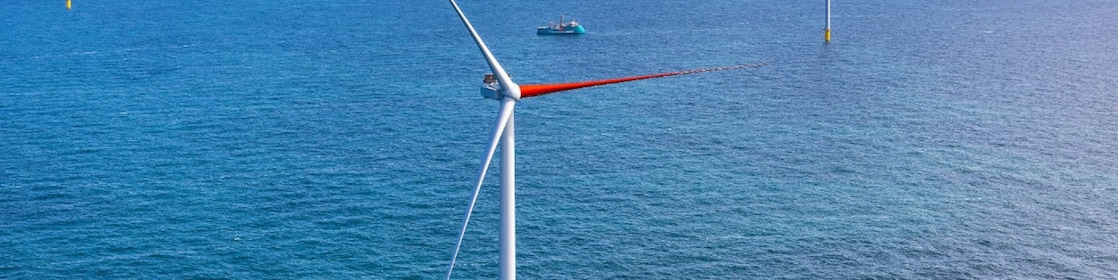
Wat het Ecowende-windpark onderscheidt van andere, is de baanbrekende aanpak op het gebied van ecologische integratie. Op initiatief van Ecowende heeft windturbinefabrikant Vestas zeven turbines uitgerust met één rood geschilderd rotorblad, om zo te testen of het kleurcontrast het risico op vogelaanvaringen vermindert.
Andere maatregelen boven water zijn een vogelcorridor, grotere tussenruimte tussen turbines en verhoogde turbinebehuizingen. Ook schakelen de windturbines tijdelijk af als er veel vogels door het park trekken. Radar met AI-ondersteunde soortherkenning van vogels en vleermuizen houdt een oogje in het zeil. Onder de waterlijn zorgen speciaal ontworpen erosiebescherming, uitsparingen en holtes voor beschutting voor vissen en ander zeeleven.
Meer weten over Ecowende?
- Lees meer over Ecowende op Ecowende.nl
- Lees meer over Shell en windenergie op Shell.nl/wind
Voetnoten
1. Ecowende is een joint venture van Shell (60%), Chubu (30%) en Eneco (10%). Het windpark staat officieel te boek als Hollandse Kust West, kavel VI.
2. De dagelijkse exploitatie en het onderhoud van het windpark worden gedaan door Eneco Wind Offshore Operations. De elektriciteitshandel wordt verzorgd door Next Kraftwerke, samen met SEEL en EET. Next Kraftwerke begon in juni 2026 met de vermarkting van de elektriciteit van Ecowende en treedt ook op als Balancing Service Provider (BSP) en Congestion Service Provider voor het windpark, en beheert de systeemintegratie en congestie op de day-ahead, intraday en balanceringsenergiemarkt namens Ecowende. Next Kraftwerke beheert een van de grootste virtuele energiecentrales van Europa. Meer dan 14.000 gedecentraliseerde energieproducenten, verbruikers en opslagfaciliteiten zijn aangesloten op de Next Pool. Met een opwekkingscapaciteit van meer dan 15 GW draagt het bedrijf bij aan de netstabiliteit en optimaliseert het de elektriciteitsproductie en -consumptie op basis van prijssignalen. Het verhandelt zijn elektriciteit op diverse Europese beurzen via zijn eigen 24/7-elektriciteitshandelsplatform. Sinds 2021 is Next Kraftwerke een 100%-dochter van Shell plc.
Cautionary note
Cautionary note
The companies in which Shell plc directly and indirectly owns investments are separate legal entities. In this announcement “Shell”, “Shell Group” and “Group” are sometimes used for convenience to reference Shell plc and its subsidiaries in general. Likewise, the words “we”, “us” and “our” are also used to refer to Shell plc and its subsidiaries in general or to those who work for them. These terms are also used where no useful purpose is served by identifying the particular entity or entities. ‘‘Subsidiaries’’, “Shell subsidiaries” and “Shell companies” as used in this announcement refer to entities over which Shell plc either directly or indirectly has control. The terms “joint venture”, “joint operations”, “joint arrangements”, and “associates” may also be used to refer to a commercial arrangement in which Shell has a direct or indirect ownership interest with one or more parties. The term “Shell interest” is used for convenience to indicate the direct and/or indirect ownership interest held by Shell in an entity or unincorporated joint arrangement, after exclusion of all third-party interest.
Forward-Looking statements
This announcement contains forward-looking statements (within the meaning of the U.S. Private Securities Litigation Reform Act of 1995) concerning the financial condition, results of operations and businesses of Shell. All statements other than statements of historical fact are, or may be deemed to be, forward-looking statements. Forward-looking statements are statements of future expectations that are based on management’s current expectations and assumptions and involve known and unknown risks and uncertainties that could cause actual results, performance or events to differ materially from those expressed or implied in these statements. Forward-looking statements include, among other things, statements concerning the potential exposure of Shell to market risks and statements expressing management’s expectations, beliefs, estimates, forecasts, projections and assumptions. These forward-looking statements are identified by their use of terms and phrases such as “aim”; “ambition”; ‘‘anticipate’’; “aspire”, “aspiration”, ‘‘believe’’; “commit”; “commitment”; ‘‘could’’; “desire”; ‘‘estimate’’; ‘‘expect’’; ‘‘goals’’; ‘‘intend’’; ‘‘may’’; “milestones”; ‘‘objectives’’; ‘‘outlook’’; ‘‘plan’’; ‘‘probably’’; ‘‘project’’; ‘‘risks’’; “schedule”; ‘‘seek’’; ‘‘should’’; ‘‘target’’; “vision”; ‘‘will’’; “would” and similar terms and phrases. There are a number of factors that could affect the future operations of Shell and could cause those results to differ materially from those expressed in the forward-looking statements included in this announcement, including (without limitation): (a) price fluctuations in crude oil and natural gas; (b) changes in demand for Shell’s products; (c) currency fluctuations; (d) drilling and production results; (e) reserves estimates; (f) loss of market share and industry competition; (g) environmental and physical risks, including climate change; (h) risks associated with the identification of suitable potential acquisition properties and targets, and successful negotiation and completion of such transactions; (i) the risk of doing business in developing countries and countries subject to international sanctions; (j) legislative, judicial, fiscal and regulatory developments including tariffs and regulatory measures addressing climate change; (k) economic and financial market conditions in various countries and regions; (l) political risks, including the risks of expropriation and renegotiation of the terms of contracts with governmental entities, delays or advancements in the approval of projects and delays in the reimbursement for shared costs; (m) risks associated with the impact of pandemics, regional conflicts, such as the Russia-Ukraine war and the conflict in the Middle East, and a significant cyber security, data privacy or IT incident; (n) the pace of the energy transition; and (o) changes in trading conditions. No assurance is provided that future dividend payments will match or exceed previous dividend payments. All forward-looking statements contained in this announcement are expressly qualified in their entirety by the cautionary statements contained or referred to in this section. Readers should not place undue reliance on forward-looking statements. Additional risk factors that may affect future results are contained in Shell plc’s Form 20-F for the year ended December 31, 2025 (available at www.shell.com/investors/news-and-filings/sec-filings.html and www.sec.gov). These risk factors also expressly qualify all forward-looking statements contained in this announcement and should be considered by the reader. Each forward-looking statement speaks only as of the date of this announcement, July 3, 2026. Neither Shell plc nor any of its subsidiaries undertake any obligation to publicly update or revise any forward-looking statement as a result of new information, future events or other information. In light of these risks, results could differ materially from those stated, implied or inferred from the forward-looking statements contained in this announcement.
Shell’s net carbon intensity
Also, in this announcement we may refer to Shell’s “net carbon intensity” (NCI), which includes Shell’s carbon emissions from the production of our energy products, our suppliers’ carbon emissions in supplying energy for that production and our customers’ carbon emissions associated with their use of the energy products we sell. Shell’s NCI also includes the emissions associated with the production and use of energy products produced by others which Shell purchases for resale. Shell only controls its own emissions. The use of the terms Shell’s “net carbon intensity” or NCI is for convenience only and not intended to suggest these emissions are those of Shell plc or its subsidiaries.
Shell’s net-zero emissions target
Shell’s operating plan and outlook are forecasted for a three-year period and ten-year period, respectively, and are updated every year. They reflect the current economic environment and what we can reasonably expect to see over the next three and ten years. Accordingly, the outlook reflects our combined Scope 1 and 2 target, NCI target and our oil products ambition over the next ten years. However, Shell’s operating plan and outlook cannot reflect our 2050 net-zero emissions target, as this target is outside our planning period. Such future operating plans and outlooks could include changes to our portfolio, efficiency improvements and the use of carbon capture and storage and carbon credits. In the future, as society moves towards net-zero emissions, we expect Shell’s operating plans and outlooks to reflect this movement. However, if society is not net zero in 2050, as of today, there would be significant risk that Shell may not meet this target.
Forward-Looking non-GAAP measures
This announcement may contain certain forward-looking non-GAAP measures. We are unable to provide a reconciliation of these forward-looking non-GAAP measures to the most comparable GAAP financial measures because certain information needed to reconcile those non-GAAP measures to the most comparable GAAP financial measures is dependent on future events some of which are outside the control of Shell, such as oil and gas prices, interest rates and exchange rates. Moreover, estimating such GAAP measures with the required precision necessary to provide meaningful reconciliation is extremely difficult and could not be accomplished without unreasonable effort. Non-GAAP measures in respect of future periods which cannot be reconciled to the most comparable GAAP financial measure are calculated in a manner which is consistent with the accounting policies applied in Shell plc’s consolidated financial statements.
The contents of websites referred to in this announcement do not form part of this announcement.
We may have used certain terms, such as resources, in this announcement that the United States Securities and Exchange Commission (SEC) strictly prohibits us from including in our filings with the SEC. Investors are urged to consider closely the disclosure in our Form 20-F, File No 1-32575, available on the SEC website www.sec.gov.
First power for Ecowende wind farm
6 Jul 2026
Shell’s fourth wind farm in the North Sea delivered its first renewable power to the Dutch electricity grid on Saturday 4 July, end of the day. This happened, after the wind farm was connected to operator TenneT’s offshore electricity grid. First power marks a new milestone in the energy transition of the Netherlands.
Shell develops the wind farm Hollandse Kust West (HKW) together with Chubu and Eneco, as the joint venture Ecowende1. The wind farm is located 53 kilometres (33 miles) off the Dutch coast, at level with the town of IJmuiden. It comprises 52 wind turbines, each with a capacity of 15 megawatts (MW) — 760 MW in total — spread across an area of around 90 square kilometres (35 sq mi).
Offshore construction began on 2 December 2025 with the installation of the first foundation (monopile). The first wind turbine followed on 30 May 2026.
Full commercial power generation is expected by the end of 2026. Once fully operational, the wind farm will generate 3.3 terawatt-hours (TWh) of renewable electricity annually. The electricity will flow ashore via grid operator TenneT’s ‘offshore socket’. Shell subsidiary Next Kraftwerke, together with SEEL and EET, will trade the generated power2.
Building in harmony with nature
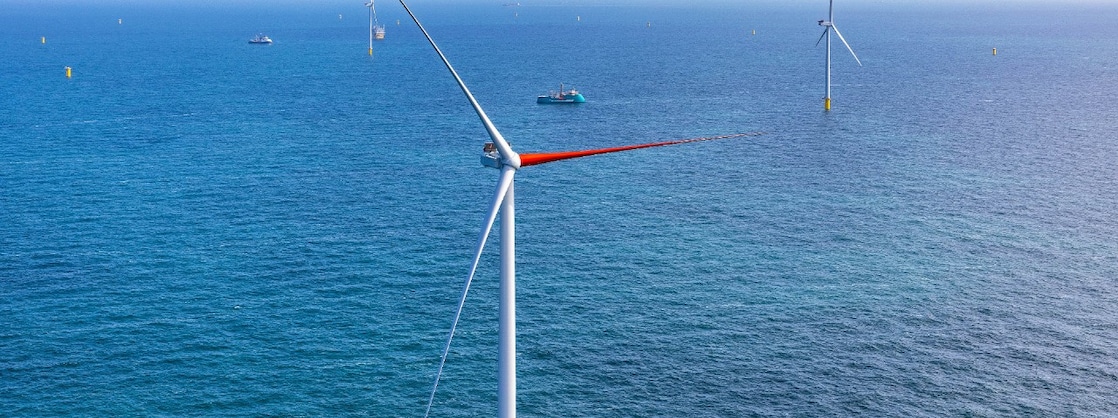
What sets the Ecowende wind farm apart is its pioneering approach to ecological integration. At Ecowende’s initiative, wind turbine manufacturer Vestas has equipped seven turbines with one red-painted rotor blade, to test whether the colour contrast reduces the risk of bird collisions.
Other measures above the waterline include a bird corridor, wider spacing between turbines and elevated nacelles. Also: the wind turbines will temporarily shut down when large numbers of birds are migrating through the wind farm. Radar with AI-supported species recognition for birds and bats will keep watch. Below the waterline, specially designed scour protection, recesses and cavities will provide shelter for fish and other marine life.
Find out more about Ecowende
- Read more at Ecowende.nl
- Read about Shell Netherlands and wind power at Shell.nl/wind
Footnotes
1. Ecowende is a joint venture of Shell (60%), Chubu (30%) and Eneco (10%). The wind farm is officially known as Hollandse Kust West, plot VI.
2. The day-to-day operations and maintenance of the wind farm will be carried out by Eneco Wind Offshore Operations. Electricity trading will be handled by Next Kraftwerke, together with SEEL and EET. Next Kraftwerke began marketing Ecowende’s electricity in June 2026 and will also act as Balancing Service Provider (BSP) and Congestion Service Provider for the wind farm, managing system integration and congestion on the day-ahead, intraday and balancing energy markets on behalf of Ecowende. Next Kraftwerke manages one of Europe’s largest virtual power plants. More than 14,000 decentralised energy producers, consumers and storage facilities are connected to the Next Pool. With generation capacity of more than 15 GW, the company contributes to grid stability and optimises electricity production and consumption based on price signals. It trades its electricity on various European exchanges via its own 24/7 electricity trading platform. Since 2021, Next Kraftwerke has been a wholly owned subsidiary of Shell plc.
Cautionary note
Cautionary note
The companies in which Shell plc directly and indirectly owns investments are separate legal entities. In this announcement “Shell”, “Shell Group” and “Group” are sometimes used for convenience to reference Shell plc and its subsidiaries in general. Likewise, the words “we”, “us” and “our” are also used to refer to Shell plc and its subsidiaries in general or to those who work for them. These terms are also used where no useful purpose is served by identifying the particular entity or entities. ‘‘Subsidiaries’’, “Shell subsidiaries” and “Shell companies” as used in this announcement refer to entities over which Shell plc either directly or indirectly has control. The terms “joint venture”, “joint operations”, “joint arrangements”, and “associates” may also be used to refer to a commercial arrangement in which Shell has a direct or indirect ownership interest with one or more parties. The term “Shell interest” is used for convenience to indicate the direct and/or indirect ownership interest held by Shell in an entity or unincorporated joint arrangement, after exclusion of all third-party interest.
Forward-Looking statements
This announcement contains forward-looking statements (within the meaning of the U.S. Private Securities Litigation Reform Act of 1995) concerning the financial condition, results of operations and businesses of Shell. All statements other than statements of historical fact are, or may be deemed to be, forward-looking statements. Forward-looking statements are statements of future expectations that are based on management’s current expectations and assumptions and involve known and unknown risks and uncertainties that could cause actual results, performance or events to differ materially from those expressed or implied in these statements. Forward-looking statements include, among other things, statements concerning the potential exposure of Shell to market risks and statements expressing management’s expectations, beliefs, estimates, forecasts, projections and assumptions. These forward-looking statements are identified by their use of terms and phrases such as “aim”; “ambition”; ‘‘anticipate’’; “aspire”, “aspiration”, ‘‘believe’’; “commit”; “commitment”; ‘‘could’’; “desire”; ‘‘estimate’’; ‘‘expect’’; ‘‘goals’’; ‘‘intend’’; ‘‘may’’; “milestones”; ‘‘objectives’’; ‘‘outlook’’; ‘‘plan’’; ‘‘probably’’; ‘‘project’’; ‘‘risks’’; “schedule”; ‘‘seek’’; ‘‘should’’; ‘‘target’’; “vision”; ‘‘will’’; “would” and similar terms and phrases. There are a number of factors that could affect the future operations of Shell and could cause those results to differ materially from those expressed in the forward-looking statements included in this announcement, including (without limitation): (a) price fluctuations in crude oil and natural gas; (b) changes in demand for Shell’s products; (c) currency fluctuations; (d) drilling and production results; (e) reserves estimates; (f) loss of market share and industry competition; (g) environmental and physical risks, including climate change; (h) risks associated with the identification of suitable potential acquisition properties and targets, and successful negotiation and completion of such transactions; (i) the risk of doing business in developing countries and countries subject to international sanctions; (j) legislative, judicial, fiscal and regulatory developments including tariffs and regulatory measures addressing climate change; (k) economic and financial market conditions in various countries and regions; (l) political risks, including the risks of expropriation and renegotiation of the terms of contracts with governmental entities, delays or advancements in the approval of projects and delays in the reimbursement for shared costs; (m) risks associated with the impact of pandemics, regional conflicts, such as the Russia-Ukraine war and the conflict in the Middle East, and a significant cyber security, data privacy or IT incident; (n) the pace of the energy transition; and (o) changes in trading conditions. No assurance is provided that future dividend payments will match or exceed previous dividend payments. All forward-looking statements contained in this announcement are expressly qualified in their entirety by the cautionary statements contained or referred to in this section. Readers should not place undue reliance on forward-looking statements. Additional risk factors that may affect future results are contained in Shell plc’s Form 20-F for the year ended December 31, 2025 (available at www.shell.com/investors/news-and-filings/sec-filings.html and www.sec.gov). These risk factors also expressly qualify all forward-looking statements contained in this announcement and should be considered by the reader. Each forward-looking statement speaks only as of the date of this announcement, July 3, 2026. Neither Shell plc nor any of its subsidiaries undertake any obligation to publicly update or revise any forward-looking statement as a result of new information, future events or other information. In light of these risks, results could differ materially from those stated, implied or inferred from the forward-looking statements contained in this announcement.
Shell’s net carbon intensity
Also, in this announcement we may refer to Shell’s “net carbon intensity” (NCI), which includes Shell’s carbon emissions from the production of our energy products, our suppliers’ carbon emissions in supplying energy for that production and our customers’ carbon emissions associated with their use of the energy products we sell. Shell’s NCI also includes the emissions associated with the production and use of energy products produced by others which Shell purchases for resale. Shell only controls its own emissions. The use of the terms Shell’s “net carbon intensity” or NCI is for convenience only and not intended to suggest these emissions are those of Shell plc or its subsidiaries.
Shell’s net-zero emissions target
Shell’s operating plan and outlook are forecasted for a three-year period and ten-year period, respectively, and are updated every year. They reflect the current economic environment and what we can reasonably expect to see over the next three and ten years. Accordingly, the outlook reflects our combined Scope 1 and 2 target, NCI target and our oil products ambition over the next ten years. However, Shell’s operating plan and outlook cannot reflect our 2050 net-zero emissions target, as this target is outside our planning period. Such future operating plans and outlooks could include changes to our portfolio, efficiency improvements and the use of carbon capture and storage and carbon credits. In the future, as society moves towards net-zero emissions, we expect Shell’s operating plans and outlooks to reflect this movement. However, if society is not net zero in 2050, as of today, there would be significant risk that Shell may not meet this target.
Forward-Looking non-GAAP measures
This announcement may contain certain forward-looking non-GAAP measures. We are unable to provide a reconciliation of these forward-looking non-GAAP measures to the most comparable GAAP financial measures because certain information needed to reconcile those non-GAAP measures to the most comparable GAAP financial measures is dependent on future events some of which are outside the control of Shell, such as oil and gas prices, interest rates and exchange rates. Moreover, estimating such GAAP measures with the required precision necessary to provide meaningful reconciliation is extremely difficult and could not be accomplished without unreasonable effort. Non-GAAP measures in respect of future periods which cannot be reconciled to the most comparable GAAP financial measure are calculated in a manner which is consistent with the accounting policies applied in Shell plc’s consolidated financial statements.
The contents of websites referred to in this announcement do not form part of this announcement.
We may have used certain terms, such as resources, in this announcement that the United States Securities and Exchange Commission (SEC) strictly prohibits us from including in our filings with the SEC. Investors are urged to consider closely the disclosure in our Form 20-F, File No 1-32575, available on the SEC website www.sec.gov.