Ecowende: eerste windturbine toonaangevend windpark geplaatst
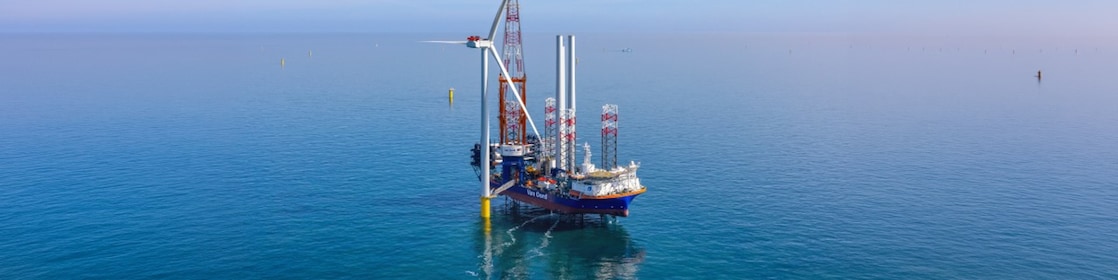
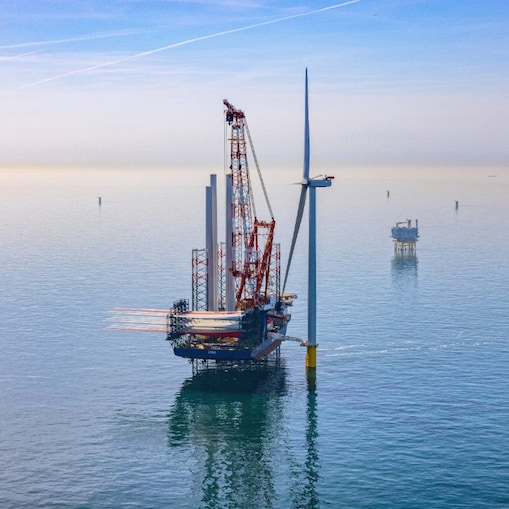
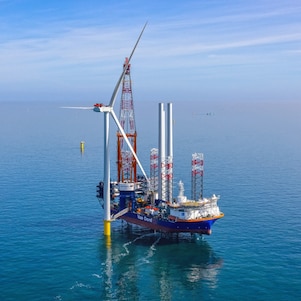
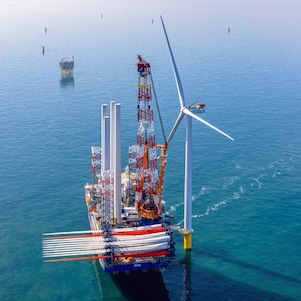
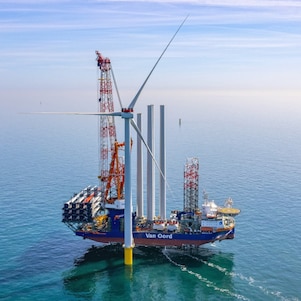
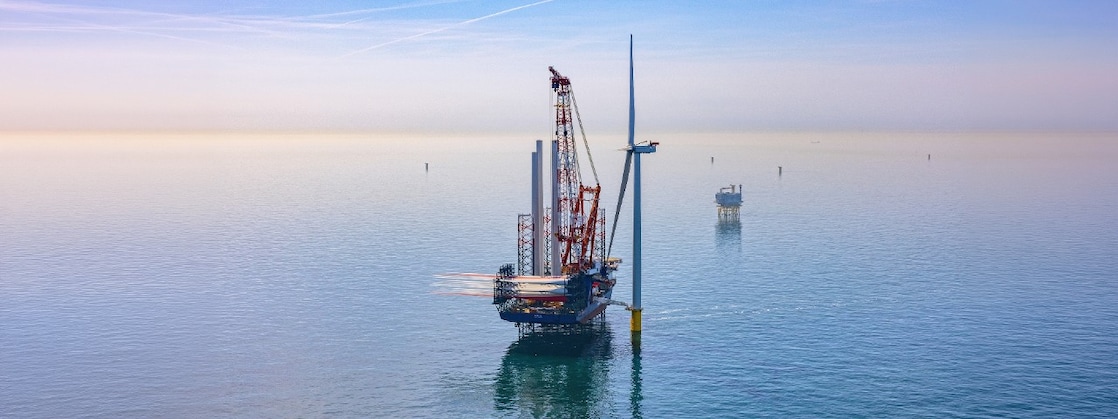
Ecowende — het offshore windpark-project van Shell, Eneco en Chubu — heeft zaterdag 30 mei de eerste windturbine geïnstalleerd. Dat gebeurde op circa 53 kilometer voor de kust van IJmuiden. De installatie werd uitgevoerd door Van Oord met het geavanceerde offshore installatieschip Boreas. Het markeert een mijlpaal voor Ecowende dat een nieuwe ecologische maatstaf stelt voor windparken op de Noordzee.
De installatie omvat in totaal 52 windturbines van het type Vestas V236-15.0 MW, elk met een vermogen van 15 megawatt. Bij volledige operationele ingebruikname levert het Ecowende-windpark (Hollandse Kust West) 760 MW aan het Nederlandse stroomnet. Dat is voldoende om circa 3 procent van de huidige Nederlandse stroomvraag duurzaam te voorzien.
"We zijn verheugd dat we met de installatie van de eerste turbine een concrete stap zetten naar een duurzame energietoekomst voor Nederland in harmonie met de natuur", zegt Tjalling de Bruin, CEO Ecowende. "Dankzij de ruime offshore ervaring van Vestas en Van Oord hebben we alle vertrouwen dat we dit windpark veilig en tijdig kunnen realiseren. Tegelijkertijd kijken we ernaar uit om samen de ecologische innovaties te implementeren die Ecowende zo bijzonder maken."
Rode turbinebladen: innovatie ter bescherming van zeevogels
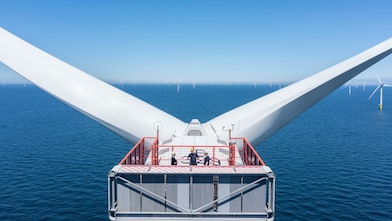
Een van de meest opvallende innovaties bij Ecowende is de inzet van rode turbinebladen. Op initiatief van de windparkontwikkelaar levert Vestas zeven windturbines met één rood geschilderd blad per turbine. Het doel: onderzoeken of de contrasterende kleur de zichtbaarheid van de draaiende rotoren voor vogels vergroot en zo het risico op botsingen vermindert.
Het principe achter het rode blad is het creëren van een zogenoemde 'smear': een zichtbaar kleurcontrast tijdens het ronddraaien dat vogels beter kunnen waarnemen dan traditionele grijze rotors. Bij de kleurkeuze werd rood uiteindelijk verkozen boven zwart en fluorescerend vanwege de prestaties op het gebied van hitteweerstand en bladlevensduur.
Bouwen in harmonie met de natuur
Andere concrete maatregelen omvatten een vogelcorridor tussen de kust en Natura 2000-gebied De Bruine Bank, met grotere tussenruimten tussen turbines en verhoogde gondels om zeevogels meer ruimte te geven onder de wieken. Ook worden adaptieve stilstandregeling en radarbewaking met AI-soortenherkenning ingezet om botsingrisico’s met vogels en vleermuizen te minimaliseren.
Om de effectiviteit van de maatregelen vast te kunnen stellen, past Ecowende verschillende monitoringtechnieken toe, zoals vogelradars, warmte- en daglichtcamera's en impactsensoren.
"De installatie van de eerste windturbine is een bijzonder moment — niet alleen voor Vestas en Ecowende, maar voor de gehele offshore windsector", selt Nils de Baar, president Vestas Noord- & Centraal-Europa. Met 52 V236-15.0 MW-turbines levert dit project het bewijs dat grootschalige windenergie en ecologische verantwoordelijkheid hand in hand gaan. We zijn trots dat onze technologie de ruggengraat vormt van wat straks het meest ecologische offshore windpark ter wereld wordt.”
Offshore installatieschip Boreas: grootste en meest duurzame van zijn soort
De installatie van de windturbines wordt uitgevoerd door Vestas, dat de turbinecomponenten produceert en verantwoordelijk is voor het transport naar en de pre-assemblage in de haven van Eemshaven. Vervolgens transporteert Van Oord de turbines met het installatieschip Boreas naar de locatie op zee. Daar verzorgt Vestas de daadwerkelijke installatie en inbedrijfstelling, gebruikmakend van de expertise van Van Oord en de hoofdkraan van de Boreas. Daarnaast is Van Oord verantwoordelijk voor het transport en de installatie van alle 52 funderingsmonopalen, het aanleggen van de kabels tussen de turbines en het aanbrengen van erosiebescherming op de zeebodem.
Het vlaggenschip van deze operatie is de Boreas, Van Oord’s grootste en meest duurzame schip in zijn klasse. De Boreas beschikt over een hijskraan van 3.310 ton en is specifiek ontworpen voor de nieuwste generatie zeer grote offshore windturbines.
"Met de installatie van de eerste turbine met de Boreas gaan we, na het succesvol afronden van de fundaties, de volgende fase van dit project in", zegt Jan Willem Elleswijk, projectdirecteur bij Van Oord. "Dit schip is specifiek ontworpen voor complete offshore windprojecten. Waarbij het aan hoge ecologische eisen van Ecowende kan voldoen. De inzet van de Boreas op de Noordzee onderstreept de kracht van het ontwerp en de schaal waarop dit schip kan opereren.”
Cautionary note
Cautionary note
The companies in which Shell plc directly and indirectly owns investments are separate legal entities. In this announcement “Shell”, “Shell Group” and “Group” are sometimes used for convenience to reference Shell plc and its subsidiaries in general. Likewise, the words “we”, “us” and “our” are also used to refer to Shell plc and its subsidiaries in general or to those who work for them. These terms are also used where no useful purpose is served by identifying the particular entity or entities. ‘‘Subsidiaries’’, “Shell subsidiaries” and “Shell companies” as used in this announcement refer to entities over which Shell plc either directly or indirectly has control. The terms “joint venture”, “joint operations”, “joint arrangements”, and “associates” may also be used to refer to a commercial arrangement in which Shell has a direct or indirect ownership interest with one or more parties. The term “Shell interest” is used for convenience to indicate the direct and/or indirect ownership interest held by Shell in an entity or unincorporated joint arrangement, after exclusion of all third-party interest.
Forward-Looking statements
This announcement contains forward-looking statements (within the meaning of the U.S. Private Securities Litigation Reform Act of 1995) concerning the financial condition, results of operations and businesses of Shell. All statements other than statements of historical fact are, or may be deemed to be, forward-looking statements. Forward-looking statements are statements of future expectations that are based on management’s current expectations and assumptions and involve known and unknown risks and uncertainties that could cause actual results, performance or events to differ materially from those expressed or implied in these statements. Forward-looking statements include, among other things, statements concerning the potential exposure of Shell to market risks and statements expressing management’s expectations, beliefs, estimates, forecasts, projections and assumptions. These forward-looking statements are identified by their use of terms and phrases such as “aim”; “ambition”; ‘‘anticipate’’; “aspire”, “aspiration”, ‘‘believe’’; “commit”; “commitment”; ‘‘could’’; “desire”; ‘‘estimate’’; ‘‘expect’’; ‘‘goals’’; ‘‘intend’’; ‘‘may’’; “milestones”; ‘‘objectives’’; ‘‘outlook’’; ‘‘plan’’; ‘‘probably’’; ‘‘project’’; ‘‘risks’’; “schedule”; ‘‘seek’’; ‘‘should’’; ‘‘target’’; “vision”; ‘‘will’’; “would” and similar terms and phrases. There are a number of factors that could affect the future operations of Shell and could cause those results to differ materially from those expressed in the forward-looking statements included in this announcement, including (without limitation): (a) price fluctuations in crude oil and natural gas; (b) changes in demand for Shell’s products; (c) currency fluctuations; (d) drilling and production results; (e) reserves estimates; (f) loss of market share and industry competition; (g) environmental and physical risks, including climate change; (h) risks associated with the identification of suitable potential acquisition properties and targets, and successful negotiation and completion of such transactions; (i) the risk of doing business in developing countries and countries subject to international sanctions; (j) legislative, judicial, fiscal and regulatory developments including tariffs and regulatory measures addressing climate change; (k) economic and financial market conditions in various countries and regions; (l) political risks, including the risks of expropriation and renegotiation of the terms of contracts with governmental entities, delays or advancements in the approval of projects and delays in the reimbursement for shared costs; (m) risks associated with the impact of pandemics, regional conflicts, such as the Russia-Ukraine war and the conflict in the Middle East, and a significant cyber security, data privacy or IT incident; (n) the pace of the energy transition; and (o) changes in trading conditions. No assurance is provided that future dividend payments will match or exceed previous dividend payments. All forward-looking statements contained in this announcement are expressly qualified in their entirety by the cautionary statements contained or referred to in this section. Readers should not place undue reliance on forward-looking statements. Additional risk factors that may affect future results are contained in Shell plc’s Form 20-F for the year ended December 31, 2025 (available at www.shell.com/investors/news-and-filings/sec-filings.html and www.sec.gov). These risk factors also expressly qualify all forward-looking statements contained in this announcement and should be considered by the reader. Each forward-looking statement speaks only as of the date of this announcement, June 1, 2026. Neither Shell plc nor any of its subsidiaries undertake any obligation to publicly update or revise any forward-looking statement as a result of new information, future events or other information. In light of these risks, results could differ materially from those stated, implied or inferred from the forward-looking statements contained in this announcement.
Shell’s net carbon intensity
Also, in this announcement we may refer to Shell’s “net carbon intensity” (NCI), which includes Shell’s carbon emissions from the production of our energy products, our suppliers’ carbon emissions in supplying energy for that production and our customers’ carbon emissions associated with their use of the energy products we sell. Shell’s NCI also includes the emissions associated with the production and use of energy products produced by others which Shell purchases for resale. Shell only controls its own emissions. The use of the terms Shell’s “net carbon intensity” or NCI is for convenience only and not intended to suggest these emissions are those of Shell plc or its subsidiaries.
Shell’s net-zero emissions target
Shell’s operating plan and outlook are forecasted for a three-year period and ten-year period, respectively, and are updated every year. They reflect the current economic environment and what we can reasonably expect to see over the next three and ten years. Accordingly, the outlook reflects our combined Scope 1 and 2 target, NCI target and our oil products ambition over the next ten years. However, Shell’s operating plan and outlook cannot reflect our 2050 net-zero emissions target, as this target is outside our planning period. Such future operating plans and outlooks could include changes to our portfolio, efficiency improvements and the use of carbon capture and storage and carbon credits. In the future, as society moves towards net-zero emissions, we expect Shell’s operating plans and outlooks to reflect this movement. However, if society is not net zero in 2050, as of today, there would be significant risk that Shell may not meet this target.
Forward-Looking non-GAAP measures
This announcement may contain certain forward-looking non-GAAP measures. We are unable to provide a reconciliation of these forward-looking non-GAAP measures to the most comparable GAAP financial measures because certain information needed to reconcile those non-GAAP measures to the most comparable GAAP financial measures is dependent on future events some of which are outside the control of Shell, such as oil and gas prices, interest rates and exchange rates. Moreover, estimating such GAAP measures with the required precision necessary to provide meaningful reconciliation is extremely difficult and could not be accomplished without unreasonable effort. Non-GAAP measures in respect of future periods which cannot be reconciled to the most comparable GAAP financial measure are calculated in a manner which is consistent with the accounting policies applied in Shell plc’s consolidated financial statements.
The contents of websites referred to in this announcement do not form part of this announcement.
We may have used certain terms, such as resources, in this announcement that the United States Securities and Exchange Commission (SEC) strictly prohibits us from including in our filings with the SEC. Investors are urged to consider closely the disclosure in our Form 20-F, File No 1-32575, available on the SEC website www.sec.gov.
Lees meer over Shell en wind op zee
Ecowende: first wind turbine of leading wind farm installed
1 Jun 2026
Ecowende, the offshore wind farm project of Shell, Eneco and Chubu, installed its first wind turbine on Saturday 31 May 2026, approximately 53 kilometres (33 miles) off the coast of IJmuiden, the Netherlands. The installation was carried out by Van Oord using the advanced offshore installation vessel Boreas. It marks a milestone for the wind farm that sets a new ecological benchmark for offshore wind development in the North Sea.
The installation comprises a total of 52 Vestas V236-15.0 MW wind turbines, each rated at 15 megawatts. At full operational capacity, the Ecowende wind farm (Hollandse Kust West) will deliver 760 MW to the Dutch electricity grid — sufficient to sustainably supply approximately 3 percent of current national electricity demand.
"We are delighted that the installation of the first turbine marks a concrete step toward a sustainable energy future for the Netherlands, in harmony with nature," Tjalling de Bruin, CEO Ecowende says. "Drawing on the extensive offshore expertise of Vestas and Van Oord, we are fully confident that we can deliver this wind farm safely and on schedule. We also look forward to jointly implementing the ecological innovations that make Ecowende so distinctive."
Red turbine blades: innovation to protect seabirds
One of the most distinctive innovations at Ecowende is the use of red turbine blades. At the initiative of the wind farm developer, Vestas is supplying seven turbines each fitted with a single, red-painted blade. The objective is to investigate whether the contrasting colour improves rotor visibility for birds, thereby reducing collision risk.
The principle behind the red blade is the creation of a so-called ‘smear’ effect — a visible colour contrast during rotation that birds can perceive more readily than conventional grey rotors. In the colour selection process, red was ultimately chosen over black and fluorescent alternatives based on its superior performance in terms of heat resistance and blade longevity.
Building in harmony with nature
Further mitigation measures include a dedicated bird corridor between the coastline and the Natura 2000 area De Bruine Bank, with wider turbine spacing and elevated nacelles to provide seabirds with greater clearance beneath the rotor sweep. Adaptive curtailment systems and radar-based monitoring with AI-assisted species recognition are also being deployed to minimise collision risk for birds and bats.
To assess the effectiveness of these measures, Ecowende is applying a range of monitoring techniques, including bird radars, thermal and daylight cameras, and impact sensors.
"The installation of the first wind turbine is a significant moment — not just for Vestas and Ecowende, but for the entire offshore wind sector," Nils de Baar, President Vestas North & Central Europe, says. "With 52 V236-15.0 MW turbines, this project demonstrates that large-scale wind energy generation and ecological responsibility can go hand in hand. We are proud that our technology forms the backbone of what will become the world’s most ecologically advanced offshore wind farm.”
Offshore installation vessel Boreas: largest and most sustainable of its class
Turbine installation is being carried out by Vestas, which manufactures the turbine components and oversees their transport and pre-assembly at the port of Eemshaven. Van Oord then transports the assembled turbines offshore aboard the Boreas. Once on location, Vestas completes the installation and commissioning — drawing on Van Oord’s expertise and the Boreas’s main crane. In addition, Van Oord is responsible for the transport and installation of all 52 monopile foundations, the inter-array cable installation, and the placement of scour protection on the seabed.
The flagship of this operation is the Boreas, Van Oord’s largest and most sustainable vessel in its class. The Boreas is equipped with a 3,310-tonne crane and has been purpose-built for the latest generation of ultra-large offshore wind turbines.
"With the installation of the first turbine using the Boreas, we are moving into the next phase of this project, following the successful completion of the foundation works," Jan Willem Elleswijk, Project Director Van Oord says. "This vessel has been purpose-designed for complete offshore wind projects and is fully capable of meeting Ecowende’s stringent ecological requirements. The deployment of the Boreas in the North Sea underlines the strength of its design and the scale at which this vessel can operate.”
Cautionary note
Cautionary note
The companies in which Shell plc directly and indirectly owns investments are separate legal entities. In this announcement “Shell”, “Shell Group” and “Group” are sometimes used for convenience to reference Shell plc and its subsidiaries in general. Likewise, the words “we”, “us” and “our” are also used to refer to Shell plc and its subsidiaries in general or to those who work for them. These terms are also used where no useful purpose is served by identifying the particular entity or entities. ‘‘Subsidiaries’’, “Shell subsidiaries” and “Shell companies” as used in this announcement refer to entities over which Shell plc either directly or indirectly has control. The terms “joint venture”, “joint operations”, “joint arrangements”, and “associates” may also be used to refer to a commercial arrangement in which Shell has a direct or indirect ownership interest with one or more parties. The term “Shell interest” is used for convenience to indicate the direct and/or indirect ownership interest held by Shell in an entity or unincorporated joint arrangement, after exclusion of all third-party interest.
Forward-Looking statements
This announcement contains forward-looking statements (within the meaning of the U.S. Private Securities Litigation Reform Act of 1995) concerning the financial condition, results of operations and businesses of Shell. All statements other than statements of historical fact are, or may be deemed to be, forward-looking statements. Forward-looking statements are statements of future expectations that are based on management’s current expectations and assumptions and involve known and unknown risks and uncertainties that could cause actual results, performance or events to differ materially from those expressed or implied in these statements. Forward-looking statements include, among other things, statements concerning the potential exposure of Shell to market risks and statements expressing management’s expectations, beliefs, estimates, forecasts, projections and assumptions. These forward-looking statements are identified by their use of terms and phrases such as “aim”; “ambition”; ‘‘anticipate’’; “aspire”, “aspiration”, ‘‘believe’’; “commit”; “commitment”; ‘‘could’’; “desire”; ‘‘estimate’’; ‘‘expect’’; ‘‘goals’’; ‘‘intend’’; ‘‘may’’; “milestones”; ‘‘objectives’’; ‘‘outlook’’; ‘‘plan’’; ‘‘probably’’; ‘‘project’’; ‘‘risks’’; “schedule”; ‘‘seek’’; ‘‘should’’; ‘‘target’’; “vision”; ‘‘will’’; “would” and similar terms and phrases. There are a number of factors that could affect the future operations of Shell and could cause those results to differ materially from those expressed in the forward-looking statements included in this announcement, including (without limitation): (a) price fluctuations in crude oil and natural gas; (b) changes in demand for Shell’s products; (c) currency fluctuations; (d) drilling and production results; (e) reserves estimates; (f) loss of market share and industry competition; (g) environmental and physical risks, including climate change; (h) risks associated with the identification of suitable potential acquisition properties and targets, and successful negotiation and completion of such transactions; (i) the risk of doing business in developing countries and countries subject to international sanctions; (j) legislative, judicial, fiscal and regulatory developments including tariffs and regulatory measures addressing climate change; (k) economic and financial market conditions in various countries and regions; (l) political risks, including the risks of expropriation and renegotiation of the terms of contracts with governmental entities, delays or advancements in the approval of projects and delays in the reimbursement for shared costs; (m) risks associated with the impact of pandemics, regional conflicts, such as the Russia-Ukraine war and the conflict in the Middle East, and a significant cyber security, data privacy or IT incident; (n) the pace of the energy transition; and (o) changes in trading conditions. No assurance is provided that future dividend payments will match or exceed previous dividend payments. All forward-looking statements contained in this announcement are expressly qualified in their entirety by the cautionary statements contained or referred to in this section. Readers should not place undue reliance on forward-looking statements. Additional risk factors that may affect future results are contained in Shell plc’s Form 20-F for the year ended December 31, 2025 (available at www.shell.com/investors/news-and-filings/sec-filings.html and www.sec.gov). These risk factors also expressly qualify all forward-looking statements contained in this announcement and should be considered by the reader. Each forward-looking statement speaks only as of the date of this announcement, June 1, 2026. Neither Shell plc nor any of its subsidiaries undertake any obligation to publicly update or revise any forward-looking statement as a result of new information, future events or other information. In light of these risks, results could differ materially from those stated, implied or inferred from the forward-looking statements contained in this announcement.
Shell’s net carbon intensity
Also, in this announcement we may refer to Shell’s “net carbon intensity” (NCI), which includes Shell’s carbon emissions from the production of our energy products, our suppliers’ carbon emissions in supplying energy for that production and our customers’ carbon emissions associated with their use of the energy products we sell. Shell’s NCI also includes the emissions associated with the production and use of energy products produced by others which Shell purchases for resale. Shell only controls its own emissions. The use of the terms Shell’s “net carbon intensity” or NCI is for convenience only and not intended to suggest these emissions are those of Shell plc or its subsidiaries.
Shell’s net-zero emissions target
Shell’s operating plan and outlook are forecasted for a three-year period and ten-year period, respectively, and are updated every year. They reflect the current economic environment and what we can reasonably expect to see over the next three and ten years. Accordingly, the outlook reflects our combined Scope 1 and 2 target, NCI target and our oil products ambition over the next ten years. However, Shell’s operating plan and outlook cannot reflect our 2050 net-zero emissions target, as this target is outside our planning period. Such future operating plans and outlooks could include changes to our portfolio, efficiency improvements and the use of carbon capture and storage and carbon credits. In the future, as society moves towards net-zero emissions, we expect Shell’s operating plans and outlooks to reflect this movement. However, if society is not net zero in 2050, as of today, there would be significant risk that Shell may not meet this target.
Forward-Looking non-GAAP measures
This announcement may contain certain forward-looking non-GAAP measures. We are unable to provide a reconciliation of these forward-looking non-GAAP measures to the most comparable GAAP financial measures because certain information needed to reconcile those non-GAAP measures to the most comparable GAAP financial measures is dependent on future events some of which are outside the control of Shell, such as oil and gas prices, interest rates and exchange rates. Moreover, estimating such GAAP measures with the required precision necessary to provide meaningful reconciliation is extremely difficult and could not be accomplished without unreasonable effort. Non-GAAP measures in respect of future periods which cannot be reconciled to the most comparable GAAP financial measure are calculated in a manner which is consistent with the accounting policies applied in Shell plc’s consolidated financial statements.
The contents of websites referred to in this announcement do not form part of this announcement.
We may have used certain terms, such as resources, in this announcement that the United States Securities and Exchange Commission (SEC) strictly prohibits us from including in our filings with the SEC. Investors are urged to consider closely the disclosure in our Form 20-F, File No 1-32575, available on the SEC website www.sec.gov.