FlexH2: hoe offshore wind in de toekomst slimmer naar de juiste plek wordt gestuurd
De perfecte integratie van offshore wind in het energiesysteem van een land is meer dan alleen het verbinden van vraag en aanbod. Zeker als je wilt kunnen kiezen of stroom rechtstreeks naar een duurzame waterstoffabriek of naar het algemene elektriciteitsnet gaat. Een oplossing is FlexH2: een uniek idee dat is uitgewerkt tot ’s werelds eerste proefinstallatie — sinds 7 op de campus van de Technische Universiteit Eindhoven in gebruik.

Tekst: Marcel Burger. Beeld: Shell International, Stuart Conway, Joep van Drunen Photography (FlexH2-serie).
In dit verhaal:
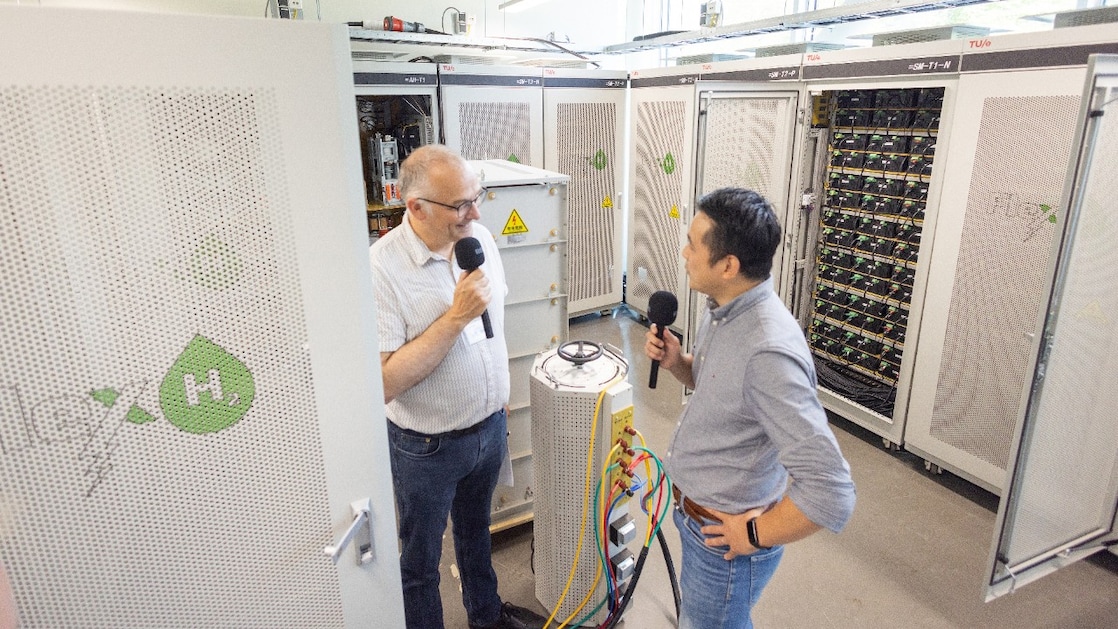
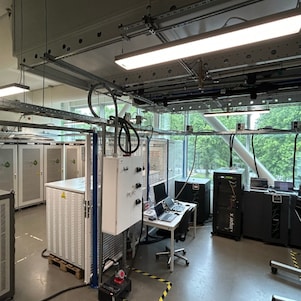
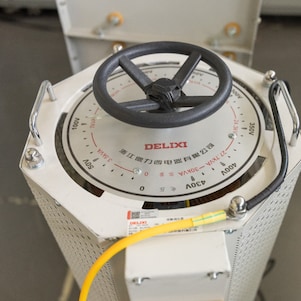
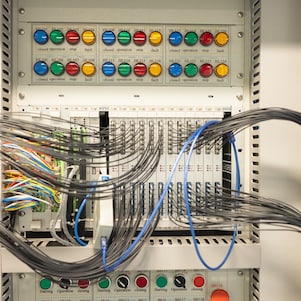
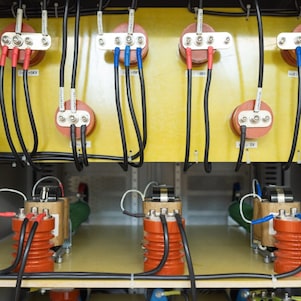
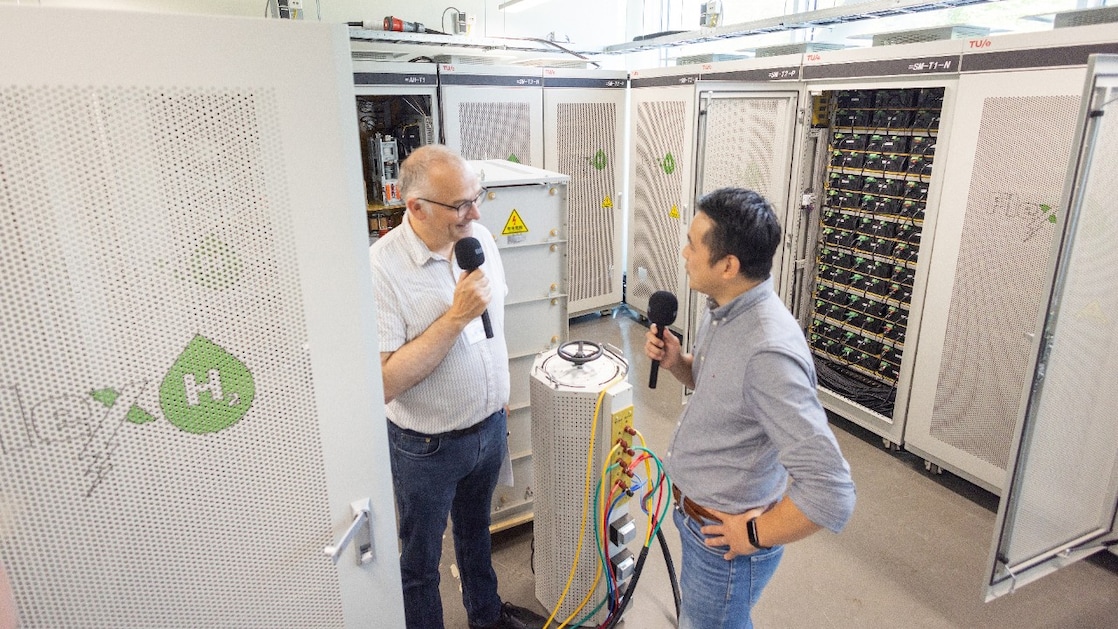
Voor de leek ziet de FlexH2-testopstelling eruit als een wirwar van kasten, kabels en meters — op het eerste gezicht niet heel anders dan een doorsnee computerruimte. Maar dit is een mogelijke toekomst voor het leveren van offshore windenergie. Het ontwerpen en bouwen van de testopstelling kostte vier jaar.
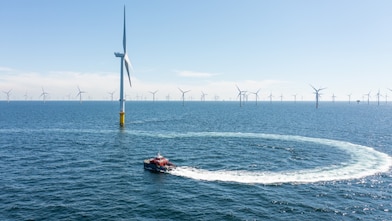
Offshore wind vandaag
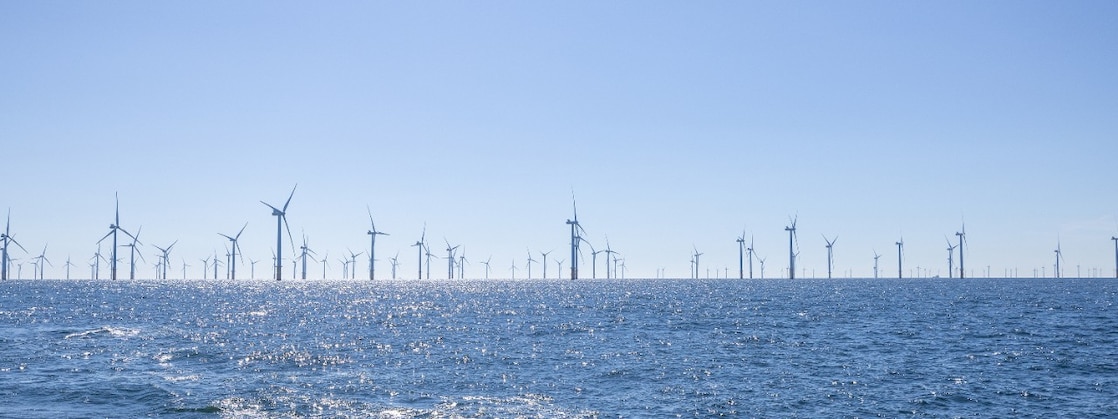
Eerst een uitleg van hoe offshore wind werkt zonder — en met — FlexH2. Net als thuis hebben offshore windparken ook een soort stekkerdoos waarop de afzonderlijke windturbines zijn aangesloten. Dit transformatorstation op zee — een fors platform op palen, uitgerust met installaties en elektronica — verzamelt de elektriciteit in wisselstroom (AC), zet deze om naar hoogspannings‑AC en stuurt die via een kabel naar een transformatorstation op land.
Dat onshore transformatorstation voedt de elektriciteit het stroomnet in. Elektronica zorgt ervoor dat de windturbines synchroon blijven lopen met het elektriciteitsnet aan land. Ofwel: de windturbines leveren alleen stroom als er ruimte is op het stroomnet.
Als een windpark verder dan 80 kilometer uit de kust ligt, moet de elektriciteit onderweg bovendien worden omgezet van wisselstroom (AC) naar gelijkstroom (DC) en daarna weer terug naar wisselstroom (AC) voor het hoogspanningsnet op land. Deze omzettingen zijn nodig voor een stabiel stroomtransport, en daarvoor is een groter en duurder offshore transformatorstation verantwoordelijk.
FlexH2 in het kort en de partners
Het doel van het Flex H2-concept is om een slim, toekomstig elektriciteitsnet voor wind van zee te demonstreren. Daarvoor werken de volgende industriële en onderzoekspartners samen: Shell, ABB, General Electric, DNV, TKF, TNO, TU Delft, TU Eindhoven, Van Oord, Vonk, Energy Innovation NL en het gezamenlijke offshore windonderzoeksprogramma GROW. FlexH2 ontving ook een financiële bijdrage van RVO MOOI (Missiegedreven Onderzoek Ontwikkeling en Innovation) onder toekenningsbesluit MOOI 52103.
Meer weten?
Nederlandse windparken en waterstof
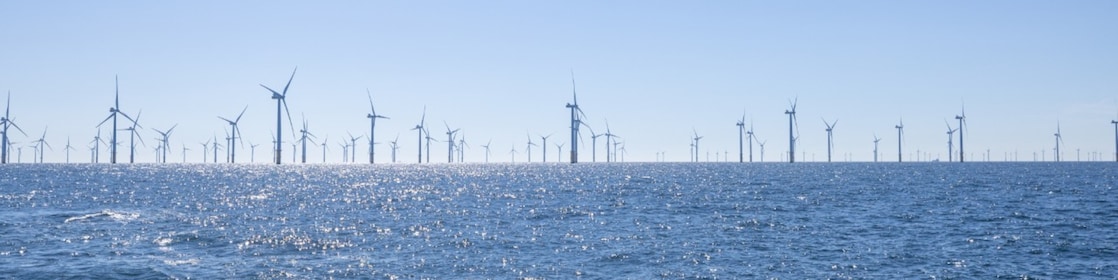
In Nederland liggen de tien bestaande offshore windparken relatief dichtbij de kust, tussen 18 en 60 kilometer van het strand. Daaronder bevinden zich vier windparken die zijn ontwikkeld door Shell en partners: NoordzeeWind, Borssele III & IV (Blauwwind), Hollandse Kust Noord V (CrossWind) en – nog in aanbouw – Hollandse Kust West VI (Ecowende). Ze leveren allemaal elektriciteit aan het net, maar CrossWind zal een deel van de stroom leveren aan de eerste grootschalige duurzame waterstoffabriek van West‑Europa. Deze installatie, Holland Hydrogen 1 (HH1), wordt momenteel gebouwd bij Rotterdam en zal naar verwachting gefaseerd in gebruik worden genomen eind 2026 en in 2027.
HH1 heeft ook een klein transformatorstation dat de wisselstroom (AC) van het net omzet in gelijkstroom (DC) voor de twintig elektrolysers in de fabriek. Deze elektrolysers — installaties ter grootte van een kleine zeecontainer — gebruiken elektriciteit om het zuurstofatoom (O) te scheiden van de twee waterstofatomen (H2). Simpel gezegd: water wordt omgezet in waterstof, met zuurstof als bijproduct. De duurzame waterstof die Holland Hydrogen 1 produceert, wordt vervolgens via een pijpleiding naar Shell Pernis vervoerd, waar deze als energiebron wordt gebruikt om de brandstofproductie in de raffinaderij verder te verduurzamen.
Het FlexH2‑concept: slimmere turbines, slimmere afname
Het FlexH2‑concept is gericht op een intelligentere integratie van energiesystemen, zoals windparken, het stroomnet en de waterstoffabriek. Met FlexH2 zijn de windturbines ‘grid forming’: ze zijn uitgerust met speciale elektronica. Daardoor hoeven ze niet op het hoofd-AC-net te zijn aangesloten. Ze kunnen zelf hun wisselstroom maken, op zee of op afstand, en vervolgens worden gekoppeld aan een eenvoudiger (en daardoor kleiner en lichter) gelijkstroomtransformatorstation (DC).
En dat is goed nieuws voor de transformatorstations van windparken op zee, waar elke vierkante meter en elk kilogram telt. Zodra de stroom opgewekt met het FlexH2‑concept aan land komt, berekent een intelligente ‘energierouter’ of de stroom direct naar een waterstoffabriek moet gaan, naar het elektriciteitsnet, of naar beide. Een slim algoritme neemt die beslissing op basis van elektriciteitsprijzen en/of beschikbare netcapaciteit. Kortom: als het stroomnet overbelast is, kan elektriciteit direct worden doorgestuurd naar een waterstoffabriek — of een andere grote afnemer.
Er is geen zwaar transformatorstation voor nodigFlexH2-windturbines kunnen zelf wisselstroom maken op zee
Kan het Nederlandse net anders werken?
De FlexH2‑oplossing is een innovatie die wereldwijd kan worden toegepast. In Nederland werkt het systeem momenteel echter iets anders, omdat er geen directe stroomkabels zijn tussen windparken en eindgebruikers. Wettelijk is TenneT namens de Nederlandse staat verantwoordelijk voor het net. Daardoor wordt de elektriciteit van het windpark Hollandse Kust Noord (CrossWind) eerst gevoed aan het openbare elektriciteitsnet voordat die Shell Holland Hydrogen 1 bereikt. Alleen voor de laatste aansluiting tussen het landelijke net en de groene waterstoffabriek heeft Shell, in samenwerking met TenneT, een speciale kabel getrokken.
"Als de FlexH2‑testopstelling aantoont dat dit ook anders kan, geeft dat de Nederlandse overheid meer flexibiliteit bij toekomstige locaties voor energieopwekking", zegt Yin Sun, een Shell-ingenieur die vanaf het begin nauw betrokken was bij FlexH2. "Dat kan vooral nuttig zijn bij extreme netcongestie, waarbij een volledige stop op nieuwe of zwaardere netaansluitingen noodzakelijk is." Zoals vanaf 1 juli dit jaar het geval is in grote delen van de provincie Utrecht.
Robuuste proefinstallatie
De werkzaamheden aan de FlexH2‑proefinstallatie duurden vier jaar en is een samenwerking van partners uit de industrie en de Nederlandse academische onderzoekswereld. Yin Sun, ingenieur bij Shell, was nauw betrokken bij het project.
“We zijn in 2019 begonnen met een idee binnen Shell New Energy Research and Technology, toen nog bekend als NERT. De discussies met experts van de OEM’s — de fabrikanten van de oorspronkelijke componenten binnen het concept — waren daarbij essentieel. Samen moesten we een idee omzetten in een werkende, verkleinde laboratoriumopstelling waarin alle afzonderlijke elementen samen konden functioneren.”
Kip-en-ei-probleem
Het vaststellen van wat elk afzonderlijk subsysteem binnen het FlexH2‑concept moest doen, bleek een uitdaging. Sun noemt dit het ‘kip‑en‑ei‑probleem’. Zo moest het gedrag van windturbines onder verschillende omstandigheden parallel worden ontworpen en ontwikkeld met het uitdenken van de andere delen van het systeem. Kortom: er moest worden gewerkt zonder bestaande specificaties. Normaal gesproken werken fabrikanten met wat een energieontwikkelaar hen aan eisen geeft.
“Het resultaat is een robuust proefsysteem”, zegt Sun. Die opstelling is dus nu in bedrijf bij Differ/Technische Universiteit Eindhoven en is vanwege veiligheidsvoorschriften voor middenspanning uitsluitend bedoeld voor onderzoekers. De definitieve testresultaten van deze FlexH2‑demo‑unit worden tegen het einde van het jaar verwacht, als bron van innovatie voor de gehele energiesector.
Cautionary note
Cautionary note
The companies in which Shell plc directly and indirectly owns investments are separate legal entities. In this announcement “Shell”, “Shell Group” and “Group” are sometimes used for convenience to reference Shell plc and its subsidiaries in general. Likewise, the words “we”, “us” and “our” are also used to refer to Shell plc and its subsidiaries in general or to those who work for them. These terms are also used where no useful purpose is served by identifying the particular entity or entities. ‘‘Subsidiaries’’, “Shell subsidiaries” and “Shell companies” as used in this announcement refer to entities over which Shell plc either directly or indirectly has control. The terms “joint venture”, “joint operations”, “joint arrangements”, and “associates” may also be used to refer to a commercial arrangement in which Shell has a direct or indirect ownership interest with one or more parties. The term “Shell interest” is used for convenience to indicate the direct and/or indirect ownership interest held by Shell in an entity or unincorporated joint arrangement, after exclusion of all third-party interest.
Forward-Looking statements
This announcement contains forward-looking statements (within the meaning of the U.S. Private Securities Litigation Reform Act of 1995) concerning the financial condition, results of operations and businesses of Shell. All statements other than statements of historical fact are, or may be deemed to be, forward-looking statements. Forward-looking statements are statements of future expectations that are based on management’s current expectations and assumptions and involve known and unknown risks and uncertainties that could cause actual results, performance or events to differ materially from those expressed or implied in these statements. Forward-looking statements include, among other things, statements concerning the potential exposure of Shell to market risks and statements expressing management’s expectations, beliefs, estimates, forecasts, projections and assumptions. These forward-looking statements are identified by their use of terms and phrases such as “aim”; “ambition”; ‘‘anticipate’’; “aspire”, “aspiration”, ‘‘believe’’; “commit”; “commitment”; ‘‘could’’; “desire”; ‘‘estimate’’; ‘‘expect’’; ‘‘goals’’; ‘‘intend’’; ‘‘may’’; “milestones”; ‘‘objectives’’; ‘‘outlook’’; ‘‘plan’’; ‘‘probably’’; ‘‘project’’; ‘‘risks’’; “schedule”; ‘‘seek’’; ‘‘should’’; ‘‘target’’; “vision”; ‘‘will’’; “would” and similar terms and phrases. There are a number of factors that could affect the future operations of Shell and could cause those results to differ materially from those expressed in the forward-looking statements included in this announcement, including (without limitation): (a) price fluctuations in crude oil and natural gas; (b) changes in demand for Shell’s products; (c) currency fluctuations; (d) drilling and production results; (e) reserves estimates; (f) loss of market share and industry competition; (g) environmental and physical risks, including climate change; (h) risks associated with the identification of suitable potential acquisition properties and targets, and successful negotiation and completion of such transactions; (i) the risk of doing business in developing countries and countries subject to international sanctions; (j) legislative, judicial, fiscal and regulatory developments including tariffs and regulatory measures addressing climate change; (k) economic and financial market conditions in various countries and regions; (l) political risks, including the risks of expropriation and renegotiation of the terms of contracts with governmental entities, delays or advancements in the approval of projects and delays in the reimbursement for shared costs; (m) risks associated with the impact of pandemics, regional conflicts, such as the Russia-Ukraine war and the conflict in the Middle East, and a significant cyber security, data privacy or IT incident; (n) the pace of the energy transition; and (o) changes in trading conditions. No assurance is provided that future dividend payments will match or exceed previous dividend payments. All forward-looking statements contained in this announcement are expressly qualified in their entirety by the cautionary statements contained or referred to in this section. Readers should not place undue reliance on forward-looking statements. Additional risk factors that may affect future results are contained in Shell plc’s Form 20-F for the year ended December 31, 2025 (available at www.shell.com/investors/news-and-filings/sec-filings.html and www.sec.gov). These risk factors also expressly qualify all forward-looking statements contained in this announcement and should be considered by the reader. Each forward-looking statement speaks only as of the date of this announcement, May 14, 2026. Neither Shell plc nor any of its subsidiaries undertake any obligation to publicly update or revise any forward-looking statement as a result of new information, future events or other information. In light of these risks, results could differ materially from those stated, implied or inferred from the forward-looking statements contained in this announcement.
Shell’s net carbon intensity
Also, in this announcement we may refer to Shell’s “net carbon intensity” (NCI), which includes Shell’s carbon emissions from the production of our energy products, our suppliers’ carbon emissions in supplying energy for that production and our customers’ carbon emissions associated with their use of the energy products we sell. Shell’s NCI also includes the emissions associated with the production and use of energy products produced by others which Shell purchases for resale. Shell only controls its own emissions. The use of the terms Shell’s “net carbon intensity” or NCI is for convenience only and not intended to suggest these emissions are those of Shell plc or its subsidiaries.
Shell’s net-zero emissions target
Shell’s operating plan and outlook are forecasted for a three-year period and ten-year period, respectively, and are updated every year. They reflect the current economic environment and what we can reasonably expect to see over the next three and ten years. Accordingly, the outlook reflects our combined Scope 1 and 2 target, NCI target and our oil products ambition over the next ten years. However, Shell’s operating plan and outlook cannot reflect our 2050 net-zero emissions target, as this target is outside our planning period. Such future operating plans and outlooks could include changes to our portfolio, efficiency improvements and the use of carbon capture and storage and carbon credits. In the future, as society moves towards net-zero emissions, we expect Shell’s operating plans and outlooks to reflect this movement. However, if society is not net zero in 2050, as of today, there would be significant risk that Shell may not meet this target.
Forward-Looking non-GAAP measures
This announcement may contain certain forward-looking non-GAAP measures. We are unable to provide a reconciliation of these forward-looking non-GAAP measures to the most comparable GAAP financial measures because certain information needed to reconcile those non-GAAP measures to the most comparable GAAP financial measures is dependent on future events some of which are outside the control of Shell, such as oil and gas prices, interest rates and exchange rates. Moreover, estimating such GAAP measures with the required precision necessary to provide meaningful reconciliation is extremely difficult and could not be accomplished without unreasonable effort. Non-GAAP measures in respect of future periods which cannot be reconciled to the most comparable GAAP financial measure are calculated in a manner which is consistent with the accounting policies applied in Shell plc’s consolidated financial statements.
The contents of websites referred to in this announcement do not form part of this announcement.
We may have used certain terms, such as resources, in this announcement that the United States Securities and Exchange Commission (SEC) strictly prohibits us from including in our filings with the SEC. Investors are urged to consider closely the disclosure in our Form 20-F, File No 1-32575, available on the SEC website www.sec.gov.
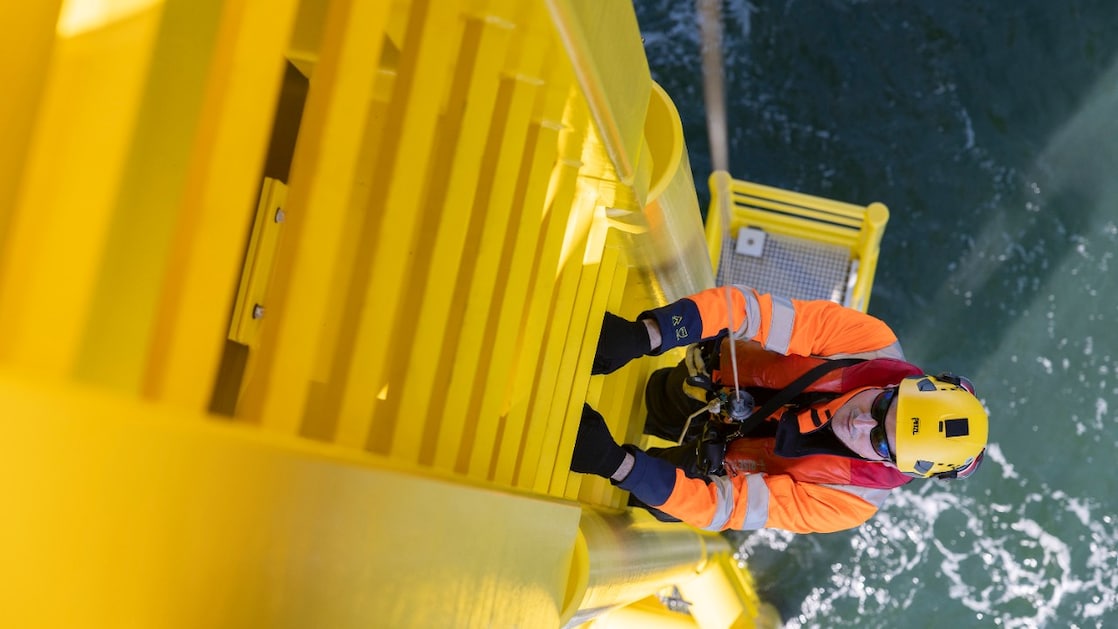
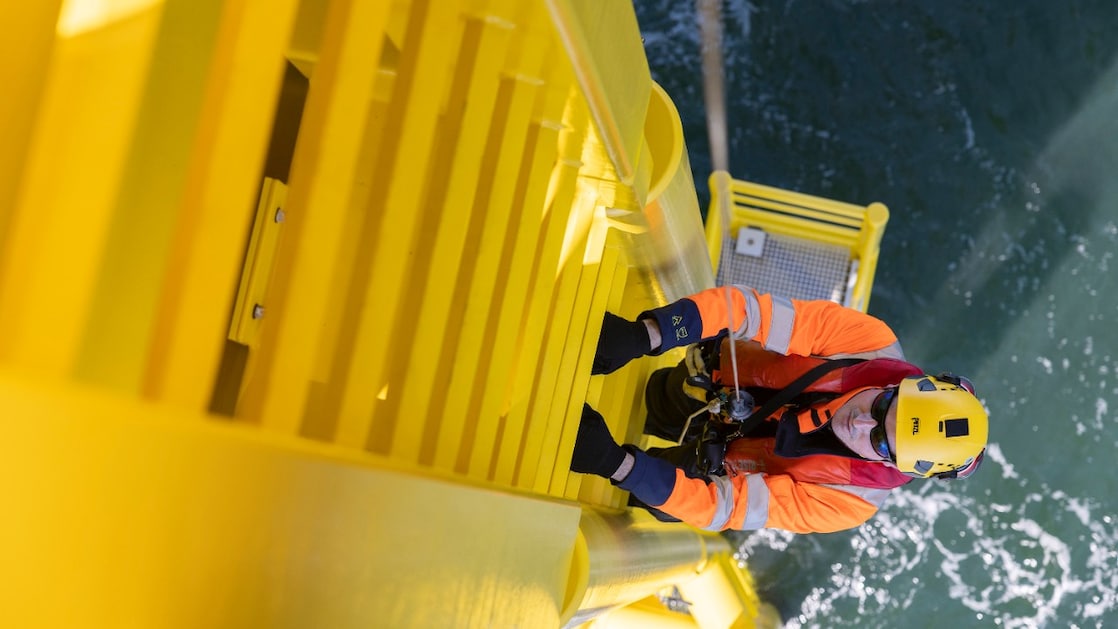
Yin Sun, Shell-ingenieur betrokken bij FlexH2FlexH2 kan nuttig zijn bij extreme netcongestie
FlexH2: how offshore wind will be directed more intelligently to the right place in the future
14 May 2026
The perfect integration of offshore wind in a nation’s energy system is more than just connecting supply and demand. Especially if you want to be able to choose whether electricity goes straight to a renewable hydrogen plant or into the electricity grid. A solution is FlexH2: a unique idea developed into the world’s first pilot installation. It was commissioned on 7 May on the campus of Eindhoven University of Technology.

Text: Marcel Burger. Photography: Shell Internatoinal, Stuart Conway, Joep van Drunen Photography (FlexH2-serie).
To the untrained eye, the FlexH2 test unit looks like a jumble of cabinets, cables and meters – at first glance not very different from a generic computer room. But this is a possible future for delivering offshore wind energy. Designing and building the test unit took four years. First, an explanation of how offshore wind works without — and with — FlexH2.
Offshore wind today
Just like at home, offshore wind farms also have a kind of power strip to which individual wind turbines are connected. This substation — a substantial platform on piles fitted with equipment and electronics — collects the power at alternating current (AC), converts it to high-voltage AC, and sends it via a cable to an onshore substation.
That onshore substation feeds the electricity into the power grid. Electronics ensure that the wind turbines remain synchronised with the power grid onshore. If a wind farm is located more than 80 kilometres (50 miles) offshore, the electricity must also be converted en route from alternating current (AC) to direct current (DC) and back again to alternating current (AC), to connect to the high-voltage grid. These conversions are needed to ensure a stable power transmission, and it requires a larger and more expensive offshore substation.
FlexH2 at a glance, and the partners
The aim of the FlexH2 concept is to demonstrate how a smart electricity grid for future offshore wind could operate. To achieve this, the following industrial and research partners are working together: Shell, ABB, General Electric, DNV, TKF, TNO, Delft University of Technology, Eindhoven University of Technology, Van Oord, Vonk, Energy Innovation NL and the offshore wind joint research programme GROW. The FlexH2 project received funding from the RVO MOOI (Missiegedreven Onderzoek Ontwikkeling en Innovation) under grant agreement MOOI 52103.
Want to know more?
Dutch wind farms and hydrogen
The ten existing Dutch offshore wind farms are located between 18 and 60 kilometres (11 and 37 miles) from the coast. These include four wind farms developed by Shell and partners: NoordzeeWind, Borssele III & IV (Blauwwind), Hollandse Kust Noord V (CrossWind) and — still under construction — Hollandse Kust West VI (Ecowende). All of them supply electricity to the grid, but CrossWind will partly produce power for Western Europe’s first large-scale renewable hydrogen plant. This facility, Holland Hydrogen 1 (HH1), is still under construction near Rotterdam and is expected to be commissioned step by step towards the end of 2026, and into 2027.
HH1 also has a small substation that converts the alternating current (AC) from the grid into direct current (DC) for the 20 electrolysers in the plant. These electrolysers — units roughly the size of a small shipping container — use electricity to split the oxygen molecule (O) from the two hydrogen molecules (H2). In simple terms, water is turned into hydrogen, with oxygen left over as a by-product. The renewable hydrogen produced by Holland Hydrogen 1 is then transported by pipeline to Shell Pernis, where it is used as an energy source to help decarbonise fuel production at the refinery.
The FlexH2 concept: smarter turbines, smarter offtake
The FlexH2 concept aims to create a more intelligent energy system integration, including wind farms, the power grid and a hydrogen factory. With FlexH2 the wind turbines are “grid forming” — equipped with power electronics and controls that mean they do not even need to be connected to the main AC grid. They can run their own AC grid (offshore or remotely) and then connect to a simpler (and therefore smaller and lighter) DC substation connection.
That is especially valuable for offshore substations, where every square meter and kilogram count. Once the electricity generated using the FlexH2 concept reaches land, an intelligent “energy router” calculates whether the power should go directly to a hydrogen plant, to the electricity grid, or to both. A smart algorithm makes this decision based on electricity market prices and/or grid capacity. In short: if the grid is congested, electricity can be routed directly to a hydrogen plant — or to another large consumer.
No need for a heavy substation connectionFlexH2 wind turbines can run their own AC grid offshore
Can the Dutch grid work differently?
The FlexH2 solution is an innovation that can be deployed worldwide. In the Netherlands, however, things currently work slightly differently, as there are no direct power cables between wind farms and end users. As a result, electricity from the Hollandse Kust Noord wind farm (CrossWind) is first fed into the public electricity grid before reaching Shell Holland Hydrogen 1. By law, TenneT is responsible for the grid on behalf of the Dutch state. Only for the final connection between the national grid and Holland Hydrogen 1 has Shell installed a dedicated cable, in cooperation with TenneT.
"If the FlexH2 test unit demonstrates that this can be done differently, it would give the Dutch government more flexibility for future power generation locations," says Yin Sun, a Shell engineer closely involved with the FlexH2 project. "This could be particularly useful in cases of extreme grid congestion, where a complete freeze on new or heavier grid connections must be imposed". As is the case in much of the province of Utrecht from 1 July this year.
Robust pilot installation
Work on the FlexH2 pilot installation took four years and involved partners from industry and the Dutch academic research community. “We started on an idea within Shell New Energy Research and Technology, formerly known as NERT back in 2019. As the coordinator of the FlexH2 project, we need to share the vision with all the project partners and further proof the feasibility of the FlexH2 concept with solid engineering design and electrical calculations,” Sun explains.
“The discussions with experts from the OEMs — the manufacturers of the original components of the concept — were therefore essential. Together, we had to develop an idea into a working down-scaled laboratory set-up in which all the individual elements could operate together.”
Chicken and egg problem
Defining what individual sub-system should perform under the FlexH2 concept is also proven to be a challenge, often referred to as the “chicken and egg” problem. For example, wind turbine behaviour under various conditions needed to be designed and engineered parallel with co-creations of other parts of the system. In short: things had to be produced without any existing specifications, apart from an idea that was still in the making. Normally, manufacturers work with specifications and requirements already set by the energy developer.
“The result is a co-created technical solution, and we show the outstanding technical performance with the help of a robust pilot demo system”, Sun says. This system is now operational at Differ/Eindhoven University of Technology and intended for researchers only, due to medium voltage safety regulation. The final test results of this FlexH2 Demo unit are expected towards the end of the year, and will serve as a source of innovation for the entire energy sector.
Cautionary note
Cautionary note
The companies in which Shell plc directly and indirectly owns investments are separate legal entities. In this announcement “Shell”, “Shell Group” and “Group” are sometimes used for convenience to reference Shell plc and its subsidiaries in general. Likewise, the words “we”, “us” and “our” are also used to refer to Shell plc and its subsidiaries in general or to those who work for them. These terms are also used where no useful purpose is served by identifying the particular entity or entities. ‘‘Subsidiaries’’, “Shell subsidiaries” and “Shell companies” as used in this announcement refer to entities over which Shell plc either directly or indirectly has control. The terms “joint venture”, “joint operations”, “joint arrangements”, and “associates” may also be used to refer to a commercial arrangement in which Shell has a direct or indirect ownership interest with one or more parties. The term “Shell interest” is used for convenience to indicate the direct and/or indirect ownership interest held by Shell in an entity or unincorporated joint arrangement, after exclusion of all third-party interest.
Forward-Looking statements
This announcement contains forward-looking statements (within the meaning of the U.S. Private Securities Litigation Reform Act of 1995) concerning the financial condition, results of operations and businesses of Shell. All statements other than statements of historical fact are, or may be deemed to be, forward-looking statements. Forward-looking statements are statements of future expectations that are based on management’s current expectations and assumptions and involve known and unknown risks and uncertainties that could cause actual results, performance or events to differ materially from those expressed or implied in these statements. Forward-looking statements include, among other things, statements concerning the potential exposure of Shell to market risks and statements expressing management’s expectations, beliefs, estimates, forecasts, projections and assumptions. These forward-looking statements are identified by their use of terms and phrases such as “aim”; “ambition”; ‘‘anticipate’’; “aspire”, “aspiration”, ‘‘believe’’; “commit”; “commitment”; ‘‘could’’; “desire”; ‘‘estimate’’; ‘‘expect’’; ‘‘goals’’; ‘‘intend’’; ‘‘may’’; “milestones”; ‘‘objectives’’; ‘‘outlook’’; ‘‘plan’’; ‘‘probably’’; ‘‘project’’; ‘‘risks’’; “schedule”; ‘‘seek’’; ‘‘should’’; ‘‘target’’; “vision”; ‘‘will’’; “would” and similar terms and phrases. There are a number of factors that could affect the future operations of Shell and could cause those results to differ materially from those expressed in the forward-looking statements included in this announcement, including (without limitation): (a) price fluctuations in crude oil and natural gas; (b) changes in demand for Shell’s products; (c) currency fluctuations; (d) drilling and production results; (e) reserves estimates; (f) loss of market share and industry competition; (g) environmental and physical risks, including climate change; (h) risks associated with the identification of suitable potential acquisition properties and targets, and successful negotiation and completion of such transactions; (i) the risk of doing business in developing countries and countries subject to international sanctions; (j) legislative, judicial, fiscal and regulatory developments including tariffs and regulatory measures addressing climate change; (k) economic and financial market conditions in various countries and regions; (l) political risks, including the risks of expropriation and renegotiation of the terms of contracts with governmental entities, delays or advancements in the approval of projects and delays in the reimbursement for shared costs; (m) risks associated with the impact of pandemics, regional conflicts, such as the Russia-Ukraine war and the conflict in the Middle East, and a significant cyber security, data privacy or IT incident; (n) the pace of the energy transition; and (o) changes in trading conditions. No assurance is provided that future dividend payments will match or exceed previous dividend payments. All forward-looking statements contained in this announcement are expressly qualified in their entirety by the cautionary statements contained or referred to in this section. Readers should not place undue reliance on forward-looking statements. Additional risk factors that may affect future results are contained in Shell plc’s Form 20-F for the year ended December 31, 2025 (available at www.shell.com/investors/news-and-filings/sec-filings.html and www.sec.gov). These risk factors also expressly qualify all forward-looking statements contained in this announcement and should be considered by the reader. Each forward-looking statement speaks only as of the date of this announcement, May 14, 2026. Neither Shell plc nor any of its subsidiaries undertake any obligation to publicly update or revise any forward-looking statement as a result of new information, future events or other information. In light of these risks, results could differ materially from those stated, implied or inferred from the forward-looking statements contained in this announcement.
Shell’s net carbon intensity
Also, in this announcement we may refer to Shell’s “net carbon intensity” (NCI), which includes Shell’s carbon emissions from the production of our energy products, our suppliers’ carbon emissions in supplying energy for that production and our customers’ carbon emissions associated with their use of the energy products we sell. Shell’s NCI also includes the emissions associated with the production and use of energy products produced by others which Shell purchases for resale. Shell only controls its own emissions. The use of the terms Shell’s “net carbon intensity” or NCI is for convenience only and not intended to suggest these emissions are those of Shell plc or its subsidiaries.
Shell’s net-zero emissions target
Shell’s operating plan and outlook are forecasted for a three-year period and ten-year period, respectively, and are updated every year. They reflect the current economic environment and what we can reasonably expect to see over the next three and ten years. Accordingly, the outlook reflects our combined Scope 1 and 2 target, NCI target and our oil products ambition over the next ten years. However, Shell’s operating plan and outlook cannot reflect our 2050 net-zero emissions target, as this target is outside our planning period. Such future operating plans and outlooks could include changes to our portfolio, efficiency improvements and the use of carbon capture and storage and carbon credits. In the future, as society moves towards net-zero emissions, we expect Shell’s operating plans and outlooks to reflect this movement. However, if society is not net zero in 2050, as of today, there would be significant risk that Shell may not meet this target.
Forward-Looking non-GAAP measures
This announcement may contain certain forward-looking non-GAAP measures. We are unable to provide a reconciliation of these forward-looking non-GAAP measures to the most comparable GAAP financial measures because certain information needed to reconcile those non-GAAP measures to the most comparable GAAP financial measures is dependent on future events some of which are outside the control of Shell, such as oil and gas prices, interest rates and exchange rates. Moreover, estimating such GAAP measures with the required precision necessary to provide meaningful reconciliation is extremely difficult and could not be accomplished without unreasonable effort. Non-GAAP measures in respect of future periods which cannot be reconciled to the most comparable GAAP financial measure are calculated in a manner which is consistent with the accounting policies applied in Shell plc’s consolidated financial statements.
The contents of websites referred to in this announcement do not form part of this announcement.
We may have used certain terms, such as resources, in this announcement that the United States Securities and Exchange Commission (SEC) strictly prohibits us from including in our filings with the SEC. Investors are urged to consider closely the disclosure in our Form 20-F, File No 1-32575, available on the SEC website www.sec.gov.
Yin Sun, Shell engineer and part of the FlexH2 teamFlexH2 could be particularly useful with extreme grid congestion