Carrière bij Shell: Dagmar is productiemanager bij NoordzeeWind
Dagmar Eisses is sinds 2022 de productiemanager van Shell NoordzeeWind. Dat betekent dat ze verantwoordelijk is voor de dagelijkse gang van zaken op het windpark, zoals het onderhoud, of de regelgeving wordt nageleefd en voor het contact met de aannemers. Dat doet ze op afstand.

Tekst: Marcel Burger. Beeld: Dagmar Eisses.
For English, click here or scroll down
“Natuurlijk zou ik liever op de fiets of in de auto stappen, maar het blijft een windpark op zee dus een live bezoek is wat ingewikkelder”, zegt Eisses. “Dat doen we met de boot zo’n twee keer per jaar. Het onderstation, de plek waar de kabels van zee aan het Nederlandse elektriciteitsnet zijn gekoppeld, staat wel op land. En in tegenstelling tot de meeste windparken op zee kun je NoordzeeWind wel gemakkelijk zien vanaf het strand.”
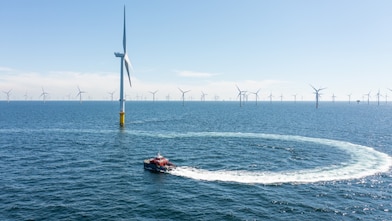
Shell NoordzeeWind was in 2007 een proef om te bewijzen dat wind op zee werkt. Het windpark, met 36 windturbines verspreid over 27 vierkante kilometer, ligt 10 tot 18 kilometer uit de kust, in de buurt van de stad Egmond aan Zee. Onlangs kreeg Shell toestemming voor een levensduurverlenging van het windpark. De activiteiten zullen nog bijna 5 jaar langer doorgaan – bovenop de aanvankelijk geplande 20 jaar. Je leest hier meer over in het verhaal Shell NoordzeeWind: eerste windpark op zee gaat langer mee.
Met hoogtevrees niet aanraden
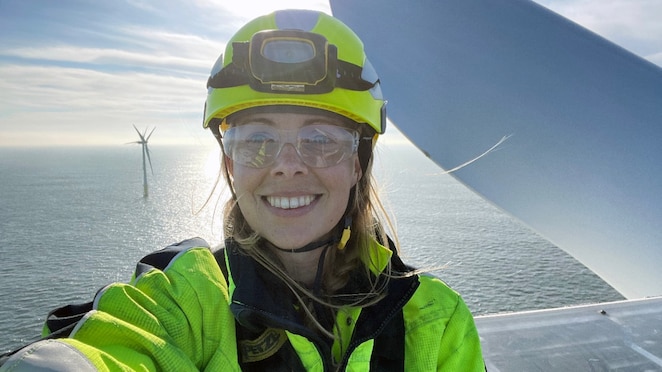
Ze is ook al een paar keer boven in de windturbines geweest. “Ik zou het iemand met hoogtevrees natuurlijk niet aanraden. Als je in de toren naar de top van de nacelle1 gaat – het grootste deel met een lift, het laatste stukje klimmen – dan beweegt die pilaar door de wind best wel. Eenmaal op het dak, uiteraard met harnas en verankerd, kijk je ver uit over de Noordzee. Dat is prachtig!”
Eisses is blij dat wat ooit begon als een proef voor wind op zee, langer dan de beoogde 20 jaar door kan. “De windturbines staan er, ze draaien, doen dat veilig, dus het is juist heel goed dat je voor het kunnen opwekken van die elektriciteit voorlopig geen nieuwe materialen nodig hebt.” Voor de 108 megawatt die NoordzeeWind jaarlijks aan het Nederlandse net levert, heeft techgigant Google een zogenoemd Power Purchase Agreement getekend, dat vanaf 2027 tot het einde van de levensduur van NoordzeeWind in 2031 geldt.
Groene stroom aan Nederland
Toch was er voor het voortzetten van NoordzeeWind wel even een extra investering nodig. Een van de drie stroomkabels die de windturbines met het onderstation op het vaste land verbindt, ging vorig jaar kapot. Reparatie van de kabel, die op sommige plekken drie meter diep in de zeebodem ligt, bleek ingewikkelder dan gedacht. “Maar nu draaien bij volle wind alle 36 turbines weer op volle kracht en leveren groene stroom aan Nederland.”
1. De nacelle is de gestroomlijnde behuizing rond alle bewegende onderdelen bovenin de windturbine. Dus rond de generator, de versnellingsbak, de aandrijflijn en de remeenheid.Heel simpel gezegd: de nacelle is de kop van de molen.

Hoe Nederlands eerste windpark op zee langer meegaat
In de afgelopen decennia heeft Shell NoordzeeWind zijn waarde voor Nederland en Shell bewezen. Aanvankelijk was het eerste offshore windpark van Nederland een samenwerking met Nuon/Vattenfall, maar Shell werd in 2021 volledig eigenaar. Hoe het nu verder gaat in dit langere verhaal.
Cautionary note
Cautionary note
The companies in which Shell plc directly and indirectly owns investments are separate legal entities. In this announcement “Shell”, “Shell Group” and “Group” are sometimes used for convenience where references are made to Shell plc and its subsidiaries in general. Likewise, the words “we”, “us” and “our” are also used to refer to Shell plc and its subsidiaries in general or to those who work for them. These terms are also used where no useful purpose is served by identifying the particular entity or entities. ‘‘Subsidiaries’’, “Shell subsidiaries” and “Shell companies” as used in this announcement refer to entities over which Shell plc either directly or indirectly has control. The term “joint venture”, “joint operations”, “joint arrangements”, and “associates” may also be used to refer to a commercial arrangement in which Shell has a direct or indirect ownership interest with one or more parties. The term “Shell interest” is used for convenience to indicate the direct and/or indirect ownership interest held by Shell in an entity or unincorporated joint arrangement, after exclusion of all third-party interest.
Forward-looking Statements
This announcement contains forward-looking statements (within the meaning of the U.S. Private Securities Litigation Reform Act of 1995) concerning the financial condition, results of operations and businesses of Shell. All statements other than statements of historical fact are, or may be deemed to be, forward-looking statements. Forward-looking statements are statements of future expectations that are based on management’s current expectations and assumptions and involve known and unknown risks and uncertainties that could cause actual results, performance or events to differ materially from those expressed or implied in these statements. Forward-looking statements include, among other things, statements concerning the potential exposure of Shell to market risks and statements expressing management’s expectations, beliefs, estimates, forecasts, projections and assumptions. These forward-looking statements are identified by their use of terms and phrases such as “aim”; “ambition”; ‘‘anticipate’’; ‘‘believe’’; “commit”; “commitment”; ‘‘could’’; ‘‘estimate’’; ‘‘expect’’; ‘‘goals’’; ‘‘intend’’; ‘‘may’’; “milestones”; ‘‘objectives’’; ‘‘outlook’’; ‘‘plan’’; ‘‘probably’’; ‘‘project’’; ‘‘risks’’; “schedule”; ‘‘seek’’; ‘‘should’’; ‘‘target’’; ‘‘will’’; “would” and similar terms and phrases. There are a number of factors that could affect the future operations of Shell and could cause those results to differ materially from those expressed in the forward-looking statements included in this announcement, including (without limitation): (a) price fluctuations in crude oil and natural gas; (b) changes in demand for Shell’s products; (c) currency fluctuations; (d) drilling and production results; (e) reserves estimates; (f) loss of market share and industry competition; (g) environmental and physical risks; (h) risks associated with the identification of suitable potential acquisition properties and targets, and successful negotiation and completion of such transactions; (i) the risk of doing business in developing countries and countries subject to international sanctions; (j) legislative, judicial, fiscal and regulatory developments including regulatory measures addressing climate change; (k) economic and financial market conditions in various countries and regions; (l) political risks, including the risks of expropriation and renegotiation of the terms of contracts with governmental entities, delays or advancements in the approval of projects and delays in the reimbursement for shared costs; (m) risks associated with the impact of pandemics, such as the COVID-19 (coronavirus) outbreak, regional conflicts, such as the Russia-Ukraine war, and a significant cybersecurity breach; and (n) changes in trading conditions. No assurance is provided that future dividend payments will match or exceed previous dividend payments. All forward-looking statements contained in this announcement are expressly qualified in their entirety by the cautionary statements contained or referred to in this section. Readers should not place undue reliance on forward-looking statements. Additional risk factors that may affect future results are contained in Shell plc’s Form 20-F for the year ended December 31, 2024 (available at www.shell.com/investors/news-and-filings/sec-filings.html and www.sec.gov). These risk factors also expressly qualify all forward-looking statements contained in this announcement and should be considered by the reader. Each forward-looking statement speaks only as of the date of this announcement, May 22, 2025. Neither Shell plc nor any of its subsidiaries undertake any obligation to publicly update or revise any forward-looking statement as a result of new information, future events or other information. In light of these risks, results could differ materially from those stated, implied or inferred from the forward-looking statements contained in this announcement.
Shell’s Net Carbon Intensity
Also, in this announcement we may refer to Shell’s “Net Carbon Intensity” (NCI), which includes Shell’s carbon emissions from the production of our energy products, our suppliers’ carbon emissions in supplying energy for that production and our customers’ carbon emissions associated with their use of the energy products we sell. Shell’s NCI also includes the emissions associated with the production and use of energy products produced by others which Shell purchases for resale. Shell only controls its own emissions. The use of the terms Shell’s “Net Carbon Intensity” or NCI are for convenience only and not intended to suggest these emissions are those of Shell plc or its subsidiaries.
Shell’s net-zero emissions target
Shell’s operating plan, outlook and budgets are forecasted for a ten-year period and are updated every year. They reflect the current economic environment and what we can reasonably expect to see over the next ten years. Accordingly, they reflect our Scope 1, Scope 2 and NCI targets over the next ten years. However, Shell’s operating plans cannot reflect our 2050 net-zero emissions target, as this target is currently outside our planning period. In the future, as society moves towards net-zero emissions, we expect Shell’s operating plans to reflect this movement. However, if society is not net zero in 2050, as of today, there would be significant risk that Shell may not meet this target.
Forward-looking non-GAAP measures
This announcement may contain certain forward-looking non-GAAP measures such as cash capital expenditure and divestments. We are unable to provide a reconciliation of these forward-looking non-GAAP measures to the most comparable GAAP financial measures because certain information needed to reconcile those non-GAAP measures to the most comparable GAAP financial measures is dependent on future events some of which are outside the control of Shell, such as oil and gas prices, interest rates and exchange rates. Moreover, estimating such GAAP measures with the required precision necessary to provide a meaningful reconciliation is extremely difficult and could not be accomplished without unreasonable effort. Non-GAAP measures in respect of future periods which cannot be reconciled to the most comparable GAAP financial measure are calculated in a manner which is consistent with the accounting policies applied in Shell plc’s consolidated financial statements.
The contents of websites referred to in this announcement do not form part of this announcement.
We may have used certain terms, such as resources, in this announcement that the United States Securities and Exchange Commission (SEC) strictly prohibits us from including in our filings with the SEC. Investors are urged to consider closely the disclosure in our Form 20-F, File No 1-32575, available on the SEC website www.sec.gov
Careers at Shell: Dagmar is Production Manager at "North Sea Wind"
22 May 2025
Dagmar Eisses has been the Production Manager of Shell NoordzeeWind (lit. North Sea Wind), in the Netherlands, since 2022. This means that she is responsible for the day-to-day operations of the oldest wind farm of Shell, such as maintenance, compliance with regulations and contact with contractors. She does this remotely.

Text: Marcel Burger. Photography: Dagmar Eisses.
"Of course, I would rather get on my bike or in the car, but it is still an offshore wind farm, so a live visit is a bit more complicated," Eisses says. "We do go out by boat about twice a year. The substation, the place where the power cables from the wind farm are connected to the Dutch power grid, is on land and easier to visit. And unlike most offshore wind farms, you can easily see NoordzeeWind from the beach."
Shell NoordzeeWind was a pioneer project in 2007, to prove that offshore wind works. The wind farm, with 36 wind turbines spread over 27 square kilometers (10.4 sq mi) is located 10 to 18 kilometers (6 to 11 miles) off the coast, near the town Egmond aan Zee. Recently, Shell got a lifetime extension on the wind farm, meaning operations will continue for another almost 5 years – on top of the 20 years initially projected.
Do not recommend with a fear of heights
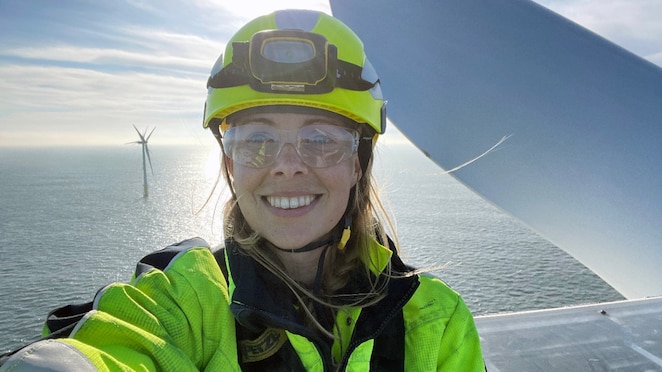
Dagmar has been to the top of the wind turbines of NoordzeeWind a few times. "Of course, I wouldn't recommend it to someone with a fear of heights. If you go to the top of the nacelle1 in the tower – most of it with an elevator, the last bit of climbing – then that pillar moves quite a bit because of the wind. Once on the roof, of course with harness and anchored, you look far out over the North Sea. That's wonderful!"
The Production Manager is pleased that what once started as a trial for offshore wind can continue, beyond the intended 20 years of service. "The wind turbines are there, they are running, safely, so it is very good that you do not need new materials to be able to generate the amount of electricity for the time being." That amount is 108 megawatts, delivered to the Dutch grid, but for which Google signed a so-called Power Purchase Agreement from 2027 to the end of the wind farm’s lifetime in 2031.
Renewable electricity to the Netherlands
Nevertheless, an extra investment was needed to continue NoordzeeWind. One of the three power cables that connect the wind turbines to the substation on the mainland broke down last year. Repairing the cable, which is located three meters (9.8 feet) deep in the seabed in some places, turned out to be more complicated than expected. "But now, when there is a full wind, all 36 turbines are running at full power again and supplying renewable electricity to the Netherlands."
1. The nacelle is the streamlined housing around all moving parts at the top of the wind turbine. So around the generator, the gearbox, the drivetrain and the brake unit. Very simply put: the nacelle is the head of the mill.
Lifetime extension of Shell NoordzeeWind
Shell NoordzeeWind will continue supplying renewable power to the Dutch electricity grid for almost five years longer than initially planned. Built in 2007 off the coast of Egmond aan Zee, the wind farm is in excellent technical condition and has received the permits needed from the Dutch government to operate until 2031. This extension is a testament to Shell's technical and financial expertise.
Cautionary note
Cautionary note
The companies in which Shell plc directly and indirectly owns investments are separate legal entities. In this announcement “Shell”, “Shell Group” and “Group” are sometimes used for convenience where references are made to Shell plc and its subsidiaries in general. Likewise, the words “we”, “us” and “our” are also used to refer to Shell plc and its subsidiaries in general or to those who work for them. These terms are also used where no useful purpose is served by identifying the particular entity or entities. ‘‘Subsidiaries’’, “Shell subsidiaries” and “Shell companies” as used in this announcement refer to entities over which Shell plc either directly or indirectly has control. The term “joint venture”, “joint operations”, “joint arrangements”, and “associates” may also be used to refer to a commercial arrangement in which Shell has a direct or indirect ownership interest with one or more parties. The term “Shell interest” is used for convenience to indicate the direct and/or indirect ownership interest held by Shell in an entity or unincorporated joint arrangement, after exclusion of all third-party interest.
Forward-looking Statements
This announcement contains forward-looking statements (within the meaning of the U.S. Private Securities Litigation Reform Act of 1995) concerning the financial condition, results of operations and businesses of Shell. All statements other than statements of historical fact are, or may be deemed to be, forward-looking statements. Forward-looking statements are statements of future expectations that are based on management’s current expectations and assumptions and involve known and unknown risks and uncertainties that could cause actual results, performance or events to differ materially from those expressed or implied in these statements. Forward-looking statements include, among other things, statements concerning the potential exposure of Shell to market risks and statements expressing management’s expectations, beliefs, estimates, forecasts, projections and assumptions. These forward-looking statements are identified by their use of terms and phrases such as “aim”; “ambition”; ‘‘anticipate’’; ‘‘believe’’; “commit”; “commitment”; ‘‘could’’; ‘‘estimate’’; ‘‘expect’’; ‘‘goals’’; ‘‘intend’’; ‘‘may’’; “milestones”; ‘‘objectives’’; ‘‘outlook’’; ‘‘plan’’; ‘‘probably’’; ‘‘project’’; ‘‘risks’’; “schedule”; ‘‘seek’’; ‘‘should’’; ‘‘target’’; ‘‘will’’; “would” and similar terms and phrases. There are a number of factors that could affect the future operations of Shell and could cause those results to differ materially from those expressed in the forward-looking statements included in this announcement, including (without limitation): (a) price fluctuations in crude oil and natural gas; (b) changes in demand for Shell’s products; (c) currency fluctuations; (d) drilling and production results; (e) reserves estimates; (f) loss of market share and industry competition; (g) environmental and physical risks; (h) risks associated with the identification of suitable potential acquisition properties and targets, and successful negotiation and completion of such transactions; (i) the risk of doing business in developing countries and countries subject to international sanctions; (j) legislative, judicial, fiscal and regulatory developments including regulatory measures addressing climate change; (k) economic and financial market conditions in various countries and regions; (l) political risks, including the risks of expropriation and renegotiation of the terms of contracts with governmental entities, delays or advancements in the approval of projects and delays in the reimbursement for shared costs; (m) risks associated with the impact of pandemics, such as the COVID-19 (coronavirus) outbreak, regional conflicts, such as the Russia-Ukraine war, and a significant cybersecurity breach; and (n) changes in trading conditions. No assurance is provided that future dividend payments will match or exceed previous dividend payments. All forward-looking statements contained in this announcement are expressly qualified in their entirety by the cautionary statements contained or referred to in this section. Readers should not place undue reliance on forward-looking statements. Additional risk factors that may affect future results are contained in Shell plc’s Form 20-F for the year ended December 31, 2024 (available at www.shell.com/investors/news-and-filings/sec-filings.html and www.sec.gov). These risk factors also expressly qualify all forward-looking statements contained in this announcement and should be considered by the reader. Each forward-looking statement speaks only as of the date of this announcement, May 22, 2025. Neither Shell plc nor any of its subsidiaries undertake any obligation to publicly update or revise any forward-looking statement as a result of new information, future events or other information. In light of these risks, results could differ materially from those stated, implied or inferred from the forward-looking statements contained in this announcement.
Shell’s Net Carbon Intensity
Also, in this announcement we may refer to Shell’s “Net Carbon Intensity” (NCI), which includes Shell’s carbon emissions from the production of our energy products, our suppliers’ carbon emissions in supplying energy for that production and our customers’ carbon emissions associated with their use of the energy products we sell. Shell’s NCI also includes the emissions associated with the production and use of energy products produced by others which Shell purchases for resale. Shell only controls its own emissions. The use of the terms Shell’s “Net Carbon Intensity” or NCI are for convenience only and not intended to suggest these emissions are those of Shell plc or its subsidiaries.
Shell’s net-zero emissions target
Shell’s operating plan, outlook and budgets are forecasted for a ten-year period and are updated every year. They reflect the current economic environment and what we can reasonably expect to see over the next ten years. Accordingly, they reflect our Scope 1, Scope 2 and NCI targets over the next ten years. However, Shell’s operating plans cannot reflect our 2050 net-zero emissions target, as this target is currently outside our planning period. In the future, as society moves towards net-zero emissions, we expect Shell’s operating plans to reflect this movement. However, if society is not net zero in 2050, as of today, there would be significant risk that Shell may not meet this target.
Forward-looking non-GAAP measures
This announcement may contain certain forward-looking non-GAAP measures such as cash capital expenditure and divestments. We are unable to provide a reconciliation of these forward-looking non-GAAP measures to the most comparable GAAP financial measures because certain information needed to reconcile those non-GAAP measures to the most comparable GAAP financial measures is dependent on future events some of which are outside the control of Shell, such as oil and gas prices, interest rates and exchange rates. Moreover, estimating such GAAP measures with the required precision necessary to provide a meaningful reconciliation is extremely difficult and could not be accomplished without unreasonable effort. Non-GAAP measures in respect of future periods which cannot be reconciled to the most comparable GAAP financial measure are calculated in a manner which is consistent with the accounting policies applied in Shell plc’s consolidated financial statements.
The contents of websites referred to in this announcement do not form part of this announcement.
We may have used certain terms, such as resources, in this announcement that the United States Securities and Exchange Commission (SEC) strictly prohibits us from including in our filings with the SEC. Investors are urged to consider closely the disclosure in our Form 20-F, File No 1-32575, available on the SEC website www.sec.gov