Hollandse Kust West (Ecowende) in het kort
Met turbinecorridors, perenbomen als onderwaterriffen en kunstmatige intelligentie wordt Hollandse Kust West het meest ecologische windpark van Nederland en daarbuiten. Maar wat gebeurt er nu precies? Een greep uit de 40 innovaties kort op een rij.

Tekst: Laura Prazeres. Beeld: Jelle Hoogendam.
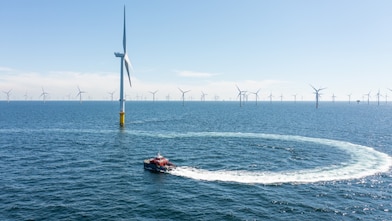
Ecowende is de joint venture van Shell, Eneco en Chubu die windpark Hollandse Kust West (HKW) heeft bedacht, laat bouwen en in bedrijf zal nemen. De opdracht daarbij is om het dierenleven boven en onder de zeespiegel zoveel mogelijk te ontzien, of zelfs een beetje vooruit te helpen.
Daarbij is de schaal omvangrijk en vernieuwend. Het project test en implementeert meer dan 40 maatregelen om de impact op de fauna te minimaliseren en de biodiversiteit te stimuleren. Sommige tests zullen succesvol zijn, andere misschien niet. Hermione van Zutphen, programmamanger Ecologie bij Ecowende, zette de meest relevante en innovatieve maatregelen op rij.
Maatregelen boven water
Ruimere plaatsing van windturbines voor een vogeltrekcorridor
“Er zijn veel vogels die van de Nederlandse kust naar de Bruine Bank vliegen, een beschermd gebied in de Noordzee, dus we hebben onze turbines in enkele zones verder uit elkaar geplaatst om een vogelcorridor te creëren. We hopen dat vogels dit zien als een veilige route.”
Gekleurde rotorbladen
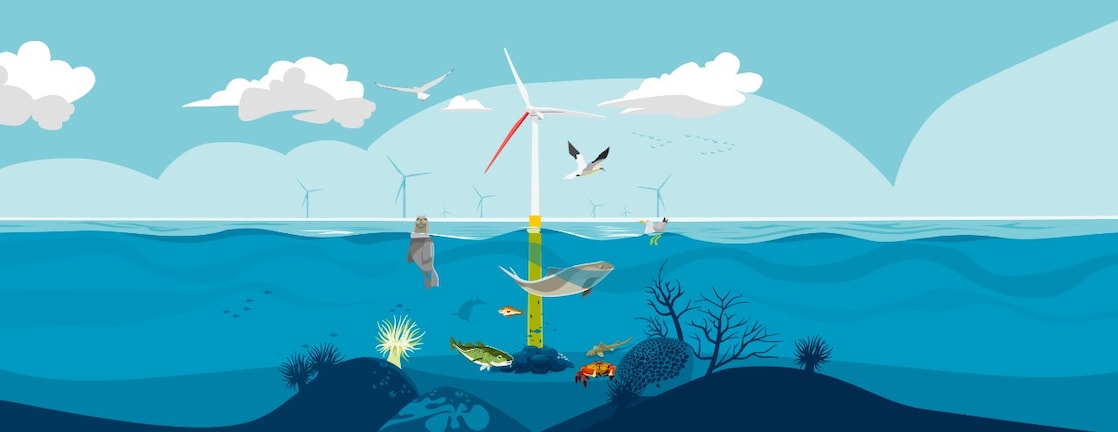
“Wanneer de bladen draaien, lijkt het één groot wit vlak. Door één blad rood te maken, doorbreekt dat het witte beeld en helpt het vogels te zien dat er iets in de weg zit. Hopelijk vliegen ze er dan omheen in plaats van erdoorheen. We testen dit en vergelijken het met normale turbines.”
Grotere afstand tussen wateroppervlak en bladpunt
“We experimenteren met een grotere afstand tussen het wateroppervlak en het onderste bladpunt. Normaal is dat 25 meter; wij hebben er 10 meter aan toegevoegd om meer ruimte te creëren voor vogels die vlak boven het water foerageren (het zoeken en vinden van voedsel in de omgeving; red.). Technisch gezien heeft dit veel impact, omdat er meer staal nodig is voor zowel de turbine als de fundering.”
Bladbotsingssensoren
“We hebben sensoren op alle bladen van enkele turbines en camera’s op het platform om te registreren of er een vogel of vleermuis tegenaan is gevlogen. Als een vogel een blad raakt, valt hij in het water – er is geen bewijs. Dit helpt ons het gedrag van de dieren beter te begrijpen.”
AI-software voor soortherkenning en geluidsafschrikking
“Overdag gebruiken we AI die herkent wanneer vogels te dicht bij de turbines komen en dreigen te botsen. Het systeem activeert dan afschrikkende geluiden. Als dat niet werkt, kan het systeem de turbine automatisch in stilstand zetten zodat de vogel kan passeren.”
AI-herkenning ’s nachts
“We trainen AI-modellen om ’s nachts soorten te onderscheiden – met warmtecamera’s. Vleermuizen en zangvogels zijn even groot, soms maar 8 centimeter, dus we analyseren vluchtgedrag, warmtesignaturen en vleugelslag om het verschil te zien.”
Maatregelen onder water
Geluidsreductie bij installatie van monopiles
“We testen verschillende technieken om geluid te verminderen tijdens de plaatsing van de funderingen en turbines. Bijvoorbeeld door een gordijn van waterbellen rondom de pilaren (monopiles; red.) te creëren, wat geluid dempt en soorten zoals bruinvissen en dolfijnen beschermt.”
Eco-erosiebescherming
“We brengen vier verschillende soorten erosiebescherming aan op de funderingen van de monopiles. De stenen bieden een leefomgeving voor vissen en andere soorten. Onderzoekers nemen monsters om te zien welke organismen erop groeien.”
Visgaten in de monopiles
“We voegen aan de monopiles extra openingen toe voor vissen. Met camera’s en wateranalyses onderzoeken we of de binnenkant van de monopiles een geschikt leefgebied vormt.”
Akoestische meetstations
“We hebben 14 meetstations op de zeebodem die het klikgeluid van bruinvissen registreren om de impact van het windpark te monitoren. Er zijn zeven stations binnen het park en zeven erbuiten om zo de twee zones met elkaar te vergelijken. We hebben zelfs al inktviseieren gevonden.”
Oude perenbomen als riffen
“We gebruiken afgedankte perenbomen uit Nederlandse boomgaarden als biologisch afbreekbare rifstructuren op de zeebodem. Roggen en haaien kunnen ze gebruiken als schuilplaats of om eieren af te zetten. In plaats van verbranding vonden we dit een circulaire manier om natuurlijke materialen opnieuw in te zetten.”
Cautionary note
Cautionary note
The companies in which Shell plc directly and indirectly owns investments are separate legal entities. In this story “Shell”, “Shell Group” and “Group” are sometimes used for convenience to reference Shell plc and its subsidiaries in general. Likewise, the words “we”, “us” and “our” are also used to refer to Shell plc and its subsidiaries in general or to those who work for them. These terms are also used where no useful purpose is served by identifying the particular entity or entities. ‘‘Subsidiaries’’, “Shell subsidiaries” and “Shell companies” as used in this storyrefer to entities over which Shell plc either directly or indirectly has control. The terms “joint venture”, “joint operations”, “joint arrangements”, and “associates” may also be used to refer to a commercial arrangement in which Shell has a direct or indirect ownership interest with one or more parties. The term “Shell interest” is used for convenience to indicate the direct and/or indirect ownership interest held by Shell in an entity or unincorporated joint arrangement, after exclusion of all third-party interest.
Forward-Looking statements
This story contains forward-looking statements (within the meaning of the U.S. Private Securities Litigation Reform Act of 1995) concerning the financial condition, results of operations and businesses of Shell. All statements other than statements of historical fact are, or may be deemed to be, forward-looking statements. Forward-looking statements are statements of future expectations that are based on management’s current expectations and assumptions and involve known and unknown risks and uncertainties that could cause actual results, performance or events to differ materially from those expressed or implied in these statements. Forward-looking statements include, among other things, statements concerning the potential exposure of Shell to market risks and statements expressing management’s expectations, beliefs, estimates, forecasts, projections and assumptions. These forward-looking statements are identified by their use of terms and phrases such as “aim”; “ambition”; ‘‘anticipate’’; “aspire”, “aspiration”, ‘‘believe’’; “commit”; “commitment”; ‘‘could’’; “desire”; ‘‘estimate’’; ‘‘expect’’; ‘‘goals’’; ‘‘intend’’; ‘‘may’’; “milestones”; ‘‘objectives’’; ‘‘outlook’’; ‘‘plan’’; ‘‘probably’’; ‘‘project’’; ‘‘risks’’; “schedule”; ‘‘seek’’; ‘‘should’’; ‘‘target’’; “vision”; ‘‘will’’; “would” and similar terms and phrases. There are a number of factors that could affect the future operations of Shell and could cause those results to differ materially from those expressed in the forward-looking statements included in this story, including (without limitation): (a) price fluctuations in crude oil and natural gas; (b) changes in demand for Shell’s products; (c) currency fluctuations; (d) drilling and production results; (e) reserves estimates; (f) loss of market share and industry competition; (g) environmental and physical risks, including climate change; (h) risks associated with the identification of suitable potential acquisition properties and targets, and successful negotiation and completion of such transactions; (i) the risk of doing business in developing countries and countries subject to international sanctions; (j) legislative, judicial, fiscal and regulatory developments including tariffs and regulatory measures addressing climate change; (k) economic and financial market conditions in various countries and regions; (l) political risks, including the risks of expropriation and renegotiation of the terms of contracts with governmental entities, delays or advancements in the approval of projects and delays in the reimbursement for shared costs; (m) risks associated with the impact of pandemics, regional conflicts, such as the Russia-Ukraine war and the conflict in the Middle East, and a significant cyber security, data privacy or IT incident; (n) the pace of the energy transition; and (o) changes in trading conditions. No assurance is provided that future dividend payments will match or exceed previous dividend payments. All forward-looking statements contained in this story are expressly qualified in their entirety by the cautionary statements contained or referred to in this section. Readers should not place undue reliance on forward-looking statements. Additional risk factors that may affect future results are contained in Shell plc’s Form 20-F and amendment thereto for the year ended December 31, 2024 (available at www.shell.com/investors/news-and-filings/sec-filings.html and www.sec.gov). These risk factors also expressly qualify all forward-looking statements contained in this story and should be considered by the reader. Each forward-looking statement speaks only as of the date of this story, January 22, 2026. Neither Shell plc nor any of its subsidiaries undertake any obligation to publicly update or revise any forward-looking statement as a result of new information, future events or other information. In light of these risks, results could differ materially from those stated, implied or inferred from the forward-looking statements contained in this story.
Shell’s net carbon intensity
Also, in this story we may refer to Shell’s “net carbon intensity” (NCI), which includes Shell’s carbon emissions from the production of our energy products, our suppliers’ carbon emissions in supplying energy for that production and our customers’ carbon emissions associated with their use of the energy products we sell. Shell’s NCI also includes the emissions associated with the production and use of energy products produced by others which Shell purchases for resale. Shell only controls its own emissions. The use of the terms Shell’s “net carbon intensity” or NCI is for convenience only and not intended to suggest these emissions are those of Shell plc or its subsidiaries.
Shell’s net-zero emissions target
Shell’s operating plan and outlook are forecasted for a three-year period and ten-year period, respectively, and are updated every year. They reflect the current economic environment and what we can reasonably expect to see over the next three and ten years. Accordingly, the outlook reflects our Scope 1, Scope 2 and NCI targets over the next ten years. However, Shell’s operating plan and outlook cannot reflect our 2050 net-zero emissions target, as this target is outside our planning period. Such future operating plans and outlooks could include changes to our portfolio, efficiency improvements and the use of carbon capture and storage and carbon credits. In the future, as society moves towards net-zero emissions, we expect Shell’s operating plans and outlooks to reflect this movement. However, if society is not net zero in 2050, as of today, there would be significant risk that Shell may not meet this target.
Forward-Looking non-GAAP measures
This story may contain certain forward-looking non-GAAP measures such as adjusted earnings and divestments. We are unable to provide a reconciliation of these forward-looking non-GAAP measures to the most comparable GAAP financial measures because certain information needed to reconcile those non-GAAP measures to the most comparable GAAP financial measures is dependent on future events some of which are outside the control of Shell, such as oil and gas prices, interest rates and exchange rates. Moreover, estimating such GAAP measures with the required precision necessary to provide a meaningful reconciliation is extremely difficult and could not be accomplished without unreasonable effort. Non-GAAP measures in respect of future periods which cannot be reconciled to the most comparable GAAP financial measure are calculated in a manner which is consistent with the accounting policies applied in Shell plc’s consolidated financial statements.
The contents of websites referred to in this story do not form part of this story.
We may have used certain terms, such as resources, in this story that the United States Securities and Exchange Commission (SEC) strictly prohibits us from including in our filings with the SEC. Investors are urged to consider closely the disclosure in our Form 20-F and any amendment thereto, File No 1-32575, available on the SEC website www.sec.gov.
Highlights of Ecowende: sensors, cameras, action!
22 Jan. 2026
Imagine a wind farm where birds fly safely through turbine corridors, old pear trees become underwater reefs, and artificial intelligence is used to help protect wildlife. That’s the vision behind Shell’s offshore wind project Hollandse Kust West, about 50 kilometres (31 miles) from the Dutch coast.

Text: Laura Prazeres. Imagery: Jelle Hoogendam.
Ecowende is the joint venture between Shell, Eneco and Chubu that is building and will run the Hollandse Kust West (HKW) wind farm. Its mission is to minimise the disturbance to marine and bird life—both above and below the waterline—or even to give nature a helping hand.
The scope is extensive and pioneering. The project is piloting and implementing over 40 measures to minimise impact on wildlife and boost diversity, both above and below the water surface. Some trials will prove successful, others perhaps less so. Hermione van Zutphen, Ecowende’s Ecology Programme Manager, outlines the most relevant and innovative measures.
Measures above the waterline
Spacing of wind turbines for a bird corridor
“There are a lot of birds that fly from the Dutch coast to the Brown Bank, which is a protected area in the North Sea, so we spaced our wind turbines further apart in some areas to create a bird corridor. We hope that the birds can see it as a safe space to fly through.”
Coloured blades
“When the blades are rotating, it just looks like a white area, so by colouring one blade red, it breaks up that white space and helps birds to see that there is something in the way. Hopefully they will then go around the turbine rather than trying to fly across. So, we're trying that and then comparing it with normal turbines to see what the impact is.”
Increased space between blades and water surface
“We are experimenting with an increased distance between the sea surface and the lower blade tip. Normally it’s 25 metres, so we added another 10 metres on our turbines to create more space below the blades for birds that forage on the water surface. From a technical point of view, that's quite an impact because we're adding steel not just to the turbine but also to the foundations, because everything is heavier and bigger.”
Blade collision monitoring sensors
“We have sensors integrated on all the blades of some turbines and cameras on the platform to monitor if there was a collision with a bird or bat, because there’s still a lot we don't know about offshore wind’s impact on seabirds. If a bird hits a blade, it disappears in the water – there’s no evidence. So, this will help us better understand wildlife behaviours.”
AI species recognition software and sound deterrence
“During the day, we’re using an artificial intelligence (AI) species recognition software, which detects when a bird is getting too close to the turbines and is on a collision course. It will trigger sounds to deter and scare away the birds, but if all the previous measures fail, then the automated system can put the turbine in idle; the bird can pass, and then you start up again.”
AI species recognition software at night
“We’re using AI software to identify bird species, so that’s a big step in innovation. The next step in the innovation is to train AI models to be able to distinguish between bats or perching birds at night, using thermal images. These species groups are of a similar size (as small as 8 cm), so we really need to look at the characteristics of their flights, thermal signatures and wing beat to be able to distinguish between the two.”
Measures underneath the waterline
Sound reduction techniques during monopile installation
“We’re piloting and using different techniques to minimise noise during installation. For example, creating a curtain of water bubbles when installing the monopiles (a steel foundation that anchors the turbines to the seabed) to provide a sound barrier and reduce noise to protect species like harbour porpoises and dolphins. These species communicate with, and are very sensitive to, sounds in their environment.”
Eco-scour protection
“We are creating four different scour protection designs at the base of the monopiles. Scour is the phenomenon of waves and underwater currents washing away sand, and if that occurs over time, the monopile loses stability. The rocks at the base of the monopile offer habitat and shelter for fish and other species. We're piloting different rock sizes and shapes and researchers will also take samples of the rocks on the scour protection to see which organisms grow on it.”
Fish holes in monopiles
“Additional holes are added to the monopiles, specifically for fish. These holes are being monitored with cameras and the chemical composition of the water, to investigate whether the inside of the monopiles provide a suitable habitat for fish and other sea life.”
Acoustic monitoring stations
“We have 14 acoustic monitoring stations on the seabed to register harbour porpoises’ clicking calls and monitor the impact of the wind farm. There are seven stations within the wind farm and seven beyond the area to compare disturbance levels pre-construction, during construction and during operations. The frames are not that big, but we already found squid eggs on them. So, it’s quite amazing to see!”
Old pear trees as reefs
“We’re also using end-of-life pear trees from Dutch fruit orchards to create a biodegradable tree reef on the seabed. Species like rays and sharks can use these as shelter and a natural habitat to lay their eggs. These old trees are normally cut down and used as firewood, but we thought this would be a nice circular way of building a reef with natural materials. Also, wood has always been a natural part of the North Sea due to fallen trees washing down the rivers.”
Cautionary note
Cautionary note
The companies in which Shell plc directly and indirectly owns investments are separate legal entities. In this story “Shell”, “Shell Group” and “Group” are sometimes used for convenience to reference Shell plc and its subsidiaries in general. Likewise, the words “we”, “us” and “our” are also used to refer to Shell plc and its subsidiaries in general or to those who work for them. These terms are also used where no useful purpose is served by identifying the particular entity or entities. ‘‘Subsidiaries’’, “Shell subsidiaries” and “Shell companies” as used in this storyrefer to entities over which Shell plc either directly or indirectly has control. The terms “joint venture”, “joint operations”, “joint arrangements”, and “associates” may also be used to refer to a commercial arrangement in which Shell has a direct or indirect ownership interest with one or more parties. The term “Shell interest” is used for convenience to indicate the direct and/or indirect ownership interest held by Shell in an entity or unincorporated joint arrangement, after exclusion of all third-party interest.
Forward-Looking statements
This story contains forward-looking statements (within the meaning of the U.S. Private Securities Litigation Reform Act of 1995) concerning the financial condition, results of operations and businesses of Shell. All statements other than statements of historical fact are, or may be deemed to be, forward-looking statements. Forward-looking statements are statements of future expectations that are based on management’s current expectations and assumptions and involve known and unknown risks and uncertainties that could cause actual results, performance or events to differ materially from those expressed or implied in these statements. Forward-looking statements include, among other things, statements concerning the potential exposure of Shell to market risks and statements expressing management’s expectations, beliefs, estimates, forecasts, projections and assumptions. These forward-looking statements are identified by their use of terms and phrases such as “aim”; “ambition”; ‘‘anticipate’’; “aspire”, “aspiration”, ‘‘believe’’; “commit”; “commitment”; ‘‘could’’; “desire”; ‘‘estimate’’; ‘‘expect’’; ‘‘goals’’; ‘‘intend’’; ‘‘may’’; “milestones”; ‘‘objectives’’; ‘‘outlook’’; ‘‘plan’’; ‘‘probably’’; ‘‘project’’; ‘‘risks’’; “schedule”; ‘‘seek’’; ‘‘should’’; ‘‘target’’; “vision”; ‘‘will’’; “would” and similar terms and phrases. There are a number of factors that could affect the future operations of Shell and could cause those results to differ materially from those expressed in the forward-looking statements included in this story, including (without limitation): (a) price fluctuations in crude oil and natural gas; (b) changes in demand for Shell’s products; (c) currency fluctuations; (d) drilling and production results; (e) reserves estimates; (f) loss of market share and industry competition; (g) environmental and physical risks, including climate change; (h) risks associated with the identification of suitable potential acquisition properties and targets, and successful negotiation and completion of such transactions; (i) the risk of doing business in developing countries and countries subject to international sanctions; (j) legislative, judicial, fiscal and regulatory developments including tariffs and regulatory measures addressing climate change; (k) economic and financial market conditions in various countries and regions; (l) political risks, including the risks of expropriation and renegotiation of the terms of contracts with governmental entities, delays or advancements in the approval of projects and delays in the reimbursement for shared costs; (m) risks associated with the impact of pandemics, regional conflicts, such as the Russia-Ukraine war and the conflict in the Middle East, and a significant cyber security, data privacy or IT incident; (n) the pace of the energy transition; and (o) changes in trading conditions. No assurance is provided that future dividend payments will match or exceed previous dividend payments. All forward-looking statements contained in this story are expressly qualified in their entirety by the cautionary statements contained or referred to in this section. Readers should not place undue reliance on forward-looking statements. Additional risk factors that may affect future results are contained in Shell plc’s Form 20-F and amendment thereto for the year ended December 31, 2025 (available at www.shell.com/investors/news-and-filings/sec-filings.html and www.sec.gov). These risk factors also expressly qualify all forward-looking statements contained in this story and should be considered by the reader. Each forward-looking statement speaks only as of the date of this story, January 22, 2026. Neither Shell plc nor any of its subsidiaries undertake any obligation to publicly update or revise any forward-looking statement as a result of new information, future events or other information. In light of these risks, results could differ materially from those stated, implied or inferred from the forward-looking statements contained in this story.
Shell’s net carbon intensity
Also, in this story we may refer to Shell’s “net carbon intensity” (NCI), which includes Shell’s carbon emissions from the production of our energy products, our suppliers’ carbon emissions in supplying energy for that production and our customers’ carbon emissions associated with their use of the energy products we sell. Shell’s NCI also includes the emissions associated with the production and use of energy products produced by others which Shell purchases for resale. Shell only controls its own emissions. The use of the terms Shell’s “net carbon intensity” or NCI is for convenience only and not intended to suggest these emissions are those of Shell plc or its subsidiaries.
Shell’s net-zero emissions target
Shell’s operating plan and outlook are forecasted for a three-year period and ten-year period, respectively, and are updated every year. They reflect the current economic environment and what we can reasonably expect to see over the next three and ten years. Accordingly, the outlook reflects our Scope 1, Scope 2 and NCI targets over the next ten years. However, Shell’s operating plan and outlook cannot reflect our 2050 net-zero emissions target, as this target is outside our planning period. Such future operating plans and outlooks could include changes to our portfolio, efficiency improvements and the use of carbon capture and storage and carbon credits. In the future, as society moves towards net-zero emissions, we expect Shell’s operating plans and outlooks to reflect this movement. However, if society is not net zero in 2050, as of today, there would be significant risk that Shell may not meet this target.
Forward-Looking non-GAAP measures
This story may contain certain forward-looking non-GAAP measures such as adjusted earnings and divestments. We are unable to provide a reconciliation of these forward-looking non-GAAP measures to the most comparable GAAP financial measures because certain information needed to reconcile those non-GAAP measures to the most comparable GAAP financial measures is dependent on future events some of which are outside the control of Shell, such as oil and gas prices, interest rates and exchange rates. Moreover, estimating such GAAP measures with the required precision necessary to provide a meaningful reconciliation is extremely difficult and could not be accomplished without unreasonable effort. Non-GAAP measures in respect of future periods which cannot be reconciled to the most comparable GAAP financial measure are calculated in a manner which is consistent with the accounting policies applied in Shell plc’s consolidated financial statements.
The contents of websites referred to in this story do not form part of this story.
We may have used certain terms, such as resources, in this story that the United States Securities and Exchange Commission (SEC) strictly prohibits us from including in our filings with the SEC. Investors are urged to consider closely the disclosure in our Form 20-F and any amendment thereto, File No 1-32575, available on the SEC website www.sec.gov.