Slim laden op reuzenschaal: Shell en DHL laten zien dat het kan
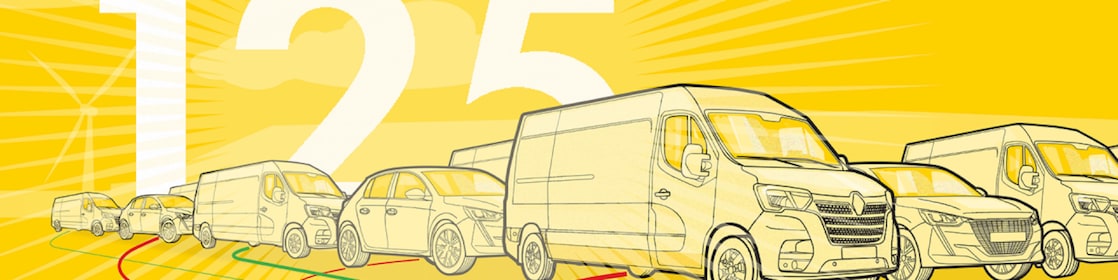
Bij logistieke dienstverlener DHL in Brussel installeerde Shell een systeem om met 125 laadpunten elektrische wagens slim op te laden. Via het zogeheten Dynamic Load Balancing laden nu buiten de wagens op, terwijl binnen de machines blijven draaien. En dat binnen de netcapaciteit.
English version further down this page
Niet eerder installeerde Shell in Europa op deze schaal geïntegreerd en slim laden. “Meer wagenparken, ook in Nederland, zullen volgen”, zegt Mark Matser, global accountmanager bij Shell Fleet Solutions in Nederland.
De vloot van bestelbusjes, trucks, bakwagens en de personenauto’s van medewerkers schakelt over op onder meer elektrisch rijden. Bedrijven laten daarom grootschalige laadinfrastructuur met 100+ laders installeren op hun bedrijfslocaties. Door over te schakelen naar duurzame mobiliteit, willen zij hun CO2-voetafdruk verkleinen.
De overstap naar elektrisch laden stelt bedrijven voor nieuwe uitdagingen. Zo is hun energiebehoefte niet de hele dag gelijk en is een zwaardere aansluiting voor de piekmomenten duur. Bovendien is een zwaardere aansluiting niet altijd en overal snel mogelijk door de overbelasting van het elektriciteitsnet.
“Door een slim controlesysteem hoef je niet midden in de nacht stroomkabels uit auto’s trekken als je net even wat meer stroom nodig hebt voor je bedrijfsmachines. Met wat we Dynamic Load Balancing noemen, kunnen wij bedrijven helpen hun energiebehoefte zo optimaal mogelijk te beheren”, zegt Job Schepers, productmanager bij Shell Recharge Solutions.
In het specifieke voorbeeld van DHL in Brussel integreerde Shell Recharge de laadinfrastructuur met het energiegebruik van onder andere de sorteermachines en de zonnepanelen van het bedrijf. Zodra personeel bijvoorbeeld transportbanden aanzet en er acuut meer stroom nodig is, stuurt de software van Shell Recharge een signaal naar de laadpunten om de laadsnelheid te verlagen. Daarnaast houdt de software rekening met de zonne-energie die de zonnepanelen terug leveren aan het elektriciteitsnet. Dit allemaal opdat het elektriciteitssysteem niet overbelast wordt.
De laders in Brussel zijn nu vooral bedoeld om de elektrische auto’s van medewerkers en bezoekers op te laden. De volgende stap is het integreren van de laadinfrastructuur voor de al bestaande en toekomstige elektrische bezorgbusjes. DHL en Shell willen op gelijke wijze nog vijf grote Europese logistieke centra van de bezorgdienst uitbreiden met een dergelijk Dynamic Load Balancing-systeem.
Zo werkt Shells Dynamic Load Balancing bij DHL
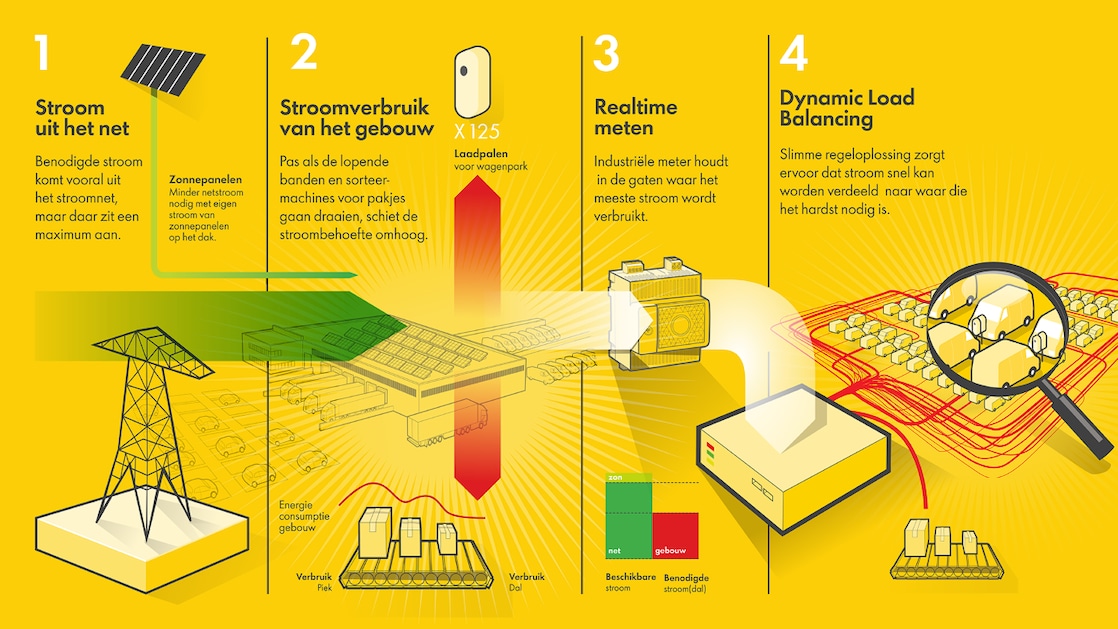
De afbeelding laat in schematische vorm Shells Dynamic Load Balancing bij DHL zien, in vier stappen.
1. Stroom uit het net. De benodigde stroom komt vooral uit het stroomnet, maar daar zit een maximum. Maar door zonnepanelen op het dak van DHL, eigen stroom dus, is er minder netstroom nodig.
2. Stroomverbruik van het gebouw. Pas als de lopende banden en sorteermachines voor pakjes gaan draaien, schiet de stroombehoefte omhoog. Buiten zijn er 125 laadpalen voor het wagenpark.
3. Realtime meten. Een industriële meter houdt in de gaten waar het meeeste stroom wordt verbruikt. De beschikbare stroom komt uit het net en van de zonnepanelen. De benodigde stroom die het gebouw nodig heeft, is op dalmomenten veel lager dan de beschikbare stroom.
4. Dynamic Load Balancing. Slimme regeloplossing zorgt ervoor dat stroom snel kan worden verdeeld naar waar die het hardst nodig is. Als het DHL-sorteercentrum op volle toeren draait, gaat het grootste deel van de stroom naar de lopende banden en de sorteermachine, terwijl de stroom naar de elektrische auto's buiten op een lager pitje wordt gezet. Bij het wagenpark verdeelt de Dynamic Load Balancing de stroom over verschillende subgroepen van snelladers.
English version
Smart-charging on a giant scale? Yes we can!
At logistics service provider DHL in Brussels, Belgium, Shell installed a smart charge system for electric cars with 125 EV chargers. By using so-called Dynamic Load Balancing, the cars are able to reload their batteries, while power is being prioritised to DHL’s package sorting machines. All of this, within grid capacity.
Never before has Shell installed, integrated and applied smart charging at this scale in Europe. "More vehicle fleets, also in the Netherlands, will follow," says Mark Matser, Global Account Manager at Shell Fleet Solutions in the Netherlands.
The fleet of vans, trucks, box vans, and employee passenger cars is switching to electric driving. Therefore, companies have large-scale charging infrastructure with 100+ EV chargers installed at their business locations. By switching to sustainable mobility, they want to reduce their CO2 footprint.
The switch from fossil fuels to electric charging poses new challenges for companies. For example, their energy needs are not the same all day and a higher capacity grid connection to cover peak times is expensive. Moreover, due to net congestion, grid connections with a higher capacity are not always possible – or have up to several years of queueing time before they become available.
"Thanks to a smart control system, you don't have to pull power supply cables from the EV cars in the middle of the night if you need just a little more power to run your company machines. With what we call Dynamic Load Balancing, we can help businesses manage their energy needs optimally," Job Schepers, Product Manager at Shell Recharge Solutions, says.
In the specific case of DHL in Brussels, Shell Recharge integrated the charging infrastructure with the energy consumption of, among other things, the company's sorting machines and solar panels. For example, as soon as staff turns on conveyor belts and more power is urgently needed, Shell Recharge software of sends a signal to the EV chargers to reduce power consumption. In addition, the software takes the produced electrons – of which overproduction is fed back to the grid -- into account. All of this within the electricity contract of the company, and as one solution against net congestion.
The EV chargers at DHL in Brussels are now mainly intended to charge the electric cars of employees and visitors. The next step is to integrate the charging infrastructure for existing and future electric delivery vans. Moreover, DHL and Shell want to roll out a similar Dynamic Load Balancing system to five major European logistics centres.
This is how Shell's Dynamic Load Balancing at DHL works
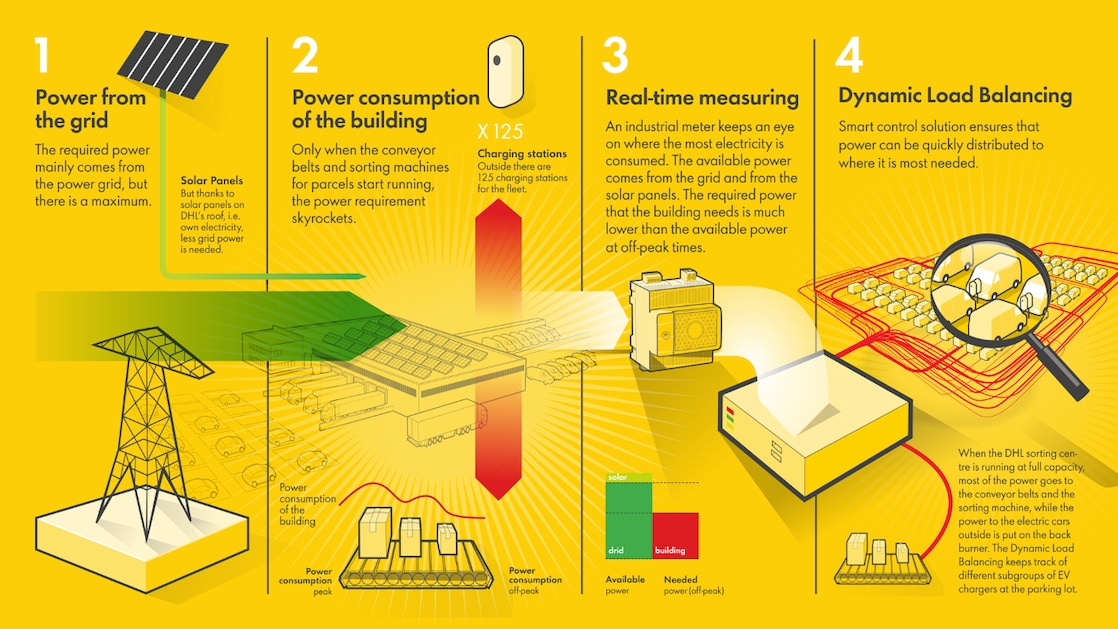
The graphic above shows Shell's Dynamic Load Balancing at the DHL location in a schematic form, in four steps. For now the texts are only available in Dutch, but below the translation.
1. Power from the grid. The required power mainly comes from the power grid, but there is a maximum. But thanks to solar panels on DHL's roof, i.e. own electricity, less grid power is needed.
2. Power consumption of the building. Only when the conveyor belts and sorting machines for parcels start running, the power requirement skyrockets. Outside there are 125 charging stations for the fleet.
3. Real-time measuring. An industrial meter keeps an eye on where the most electricity is consumed. The available power comes from the grid and from the solar panels. The required power that the building needs is much lower than the available power at off-peak times.
4. Dynamic Load Balancing. Smart control solution ensures that power can be quickly distributed to where it is most needed. When the DHL sorting centre is running at full capacity, most of the power goes to the conveyor belts and the sorting machine, while the power to the electric cars outside is put on the back burner. The Dynamic Load Balancing keeps track of different subgroups of EV chargers at the parking lot.