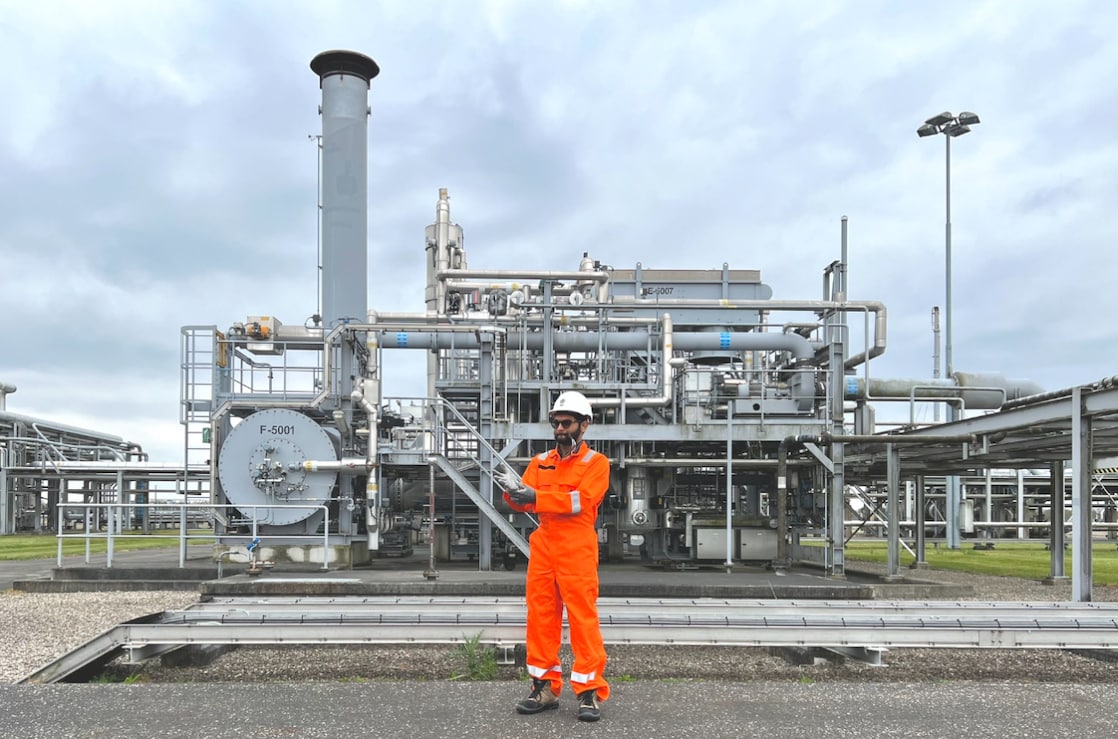
IDT-afgestudeerde bij Shell: Hemanth vond zijn digitale tweeling
Shell wordt in Nederland vaak bekritiseerd, maar als IT-afgestudeerde bij Shell promoot Hemanth Kumar op Nederlandse universiteiten juist het bedrijf. Kumar zegt bewust voor het grote energiebedrijf te hebben gekozen, vanwege “de inclusiviteit, met gelijke kansen voor iedereen".

Tekst: Marcel Burger. Beeld: Hemanth Kumar (courtesy)
For English version, click here or scroll further down
"Netwerken en sociale activiteiten met elkaar, behoren tot de leuke dingen als je bij Shell begint,” zegt Kumar. “Als afgestudeerde krijg je bij Shell echt de kans om te zien hoe een groot bedrijf in elkaar steekt en hoe medewerkers dagelijks bezig zijn de energietransitie verder vooruit te helpen."
Kumar kwam als stagiair bij Shell en ging als Graduate verder bij de afdeling Informatie en Digitale Technologie (IDT) van het energiebedrijf. In een klein team op de Shell Campus in Den Haag werkt hij nu aan de ontwikkeling van de zogenaamde Digital Twin.
Voor de kenners, dit is een soort mix van SimCity, Flight Simulator en de echte wereld. In een nagebootste omgeving kan worden voorspeld hoe bijvoorbeeld kleppen op productieplatforms op zee, rotorbladen van windturbines of complete installaties het gedurende hun levensduur doen.
"Met een Digital Twin kun je op afstand meekijken"
Met hulp van de virtuele omgeving kan een expert voorspellen wanneer en waar het weer, slijtage of andere factoren schade of storingen kunnen veroorzaken. Doel is om die dan te voorkomen.
"Met een Digital Twin hoef je niet zo vaak per helikopter, boot of auto naar de locatie af te reizen omdat je op afstand kunt meekijken, en zo verklein je de CO2-afdruk," zegt Kumar. "Tijd en energie die normaal gesproken besteed wordt aan het vinden van informatie op locatie ter plekke is nu binnen handbereik. Dit vermindert ook het risico op veiligheidsincidenten, omdat medewerkers minder vaak op lastige plekken hoeven te komen."

Mensenwerk
Kumar houdt van praten, zegt hij. Of het nu gaat om mensen te laten 'praten' met machines en installaties, andersom, of met mensen. Zelf spreekt hij vijf talen: Tamil, Engels, Frans, Arabisch en Nederlands. Als jongen groeide hij op in Chennai, in de Indiase staat Tamil Nadu. Hij ging er naar het Sri Sivasubramaniya Nadar College of Engineering en behaalde zijn bachelor in werktuigbouwkunde.
Kumar over zijn overstap van werktuigbouwkundige naar informatietechnologie. “IT verhoogt het tempo waarin we verandering brengen. Het stelt ons in staat om sneller te schakelen en op te schalen. Goed werkende IT-systemen helpen je voorspellen en analyseren. Simpel gezegd: met IT kun je het aantal onvoorziene omstandigheden terugbrengen. De technische wereld bestaat vooral uit bewegende delen, zoals tandwielen, robots, drones en zware machines ... het is dan wachten tot er iets stukgaat, maar dat voorkom je liever. Daar kan een IT-oplossing bij helpen.”
Aan de Universiteit Twente behaalde hij zijn master in Business IT – Information Management and Enterprise Architecture, gevolgd door een master in Change Leadership, waar je leert hoe je leidinggeeft aan veranderingen. In januari 2022 kwam Kumar via het Shell Graduate-programma bij het IDT-team van Shell.
Omdat ik uit India kom
"Toen ik op zoek was naar een baan, sprong Shell eruit als een bedrijf dat gelijke kansen biedt. Vooral omdat ik uit India kom, trok dit mijn aandacht. Bij Shell praat je met collega's van over de hele wereld, ontmoet je veel mensen met verschillende culturele achtergronden en leer je veel. Iedereen neemt zijn eigen lessen mee, uit de regio’s en landen waar ze vandaan komen, of door hoe ze zijn opgevoed."
Internationaal ligt Shell onder vuur omdat het te weinig zou doen om de samenleving te leiden op het pad naar verduurzaming. Kumar: "Ik ben juist blij met de gesprekken binnen en buiten Shell over de energietransitie. En als dat niet zou gelden voor de afgelopen eeuw, dan toch zeker voor de laatste tien tot twintig jaar. Ik wil niet buiten, maar midden in de energietransitie staan.”
Hemanth Kumar, IDT-graduate"Ik ben juist blij met de gesprekken binnen en buiten Shell over de energietransitie."

Snelheid Shells energietransitie
Over de snelheid van Shells bijdrage aan de energietransitie zegt Kumar: "Ik denk dat we de tijd nemen om onze opties te af te wegen, om veilige en verantwoorde keuzes te maken, want wat we doen heeft invloed op het leven van velen. Ik zie mensen protesteren voor schonere energie, maar ze zien niet altijd de complexiteit van de uitdagingen voor de hele wereld.”
Hij vervolgt: "Tijdens mijn studietijd in India was er vaak stroomuitval. Zonder elektriciteit is studeren moeilijker, of mis je het comfort van een plafondventilator in het warme, vochtige weer van Chennai. Voor landen als India, waar niet genoeg eigen stroomproductie is, moet energie uit het buitenland worden geïmporteerd en dat is duur. Omdat de vraag te groot is, valt de stroom op plekken uit.”
Niet alleen om geld verdienen
Wat heeft dit met Shell te maken? Kumar: “Shell onderkent dit soort dilemma's, in haar plannen, strategie en scenario's. Sla de Shell-documentatie erop na en je ziet duidelijk dat het niet alleen om geld verdienen gaat. Natuurlijk moet Shell geld verdienen maar de investeringen zijn strategisch verdeeld over de hele wereld en stimuleren verandering. En dat is waar ik deel van uit wil maken.”

Young Shell
Impact maken en mooie ervaringen opdoen. Is dat niet wat alle starters willen? In deze serie delen 10 jonge Shell-ers wie ze zijn, wat hun leven heeft veranderd en waarom ze kozen om voor Shell te werken.
6 Nov. 2023
IDT Graduate at Shell: Hemanth found his digital twin
Shell is often criticized, but as an IT Graduate at Shell, Hemanth Kumar promotes the company at universities in the Netherlands. Kumar says he deliberately chose the large energy company, because of "the inclusivity, with equal opportunities for everyone."
Tekst: Marcel Burger. Beeld: Hemanth Kumar (courtesy)
"Networking and social activities are among the fun things when you start at Shell," says Kumar. "As a graduate, you really get the chance to see how a large company works and how employees are engaged in advancing the energy transition, every day."
Kumar joined Shell as an intern and continued as a Graduate at the company’s Information and Digital Technology (IDT) department. In a small team at the Shell Campus in The Hague, Kumar works on the development of the so-called Digital Twin. This is sort of a mix of SimCity, Flight Simulator and the real world. In a simulated environment, it is possible to predict how, for example, valves on offshore production platforms, rotor blades of wind turbines or entire installations will perform during their life cycle.
With the help of the virtual environment, an expert can predict when and where weather, wear and tear, or other factors may cause damage or malfunctions. The aim is to prevent them.
"With Digital Twin, one no longer needs to travel to a location as often as before. Watching things on distance, means no helicopter, boat or car ride is necessary, thus the CO2 footprint is reduced," says Kumar. "Time and energy that is normally spent on finding information on site is now within reach behind a desk. This also reduces the risk of safety incidents, because it means less live inspections in spots challenging to reach."
Getting people to ‘talk’
Kumar likes to talk, he says. Whether it is getting people to 'talk' to machines and installations, the other way around, or to people. He speaks five languages: Tamil, English, French, Arabic and Dutch. As a boy, he grew up in Chennai, in the Indian state of Tamil Nadu. He attended Sri Sivasubramaniya Nadar College of Engineering and obtained his bachelor's degree in mechanical engineering.
But information technology interested him enormously and he chose to broaden his horizons in the Netherlands.
Kumar on his switch from mechanical engineering to information technology: "IT is accelerating the pace at which we bring change. It enables us to switch and scale up faster. Well-functioning IT systems help you predict and analyse. Simply put, IT can reduce the number of contingencies. The technical world consists mainly of moving parts, such as gears, robots, drones and heavy machinery... it is just a matter of time before something breaks down, but it would be better to prevent this from happening. That is where an IT solution comes in."
At the University of Twente, the Netherlands, he obtained his master's degree in Business IT – Information Management and Enterprise Architecture, followed by a master's degree in Change Leadership. In January 2022, Kumar joined Shell's IDT team through the Shell Graduate program.


Because I am from India
"When I was looking for a job, Shell stood out as an equal opportunity company. Especially since I'm from India, this caught my attention. At Shell, you talk to colleagues from all over the world, meet a lot of people from different cultural backgrounds and learn a lot. Everyone brings their own lessons, from the regions and countries they come from, or from how they were raised."
Internationally, Shell is under fire for allegedly doing too little to lead society on the path to sustainability. Kumar: "I am actually pleased with the discussions within and outside Shell about the energy transition. And if that would not apply to the past century, then at least to the last ten to twenty years. I don't want to be outside, but in the middle of the energy transition."
See the complexity of the challenges
Commenting on the speed of Shell's contribution to the energy transition, Kumar says: "I think we are taking the time to validate our options, to make safe and responsible choices, because what we do affects the lives of many. I see people protesting for cleaner energy, but they don't always see the complexity of the challenges facing the whole world."
He continues: "During my time as a student in India, there were frequent power outages. Without electricity, studying is harder, or you miss out on comfort – like having a working ceiling fan in Chennai's hot, humid weather. For countries like India, with insufficient electricity production of their own, energy has to be imported from abroad and that is expensive. With a demand too high, power outages are the result."
Not just about making money
What does this have to do with Shell? Kumar: "Shell recognises these kinds of dilemmas in its plans, strategy and scenarios. Take a look at the Shell documentation and you will clearly see it is not just about making money. Of course, Shell needs to make money, but her investments are strategically distributed around the world and drive change. And that is what I want to be a part of."
About the Shell Graduate Program
The Shell Graduate Program lasts at least 3 years, and has been the beginning of a Shell career for many. Typical Graduate roles are available in Global functions such as Finance and Human Resources; in Commercial functions; in Technical roles such as Mechanical Engineering or Safety and environment or in Trading and supply.


