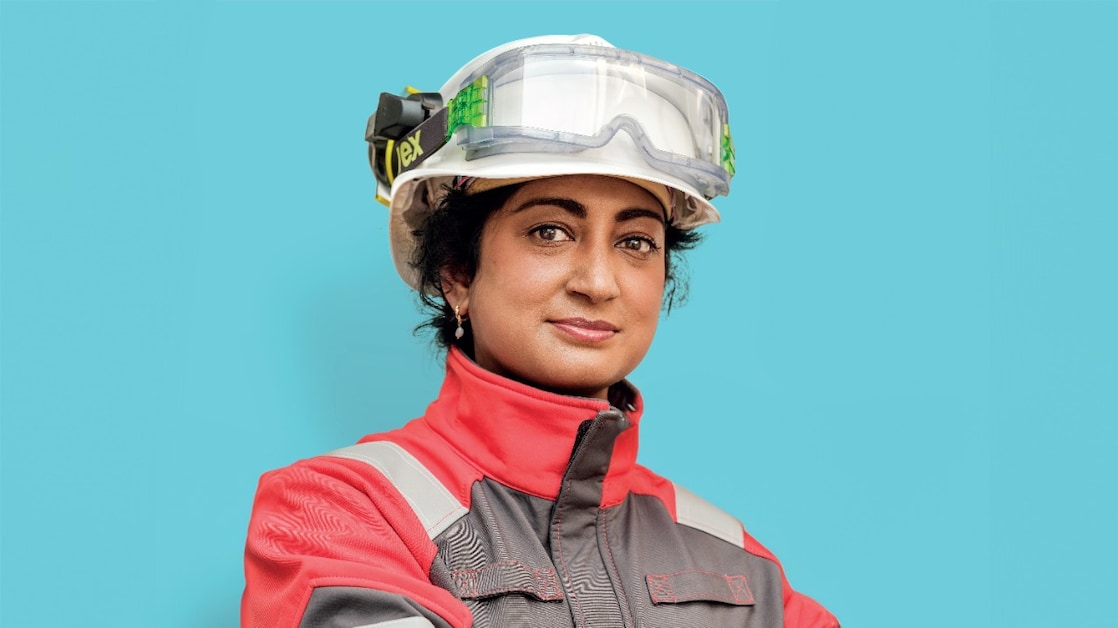
Waterstoffabriek: Archana's verhaal
Shell gaat Europa's grootste fabriek bouwen die met stroom van wind op zee waterstof gaat maken, op de Maasvlakte. Voor het schoner maken van de energie voor de industrie. augustus de bouw van de fabriek op de Rotterdamse Maasvlakte begeleidt. Voor Archana, die werktuigbouwkunde studeerde, is het waterstofproject in meerdere opzichten een uitdaging. “We hebben nog nooit een waterstoffabriek gebouwd van deze omvang.”
“Bij Shell wilde ik altijd al de kant op van de duurzame energie. Toen de kans zich voordeed om als constructiemanager aan de slag te gaan bij Holland Hydrogen I, hoefde ik niet lang na te denken. Hier wil ik onderdeel van zijn.” Archana overziet alle bouwactiviteiten voor wat de grootste groene waterstoffabriek van Europa, die waterstof maakt met stroom van wind op zee.
“Het is een uniek project”, vertelt de constructiemanager, die sinds afgelopen augustus de bouw van de fabriek op de Rotterdamse Maasvlakte begeleidt. “We hebben nog nooit een waterstoffabriek gebouwd van deze omvang: 200 MW.” Voor Archana, die werktuigbouwkunde studeerde, is het waterstofproject in meerdere opzichten een uitdaging, in de eerste plaats een technische. Het bouwterrein heeft een relatief klein oppervlakte, waar veel moet gebeuren, en veel tegelijk, geeft ze aan.
Tekst gaat verder onder de afbeeldingen.


Onzichtbaar werk, maar essentieel
De afgelopen periode stond voor haar in het teken van het aanleggen van de ondergrondse infrastructuur en het gereed maken van het bouwterrein. Inmiddels is alles vlak. Verder zijn alle tijdelijke faciliteiten gerealiseerd die nodig zijn voor de bouw. Denk aan de kantoren, parkeerplaatse, opslag en de kantine.
Beginnen aan de puzzel boven de grond
Archana en haar team zijn klaar voor de grote bovengrondse puzzel. Een voor een zullen de grote onderdelen voor de waterstoffabriek binnenkomen. Electrolysers, luchtkoelers, compressoren, tanks en andere fabrieksonderdelen. “Het gaat in totaal om meer dan 400 containers vol materiaal. Dat vraagt om een goede timing en logistiek.”
Maatschappelijke verantwoordelijkheid
Naast een technische uitdaging is het voor Archana ook een duurzame uitdaging. Ze voelt een sterke maatschappelijke verantwoordelijkheid om de energietransitie verder te brengen. “Ik verwacht dat waterstof hierin een belangrijke rol gaat spelen. Met dit project kunnen we echt impact maken.”
De eerste betekent: alles is nieuw
De naam zegt het al: Holland Hydrogen 1. Met de nadruk op één. Het is de eerste keer dat wij op deze schaal groene waterstof maken. Archana: “Gaandeweg het project leren we. En alles wat we leren, brengen we meteen in de praktijk. Daarnaast delen we de kennis die we opdoen met andere bedrijven, zodat zij ook kunnen meehelpen om de waterstofeconomie op gang te krijgen.” Er is inmiddels een kenniscentrum op het terrein en periodiek komen de bedrijven die een rol spelen in de waterstofeconomie bij elkaar. “Het is goed om samen na te denken over de toekomst van waterstof. Als Shell spelen we een belangrijke rol in het beschikbaar stellen en delen van kennis.” Als de fabriek straks draait, kunnen alle geïnteresseerden in een bezoekerscentrum meer leren over waterstof.
Duurzaam tijdens de bouw
Niet alleen produceert Holland Hydrogen 1 straks duurzame energie, ook tijdens de bouw van de fabriek wordt rekening gehouden met een schonere manier van werken, om de CO2-uitstoot tijdens de bouw te verminderen. Archana noemt een aantal voorbeelden: “We hebben drie grote kranen op het terrein. Die zijn alle drie volledig elektrisch. Ook hebben we geen dieselgeneratoren meer op de bouwplaats, enkel bouwstroom. En de bouwmaterialen halen we het liefst van zo dichtbij mogelijk.”
Samen blijven verbeteren
Verder worden de rijplaten die nu op het terrein liggen straks hergebruikt in de fabriek of ingezet bij andere projecten. En voor de kantine en het kantoor is het meubilair van de oude Shell-locatie in Rijswijk gebruikt. “Een ogenschijnlijk eenvoudig idee, een collega kwam ermee, maar het geeft wel aan dat iedereen binnen het team bezig is om verantwoorde keuzes te maken. Het is belangrijk om je continu af te vragen: hoe kunnen we de dingen beter en duurzamer doen? Dat vind ik mooi.”
Nog een puzzel: de waterstofeconomie
Archana kijkt uit naar de komende periode, de periode van de bouw en de uiteindelijke oplevering van Holland Hydrogen 1. Een mijlpaal, vindt ze. Wel benadrukt ze dat de waterstoffabriek die zij helpt op te bouwen ‘slechts’ een puzzelstuk – wel een cruciaal – is van een hele waterstofketen die moet worden ontwikkeld. Dat vraagt om investeringen in wind op zee, waterstofleidingen door het havengebied en afnamepunten voor zwaar transport. Ook de potentiële afnemers van waterstof, transportbedrijven, zullen zich moeten ontwikkelen. “Dit is allemaal nodig, en allemaal in samenhang”, stelt Archana. “Deze geïntegreerde manier van ontwikkelen is een stuk uitdagender dan het realiseren van projecten in olie of gas, waar de keten al bestaat.”
Ruimte om impact te maken
Archana is enthousiast dat ze onderdeel is van dit voorbeeldproject. Het was tijdens haar studie altijd al haar wens om bij een groot bedrijf te werken waar ze impact kan maken in de energietransitie. “Dat geldt zeker ook voor jongeren die nu op de universiteit zitten. Ik vind het belangrijk om te laten zien wat voor gave projecten we doen en hoe we met duurzaamheid omgaan. En ik kan je zeggen: ik heb er veel invloed op. Ik kan een keuze maken om de constructie nog duurzamer te ontwikkelen. En ik krijg de ruimte om die beslissingen te nemen.”
Cautionary Note
Cautionary Note
The companies in which Shell plc directly and indirectly owns investments are separate legal entities. In this webpage “Shell”, “Shell Group” and “Group” are sometimes used for convenience where references are made to Shell plc and its subsidiaries in general. Likewise, the words “we”, “us” and “our” are also used to refer to Shell plc and its subsidiaries in general or to those who work for them. These terms are also used where no useful purpose is served by identifying the particular entity or entities. ‘‘Subsidiaries’’, “Shell subsidiaries” and “Shell companies” as used in this webpage refer to entities over which Shell plc either directly or indirectly has control. Entities and unincorporated arrangements over which Shell has joint control are generally referred to as “joint ventures” and “joint operations”, respectively. “Joint ventures” and “joint operations” are collectively referred to as “joint arrangements”. Entities over which Shell has significant influence but neither control nor joint control are referred to as “associates”. The term “Shell interest” is used for convenience to indicate the direct and/or indirect ownership interest held by Shell in an entity or unincorporated joint arrangement, after exclusion of all third-party interest.
Forward-Looking Statements
This webpage contains forward-looking statements (within the meaning of the U.S. Private Securities Litigation Reform Act of 1995) concerning the financial condition, results of operations and businesses of Shell. All statements other than statements of historical fact are, or may be deemed to be, forward-looking statements. Forward-looking statements are statements of future expectations that are based on management’s current expectations and assumptions and involve known and unknown risks and uncertainties that could cause actual results, performance or events to differ materially from those expressed or implied in these statements. Forward-looking statements include, among other things, statements concerning the potential exposure of Shell to market risks and statements expressing management’s expectations, beliefs, estimates, forecasts, projections and assumptions. These forward-looking statements are identified by their use of terms and phrases such as “aim”, “ambition”, ‘‘anticipate’’, ‘‘believe’’, ‘‘could’’, ‘‘estimate’’, ‘‘expect’’, ‘‘goals’’, ‘‘intend’’, ‘‘may’’, “milestones”, ‘‘objectives’’, ‘‘outlook’’, ‘‘plan’’, ‘‘probably’’, ‘‘project’’, ‘‘risks’’, “schedule”, ‘‘seek’’, ‘‘should’’, ‘‘target’’, ‘‘will’’ and similar terms and phrases. There are a number of factors that could affect the future operations of Shell and could cause those results to differ materially from those expressed in the forward-looking statements included in this webpage, including (without limitation): (a) price fluctuations in crude oil and natural gas; (b) changes in demand for Shell’s products; (c) currency fluctuations; (d) drilling and production results; (e) reserves estimates; (f) loss of market share and industry competition; (g) environmental and physical risks; (h) risks associated with the identification of suitable potential acquisition properties and targets, and successful negotiation and completion of such transactions; (i) the risk of doing business in developing countries and countries subject to international sanctions; (j) legislative, judicial, fiscal and regulatory developments including regulatory measures addressing climate change; (k) economic and financial market conditions in various countries and regions; (l) political risks, including the risks of expropriation and renegotiation of the terms of contracts with governmental entities, delays or advancements in the approval of projects and delays in the reimbursement for shared costs; (m) risks associated with the impact of pandemics, such as the COVID-19 (coronavirus) outbreak, regional conflicts, such as Russia’s invasion of Ukraine, and a significant cybersecurity breach; and (n) changes in trading conditions. No assurance is provided that future dividend payments will match or exceed previous dividend payments. All forward-looking statements contained in this [report] are expressly qualified in their entirety by the cautionary statements contained or referred to in this section. Readers should not place undue reliance on forward-looking statements. Additional risk factors that may affect future results are contained in Shell plc’s Form 20-F for the year ended December 31, 2022 (available at www.shell.com/investors/news-and-filings/sec-filings.html and www.sec.gov). These risk factors also expressly qualify all forward-looking statements contained on this webpage and should be considered by the reader. Each forward-looking statement speaks only as of the date of this webpage. February 23 2024. Neither Shell plc nor any of its subsidiaries undertake any obligation to publicly update or revise any forward-looking statement as a result of new information, future events or other information. In light of these risks, results could differ materially from those stated, implied or inferred from the forward-looking statements contained in this webpage.
Shell’s net carbon intensity
Also, on this webpage we may refer to Shell’s “Net Carbon Intensity”, which includes Shell’s carbon emissions from the production of our energy products, our suppliers’ carbon emissions in supplying energy for that production and our customers’ carbon emissions associated with their use of the energy products we sell. Shell only controls its own emissions. The use of the term Shell’s “Net Carbon Intensity” is for convenience only and not intended to suggest these emissions are those of Shell plc or its subsidiaries.
Shell’s net-Zero Emissions Target
Shell’s operating plan, outlook and budgets are forecasted for a ten-year period and are updated every year. They reflect the current economic environment and what we can reasonably expect to see over the next ten years. Accordingly, they reflect our Scope 1, Scope 2 and Net Carbon Intensity (NCI) targets over the next ten years. However, Shell’s operating plans cannot reflect our 2050 net-zero emissions target and 2035 NCI target, as these targets are currently outside our planning period. In the future, as society moves towards net-zero emissions, we expect Shell’s operating plans to reflect this movement. However, if society is not net zero in 2050, as of today, there would be significant risk that Shell may not meet this target.
Shell expects to publish its 2024 Energy Transition Strategy on March 14, 2024, which will include an update on Shell’s energy transition strategy and set out Shell’s climate targets and ambitions for the future.
Forward Looking Non-GAAP measures
This webpage may contain certain forward-looking non-GAAP measures such as cash capital expenditure and divestments. We are unable to provide a reconciliation of these forward-looking Non-GAAP measures to the most comparable GAAP financial measures because certain information needed to reconcile those Non-GAAP measures to the most comparable GAAP financial measures is dependent on future events some of which are outside the control of Shell, such as oil and gas prices, interest rates and exchange rates. Moreover, estimating such GAAP measures with the required precision necessary to provide a meaningful reconciliation is extremely difficult and could not be accomplished without unreasonable effort. Non-GAAP measures in respect of future periods which cannot be reconciled to the most comparable GAAP financial measure are calculated in a manner which is consistent with the accounting policies applied in Shell plc’s consolidated financial statements.
The contents of websites referred to in this webpage do not form part of this webpage.
We may have used certain terms, such as resources, on this webpage that the United States Securities and Exchange Commission (SEC) strictly prohibits us from including in our filings with the SEC. Investors are urged to consider closely the disclosure in our Form 20-F, File No 1-32575, available on the SEC website www.sec.gov.


