Anno 1961: kamergrote rekenkracht
26 mrt. 2026
Je ziet ze af en toe nog in een film van vroeger of op de lokale rommelmarkt: een telraam. En laat de moderne versie van zo’n ding nu net bij iedereen in de broekzak of handtas zitten. Ver voor de komst van de smartphone was elektronische dataverwerking een klus voor kamervullende machines. En daarbij scoorde “de 7070” begin jaren 60 hoge ogen.
Tekst: Rosalie van Egmond en Marcel Burger. Beeld: Shell Heritage and Historical Archive.
Een nieuw tijdperk
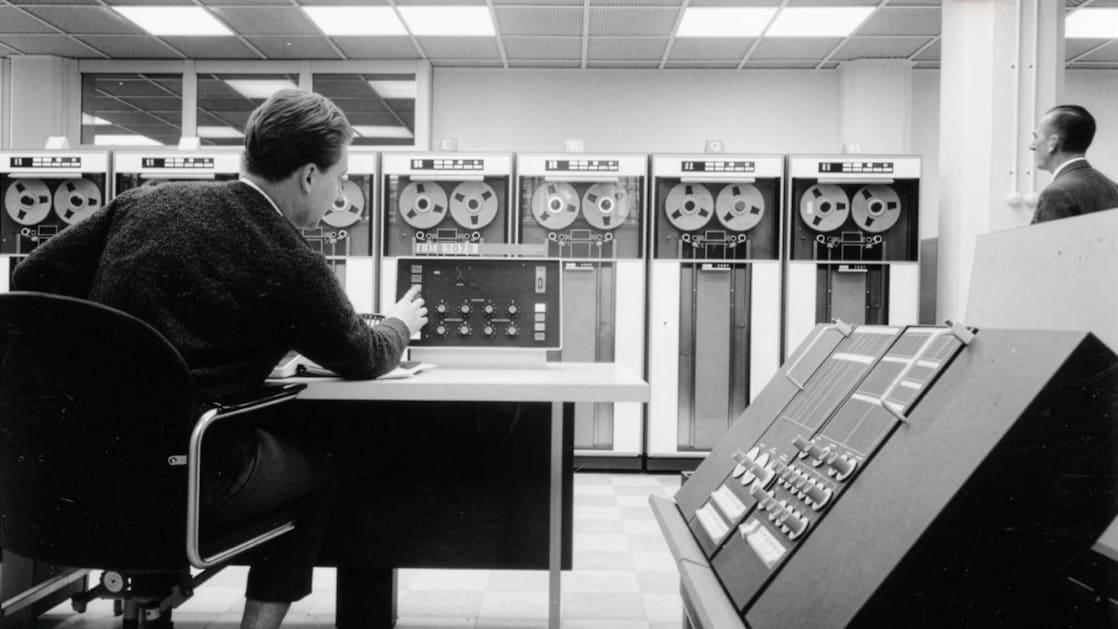
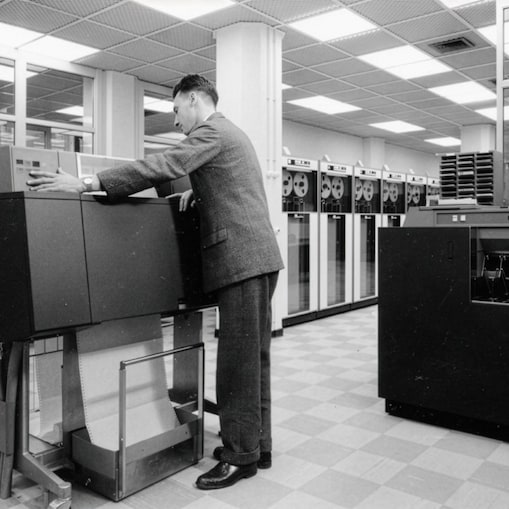
Zie daar de vroege jaren van de informatietechnologie (IT) bij Shell in Nederland. Het is 1961 en de foto’s bij dit verhaal zijn gemaakt in wat vandaag de dag de Shell Campus Den Haag heet. Tot de verhuizing naar Londen in 2022 waren de gebouwen aan de Carel van Bylandtlaan het wereldwijde Shell-hoofdkantoor (in de tijd van "Koninklijke" en "Shell" was er een centraal kantoor in Den Haag en een centraal kantoor in Londen).
En daar stonden 65 jaar geleden de IBM 7070 en IBM 1401 te blinken. De machines luidden een nieuw tijdperk in voor geautomatiseerde berekeningen, en vervingen handmatige en mechanische telmethodes.
Operators en ponskaarten
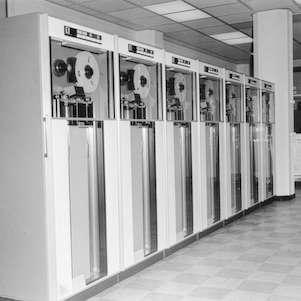
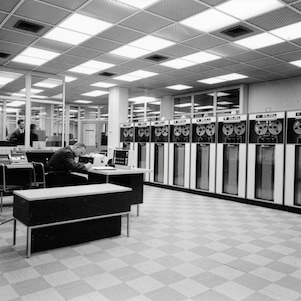
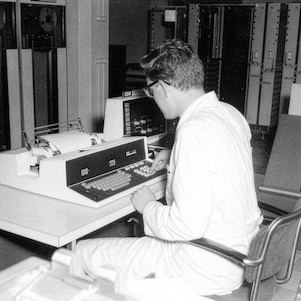
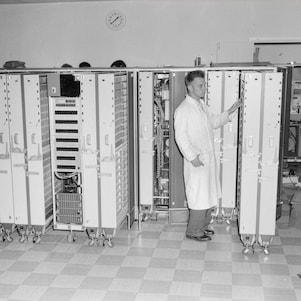
De foto’s tonen “operators” aan het werk met apparaten met magnetische tape — waarop gegevens konden worden opgeslagen, ponskaartlezers en hogesnelheidsprinters. Allemaal essentiële componenten in de sprong voorwaarts in de automatisering van dat moment. De beelden laten ook de schaal, de precisie en de menselijke kennis zijn die nodig waren om digitalisering in gang te houden.
Vanaf de ingebruikneming van de grote rekenwonders begon Shell meer en meer te vertrouwen op elektronica om de technische, administratieve en financiële data te verwerken. De digitale infrastructuur van toen was een voorbode van wat nog zou komen.
Zelfdenkende software
Vandaag de dag zit er meer rekenkracht in je smartphone en wordt menselijke expertise steeds vaker aangevuld met zelfdenkende software: artificial intelligence. En over een x aantal jaren is de IT en AI van nu vast ook een film of foto van vroeger.
1961: Room‑sized computing power
You still occasionally see them in old films or at a local jumble sale: an abacus. The modern version of such a device now happens to be in everyone’s pocket or handbag. Long before the arrival of the smartphone, electronic data processing was the work of machines that filled entire rooms. And at the start of the 1960s, “the 7070” was held in particularly high regard.
Text: Rosalie van Egmond en Marcel Burger. Photography: Shell Heritage and Historical Archive.
A new era
On the photos you see the early years of information technology (IT) at Shell. It is 1961, and the photographs accompanying this story were taken at what is now known as the Shell Campus The Hague. Until the move to London in 2022, the buildings in the administrational capital of the Netherlands served as Shell’s global headquarters (during the times of "Royal Dutch" and "Shell" there were two central offices: one in London, one in The Hague).
Sixty‑five years ago, the IBM 7070 and IBM 1401 were gleaming there. These machines ushered in a new era of automated calculations, replacing manual and mechanical counting methods.
Operators and punch cards
The photos show “operators” at work with magnetic tape units — on which data could be stored — punch‑card readers and high‑speed printers. All were essential components of the leap forward in automation at the time. The images also highlight the scale, precision and human expertise required to keep digitisation running.
From the moment these powerful computing machines were put into operation, Shell increasingly relied on electronics to process technical, administrative and financial data. The digital infrastructure of that era was a precursor to what was yet to come.
Self‑thinking software
Today, there is more computing power in your smartphone, and human expertise is increasingly complemented by self‑thinking software: artificial intelligence. And in a number of years’ time, today’s IT and AI will no doubt also be seen as something from an old film or photograph.