Bij Shell in Amsterdam wordt SAF verder uitgedokterd
De Europese Unie maakt mogelijk volgend jaar meer bijmenging van duurzame vliegtuigbrandstof bij gewone kerosine verplicht. Op de Energy Transition Campus Amsterdam (ETCA) werkt Shell aan een manier om SAF gemakkelijker en misschien zelfs goedkoper te maken. Manager onderzoek en ontwikkeling (R&D) Erwin van der Geer vertelt erover.

Tekst: Marcel Burger. Beeld: Marcel Burger (openingsplaat), Jiri Büller (ETCA-beelden).
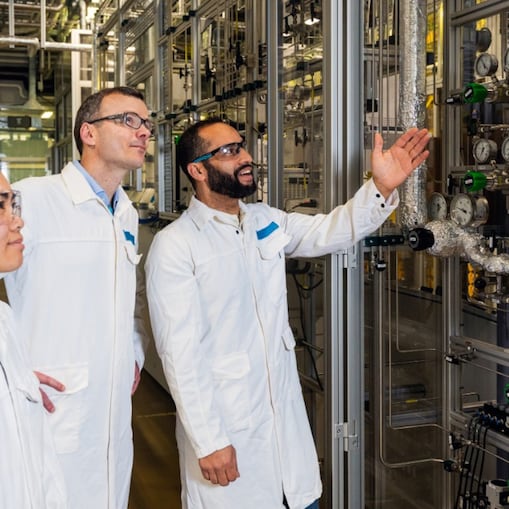
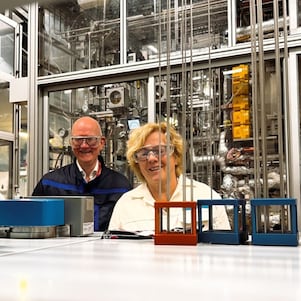
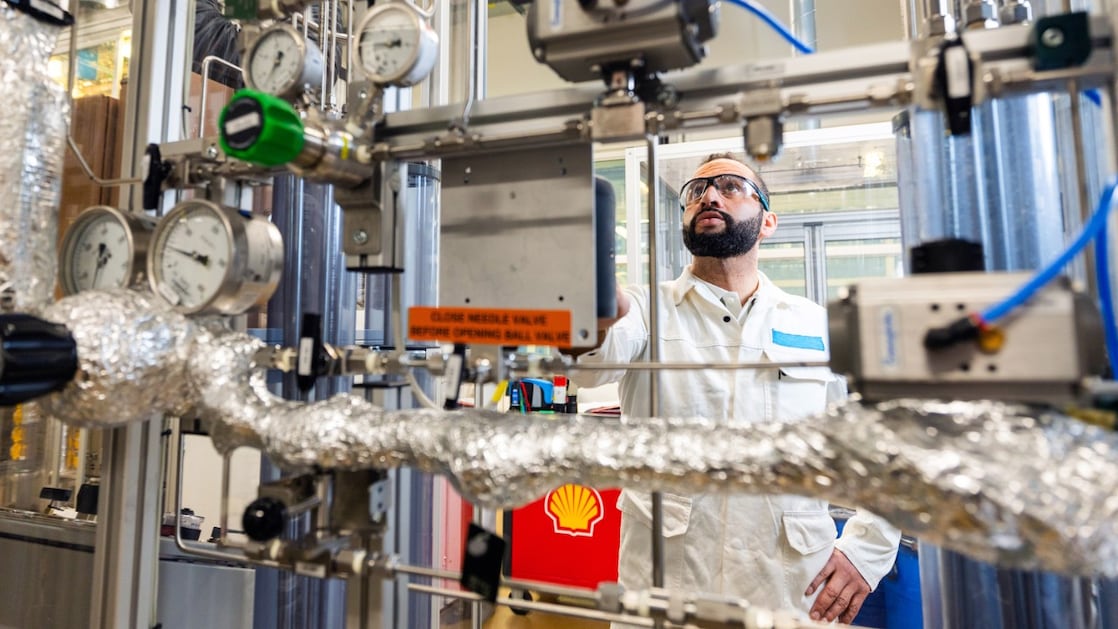
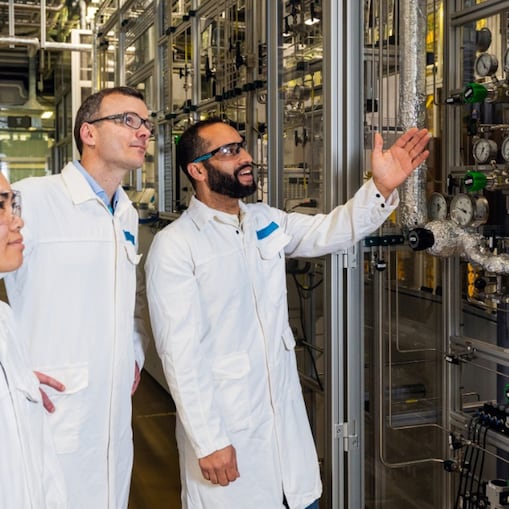
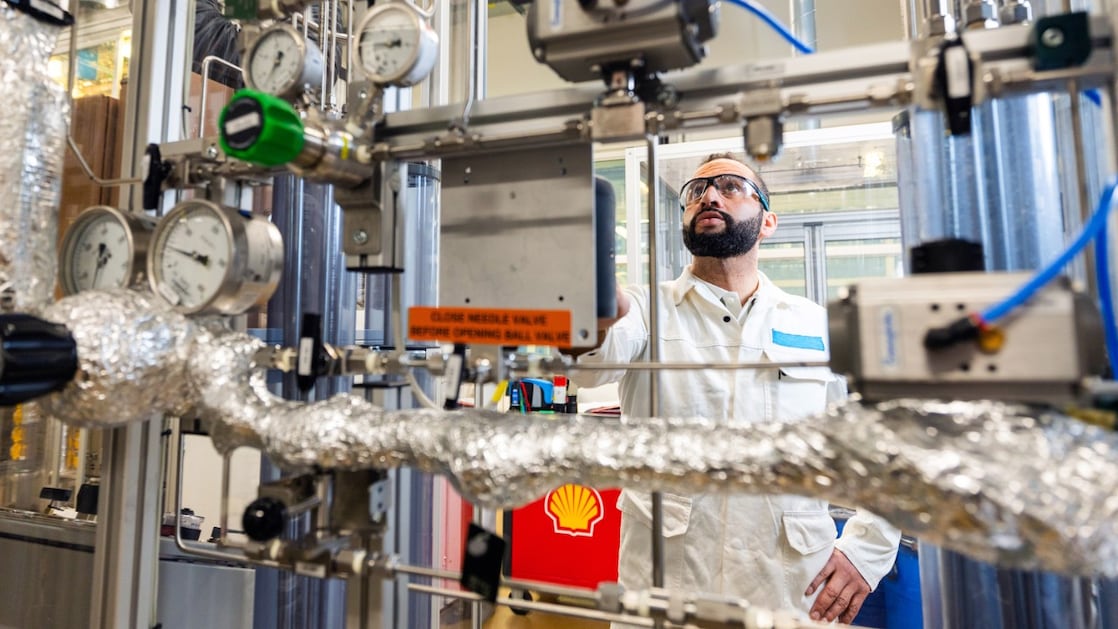
”Sweet sixteen”-lintjes werden op 12 maart feestelijk doorgeknipt in het laboratorium van de ETCA. Want een nieuwe testopstelling maakt het nu mogelijk om gelijktijdig in 16 reactoren te testen of Sustainable Aviation Fuel (SAF) beter, en wellicht ook goedkoper, gemaakt kan worden. Zo’n geavanceerde set-up is ”sweet” voor wetenschappers. Let wel: het gaat om nanoreactoren voor vloeistoffen. Simpel gezegd: een soort buisjes waardoor superdunne stroompjes vloeistof kunnen worden geleid langs of door verschillende materialen (katalysatoren, zo dadelijk meer daarover). Die kleine opzet maakt het allemaal veel efficiënter en voorkomt verkwisting: iedere test kost maar een klein beetje brandstof en geeft minder afval.
Kleiner dan een stadsbus
Voor de goede orde: die 16 reactoren van de SAF-testinstallatie, ontworpen en gebouwd door Shell spin-off Avantium R&D Solutions, lijken in de verste verte niet op kernreactoren. Er is geen enkel gevaar en al helemaal geen radioactiviteit. Ook in de omvang heeft het niets weg van die grote nucleaire reactoren. De vloeistoffentestopstelling — de technologie wordt Flowrence genoemd — is zelfs smaller en korter dan een gewone stadsbus: 2 meter breed en 7 meter lang.
”We testen verbeteringen in de verwerking van bijgemengd biomateriaal om het geschikt te maken voor vliegtuigbrandstof”, zegt Erwin van der Geer, manager van het Shell-onderzoeksteam dat de proeven ontwerpt en uitvoert. ”Hoe beter onze katalysatoren het biomateriaal kunnen verwerken, hoe makkelijker we het kunnen vermengen met conventionele kerosine om de luchtvaart duurzamer te maken.”
De EU, SAF en ”Euro 95” voor vliegtuigen
De EU voerde in januari 2025 de ReFuelEU Aviation-regeling in. Die verplicht dat er op veel luchthavens minimaal 2% aan Sustainable Aviation Fuel (SAF) door de vliegtuigen moet worden getankt. Dat wordt ook wel de bijmengverplichting genoemd, en de EU wil die bijmenging optrekken naar 70% in 2050.
Je kunt het dus een beetje vergelijken met gewone Euro 95-benzine (E5) in je auto, waar al een tijdje verplicht 5% bio-ethanol in zit. Maar op sommige pompen kun je Euro 95 van type E10 tanken, met dus 10% bio-ethanol. Tijdens het rijden merk je niets van die biocomponent in je auto.
Zo moet het ook voor piloten en passagiers tijdens het vliegen zijn. En dat wordt dus onder meer met de nieuwe testopstelling in de ETCA aan ’t IJ in Amsterdam getest.
SAF maken met ”hagelslag”
Die katalysator is niet de knalpot onder je auto, maar een materiaal waarmee je een chemische omzetting mogelijk maakt. Voor de testopstelling van SAF bestaat het materiaal uit korrels. ”Een soort van hagelslag”, grapt Van der Geer. Het proces is misschien wat ingewikkeld, maar voor de technisch geïnteresseerden legt hij het als volgt uit:
”Vliegtuigbrandstof wordt op de raffinaderij gemaakt door middel van hydroprocessing. Daarbij worden de moleculen van de ruwe brandstof meer vertakt en worden zuurstofatomen omgezet in water. Hoe meer biocomponenten er bij de brandstof zitten, hoe meer water er wordt gevormd dat samen met andere componenten zoals stikstofverbindingen en chloride kan zorgen voor corrosie.”
Met andere woorden: de gemaakte vloeistof kan onder meer de stalen buisjes en leidingen aantasten. De nieuwe testopstelling is dan ook gemaakt van speciaal resistent materiaal. Eenmaal gemaakt en ontdaan van de bijproducten, is SAF veilig in gebruik en vergaand getest door vliegtuigfabrikanten en luchtvaartmaatschappijen.
Plantaardige olie
Wat is nu die biocomponent in SAF? ”Plantaardige olie”, zegt Van der Geer. Die olie kan worden gemaakt uit landbouwproducten, maar ook uit gebruikte frituurolie van de patatkraam op de hoek.
Van der Geer: ”Het voordeel van het bijmengen van SAF aan kerosine is dat het een relatief eenvoudige manier is om de luchtvaart een stapje duurzamer te maken. Raffinaderijen hoeven geen grote aanpassingen te maken aan hun fabrieken. Je moet er natuurlijk wel absoluut zeker van zijn dat de resulterende vliegtuigbrandstof goed werkt, ook bijvoorbeeld onder extreem koude temperaturen. Daarom is testen ook zo belangrijk.”
Kosten omlaag, dan kan de prijs van SAF omlaag
De nieuwe SAF-proefopstelling in het ETCA-lab kan dus in één keer zestien keer testen of de ene katalysator beter werkt dan de ander, en daarbij bijvoorbeeld zal leiden tot minder productiekosten voor een raffinaderij. Kunnen die kosten omlaag, dan kan dus ook de prijs van SAF omlaag en wordt het voor luchtvaartmaatschappijen nog aantrekkelijker om veilig meer SAF bij te mengen.
”We verwachten de eerste resultaten tegen het einde van dit jaar”, zegt Van der Geer. ”Bij succes kan de katalysator worden opgeschaald naar een volwaardige installatie op een raffinaderij van Shell of bij andere bedrijven.”
Cautionary note
Cautionary note
The companies in which Shell plc directly and indirectly owns investments are separate legal entities. In this announcement “Shell”, “Shell Group” and “Group” are sometimes used for convenience to reference Shell plc and its subsidiaries in general. Likewise, the words “we”, “us” and “our” are also used to refer to Shell plc and its subsidiaries in general or to those who work for them. These terms are also used where no useful purpose is served by identifying the particular entity or entities. ‘‘Subsidiaries’’, “Shell subsidiaries” and “Shell companies” as used in this announcement refer to entities over which Shell plc either directly or indirectly has control. The terms “joint venture”, “joint operations”, “joint arrangements”, and “associates” may also be used to refer to a commercial arrangement in which Shell has a direct or indirect ownership interest with one or more parties. The term “Shell interest” is used for convenience to indicate the direct and/or indirect ownership interest held by Shell in an entity or unincorporated joint arrangement, after exclusion of all third-party interest.
Forward-Looking statements
This announcement contains forward-looking statements (within the meaning of the U.S. Private Securities Litigation Reform Act of 1995) concerning the financial condition, results of operations and businesses of Shell. All statements other than statements of historical fact are, or may be deemed to be, forward-looking statements. Forward-looking statements are statements of future expectations that are based on management’s current expectations and assumptions and involve known and unknown risks and uncertainties that could cause actual results, performance or events to differ materially from those expressed or implied in these statements. Forward-looking statements include, among other things, statements concerning the potential exposure of Shell to market risks and statements expressing management’s expectations, beliefs, estimates, forecasts, projections and assumptions. These forward-looking statements are identified by their use of terms and phrases such as “aim”; “ambition”; ‘‘anticipate’’; “aspire”, “aspiration”, ‘‘believe’’; “commit”; “commitment”; ‘‘could’’; “desire”; ‘‘estimate’’; ‘‘expect’’; ‘‘goals’’; ‘‘intend’’; ‘‘may’’; “milestones”; ‘‘objectives’’; ‘‘outlook’’; ‘‘plan’’; ‘‘probably’’; ‘‘project’’; ‘‘risks’’; “schedule”; ‘‘seek’’; ‘‘should’’; ‘‘target’’; “vision”; ‘‘will’’; “would” and similar terms and phrases. There are a number of factors that could affect the future operations of Shell and could cause those results to differ materially from those expressed in the forward-looking statements included in this announcement, including (without limitation): (a) price fluctuations in crude oil and natural gas; (b) changes in demand for Shell’s products; (c) currency fluctuations; (d) drilling and production results; (e) reserves estimates; (f) loss of market share and industry competition; (g) environmental and physical risks, including climate change; (h) risks associated with the identification of suitable potential acquisition properties and targets, and successful negotiation and completion of such transactions; (i) the risk of doing business in developing countries and countries subject to international sanctions; (j) legislative, judicial, fiscal and regulatory developments including tariffs and regulatory measures addressing climate change; (k) economic and financial market conditions in various countries and regions; (l) political risks, including the risks of expropriation and renegotiation of the terms of contracts with governmental entities, delays or advancements in the approval of projects and delays in the reimbursement for shared costs; (m) risks associated with the impact of pandemics, regional conflicts, such as the Russia-Ukraine war and the conflict in the Middle East, and a significant cyber security, data privacy or IT incident; (n) the pace of the energy transition; and (o) changes in trading conditions. No assurance is provided that future dividend payments will match or exceed previous dividend payments. All forward-looking statements contained in this announcement are expressly qualified in their entirety by the cautionary statements contained or referred to in this section. Readers should not place undue reliance on forward-looking statements. Additional risk factors that may affect future results are contained in Shell plc’s Form 20-F for the year ended December 31, 2025 (available at www.shell.com/investors/news-and-filings/sec-filings.html and www.sec.gov). These risk factors also expressly qualify all forward-looking statements contained in this announcement and should be considered by the reader. Each forward-looking statement speaks only as of the date of this announcement, March 26, 2026. Neither Shell plc nor any of its subsidiaries undertake any obligation to publicly update or revise any forward-looking statement as a result of new information, future events or other information. In light of these risks, results could differ materially from those stated, implied or inferred from the forward-looking statements contained in this announcement.
Shell’s net carbon intensity
Also, in this announcement we may refer to Shell’s “net carbon intensity” (NCI), which includes Shell’s carbon emissions from the production of our energy products, our suppliers’ carbon emissions in supplying energy for that production and our customers’ carbon emissions associated with their use of the energy products we sell. Shell’s NCI also includes the emissions associated with the production and use of energy products produced by others which Shell purchases for resale. Shell only controls its own emissions. The use of the terms Shell’s “net carbon intensity” or NCI is for convenience only and not intended to suggest these emissions are those of Shell plc or its subsidiaries.
Shell’s net-zero emissions target
Shell’s operating plan and outlook are forecasted for a three-year period and ten-year period, respectively, and are updated every year. They reflect the current economic environment and what we can reasonably expect to see over the next three and ten years. Accordingly, the outlook reflects our combined Scope 1 and 2 target, NCI target and our oil products ambition over the next ten years. However, Shell’s operating plan and outlook cannot reflect our 2050 net-zero emissions target, as this target is outside our planning period. Such future operating plans and outlooks could include changes to our portfolio, efficiency improvements and the use of carbon capture and storage and carbon credits. In the future, as society moves towards net-zero emissions, we expect Shell’s operating plans and outlooks to reflect this movement. However, if society is not net zero in 2050, as of today, there would be significant risk that Shell may not meet this target.
Forward-Looking non-GAAP measures
This announcement may contain certain forward-looking non-GAAP measures. We are unable to provide a reconciliation of these forward-looking non-GAAP measures to the most comparable GAAP financial measures because certain information needed to reconcile those non-GAAP measures to the most comparable GAAP financial measures is dependent on future events some of which are outside the control of Shell, such as oil and gas prices, interest rates and exchange rates. Moreover, estimating such GAAP measures with the required precision necessary to provide meaningful reconciliation is extremely difficult and could not be accomplished without unreasonable effort. Non-GAAP measures in respect of future periods which cannot be reconciled to the most comparable GAAP financial measure are calculated in a manner which is consistent with the accounting policies applied in Shell plc’s consolidated financial statements.
The contents of websites referred to in this announcement do not form part of this announcement.
We may have used certain terms, such as resources, in this announcement that the United States Securities and Exchange Commission (SEC) strictly prohibits us from including in our filings with the SEC. Investors are urged to consider closely the disclosure in our Form 20-F, File No 1-32575, available on the SEC website www.sec.gov.
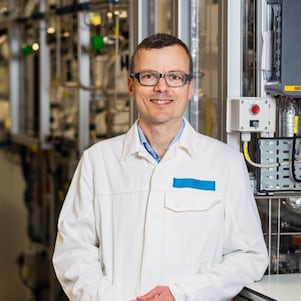
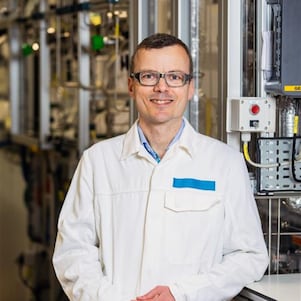
Erwin van der Geer, manager Research & Development, ETCA"Het voordeel van het bijmengen van SAF aan kerosine is dat het een relatief eenvoudige manier is om de luchtvaart een stapje duurzamer te maken"

At Shell in Amsterdam, SAF is being further refined
26 Mar 2026
Next year, the European Union may make it compulsory to blend more sustainable aviation fuel with conventional kerosene. At the Energy Transition Campus Amsterdam (ETCA), the Netherlands, Shell is working on a way to make SAF easier — and perhaps even cheaper — to produce. Manager Research and Development (R&D) Erwin van der Geer explains.

Text: Marcel Burger. Photography: Marcel Burger (featured photo), Jiri Büller (ETCA photos).
“Sweet sixteen” ribbons were festively cut on 12 March in the ETCA laboratory. A new set-up now makes it possible to test simultaneously in 16 reactors whether Sustainable Aviation Fuel (SAF) can be produced better – and possibly with reduced costs. Such an advanced installation is “sweet” for scientists. To be clear: the set-up’s core are nano‑reactors for liquids. Put simply, they are a kind of small tubes through which ultra‑thin streams of liquid can be guided along or through different materials (catalysts — more on those in a moment). This small-scale system makes everything far more efficient and prevents waste: each test requires only a tiny amount of fuel and produces less waste.
Smaller than a city bus
To avoid any misunderstanding: the 16 reactors in the SAF test installation, designed and built by Shell spin‑off Avantium, are nothing like nuclear reactors. There is no danger whatsoever, and certainly no radioactivity. In terms of size, too, they bear no resemblance to those large nuclear installations. The liquid‑testing set‑up — its technology is called Flowrence — is narrower and shorter than an ordinary city bus: 2 metres (6.6 feet) wide and 7 metres (23 feet) long.
“We test improvements in the processing of blended bio‑materials to make them suitable for aviation fuel,” says Erwin van der Geer, Manager of the Shell research team that designs and carries out the experiments. “The better our catalysts can process the bio‑material, the easier it becomes to blend it with conventional kerosene to make aviation more sustainable.”
The EU, SAF and “Euro 95” for aircraft
The EU introduced the ReFuelEU Aviation regulation in January 2025. This requires that aircraft at many airports must refuel with at least 2% Sustainable Aviation Fuel (SAF). This is known as the blending mandate, and the EU aims to increase that level to 70% by 2050.
Compare it to ordinary Euro 95 petrol (E5) for cars, if you like, which has for some time already contained a mandatory 5% bio‑ethanol element. But at some petrol stations motorists can fill up with Euro 95 E10, which contains 10% bio‑ethanol. On the road, drivers do not notice there is a bio-component in the fuel of their car.
And that is how it should be for pilots and passengers up in the air as well. This is what is being tested, among other things, with the new test set‑up at the ETCA in Amsterdam.
Making SAF with “chocolate sprinkles”
The catalyst is a material that enables a chemical conversion. For the SAF test set‑up, this material consists of granules. “A bit like chocolate sprinkles,” Van der Geer jokes. The process may sound complicated, but for the technically minded he explains it as follows:
“Aviation fuel is made at the refinery through hydro processing. This increases the branching of molecules in the raw fuel and converts oxygen atoms into water. The more bio-components that are present in the fuel, the more water is formed. Together with other components such as nitrogen compounds and chloride, this can cause corrosion.”
In other words: the produced liquid can affect steel tubes and pipes, among other things. The new test set‑up is therefore made of special resistant material. Once produced and stripped of by‑products, SAF is safe to use and has been extensively tested by aircraft manufacturers and airlines.
Vegetable oil
So, what exactly is the bio-component in SAF? “Vegetable oil,” says Van der Geer. This oil can be made from agricultural products, but also from used cooking oil sourced from your local chip shop.
Van der Geer: “The advantage of blending SAF with kerosene is that it’s a relatively straightforward way to make aviation a bit more sustainable. Refineries don’t need to make major changes to their facilities. You must, of course, be absolutely certain that the resulting aviation fuel performs well, including under extremely cold conditions. That’s why testing is so important.”
Lower costs could mean lower SAF prices
The new SAF test installation in the ETCA lab can test sixteen catalysts at once to see which performs better, and which might, for example, reduce production costs for a refinery. If those costs can come down, the price of SAF could decrease, making it even more attractive for airlines to safely blend more SAF.
“We expect the first results by the end of this year,” says Van der Geer. “If successful, the catalyst can be scaled up to a full installation at a Shell refinery or at other companies.”
Cautionary note
Cautionary note
The companies in which Shell plc directly and indirectly owns investments are separate legal entities. In this announcement “Shell”, “Shell Group” and “Group” are sometimes used for convenience to reference Shell plc and its subsidiaries in general. Likewise, the words “we”, “us” and “our” are also used to refer to Shell plc and its subsidiaries in general or to those who work for them. These terms are also used where no useful purpose is served by identifying the particular entity or entities. ‘‘Subsidiaries’’, “Shell subsidiaries” and “Shell companies” as used in this announcement refer to entities over which Shell plc either directly or indirectly has control. The terms “joint venture”, “joint operations”, “joint arrangements”, and “associates” may also be used to refer to a commercial arrangement in which Shell has a direct or indirect ownership interest with one or more parties. The term “Shell interest” is used for convenience to indicate the direct and/or indirect ownership interest held by Shell in an entity or unincorporated joint arrangement, after exclusion of all third-party interest.
Forward-Looking statements
This announcement contains forward-looking statements (within the meaning of the U.S. Private Securities Litigation Reform Act of 1995) concerning the financial condition, results of operations and businesses of Shell. All statements other than statements of historical fact are, or may be deemed to be, forward-looking statements. Forward-looking statements are statements of future expectations that are based on management’s current expectations and assumptions and involve known and unknown risks and uncertainties that could cause actual results, performance or events to differ materially from those expressed or implied in these statements. Forward-looking statements include, among other things, statements concerning the potential exposure of Shell to market risks and statements expressing management’s expectations, beliefs, estimates, forecasts, projections and assumptions. These forward-looking statements are identified by their use of terms and phrases such as “aim”; “ambition”; ‘‘anticipate’’; “aspire”, “aspiration”, ‘‘believe’’; “commit”; “commitment”; ‘‘could’’; “desire”; ‘‘estimate’’; ‘‘expect’’; ‘‘goals’’; ‘‘intend’’; ‘‘may’’; “milestones”; ‘‘objectives’’; ‘‘outlook’’; ‘‘plan’’; ‘‘probably’’; ‘‘project’’; ‘‘risks’’; “schedule”; ‘‘seek’’; ‘‘should’’; ‘‘target’’; “vision”; ‘‘will’’; “would” and similar terms and phrases. There are a number of factors that could affect the future operations of Shell and could cause those results to differ materially from those expressed in the forward-looking statements included in this announcement, including (without limitation): (a) price fluctuations in crude oil and natural gas; (b) changes in demand for Shell’s products; (c) currency fluctuations; (d) drilling and production results; (e) reserves estimates; (f) loss of market share and industry competition; (g) environmental and physical risks, including climate change; (h) risks associated with the identification of suitable potential acquisition properties and targets, and successful negotiation and completion of such transactions; (i) the risk of doing business in developing countries and countries subject to international sanctions; (j) legislative, judicial, fiscal and regulatory developments including tariffs and regulatory measures addressing climate change; (k) economic and financial market conditions in various countries and regions; (l) political risks, including the risks of expropriation and renegotiation of the terms of contracts with governmental entities, delays or advancements in the approval of projects and delays in the reimbursement for shared costs; (m) risks associated with the impact of pandemics, regional conflicts, such as the Russia-Ukraine war and the conflict in the Middle East, and a significant cyber security, data privacy or IT incident; (n) the pace of the energy transition; and (o) changes in trading conditions. No assurance is provided that future dividend payments will match or exceed previous dividend payments. All forward-looking statements contained in this announcement are expressly qualified in their entirety by the cautionary statements contained or referred to in this section. Readers should not place undue reliance on forward-looking statements. Additional risk factors that may affect future results are contained in Shell plc’s Form 20-F for the year ended December 31, 2025 (available at www.shell.com/investors/news-and-filings/sec-filings.html and www.sec.gov). These risk factors also expressly qualify all forward-looking statements contained in this announcement and should be considered by the reader. Each forward-looking statement speaks only as of the date of this announcement, March 26, 2026. Neither Shell plc nor any of its subsidiaries undertake any obligation to publicly update or revise any forward-looking statement as a result of new information, future events or other information. In light of these risks, results could differ materially from those stated, implied or inferred from the forward-looking statements contained in this announcement.
Shell’s net carbon intensity
Also, in this announcement we may refer to Shell’s “net carbon intensity” (NCI), which includes Shell’s carbon emissions from the production of our energy products, our suppliers’ carbon emissions in supplying energy for that production and our customers’ carbon emissions associated with their use of the energy products we sell. Shell’s NCI also includes the emissions associated with the production and use of energy products produced by others which Shell purchases for resale. Shell only controls its own emissions. The use of the terms Shell’s “net carbon intensity” or NCI is for convenience only and not intended to suggest these emissions are those of Shell plc or its subsidiaries.
Shell’s net-zero emissions target
Shell’s operating plan and outlook are forecasted for a three-year period and ten-year period, respectively, and are updated every year. They reflect the current economic environment and what we can reasonably expect to see over the next three and ten years. Accordingly, the outlook reflects our combined Scope 1 and 2 target, NCI target and our oil products ambition over the next ten years. However, Shell’s operating plan and outlook cannot reflect our 2050 net-zero emissions target, as this target is outside our planning period. Such future operating plans and outlooks could include changes to our portfolio, efficiency improvements and the use of carbon capture and storage and carbon credits. In the future, as society moves towards net-zero emissions, we expect Shell’s operating plans and outlooks to reflect this movement. However, if society is not net zero in 2050, as of today, there would be significant risk that Shell may not meet this target.
Forward-Looking non-GAAP measures
This announcement may contain certain forward-looking non-GAAP measures. We are unable to provide a reconciliation of these forward-looking non-GAAP measures to the most comparable GAAP financial measures because certain information needed to reconcile those non-GAAP measures to the most comparable GAAP financial measures is dependent on future events some of which are outside the control of Shell, such as oil and gas prices, interest rates and exchange rates. Moreover, estimating such GAAP measures with the required precision necessary to provide meaningful reconciliation is extremely difficult and could not be accomplished without unreasonable effort. Non-GAAP measures in respect of future periods which cannot be reconciled to the most comparable GAAP financial measure are calculated in a manner which is consistent with the accounting policies applied in Shell plc’s consolidated financial statements.
The contents of websites referred to in this announcement do not form part of this announcement.
We may have used certain terms, such as resources, in this announcement that the United States Securities and Exchange Commission (SEC) strictly prohibits us from including in our filings with the SEC. Investors are urged to consider closely the disclosure in our Form 20-F, File No 1-32575, available on the SEC website www.sec.gov.
Erwin van der Geer, Manager Research & Development, ETCA"The advantage of blending SAF with kerosene is that it’s a relatively straightforward way to make aviation a bit more sustainable"