Wellicht meest efficiënte vloeistofkraker van Europa staat in Moerdijk
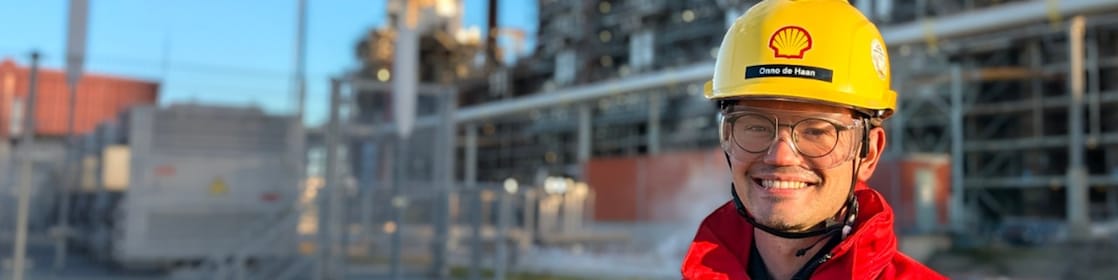
Dat de basisindustrie het moeilijk heeft in Nederland, in Europa en op de wereldmarkt, is regelmatig te lezen en te horen. Je zou daardoor bijna vergeten dat diezelfde industrie ook flink aan het verduurzamen is. Neem Shell Chemicals Park in Moerdijk, waar sinds de zogenoemde ”turnaround” van eerder dit jaar Europa’s waarschijnlijk meest efficiënte vloeistofkraker staat.1 En die zorgt er mede voor dat jij je alledaagse producten kunt kopen — gemaakt met minder energie dan elders. Een interview met de productieleider van de kraker: Onno de Haan.

Tekst: Marcel Burger. Beeld: via Onno de Haan (portret), Shell Nederland (dronebeelden).
In dit verhaal:
- Op Shell Chemicals Park Moerdijk staat waarschijnlijk de meest energie-efficiënte vloeistofkraker van Europa.1 De installatie produceert basischemicaliën zoals etheen, propeen en benzeen, belangrijke grondstoffen voor kunststoffen en veel alledaagse producten.
- Projecten Skyline en E-Drives verlaagden het energiegebruik en de CO2-uitstoot van Shell in Moerdijk. Energiezuinigere fornuizen en elektrische aandrijvingen zorgen samen bij volledige productie voor circa 450.000 ton minder CO2-uitstoot per jaar.
- De kraker speelt ook een rol in circulaire chemie. Via de MDU kan pyrolyseolie uit moeilijk recyclebaar plastic worden verwerkt tot grondstoffen waarmee weer nieuwe kunststoffen kunnen worden gemaakt.
”Zonder een stoomkraker is je moderne leven onmogelijk”, zegt Onno de Haan. Hij is production unit manager MLO bij Shell in Moerdijk en een expert in ”kraken”. Want de MLO (Moerdijk Lower Olefins) is die efficiënte vloeistofkraker: een flinke fabriek waar dagelijks de basisbestanddelen van veel kunststoffen worden gemaakt.
”Het bedschuim in het matras waarop je wakker wordt, de telefoon met je ochtendwekker, de leidingen voor het water uit de kraan, je kleren, het dashboard en de banden van de auto of bus waarmee je naar je werk gaat ... elk stukje van je moderne leven zou niet mogelijk zijn zonder chemie, zonder krakers.”
Het hart van Shells chemiepark in Moerdijk
De Haan woonde jarenlang in Breda en dus was Shell Chemicals Park Moerdijk voor hem redelijk dichtbij. Hij deed er zijn stage voor de studie technische natuurkunde en kwam in 2013 in vaste dienst. Hoewel zijn huis vanwege de liefde nu in Vleuten bij Utrecht staat, is hij op Moerdijk aan het werk gebleven. Aanvankelijk ging hij aan de slag in onderhoudsteams, werd in 2019 maintenance supervisor bij de MLO en is inmiddels eindverantwoordelijke voor de productie van die kraker: het hart van Shells chemiepark in Moerdijk.
”Krakers knippen nafta, dat uit ruwe olie komt, op in losse stukjes waarvan dan basischemicaliën als etheen, propeen, benzeen en meer worden gemaakt. Op Moerdijk is daar een groep van meer dan 150 mensen in ploegen- en dagdienst 24/7 mee bezig. We zorgen niet alleen dat alles veilig blijft draaien, maar kijken ook waar we zaken kunnen verbeteren.”
Meer weten over kraken?
Energiebesparing in de kraker van Shell Moerdijk
Dat verbeteren kan in kleine en grote stappen. Twee van die grote stappen zijn de afgelopen paar jaar uitgevoerd. Tussen 2020 en zomer 2026 werden de zestien oudste fornuizen van de kraker vervangen door acht energiezuinigere nieuwe. Daarmee veranderden de schoorstenen en dus het profiel van Shell Chemicals Park Moerdijk. Dit project kreeg daarom de passende naam Skyline. De energiebesparing door dit project heeft gezorgd voor een CO2-uitstootvermindering van 10% van de site.
Daarnaast verving Moerdijk tijdens de onderhoudsstop van 2026 twee stoomturbines door elektromotoren. Dit e-Drives-project leverde opnieuw 10% uitstootbesparing op, doordat er minder stoom opgewekt hoeft te worden met (aard)gas. “Skyline en E-Drives maken echt een enorm verschil. Samen verminderen ze onze CO2-uitstoot bij volledige productie met zo’n 450.000 ton per jaar. Dat is ongeveer de jaarlijkse CO2-voetafdruk van ruim 56.000 Nederlanders, zeg maar een kleine stad.”2
Stoombalans in de fabriek
”Vervangen van machines klinkt eenvoudig, maar dat is het niet”, stelt De Haan. ”Het gaat echt om een enorme operatie met grote apparaten. Daarnaast moet je met veel meer dingen rekening houden. Want door de stoomturbines te vervangen door elektrische versies, gebruik je minder stoom en dat zorgt voor een verandering in de stoombalans in je fabriek.”
”Als voorbeeld: om stoom te maken heb je brandstof nodig. Vóór de grote projecten importeerden we daarom veel aardgas. Nu hebben we bij volle doorzet soms juist een overschot, en dat is al zonder intrek van extra gas. Dat overschot moet ergens heen, waar ook weer logistiek en faciliteiten voor nodig zijn.” Die restbrandstof blijkt overigens prima te gebruiken in traditionele scheepsmotoren, dus Moerdijk exporteert die nu.
Circulaire chemie op Moerdijk
In tandem met de kraker werkt een andere installatie op Moerdijk aan hergebruik van oude chemieproducten, namelijk plastic. De MDU (Market Development Upgrader) werd in november 2024 in gebruik genomen om basisgrondstof van moeilijk te recyclen plastic (pyrolyseolie) te kunnen voeden aan de kraker. ”Daarmee haalden we circulaire chemie in huis en dat is nog redelijk uniek in Europa.”
De MLO/kraker is weliswaar het meest efficiënt in Europa, er is nog meer energiewinst te behalen op Moerdijk. Zo zijn er nog meer (brandstofgestookte) stoomturbines in bedrijf. ”Vervangen kost heel veel geld en kan — zeker met de hevige concurrentie van goedkope chemieproducten uit onder meer China — niet in één keer.” Toch is dat wel de toekomst voor de Nederlandse basisindustrie, vindt De Haan: ”Energiebesparing is een noodzaak om te overleven.”
Voetnoot:
1. De kraker (MLO) van Moerdijk zit ruim onder de EU-benchmark. Verdere argumenten voor Moerdijk zijn: CO2-uitstootreductie van 10% door nieuwe energiezuinigere fornuizen (project Skyline) bij het in standhouden van de productiecapaciteit op 900.000 ton per jaar. Verder de vervanging van 25 MW- en 8 MW-compressoren door elektrisch aangedreven versies van Siemens Energy, die goed zijn voor een ruwe uitstootreductie van 230 kiloton CO2 per jaar, ofwel 10% van de emissies van de MLO/Moerdijk. Bij Coolbrook op het industriecomplex Chemelot in Geleen staat wel een proefkraker die nog efficiënter is, maar dat is dus geen kraker op schaal vergelijkbaar met die van Moerdijk. In Antwerpen wordt wel gewerkt aan een zeer efficiënte kraker, maar deze Project One is nog niet afgebouwd en zal op z'n vroegst in 2027, mogelijk later, worden opgeleverd.
2. Berekening gebaseerd op cijfers van de RIVM, waaruit valt af te leiden dat de gemiddelde territorial CO2-uitstoot per Nederlander in 2024 circa 8 ton per jaar was. Daarmee komt de uitstootbesparing op Moerdijk neer op de gemiddelde jaarlijkse uitstoot in eigen land van 56.250 Nederlanders. Bron: Greenhouse gas emissions in the Netherlands 1990-2024. National Inventory Document 2026 | RIVM, geraadpleegd 16 november 2026
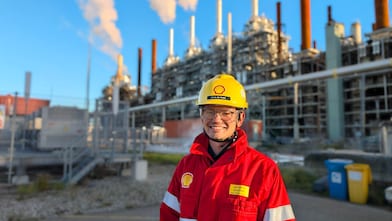
Onno de Haan, productieleider kraker (MLO) Shell Chemicals Park Moerdijk"Energiebesparing is een noodzaak om te overleven"
Cautionary note
Cautionary note
The companies in which Shell plc directly and indirectly owns investments are separate legal entities. In this publication “Shell”, “Shell Group” and “Group” are sometimes used for convenience to reference Shell plc and its subsidiaries in general. Likewise, the words “we”, “us” and “our” are also used to refer to Shell plc and its subsidiaries in general or to those who work for them. These terms are also used where no useful purpose is served by identifying the particular entity or entities. ‘‘Subsidiaries’’, “Shell subsidiaries” and “Shell companies” as used in this publication refer to entities over which Shell plc either directly or indirectly has control. The terms “joint venture”, “joint operations”, “joint arrangements”, and “associates” may also be used to refer to a commercial arrangement in which Shell has a direct or indirect ownership interest with one or more parties. The term “Shell interest” is used for convenience to indicate the direct and/or indirect ownership interest held by Shell in an entity or unincorporated joint arrangement, after exclusion of all third-party interest.
Forward-Looking statements
This publication contains forward-looking statements (within the meaning of the U.S. Private Securities Litigation Reform Act of 1995) concerning the financial condition, results of operations and businesses of Shell. All statements other than statements of historical fact are, or may be deemed to be, forward-looking statements. Forward-looking statements are statements of future expectations that are based on management’s current expectations and assumptions, including (without limitation) those concerning Shell’s strategy and operating plans, macroeconomic conditions, future energy demand, supply and product mix, commodity prices, demand for Shell’s products, production results and reserve estimates, development, execution and management of projects, energy transition and climate change, management of safety and environmental risks, costs, cash capital expenditures, technology advancements, legislative, judicial, fiscal and regulatory developments, regional conflicts and trading conditions, and involve known and unknown risks and uncertainties that could cause actual results, performance or events to differ materially from those expressed or implied in these statements. Forward-looking statements include, among other things, statements concerning the potential exposure of Shell to market risks and statements expressing management’s expectations, beliefs, estimates, forecasts, projections and assumptions. These forward-looking statements are identified by their use of terms and phrases such as “aim”; “ambition”; ‘‘anticipate’’; “aspire”, “aspiration”, ‘‘believe’’; “commit”; “commitment”; ‘‘could’’; “desire”; ‘‘estimate’’; ‘‘expect’’; ‘‘goals’’; ‘‘intend’’; ‘‘may’’; “milestones”; ‘‘objectives’’; ‘‘outlook’’; ‘‘plan’’; ‘‘probably’’; ‘‘project’’; ‘‘risks’’; “schedule”; ‘‘seek’’; ‘‘should’’; ‘‘target’’; “vision”; ‘‘will’’; “would” and similar terms and phrases. There are a number of factors that could affect the future operations of Shell and could cause those results to differ materially from those expressed in the forward-looking statements included in this publication, including (without limitation): (a) price fluctuations in crude oil and natural gas; (b) changes in demand for Shell’s products; (c) currency fluctuations; (d) drilling and production results; (e) reserves estimates; (f) loss of market share and industry competition; (g) environmental and physical risks, including climate change; (h) risks associated with the identification of suitable potential acquisition properties and targets, and successful negotiation and completion of such transactions; (i) the risk of doing business in developing countries and countries subject to international sanctions; (j) legislative, judicial, fiscal and regulatory developments including tariffs and regulatory measures addressing climate change; (k) economic and financial market conditions in various countries and regions; (l) political risks, including the risks of expropriation and renegotiation of the terms of contracts with governmental entities, delays or advancements in the approval of projects and delays in the reimbursement for shared costs; (m) risks associated with the impact of pandemics, regional conflicts, such as the Russia-Ukraine war and the conflict in the Middle East, and a significant cyber security, data privacy or IT incident; (n) the pace of the energy transition; and (o) changes in trading conditions. No assurance is provided that future dividend payments will match or exceed previous dividend payments. All forward-looking statements contained in this publication are expressly qualified in their entirety by the cautionary statements contained or referred to in this section. Readers should not place undue reliance on forward-looking statements. Additional risk factors that may affect future results are contained in Shell plc’s Form 20-F for the year ended December 31, 2025 (available at www.shell.com/investors/news-and-filings/sec-filings.html and www.sec.gov). These risk factors also expressly qualify all forward-looking statements contained in this publication and should be considered by the reader. Each forward-looking statement speaks only as of the date of this publication, November 26, 2026. Neither Shell plc nor any of its subsidiaries undertake any obligation to publicly update or revise any forward-looking statement as a result of new information, future events or other information. In light of these risks, results could differ materially from those stated, implied or inferred from the forward-looking statements contained in this publication.
Shell’s net carbon intensity and net-zero emissions target
In this publication we may refer to Shell’s “net carbon intensity” (NCI), which includes Shell’s carbon emissions from the production of our energy products, our suppliers’ carbon emissions in supplying energy for that production and our customers’ carbon emissions associated with their use of the energy products we sell. Shell’s NCI also includes the emissions associated with the production and use of energy products produced by others which Shell purchases for resale. Shell only controls its own emissions. The use of the terms Shell’s “net carbon intensity” or NCI is for convenience only and not intended to suggest these emissions are those of Shell plc or its subsidiaries.
Shell’s operating plan and outlook are forecasted for a three-year period and ten-year period, respectively, and are updated every year. They reflect the current economic environment and what we can reasonably expect to see over the next three and ten years. Accordingly, the outlook reflects our combined Scope 1 and 2 target, NCI target and our oil products ambition over the next ten years. However, Shell’s operating plan and outlook cannot reflect our 2050 net-zero emissions target, as this target is outside our planning period. Such future operating plans and outlooks could include changes to our portfolio, efficiency improvements and the use of carbon capture and storage and carbon credits. In the future, as society moves towards net-zero emissions, we expect Shell’s operating plans and outlooks to reflect this movement. However, if society is not net zero in 2050, as of today, there would be significant risk that Shell may not meet this target.
The information provided above regarding Shell’s NCI and net zero emissions target are not intended, nor should they be construed as introducing, suggesting or making any claim, target or representation thereof other than what is included in the publicaiton..
Forward-Looking non-GAAP measures
This publication may contain certain forward-looking non-GAAP measures such as free cash flow and underlying operating expenses. We are unable to provide a reconciliation of these forward-looking non-GAAP measures to the most comparable GAAP financial measures because certain information needed to reconcile those non-GAAP measures to the most comparable GAAP financial measures is dependent on future events some of which are outside the control of Shell, such as oil and gas prices, interest rates and exchange rates. Moreover, estimating such GAAP measures with the required precision necessary to provide a meaningful reconciliation is extremely difficult and could not be accomplished without unreasonable effort. Non-GAAP measures in respect of future periods which cannot be reconciled to the most comparable GAAP financial measure are calculated in a manner which is consistent with the accounting policies applied in Shell plc’s consolidated financial statements. These forward-looking non-GAAP measures are provided to assist readers in understanding management’s use and expectations of such measures and may not be appropriate for other purposes.
The contents of websites referred to in this publication do not form part of this publication.
We may have used certain terms, such as resources, in this publication that the United States Securities and Exchange Commission (SEC) strictly prohibits us from including in our filings with the SEC. Investors are urged to consider closely the disclosure in our Form 20-F, File No 1-32575, available on the SEC website www.sec.gov.