Opslag van CO2-uitstoot: Shell Pernis nu rechtstreeks verbonden met de zeebodem
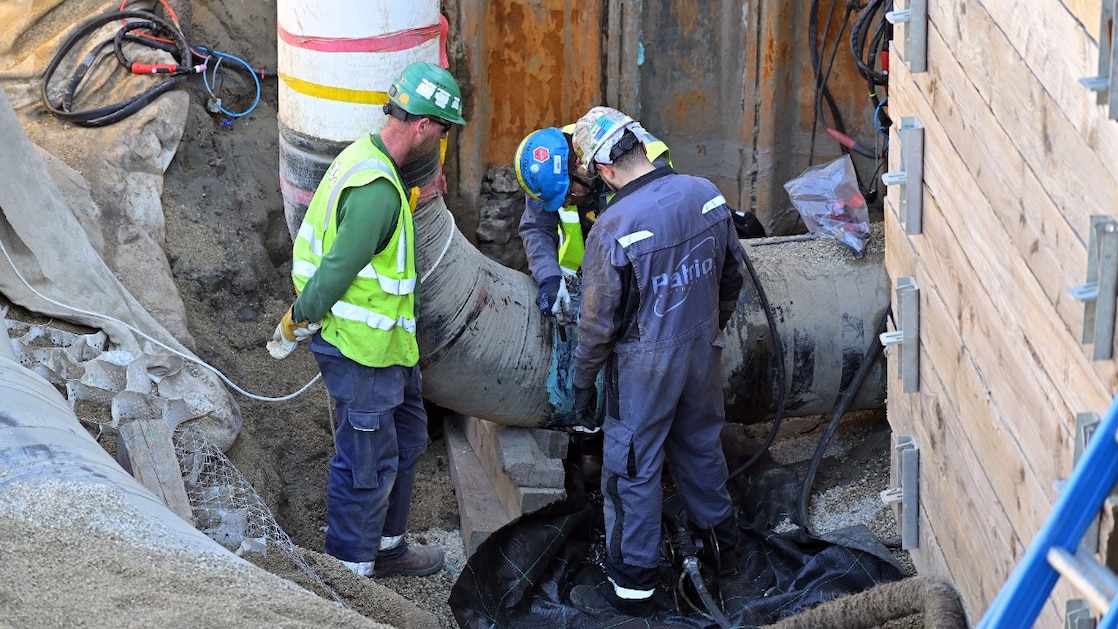
Sinds dit voorjaar is een dikke buis van Shell Pernis aangesloten op het CO2-opslagnetwerk van Porthos. Een mijlpaal, noemt Thijs Lepelaar (technoloog bij Shell Pernis) deze ‘gouden las’. Hiermee wordt het mogelijk om de koolstofuitstoot van de raffinaderij van Pernis veilig en permanent op te slaan in een leeg gasveld onder de zeebodem. Dat scheelt CO2 in de lucht. Toch moet Pernis nog even wachten tot het ook echt zo ver is.

Tekst: Matthijs Timmers. Beeld: Shell Nederland, Jelle Hoogendam, Porthos/Linde.
“We gaan voor het eerst in Nederland CO2 opslaan onder de zeebodem. We willen natuurlijk zorgen dat dit goed en veilig gaat. Dat is ons gezamenlijk belang en daar werken we hard aan,” zegt Thijs Lepelaar. Nederland is naast Noorwegen een koploper in CO2-opslag onder zee.
Grote stap in het terugbrengen van uitstoot
De opslag van CO2 is voor Shell een essentieel onderdeel om op relatief korte termijn de uitstoot van de raffinaderij in Pernis terug te dringen. De verwachting is met wel 20%. “Dit is een essentieel project voor de toekomst”, vertelt Lepelaar. “Niet alleen voor ons, maar ook voor andere partijen in de Rotterdamse haven.” Shell is het eerste bedrijf dat de aansluiting heeft gemaakt op het opslagsysteem van Porthos. De komende periode volgen andere bedrijven in de omgeving dit voorbeeld.
De reis van CO2 naar de zeebodem
De CO2-uitstoot van Shell Pernis legt in de toekomst een hele reis af richting de zeebodem. De transportbuis, 50 centimeter in doorsnee, loopt vanaf een waterstoffabriek op het Shell-terrein in Pernis, langs de snelweg A15 westwaarts, richting een compressorstation een stuk verderop in de haven.
Daar wordt de CO2 met compressorstation ‘op druk’ van 30 bar gebracht. Vervolgens wordt de aansluiting met het Porthos-netwerk gemaakt: een 30 kilometer lange buis op land, en vanaf de Tweede Maasvlakte nog eens 20 kilometer in de Noordzee. Daar wordt de CO2 tot drie kilometer diepte in de zeebodem gepompt, waar het permanent wordt opgeslagen in een leeggeproduceerd gasveld.
“Met de ‘gouden las’ is onze waterstoffabriek nu rechtstreeks verbonden met de infrastructuur waarmee de CO2 helemaal naar de zeebodem kan stromen”, legt de technoloog uit.
Wie is Thijs Lepelaar?
Thijs Lepelaar werkt sinds 2019 voor Shell als unittechnoloog en voor het Porthos-project als integratiespecialist. Hij kijkt vanuit technisch en commercieel perspectief naar de aansluiting van Shell Pernis op het CCS-netwerk (Carbon capture and storage) in de haven voor de opslag van CO2 onder de zeebodem. Lepelaar studeerde Chemical Engineering aan de Universiteit van Edinburgh, Schotland.
Uitleg grafische weergave CCS
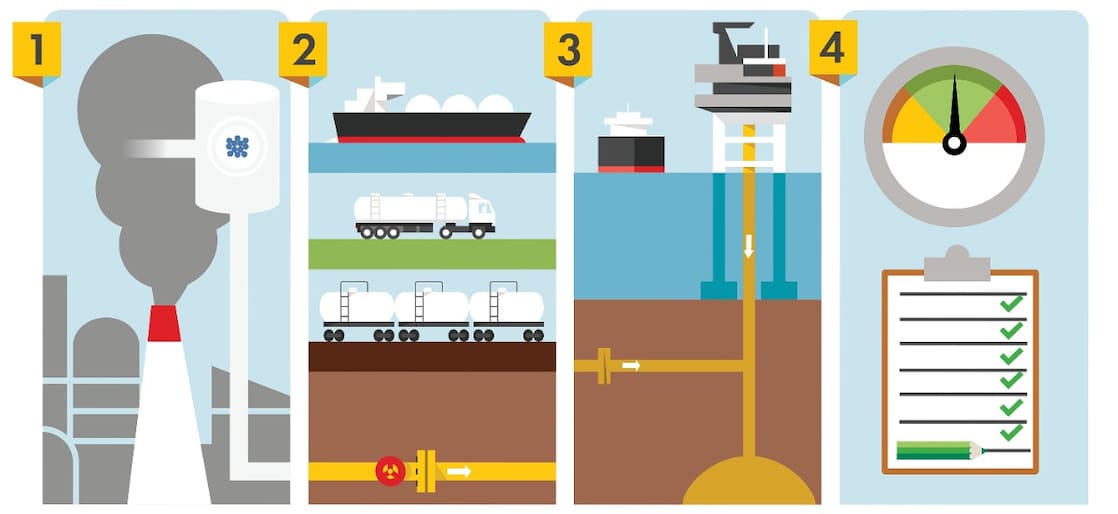
Uitleg grafische weergave CCS
- Afvangen van CO2
Bij CO2-afvang wordt CO2 van gas gescheiden voordat het wordt uitgestoten. Vervolgens wordt de afgevangen CO2 gecomprimeerd naar een vloeibare dan wel gasvorm voor transport. - Transport van CO2
De afgevangen CO2 kan, gekoeld en daardoor compacter dan als gas, vervolgens per schip, trein, vrachtwagen of per pijpleiding worden vervoerd. - Opslag van CO2
De CO2 wordt diep onder de grond geïnjecteerd in de microscopische ruimtes in poreuze gesteenten, bijvoorbeeld in lege reservoirs onder de zee. Een laag ondoordringbaar gesteente dat dient als afsluitingslaag, ligt direct boven de poreuze gesteenten en zorgt ervoor dat de CO2 daar permanent blijft. - Meten, monitoren en verifiëren
Monitoring van opslaglocaties vindt plaats in het opslagreservoir en bij de injectieput, waar sensoren kleine veranderingen in druk- of CO2-niveaus kunnen detecteren. Zo is er zekerheid dat CO2 permanent blijft opgeslagen.
Waarom de waterstoffabriek?
De waterstoffabriek op het terrein van Shell Pernis stoot relatief veel CO2 uit. Hier wordt met aardgas (“grijze”) waterstof gemaakt als basis voor de productie van brandstoffen. Door juist die emissies af te vangen en op te slaan zet Shell een grote stap in het terugdringen van de uitstoot van de gehele raffinaderij. Dat wordt carbon capture en storage (CCS) genoemd: waterstof gemaakt met aardgas, maar zonder dat er CO2 in de atmosfeer komt (“blauwe” waterstof). Uiteindelijk gaat Pernis voor een deel ook “groene” waterstof gebruiken, geleverd door de Shell Holland Hydrogen 1 die nog in aanbouw is.
De waterstoffabriek op Pernis heeft overigens al een afvanginstallatie, zodat de CO2 aan onder meer de Westlandse tuinders kan worden geleverd. Voor de tuinbouwsector is CO2 belangrijk voor de groei van gewassen. “We hoefden dus geen nieuwe afvanginstallatie te bouwen, die was er al”, zegt Lepelaar.
Buis moet jaren mee
Het afvangen en opslaan van CO2 is een manier om de Nederlandse klimaatdoelen te halen en de overstap naar schonere energie mogelijk te maken. Het Porthos-project —met Shell (Pernis), ExxonMobil, Air Liquide en Air Products als klanten — is hiervoor het begin. Via Porthos zal volgens plan circa 2,5 megaton CO2 per jaar worden opgeslagen, gedurende 15 jaar.
Dat vraagt wat van de infrastructuur. Om lang van de buis gebruik te maken, is het belangrijk dat de CO2 zuiver genoeg is om erdoorheen te stromen. “Er mogen niet te veel andere stoffen — zoals zwavel, zuurstof of water — in de CO2 zitten. Want anders kan de buis aan de binnenkant gaan roesten”, schetst Lepelaar de mogelijke gevolgen. “We hebben hiervoor intensieve studies gedaan en meetapparatuur geïnstalleerd die ervoor moet zorgen dat we zuivere CO2 door de buizen laten stromen.”
Langer naar de tuinbouw
Onlangs maakte Porthos bekend dat het gereed maken van de CO2-opslag een jaar is vertraagd. Niet zoals gepland eind 2026, maar eind 2027 kan de eerste CO2 in de zeebodem worden geïnjecteerd.
“Het is natuurlijk jammer dat de oplevering van het project langer duurt dan eerder werd gedacht”, reflecteert de Shell-technoloog. “Maar aan de andere kant kunnen we onze CO2 nu langer aan de tuinbouw leveren.” Shell werkt hiervoor intensief samen met OCAP, leverancier van CO2 aan de tuinbouw en eigenaar van het nabijgelegen compressorstation én verantwoordelijk voor de aanleg van de buizen naar de glastuinders.
Superinteressant project
Met het maken van de gouden las is een deel van het werk gedaan — een klus die Porthos, Shell Pernis, OCAP en partners samen hebben geklaard. Een mooi moment voor Thijs Lepelaar om terug te blikken. “CO2-opslag is een boeiend domein om in te werken. We koppelen de traditionele industrie aan nieuwe technieken, waarmee we samen werken aan een van de oplossingen in de energietransitie.”
Cautionary note
Cautionary note
The companies in which Shell plc directly and indirectly owns investments are separate legal entities. In this announcement “Shell”, “Shell Group” and “Group” are sometimes used for convenience to reference Shell plc and its subsidiaries in general. Likewise, the words “we”, “us” and “our” are also used to refer to Shell plc and its subsidiaries in general or to those who work for them. These terms are also used where no useful purpose is served by identifying the particular entity or entities. ‘‘Subsidiaries’’, “Shell subsidiaries” and “Shell companies” as used in this announcement refer to entities over which Shell plc either directly or indirectly has control. The terms “joint venture”, “joint operations”, “joint arrangements”, and “associates” may also be used to refer to a commercial arrangement in which Shell has a direct or indirect ownership interest with one or more parties. The term “Shell interest” is used for convenience to indicate the direct and/or indirect ownership interest held by Shell in an entity or unincorporated joint arrangement, after exclusion of all third-party interest.
Forward-Looking statements
This announcement contains forward-looking statements (within the meaning of the U.S. Private Securities Litigation Reform Act of 1995) concerning the financial condition, results of operations and businesses of Shell. All statements other than statements of historical fact are, or may be deemed to be, forward-looking statements. Forward-looking statements are statements of future expectations that are based on management’s current expectations and assumptions and involve known and unknown risks and uncertainties that could cause actual results, performance or events to differ materially from those expressed or implied in these statements. Forward-looking statements include, among other things, statements concerning the potential exposure of Shell to market risks and statements expressing management’s expectations, beliefs, estimates, forecasts, projections and assumptions. These forward-looking statements are identified by their use of terms and phrases such as “aim”; “ambition”; ‘‘anticipate’’; “aspire”, “aspiration”, ‘‘believe’’; “commit”; “commitment”; ‘‘could’’; “desire”; ‘‘estimate’’; ‘‘expect’’; ‘‘goals’’; ‘‘intend’’; ‘‘may’’; “milestones”; ‘‘objectives’’; ‘‘outlook’’; ‘‘plan’’; ‘‘probably’’; ‘‘project’’; ‘‘risks’’; “schedule”; ‘‘seek’’; ‘‘should’’; ‘‘target’’; “vision”; ‘‘will’’; “would” and similar terms and phrases. There are a number of factors that could affect the future operations of Shell and could cause those results to differ materially from those expressed in the forward-looking statements included in this announcement, including (without limitation): (a) price fluctuations in crude oil and natural gas; (b) changes in demand for Shell’s products; (c) currency fluctuations; (d) drilling and production results; (e) reserves estimates; (f) loss of market share and industry competition; (g) environmental and physical risks, including climate change; (h) risks associated with the identification of suitable potential acquisition properties and targets, and successful negotiation and completion of such transactions; (i) the risk of doing business in developing countries and countries subject to international sanctions; (j) legislative, judicial, fiscal and regulatory developments including tariffs and regulatory measures addressing climate change; (k) economic and financial market conditions in various countries and regions; (l) political risks, including the risks of expropriation and renegotiation of the terms of contracts with governmental entities, delays or advancements in the approval of projects and delays in the reimbursement for shared costs; (m) risks associated with the impact of pandemics, regional conflicts, such as the Russia-Ukraine war and the conflict in the Middle East, and a significant cyber security, data privacy or IT incident; (n) the pace of the energy transition; and (o) changes in trading conditions. No assurance is provided that future dividend payments will match or exceed previous dividend payments. All forward-looking statements contained in this announcement are expressly qualified in their entirety by the cautionary statements contained or referred to in this section. Readers should not place undue reliance on forward-looking statements. Additional risk factors that may affect future results are contained in Shell plc’s Form 20-F for the year ended December 31, 2025 (available at www.shell.com/investors/news-and-filings/sec-filings.html and www.sec.gov). These risk factors also expressly qualify all forward-looking statements contained in this announcement and should be considered by the reader. Each forward-looking statement speaks only as of the date of this announcement, June 16, 2026. Neither Shell plc nor any of its subsidiaries undertake any obligation to publicly update or revise any forward-looking statement as a result of new information, future events or other information. In light of these risks, results could differ materially from those stated, implied or inferred from the forward-looking statements contained in this announcement.
Shell’s net carbon intensity
Also, in this announcement we may refer to Shell’s “net carbon intensity” (NCI), which includes Shell’s carbon emissions from the production of our energy products, our suppliers’ carbon emissions in supplying energy for that production and our customers’ carbon emissions associated with their use of the energy products we sell. Shell’s NCI also includes the emissions associated with the production and use of energy products produced by others which Shell purchases for resale. Shell only controls its own emissions. The use of the terms Shell’s “net carbon intensity” or NCI is for convenience only and not intended to suggest these emissions are those of Shell plc or its subsidiaries.
Shell’s net-zero emissions target
Shell’s operating plan and outlook are forecasted for a three-year period and ten-year period, respectively, and are updated every year. They reflect the current economic environment and what we can reasonably expect to see over the next three and ten years. Accordingly, the outlook reflects our combined Scope 1 and 2 target, NCI target and our oil products ambition over the next ten years. However, Shell’s operating plan and outlook cannot reflect our 2050 net-zero emissions target, as this target is outside our planning period. Such future operating plans and outlooks could include changes to our portfolio, efficiency improvements and the use of carbon capture and storage and carbon credits. In the future, as society moves towards net-zero emissions, we expect Shell’s operating plans and outlooks to reflect this movement. However, if society is not net zero in 2050, as of today, there would be significant risk that Shell may not meet this target.
Forward-Looking non-GAAP measures
This announcement may contain certain forward-looking non-GAAP measures. We are unable to provide a reconciliation of these forward-looking non-GAAP measures to the most comparable GAAP financial measures because certain information needed to reconcile those non-GAAP measures to the most comparable GAAP financial measures is dependent on future events some of which are outside the control of Shell, such as oil and gas prices, interest rates and exchange rates. Moreover, estimating such GAAP measures with the required precision necessary to provide meaningful reconciliation is extremely difficult and could not be accomplished without unreasonable effort. Non-GAAP measures in respect of future periods which cannot be reconciled to the most comparable GAAP financial measure are calculated in a manner which is consistent with the accounting policies applied in Shell plc’s consolidated financial statements.
The contents of websites referred to in this announcement do not form part of this announcement.
We may have used certain terms, such as resources, in this announcement that the United States Securities and Exchange Commission (SEC) strictly prohibits us from including in our filings with the SEC. Investors are urged to consider closely the disclosure in our Form 20-F, File No 1-32575, available on the SEC website www.sec.gov.
Meer weten over Shell en CCS?
Northern Lights: voorloper voor CO2-opslag
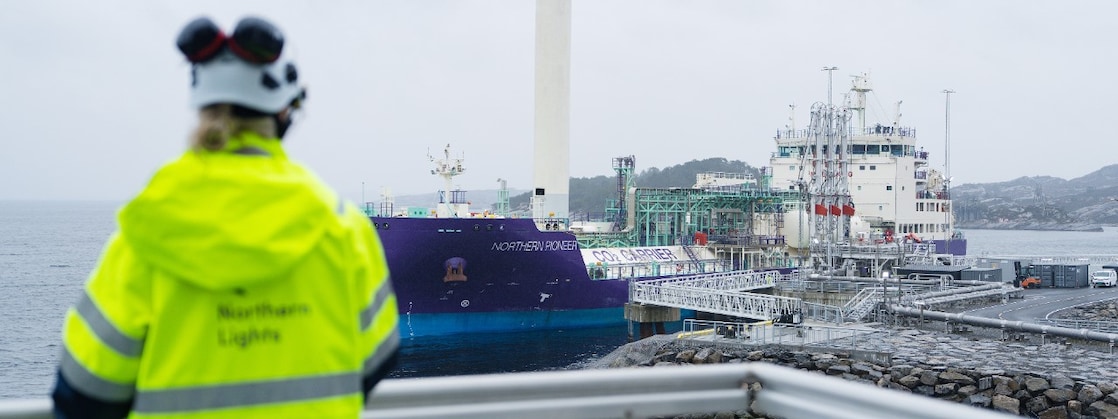
Porthos is in Nederland de eerste grote stap naar onderzeese CO2-opslag, in Noorwegen is dat de joint venture Northern Lights — van Equinor, TotalEnergies en Shell. De Noorse activiteiten zijn al een stuk verder dan de Nederlandse.
Eind maart accepteerde Northern Lights de eerste lading CO2 van de grootste Noorse waterzuiveringsinstallatie bij Oslo, in de ontvangstterminal in Øygarden in het zuidwesten van het land. De vloeibaar gemaakte koolstof kwam per tankwagen aan.
Van Øygarden gaat de vloeibare CO2 per pijpleiding naar het Aurora-reservoir 100 kilometer uit de Noorse kust. Daar wordt het 2.600 meter onder de zeebodem geïnjecteerd voor permanente opslag. Dat deed Northern Lights voor het eerst in augustus 2025.
Onder de klanten van Northern Lights zijn twee Noorse bedrijven, het Deense energiebedrijf Ørsted, het Zweedse energiebedrijf Stockholm Exergi en het Nederlande Yara. Northern Lights nam eind april haar derde transportschip in gebruik, juist voor het vervoer van vloeibaar gemaakte CO2 van Yara in Zeeland.
Storage of CO₂ emissions: Shell Pernis now directly connected to the seabed
17 Jun 2026
Since this spring, a large pipeline from Shell Pernis has been connected to the Porthos CO2 storage network. Thijs Lepelaar (a technologist at Shell Pernis) describes this “golden weld” as a milestone. It makes it possible to safely and permanently store the refinery’s carbon emissions in an empty gas field beneath the seabed, thereby reducing CO2 in the atmosphere. Pernis will, however, have to wait a little longer before this can actually begin.

Text: Matthijs Timmers. Photography: Shell Nederland, Jelle Hoogendam, Porthos/Linde.
“We are going to store CO2 beneath the seabed in the Netherlands for the first time. Naturally, we want to ensure this is done properly and safely. That is our shared interest, and we are working hard towards it,” says Thijs Lepelaar. Alongside Norway, the Netherlands is a front runner in offshore CO2 storage.
Major step in reducing emissions
CO2 storage is an essential part of Shell’s strategy to reduce emissions from the Pernis refinery in the relatively short term — potentially by as much as 20%. “This is a crucial project for the future,” Lepelaar explains. “Not only for us, but also for other parties in the Port of Rotterdam.” Shell is the first company to connect to the Porthos storage system. In the coming period, other companies in the area will follow suit.
The journey of CO2 to the seabed
In future, CO2 emissions from Shell Pernis will undergo a significant journey to the seabed. The transport pipeline, 50 centimetres (19.7 inches) in diameter, runs from a hydrogen plant on the Shell site in Pernis, westwards along the A15 motorway, towards a compressor station further into the port area.
At this station, the CO₂ is pressurised to around 30 bar. It is then connected to the Porthos network: a 30‑kilometre pipeline on land, followed by a further 20 kilometres beneath the North Sea from the Maasvlakte. There, the CO2 is pumped to a depth of around three kilometres below the seabed, where it is permanently stored in a depleted gas field.
“With the ‘golden weld’, our hydrogen plant is now directly connected to the infrastructure that allows the CO2 to flow all the way to the seabed,” the technologist explains.
Who is Thijs Lepelaar?
Thijs Lepelaar has been working for Shell since 2019 as a unit technologist and, for the Porthos project, as an integration specialist. From both a technical and commercial perspective, he is involved in connecting Shell Pernis to the CCS (carbon capture and storage) network in the port for the storage of CO2 beneath the seabed. Lepelaar studied Chemical Engineering at the University of Edinburgh in Scotland.
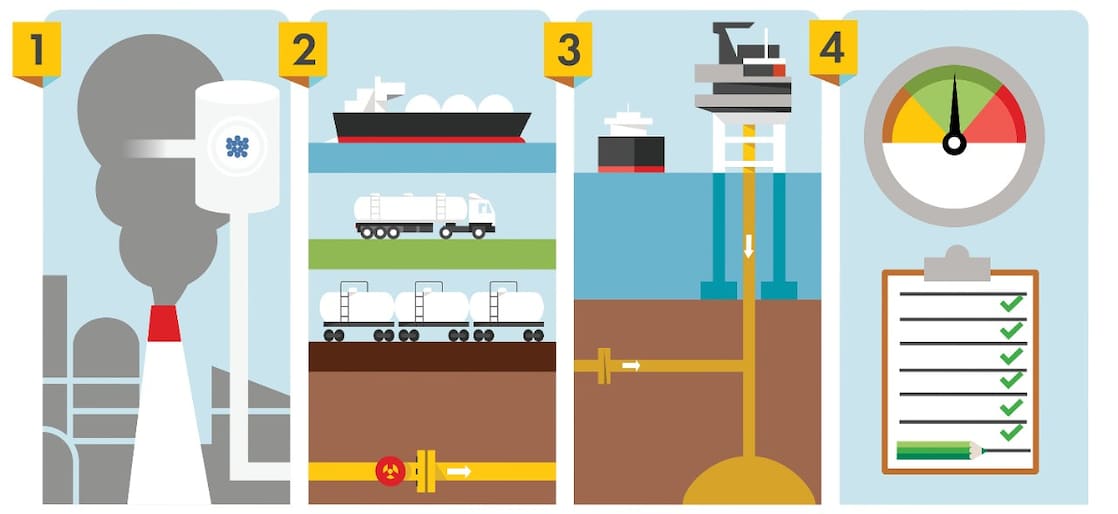
Explanation of graphic "CCS in 4 steps"
Explanation of graphic "CCS in 4 steps"
- Capture of CO2
CO2 capture involves separating CO2 from gas before it is emitted. The captured CO₂ is then compressed into either a liquid or gaseous state for transport.
- Transport of CO2
The captured CO2 can then be transported—once cooled and therefore more compact than in gaseous form—by ship, rail, lorry, or pipeline.
- Storage of CO2
The CO2 is injected deep underground into the microscopic spaces within porous rock formations, such as depleted reservoirs beneath the sea. A layer of impermeable rock acting as a sealing layer sits directly above the porous rock, ensuring that the CO2 remains stored there permanently.
- Measurement, monitoring and verification
Storage sites are monitored within the reservoir and at the injection well, where sensors can detect small changes in pressure or CO2 levels. This ensures that the CO2 remains permanently stored.
Why the hydrogen plant?
The hydrogen plant at the Shell Pernis site emits relatively large amounts of CO2. Here, hydrogen is produced from natural gas (“grey” hydrogen) as a basis for fuel production. By capturing and storing these specific emissions, Shell is taking a major step in reducing the refinery’s overall emissions. This process is known as carbon capture and storage (CCS): hydrogen produced from natural gas without releasing CO2 into the atmosphere (“blue” hydrogen).
In the longer term, Pernis will also partly use “green” hydrogen, supplied by Shell Holland Hydrogen 1, which is currently under construction.
The hydrogen plant at Pernis already has a capture installation in place, allowing CO2 to be supplied to greenhouse growers in the Westland region. In the horticultural sector, CO2 is important for crop growth. “So we did not need to build a new capture installation — it was already there,” says Lepelaar.
Pipeline must last for years
Capturing and storing CO2 is one way to meet Dutch climate targets and enable the transition to cleaner energy. The Porthos project — with Shell (Pernis), ExxonMobil, Air Liquide and Air Products as clients — marks the starting point. According to plan, around 2.5 megatonnes of CO2 will be stored annually via Porthos over a period of 15 years.
This places significant demands on the infrastructure. To ensure long-term use of the pipeline, it is vital that the CO2 is sufficiently pure to flow through it safely. “It must not contain too many other substances — such as sulphur, oxygen or water — because that could cause the inside of the pipe to corrode,” Lepelaar explains. “We have carried out extensive studies and installed monitoring equipment to ensure that only pure CO2 flows through the pipelines.”
Longer supply to the horticultural sector
Porthos recently announced that the preparation of the CO2 storage facility has been delayed by a year. Instead of the originally planned end of 2026, the first CO2 can now be injected beneath the seabed by the end of 2027.
“Naturally, it is regrettable that the completion of the project will take longer than previously expected,” reflects the Shell technologist. “But on the other hand, it means we can continue supplying our CO2 to the horticultural sector for longer.” For this, Shell works closely with OCAP, a supplier of CO2 to the horticulture sector and owner of the nearby compressor station, as well as being responsible for installing the pipelines to greenhouse growers.
A highly interesting project
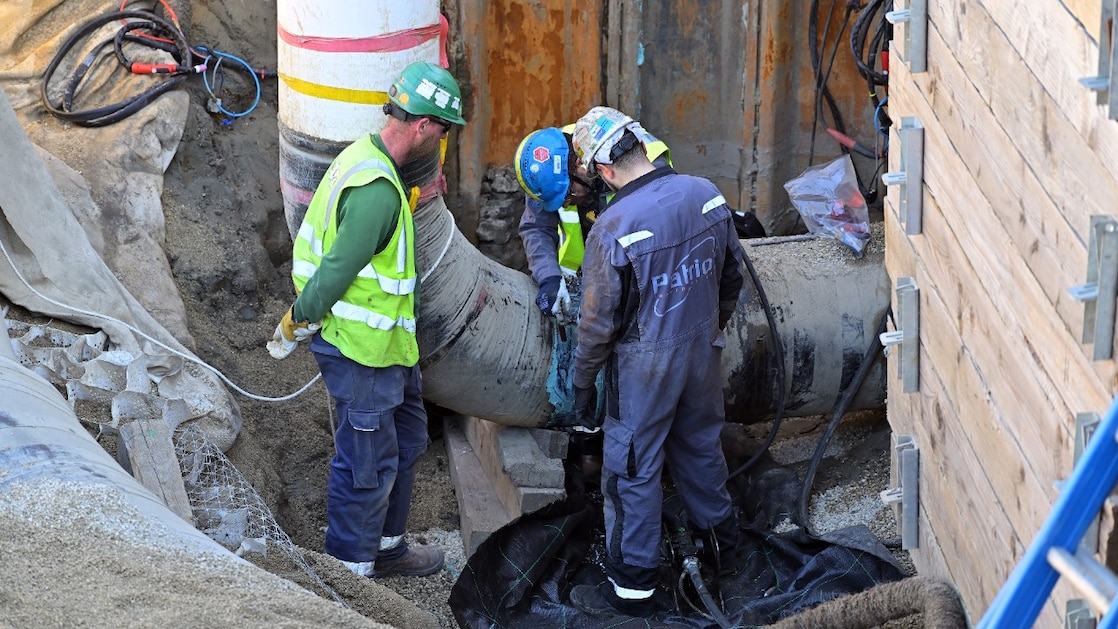
With the completion of the “golden weld”, part of the work has been finalised — a task carried out jointly by Porthos, Shell Pernis, OCAP and their partners. For Thijs Lepelaar, it is a fitting moment to reflect.
“CO2 storage is a fascinating field to work in. We are linking traditional industry with new technologies, working together on one of the solutions for the energy transition.”
Cautionary note
Cautionary note
The companies in which Shell plc directly and indirectly owns investments are separate legal entities. In this announcement “Shell”, “Shell Group” and “Group” are sometimes used for convenience to reference Shell plc and its subsidiaries in general. Likewise, the words “we”, “us” and “our” are also used to refer to Shell plc and its subsidiaries in general or to those who work for them. These terms are also used where no useful purpose is served by identifying the particular entity or entities. ‘‘Subsidiaries’’, “Shell subsidiaries” and “Shell companies” as used in this announcement refer to entities over which Shell plc either directly or indirectly has control. The terms “joint venture”, “joint operations”, “joint arrangements”, and “associates” may also be used to refer to a commercial arrangement in which Shell has a direct or indirect ownership interest with one or more parties. The term “Shell interest” is used for convenience to indicate the direct and/or indirect ownership interest held by Shell in an entity or unincorporated joint arrangement, after exclusion of all third-party interest.
Forward-Looking statements
This announcement contains forward-looking statements (within the meaning of the U.S. Private Securities Litigation Reform Act of 1995) concerning the financial condition, results of operations and businesses of Shell. All statements other than statements of historical fact are, or may be deemed to be, forward-looking statements. Forward-looking statements are statements of future expectations that are based on management’s current expectations and assumptions and involve known and unknown risks and uncertainties that could cause actual results, performance or events to differ materially from those expressed or implied in these statements. Forward-looking statements include, among other things, statements concerning the potential exposure of Shell to market risks and statements expressing management’s expectations, beliefs, estimates, forecasts, projections and assumptions. These forward-looking statements are identified by their use of terms and phrases such as “aim”; “ambition”; ‘‘anticipate’’; “aspire”, “aspiration”, ‘‘believe’’; “commit”; “commitment”; ‘‘could’’; “desire”; ‘‘estimate’’; ‘‘expect’’; ‘‘goals’’; ‘‘intend’’; ‘‘may’’; “milestones”; ‘‘objectives’’; ‘‘outlook’’; ‘‘plan’’; ‘‘probably’’; ‘‘project’’; ‘‘risks’’; “schedule”; ‘‘seek’’; ‘‘should’’; ‘‘target’’; “vision”; ‘‘will’’; “would” and similar terms and phrases. There are a number of factors that could affect the future operations of Shell and could cause those results to differ materially from those expressed in the forward-looking statements included in this announcement, including (without limitation): (a) price fluctuations in crude oil and natural gas; (b) changes in demand for Shell’s products; (c) currency fluctuations; (d) drilling and production results; (e) reserves estimates; (f) loss of market share and industry competition; (g) environmental and physical risks, including climate change; (h) risks associated with the identification of suitable potential acquisition properties and targets, and successful negotiation and completion of such transactions; (i) the risk of doing business in developing countries and countries subject to international sanctions; (j) legislative, judicial, fiscal and regulatory developments including tariffs and regulatory measures addressing climate change; (k) economic and financial market conditions in various countries and regions; (l) political risks, including the risks of expropriation and renegotiation of the terms of contracts with governmental entities, delays or advancements in the approval of projects and delays in the reimbursement for shared costs; (m) risks associated with the impact of pandemics, regional conflicts, such as the Russia-Ukraine war and the conflict in the Middle East, and a significant cyber security, data privacy or IT incident; (n) the pace of the energy transition; and (o) changes in trading conditions. No assurance is provided that future dividend payments will match or exceed previous dividend payments. All forward-looking statements contained in this announcement are expressly qualified in their entirety by the cautionary statements contained or referred to in this section. Readers should not place undue reliance on forward-looking statements. Additional risk factors that may affect future results are contained in Shell plc’s Form 20-F for the year ended December 31, 2025 (available at www.shell.com/investors/news-and-filings/sec-filings.html and www.sec.gov). These risk factors also expressly qualify all forward-looking statements contained in this announcement and should be considered by the reader. Each forward-looking statement speaks only as of the date of this announcement, June 16, 2026. Neither Shell plc nor any of its subsidiaries undertake any obligation to publicly update or revise any forward-looking statement as a result of new information, future events or other information. In light of these risks, results could differ materially from those stated, implied or inferred from the forward-looking statements contained in this announcement.
Shell’s net carbon intensity
Also, in this announcement we may refer to Shell’s “net carbon intensity” (NCI), which includes Shell’s carbon emissions from the production of our energy products, our suppliers’ carbon emissions in supplying energy for that production and our customers’ carbon emissions associated with their use of the energy products we sell. Shell’s NCI also includes the emissions associated with the production and use of energy products produced by others which Shell purchases for resale. Shell only controls its own emissions. The use of the terms Shell’s “net carbon intensity” or NCI is for convenience only and not intended to suggest these emissions are those of Shell plc or its subsidiaries.
Shell’s net-zero emissions target
Shell’s operating plan and outlook are forecasted for a three-year period and ten-year period, respectively, and are updated every year. They reflect the current economic environment and what we can reasonably expect to see over the next three and ten years. Accordingly, the outlook reflects our combined Scope 1 and 2 target, NCI target and our oil products ambition over the next ten years. However, Shell’s operating plan and outlook cannot reflect our 2050 net-zero emissions target, as this target is outside our planning period. Such future operating plans and outlooks could include changes to our portfolio, efficiency improvements and the use of carbon capture and storage and carbon credits. In the future, as society moves towards net-zero emissions, we expect Shell’s operating plans and outlooks to reflect this movement. However, if society is not net zero in 2050, as of today, there would be significant risk that Shell may not meet this target.
Forward-Looking non-GAAP measures
This announcement may contain certain forward-looking non-GAAP measures. We are unable to provide a reconciliation of these forward-looking non-GAAP measures to the most comparable GAAP financial measures because certain information needed to reconcile those non-GAAP measures to the most comparable GAAP financial measures is dependent on future events some of which are outside the control of Shell, such as oil and gas prices, interest rates and exchange rates. Moreover, estimating such GAAP measures with the required precision necessary to provide meaningful reconciliation is extremely difficult and could not be accomplished without unreasonable effort. Non-GAAP measures in respect of future periods which cannot be reconciled to the most comparable GAAP financial measure are calculated in a manner which is consistent with the accounting policies applied in Shell plc’s consolidated financial statements.
The contents of websites referred to in this announcement do not form part of this announcement.
We may have used certain terms, such as resources, in this announcement that the United States Securities and Exchange Commission (SEC) strictly prohibits us from including in our filings with the SEC. Investors are urged to consider closely the disclosure in our Form 20-F, File No 1-32575, available on the SEC website www.sec.gov.
Want to know more about Shell and CCS?
Northern Lights CCS: ahead of everyone
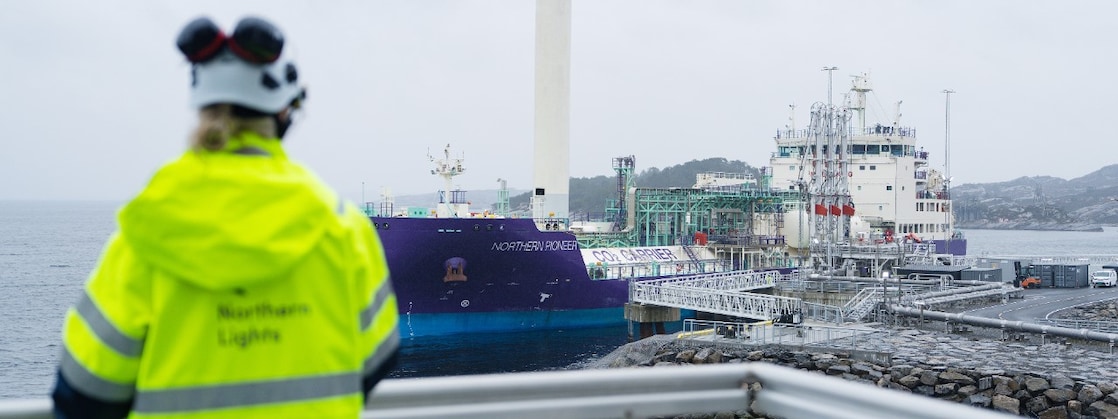
At the end of March, Northern Lights received its first shipment of CO2 from Norway’s largest wastewater treatment plant near Oslo, at the reception terminal in Øygarden in the south-west of the country. The liquefied carbon was delivered by tanker lorry.
From Øygarden, the liquefied CO2 is transported by pipeline to the Aurora reservoir, located 100 kilometres (62 miles) off the Norwegian coast. There, it is injected 2,600 metres (8,530 feet) beneath the seabed for permanent storage. Northern Lights carried out this process for the first time in August 2025.
Northern Lights’ customers include two Norwegian companies, the Danish energy company Ørsted, the Swedish energy company Stockholm Exergi, and the Dutch company Yara. At the end of April, Northern Lights also brought its third transport vessel into operation, specifically for shipping liquefied CO₂ from Yara in Zeeland.