Oliecrisis: lijkt die van toen op de situatie van nu?
1973. Oorlog in het Midden-Oosten. In Nederland gaat de benzine op de bon en volgen er tien autoloze zondagen. Voor de gewone consument komen olieschaarste en de plotselinge stijging van de brandstofprijzen als een totale verrassing.

Tekst: Marcel Burger. Met bijdrage van Rosalie van Egmond.
Beeld: Cor Out (Nationaal Archief/Collectie Spaarnestad/ANP), NASA/JSC, ANP Graphics, Ed Robinson (Shell International), Stuart Conway (Shell International), Shell Heritage & Historical Archive.
In dit verhaal:
Als de Nederlandse regering dit voorjaar anders had besloten, had de tekst uit Shells historische tijdlijn in de inleiding zo maar gisteren geschreven kunnen zijn. Maar we stappen terug naar in de tijd. De olieproducerende landen verenigd in Opec verviervoudigen tussen oktober en december 1973 de olieprijzen*. En dan breekt ook nog eens als de Jom Kipoer- of Ramadan-oorlog uit.
Operatie Nickel Grass
Op 6 oktober 1973 voeren Egypte en Syrië een verrassingsaanval uit op Israël, om het gebied terug te winnen dat de joodse staat in 1967 had ingenomen*. Een Israëlische nederlaag lijkt in het verschiet. De Verenigde Staten en Nederland schieten Israël te hulp. De VS lanceert op 12 oktober Nickel Grass: een immense bevoorradingsoperatie. Tweeëntachtig omgespoten gevechtsvliegtuigen van de Amerikaanse strijdkrachten, geleide bommen om luchtafweer uit te schakelen en 567 transportvluchten om de Israëlische landmacht van wapens en munitie te voorzien. De Europese landen stellen hun luchtruim niet open voor die vluchten, maar de Amerikanen mogen van Portugal wel een tussenlanding maken op Lajes, op de Azoren midden in de Atlantische Oceaan. Zwaarder materieel, waaronder tanks, volgt per schip.
Nederlandse Centurion-tanks
Nederland doet ook mee. Met een haastig besluit van defensieminister Henk Vredeling schenkt Den Haag 36 Centurions aan Israël. De joodse staat had eerder al 222 van die ietswat verouderde overtollige tanks van Nederland gekregen. Europa vreest echter in de jaren 60, 70 en 80 een conflict met het door Moskou afgedwongen Warschau Pact van Oost-Europese landen. Na de tankgift beschikt Nederland nog wel over ongeveer 369 Centurions. Maar Den Haag stuurt nog zoveel reservedelen en tankgranaten na, dat het de eigen paraatheid ondermijnt. Dit blijft jarenlang geheim.
Pas in 1998 zegt oud-staatssecretaris Bram Stemerdink daarover in het tv-programma 2Vandaag: “(Vredeling en ik) besloten in een paar minuten tijd Israël alle steun te geven die mogelijk was. Je zou kunnen zeggen dat op dat moment het Nederlandse leger volstrekt onvoldoende voorzien was van reservedelen en munitie voor een van z’n hoofdwapensystemen: de Centurion-tanks.”
Benzine op de bon
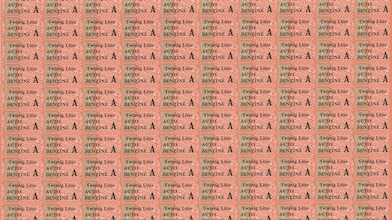
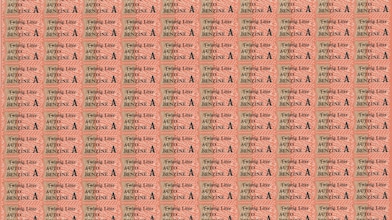
Eind 1973 is nog onduidelijk hoe zwaar het Opec-olie-embargo Nederland gaat treffen. De overheid kondigt aan van 12 januari 1974 er voor drie werken een gereguleerde benzindistributie zal zijn. Al snel word duidelijk dat er voldoende ruwe olie beschikbaar is en komt er op 4 februari een einde aan benzine op de bon. Tijdens de rantsoenering moeten klanten doorgaans eerst hun bonnen bij de kassa van een tankstation inleveren, alvorens ze mogen tanken.
Op de foto: artikel 190C 679 uit het Shell Heritage & Historical Archive: een bonnenboekje uit 1974
Benzine op rantsoen
De Arabische landen straffen Nederland, de Verenigde Staten en Portugal voor hun openlijke militaire steun aan Israël met een olie-embargo. Voor Nederland blijft de blokkade in stand tot 10 juli 1974.
Voor de Nederlandse regering is de impact aanvankelijk nog niet helemaal te overzien. Uit angst voor een landelijk tekort aan ruwe olie, waarmee onder meer op Shell Pernis brandstoffen worden gemaakt, gaat benzine op rantsoen. Drie weken lang, van 12 januari tot 4 februari 1974, moeten klanten bij tankstations eerst hun bonnen bij de kassa inleveren, voordat ze een beperkte hoeveelheid benzine mogen tanken.
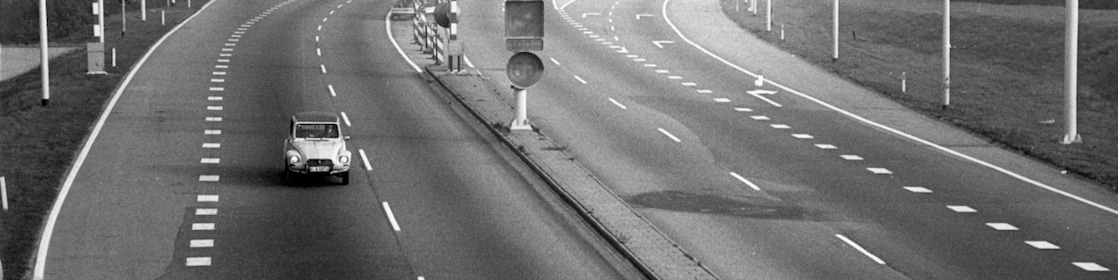
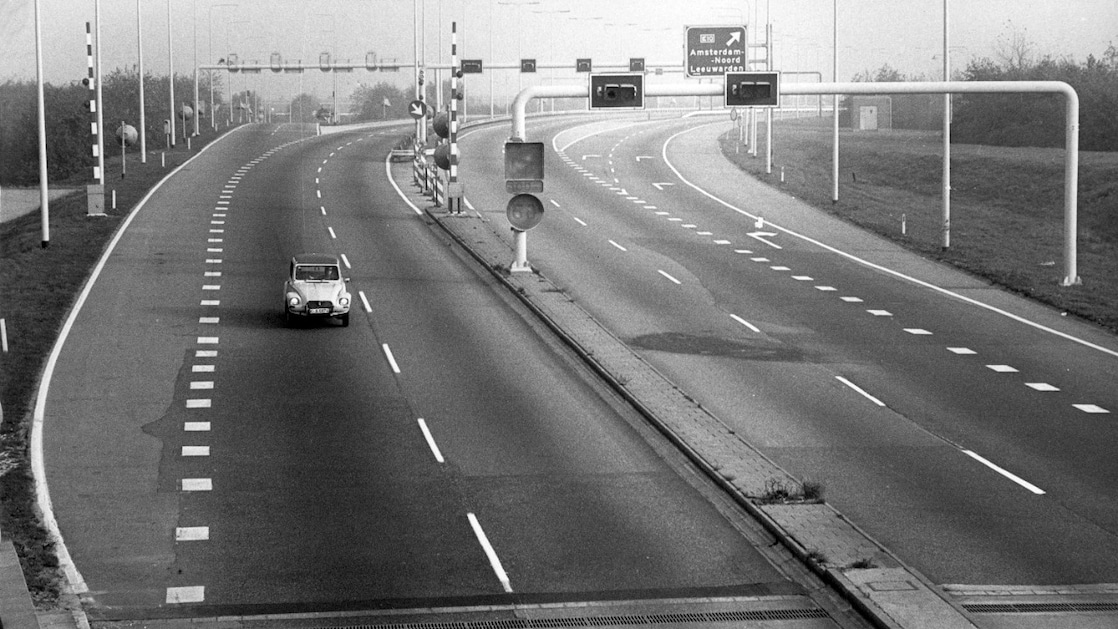
Uiteindelijk blijkt er voldoende ruwe olie beschikbaar, al blijven de automobilisten de hogere prijs aan de pomp merken. Het is een tijd waarin Nederlanders voor de lol met de fiets of rolschaatsen over de snelweg gaan, op door de regering verplichte autoloze zondagen.
Amerikanen hamsteren
In de Verenigde Staten zorgt het vooruitzicht van brandstofschaarste voor paniek bij autobezitters — de Amerikanen slaan aan het hamsteren. Lange rijen stilstaande auto’s bij tankstations worden een symbool voor de oliecrisis*. De Verenigde Staten waren juist in de jaren 60 veranderd van een olie-exporterend naar olie-importerend land. De industrie, verwarming van huizen, stroomopwekking en transport kunnen niet zonder olie en de olieproducten*.
Bondgenoten zijn bang voor de Amerikaanse reactie op het Arabische olieembargo. In Londen waarschuwt de Joint Intelligence Committee — de nationale veiligheidsraad van Groot-Brittannië — het Britse kabinet dat de Verenigde Staten zouden kunnen overwegen ”geweld te gebruiken om olievelden in Saudi-Arabië en de Golf te veroveren”.*
Uit: Geschiedenis van de Koninklijke Shell door Joost Jonker (2007)Lange rijen stilstaande auto's bij tankstations symbool voor de oliecrisis
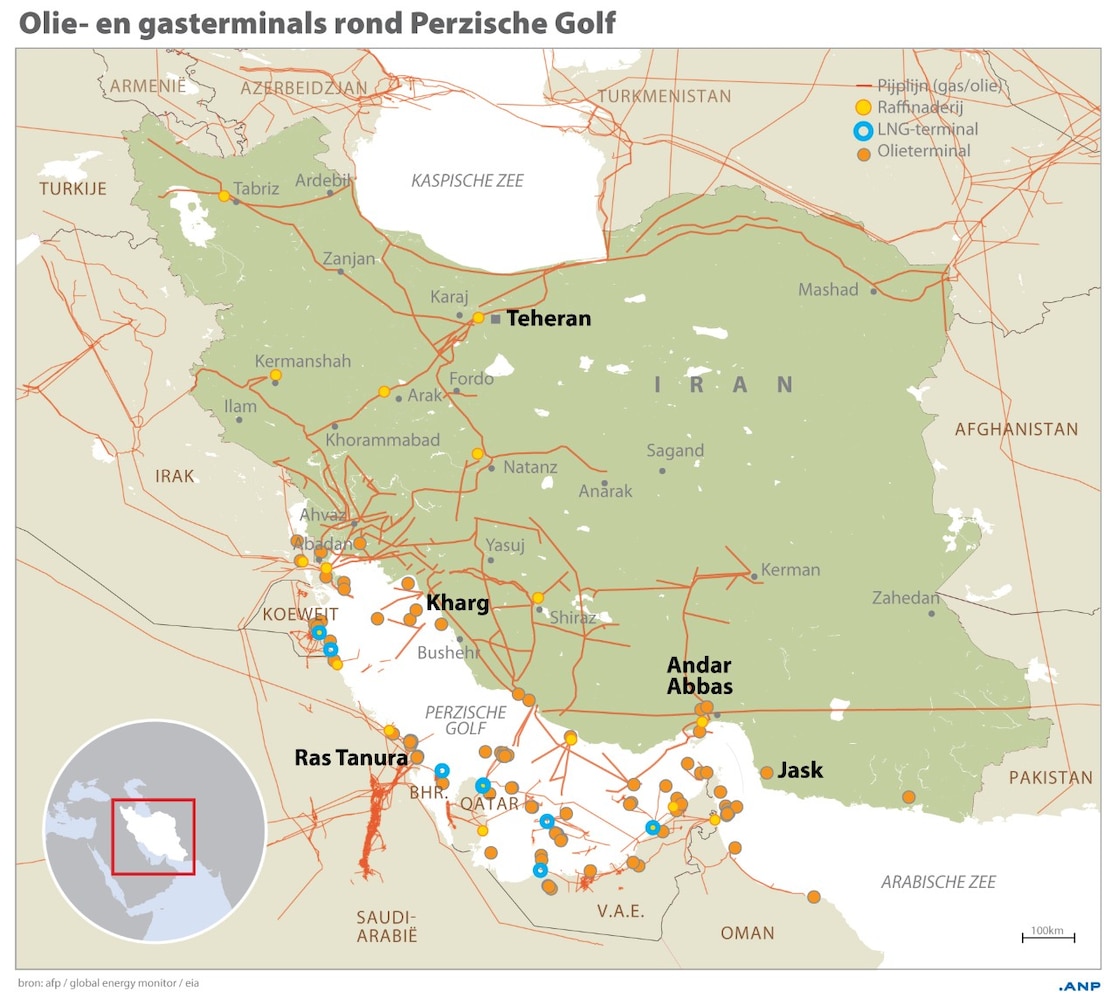
Beschrijving kaart Olie- en gasterminals rond Perzische Golf
Beschrijving kaart Olie- en gasterminals rond Perzische Golf
Op deze kaart van het ANP van 3 maart 2026 staan de olie- en gasterminals in de Perzische Golf weergegeven. Centraal op de kaart ligt Iran in donkergroen, met daarom heen de andere landen in lichtgroen/grijs — van linksboven met de klok mee: Armenië, Azerbeidzjan, Turkmenistan, Afghanistan, Pakistan, Oman, de Verenigde Arabische Emiraten, Saudi-Arabië, Qatar, Bahrein, Koeweit, Irak, Turkije. Daarnaast staan de Kaspische Zee ten noorden van Iran, de Perzische Golf (ten westen van de Straat van Hormuz) en de Arabische Zee (ten oosten van de Straat van Hormuz) weergegeven.
Met rode lijnen worden de uitgebreide pijpleidingen voor olie en gas weergegeven, een weerwar van lijntjes zowel op land als in zee. Gele stippen met een rode lijn eromheen geven de raffinaderijen weer, blauwe rondjes de LNG-terminals en oranje stippen de olieterminals.
In totaal staan er tientallen locaties op. Gelegen aan de Perzische Golf zijn een aantal belangrijke plekken met vet aangegeven: het Iraanse energie-eiland Kharg en de Iraanse energieknooppunten Andar Abbas en Jask. Daarnaast is het Saudische energieknooppunt Ras Tanura vetgedrukt.
Opkomst van de Opec-landen
Zover komt het niet, maar wereldwijd gaan de olieprijzen wel flink omhoog. Vooral door handelen van de Opec, de staatsbedrijven van olieproducerende landen die in 1970 samen slechts 8% van de ruwe olieproductie controleren. De historisch grote bedrijven (“Zeven Zusters”, zie kader) bezaten 69% en relatief nieuwe spelers 23%.
Libië, Iran en daarna de andere Arabische landen aan de Perzische Golf willen meer zeggenschap en inkomsten over hun eigen bodemschatten en dwingen de oliebedrijven in 1970 om niet de helft maar 55% van de olieinkomsten af te dragen. In 1972 forceren ze gedeeld eigenaarschap in de activiteiten.
Hek van de dam
Voor Shell betekent dat een overheidsaandeel van 25% in haar belangen in Qatar en Abu Dhabi (Verenigde Arabische Emiraten). Een paar maanden later stelt Ahmed Zaki Yamani, de olieminister van Saoedi-Arabië, in een toespraak dat “nationale oliemaatschappijen in de producerende landen zich moeten gaan bezighouden met de verkoop (van olie)”. Een teken aan de wand.*
En dan volgt 8 oktober 1973 — twee dagen na het begin van de Jom Kipoer/Ramadan-oorlog. De Opec-landen besluiten dat hun overheidsaandeel op elk vat ruwe olie omhoog gaat van $1,77 naar $3,04. De Arabische olieproducerende landen binnen Opec volgen een paar dagen later ook nog eens met een 5% verlaging van de olieproductie, per maand.* Daarmee is het hek van de dam voor de olieprijzen.
Shells wereldwijde handelservaring
Een aantal oliebedrijven, waaronder Shell, besluit om de gevolgen gelijk over alle klanten te verdelen. Voor Shell brachten de handelservaring en het wereldwijde netwerk uitkomst, ook voor Nederland. Door de grote spreiding van oliebronnen kon Shell olie uitwisselen, uit Arabische en niet-Arabische putten, en zo ook de landen met embargo te bevoorraden. Voor Nederland haalde Shell nu de ruwe olie uit Iran en Nigeria, een deel van de Iraanse olie naar Japan werd vervangen door olie uit Qatar.*
De (Eerste) Oliecrisis is voor olie- en gasbedrijven en landen het startschot om de afhankelijkheid van “Golf-olie” te verminderen. Onder meer door olie- en gaswinning op zee te ontwikkelen.
Uit: Geschiedenis van de Koninklijke Shell door Joost Jonker (2007)Voor Shell brachten handelservaring en wereldwijde netwerk uitkomst
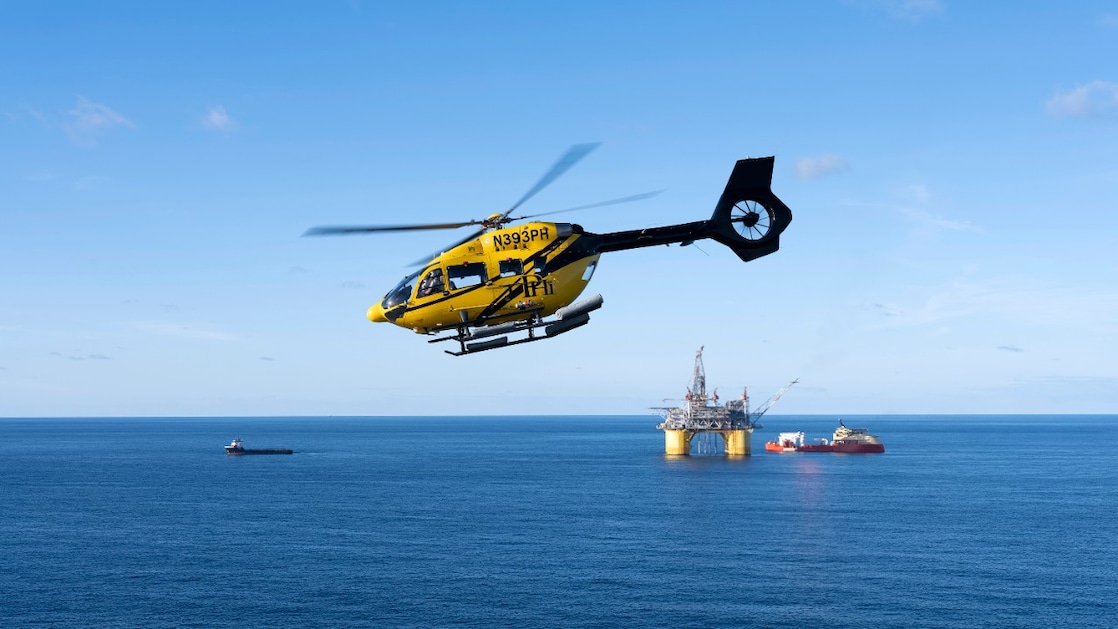
Van Ierland tot Brazilië, en de Noordzee
Ook Shell kijkt naar zee. In 1976 zijn haar activiteiten gespreid over een miljoen vierkante kilometer, met 60% van de exploratie en productie offshore.* Van de wateren bij Ierland, Spanje, Turkije en Maleisië tot Brazilië — en in wat in alle atlassen dan nog gewoon de Golf van Mexico heet.
Het meest succesvol is Shell in de jaren 70 in de Noordzee. Het bedrijf zet met de hoge kwaliteit olie uit het Brent-veld de toon, en de Brent-standaard is tot de dag van vandaag een wereldwijde graadmeter voor de olieprijs. Andere oliebedrijven doen eveneens grote investeringen in de Noordzee, in een geopolitiek stabiele regio.
De Tweede Oliecrisis
Een sterk contrast met de Perzische Golfregio, waar het al snel opnieuw misgaat — in Iran. Onder het regime van haar leider, sjah Mohammad Reza Pahlavi, baadt een kleine elite in rijkdom en luxe, terwijl het merendeel van het volk in armoede leeft. In 1978 leidt dit tot massale volksprotesten — van studenten, intellectuelen en politieke tegenstanders.
De sjah reageert met verdere beperking van vrijheden door de staat van beleg af te kondigen. Hierdoor krijgen de veiligheidsdiensten vergaande bevoegdheden protesten de kop in te drukken. Maar dat pikken de 37.000 arbeiders van de inmiddels genationaliseerde olieindustrie niet. In november 1978 gaan ze in staking. De Iraanse olieproductie valt terug van 6 miljoen naar 1,5 miljoen vaten.
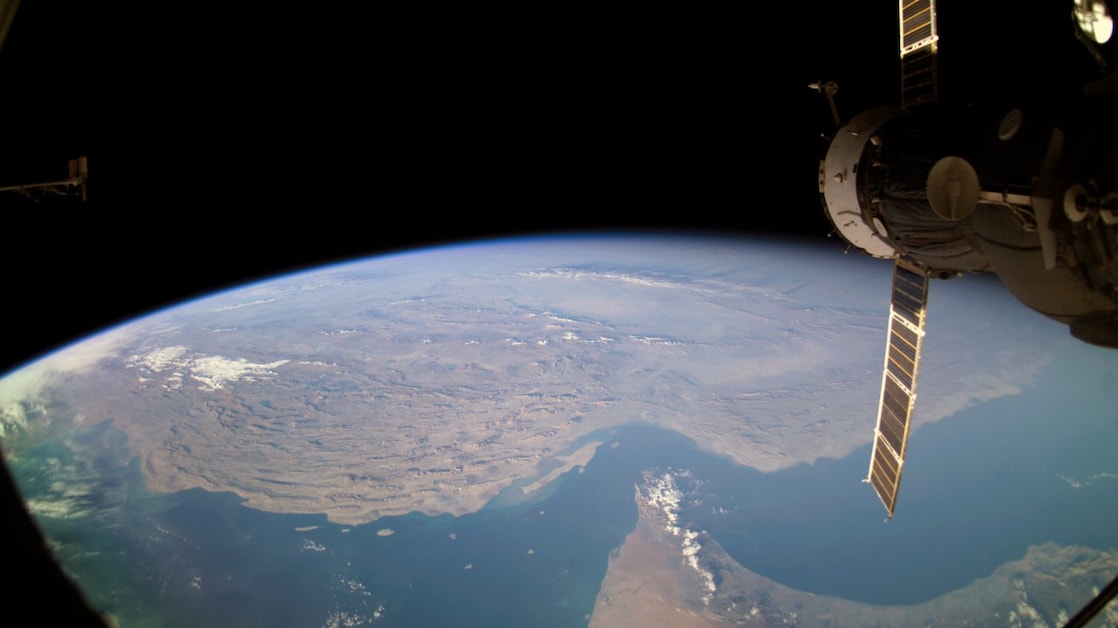
Ruim een jaar later (december 1979) grijpt de anti-westerse, radicaal islamitische ayatollah Khomeini de macht. Zijn buurman, de Iraakse dictator Saddam Hoessein, ziet in de chaos zijn kans schoon en stuurt het Iraakse leger de grens over. Na aanvankelijk succes lopen de Iraakse troepen vast op de lange Iraanse bergketens zo’n 100 kilometer landinwaarts. Het conflict zal uiteindelijk acht jaar duren en krijgt de bijnaam de Tankeroorlog: zowel Iran als Irak leggen mijnen in en rond de Straat van Hormuz en vallen olietankers aan met raketten en kleine boten.
Begin van offshore winningsactiviteiten jaren 70Shell zet met hoge kwaliteit Noordzee-olie uit het Brent-veld de toon
Energiekoers Nederland in Tweede Oliecrisis
De Tweede Oliecrisis leidt in Nederland niet tot echte tekorten, maar de hogere prijzen en inflatie spelen ons land rond 1980 wel parten. Het kabinet verhoogt de aardgasprijs en de belastingen op tabak, alcohol, benzine en personenauto’s.* Daarnaast worden de lonen verlaagd.
Om brandstofverbruik te beperken wordt een maximumsnelheid van 100 kilometer per uur op autosnelwegen scherper nageleefd. De regering zet de in 1973 ingezette energiekoers voort: meer kernenergie, meer steenkoolcentrales, meer zonnestroom en meer windenergie. Ook vraagt de regering de Nederlanders zuiniger aan te doen met energie.
Derde Oliecrisis
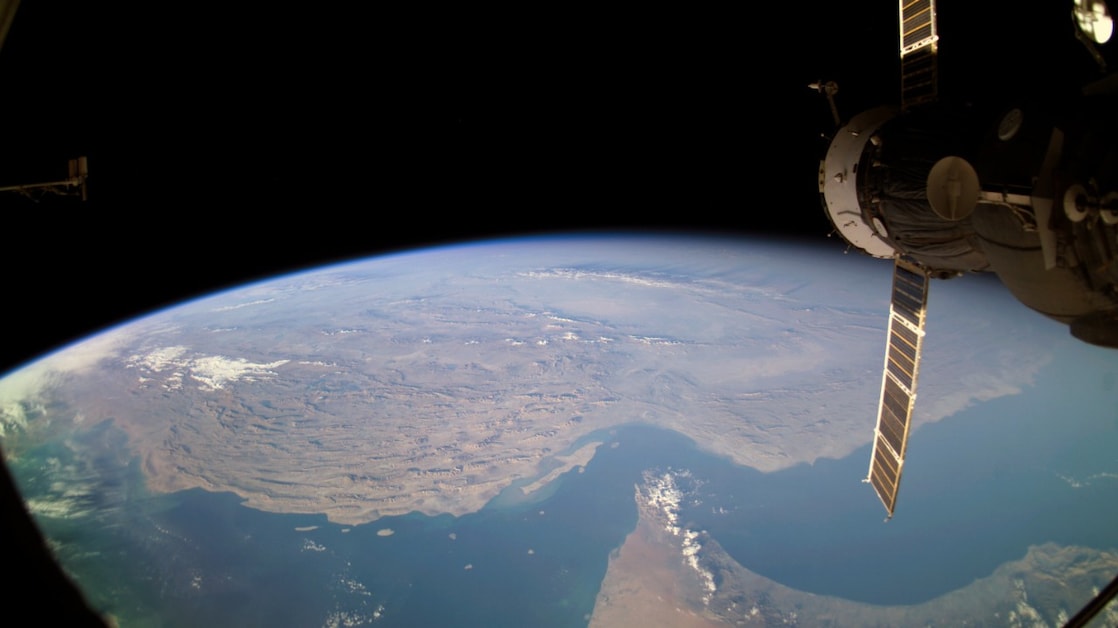
Ruim vijftig jaar later, voorjaar 2026: oorlog in het Midden-Oosten. Israël en de Verenigde Staten vallen Iran aan, Iran slaat terug met aanvallen op Amerikaanse militaire bases in de regio, en probeert energie- en waterinstallaties in de Arabische bondgenoten van de VS uit te schakelen. Iran verklaart eenzijdig de Straat van Hormuz voor gesloten. Er worden mijnen gelegd en er zijn aanvallen op schepen met drones, kleine boten en raketten.
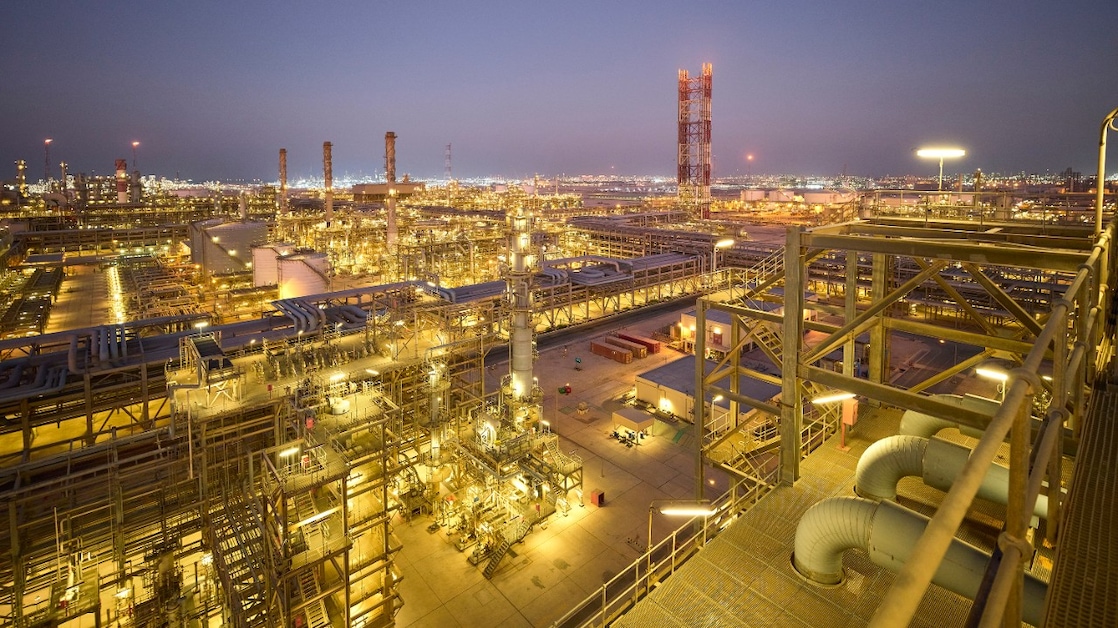
De productie en uitvoer van allerlei olie- en gasproducten in de Perzische Golf-regio ligt nagenoeg stil. Er is wereldwijd schaarste, en ook in Europa worden mogelijke tekorten van onder meer vliegtuigbrandstof en diesel voorspeld. Voor de gewone consument komen olieschaarste en de plotselinge stijging van de brandstofprijzen als een verrassing. De Derde Oliecrisis is een feit.
Cautionary note
Cautionary note
The companies in which Shell plc directly and indirectly owns investments are separate legal entities. In this announcement “Shell”, “Shell Group” and “Group” are sometimes used for convenience to reference Shell plc and its subsidiaries in general. Likewise, the words “we”, “us” and “our” are also used to refer to Shell plc and its subsidiaries in general or to those who work for them. These terms are also used where no useful purpose is served by identifying the particular entity or entities. ‘‘Subsidiaries’’, “Shell subsidiaries” and “Shell companies” as used in this announcement refer to entities over which Shell plc either directly or indirectly has control. The terms “joint venture”, “joint operations”, “joint arrangements”, and “associates” may also be used to refer to a commercial arrangement in which Shell has a direct or indirect ownership interest with one or more parties. The term “Shell interest” is used for convenience to indicate the direct and/or indirect ownership interest held by Shell in an entity or unincorporated joint arrangement, after exclusion of all third-party interest.
Forward-Looking statements
This announcement contains forward-looking statements (within the meaning of the U.S. Private Securities Litigation Reform Act of 1995) concerning the financial condition, results of operations and businesses of Shell. All statements other than statements of historical fact are, or may be deemed to be, forward-looking statements. Forward-looking statements are statements of future expectations that are based on management’s current expectations and assumptions and involve known and unknown risks and uncertainties that could cause actual results, performance or events to differ materially from those expressed or implied in these statements. Forward-looking statements include, among other things, statements concerning the potential exposure of Shell to market risks and statements expressing management’s expectations, beliefs, estimates, forecasts, projections and assumptions. These forward-looking statements are identified by their use of terms and phrases such as “aim”; “ambition”; ‘‘anticipate’’; “aspire”, “aspiration”, ‘‘believe’’; “commit”; “commitment”; ‘‘could’’; “desire”; ‘‘estimate’’; ‘‘expect’’; ‘‘goals’’; ‘‘intend’’; ‘‘may’’; “milestones”; ‘‘objectives’’; ‘‘outlook’’; ‘‘plan’’; ‘‘probably’’; ‘‘project’’; ‘‘risks’’; “schedule”; ‘‘seek’’; ‘‘should’’; ‘‘target’’; “vision”; ‘‘will’’; “would” and similar terms and phrases. There are a number of factors that could affect the future operations of Shell and could cause those results to differ materially from those expressed in the forward-looking statements included in this announcement, including (without limitation): (a) price fluctuations in crude oil and natural gas; (b) changes in demand for Shell’s products; (c) currency fluctuations; (d) drilling and production results; (e) reserves estimates; (f) loss of market share and industry competition; (g) environmental and physical risks, including climate change; (h) risks associated with the identification of suitable potential acquisition properties and targets, and successful negotiation and completion of such transactions; (i) the risk of doing business in developing countries and countries subject to international sanctions; (j) legislative, judicial, fiscal and regulatory developments including tariffs and regulatory measures addressing climate change; (k) economic and financial market conditions in various countries and regions; (l) political risks, including the risks of expropriation and renegotiation of the terms of contracts with governmental entities, delays or advancements in the approval of projects and delays in the reimbursement for shared costs; (m) risks associated with the impact of pandemics, regional conflicts, such as the Russia-Ukraine war and the conflict in the Middle East, and a significant cyber security, data privacy or IT incident; (n) the pace of the energy transition; and (o) changes in trading conditions. No assurance is provided that future dividend payments will match or exceed previous dividend payments. All forward-looking statements contained in this announcement are expressly qualified in their entirety by the cautionary statements contained or referred to in this section. Readers should not place undue reliance on forward-looking statements. Additional risk factors that may affect future results are contained in Shell plc’s Form 20-F for the year ended December 31, 2025 (available at www.shell.com/investors/news-and-filings/sec-filings.html and www.sec.gov). These risk factors also expressly qualify all forward-looking statements contained in this announcement and should be considered by the reader. Each forward-looking statement speaks only as of the date of this announcement, May 12, 2026. Neither Shell plc nor any of its subsidiaries undertake any obligation to publicly update or revise any forward-looking statement as a result of new information, future events or other information. In light of these risks, results could differ materially from those stated, implied or inferred from the forward-looking statements contained in this announcement.
Shell’s net carbon intensity
Also, in this announcement we may refer to Shell’s “net carbon intensity” (NCI), which includes Shell’s carbon emissions from the production of our energy products, our suppliers’ carbon emissions in supplying energy for that production and our customers’ carbon emissions associated with their use of the energy products we sell. Shell’s NCI also includes the emissions associated with the production and use of energy products produced by others which Shell purchases for resale. Shell only controls its own emissions. The use of the terms Shell’s “net carbon intensity” or NCI is for convenience only and not intended to suggest these emissions are those of Shell plc or its subsidiaries.
Shell’s net-zero emissions target
Shell’s operating plan and outlook are forecasted for a three-year period and ten-year period, respectively, and are updated every year. They reflect the current economic environment and what we can reasonably expect to see over the next three and ten years. Accordingly, the outlook reflects our combined Scope 1 and 2 target, NCI target and our oil products ambition over the next ten years. However, Shell’s operating plan and outlook cannot reflect our 2050 net-zero emissions target, as this target is outside our planning period. Such future operating plans and outlooks could include changes to our portfolio, efficiency improvements and the use of carbon capture and storage and carbon credits. In the future, as society moves towards net-zero emissions, we expect Shell’s operating plans and outlooks to reflect this movement. However, if society is not net zero in 2050, as of today, there would be significant risk that Shell may not meet this target.
Forward-Looking non-GAAP measures
This announcement may contain certain forward-looking non-GAAP measures. We are unable to provide a reconciliation of these forward-looking non-GAAP measures to the most comparable GAAP financial measures because certain information needed to reconcile those non-GAAP measures to the most comparable GAAP financial measures is dependent on future events some of which are outside the control of Shell, such as oil and gas prices, interest rates and exchange rates. Moreover, estimating such GAAP measures with the required precision necessary to provide meaningful reconciliation is extremely difficult and could not be accomplished without unreasonable effort. Non-GAAP measures in respect of future periods which cannot be reconciled to the most comparable GAAP financial measure are calculated in a manner which is consistent with the accounting policies applied in Shell plc’s consolidated financial statements.
The contents of websites referred to in this announcement do not form part of this announcement.
We may have used certain terms, such as resources, in this announcement that the United States Securities and Exchange Commission (SEC) strictly prohibits us from including in our filings with the SEC. Investors are urged to consider closely the disclosure in our Form 20-F, File No 1-32575, available on the SEC website www.sec.gov.
Geraadpleegde bronnen voor dit verhaal zijn onder meer: Geschiedenis van de Koninklijke Shell door Joost Jonker (* geeft geciteerde passages aan) (2007), Huzarenvanboreel.nl, 2Vandaag/Reformatorisch Dagblad, Reasons to Revolt: Iranian Oil Workers in the 1970s door Peyman Jafari, NY Times, Historisch Nieuwsblad, The Power of Geography door Tim Marshall (2021), CNBC, The Kingdom door Robert Lacey (1981), The Yom Kippur War: The Arab-Israeli War of 1973 door Simon Dunstan (2007), Nickel Grass in Air Force Magazine door Walter J. Boyne (1998) (PDF), Timeline of the 2026 Iran War op Wikipedia, Brittannica.com
Wie zijn de "Zeven Zusters"?
69% ruwe oliehandel
In aanloop naar de (Eerste) Oliecrisis van 1973 hadden de grote oliebedrijven al een deel van hun marktaandeel verloren. Toch was begin jaren 70 nog altijd 69% van de ruwe oliehandel onder controle van de zogenaamde “Zeven Zusters”: Royal Dutch Shell, Anglo-Persian Oil Company (later BP), Standard Oil of California (Socal), Standard Oil of New Jersey (Sonj, later Exxon), Standard Oil of New York (Socony, later Mobil) en Texaco.
Nieuwe spelers en landen
Nieuwe spelers — waaronder Amerada Hess, Sinclair Oil en Occidental — bezaten in 1970 samen 23% van de ruwe olie. Daarmee was er nog 8% over voor de staatsbedrijven van de olieproducerende landen. Die hadden zich onder aanvoering van Venezuela in de jaren 50 en 60 georganiseerd in Opec (Organization of Petroleum Exporting Countries).
's Werelds grootste olieproducent
Vanaf midden jaren 70 is de wereldwijde energiemarkt meer divers geworden. Eind april 2026 is het Saoedische staatsbedrijf Saudi Aramco ’s werelds grootste olieproductent. Ook staan de nationale oliebedrijven van China (PetroChina en GNOOC) en Brazilië (BR) in de top 10.
Bronnen: Geschiedenis van de Koninklijke Shell door Joost Jonker (2007), Companiesmarketcap.com
Oil crisis: was the one back then similar to now?
15 May 2026
1973. War in the Middle East. In the Netherlands, petrol is rationed and ten car-free Sundays follow. For the average consumer, the oil shortage and the sudden rise in fuel prices come as a complete surprise.

Text: Marcel Burger. With contribution by Rosalie van Egmond.
Photography: Cor Out (Nationaal Archief/Collectie Spaarnestad/ANP), NASA/JSC, Getty Images, Ed Robinson (Shell International), Stuart Conway (Shell International), Shell Heritage & Historical Archive.
If the Dutch government had made different decisions this spring, the text from Shell’s historical timeline in the introduction could easily have been written yesterday. But we step back in time. The oil-producing countries united in OPEC quadruple oil prices between October and December 1973*. And then the Yom Kippur War, or Ramadan War, breaks out as well.
Operation Nickel Grass
On 6 October 1973, Egypt and Syria launch a surprise attack on Israel in an attempt to regain territory that the Jewish state had seized in 1967*. An Israeli defeat appears imminent. The United States and the Netherlands come to Israel’s aid. On 12 October, the US launches Nickel Grass: a giant resupply operation. Shipments include 82 refurbished combat aircraft from the US armed forces, guided bombs to neutralise air defences, and 567 military cargo flights to supply the Israeli army with weapons and ammunition. European countries do not open their airspace to these flights, but Portugal allows the Americans to stopover at Lajes, on the Azores in the middle of the Atlantic. Heavier equipment, including tanks, follows by ship.
Dutch Centurion tanks
The Netherlands ships supplies too. In a hurried decision by Defence Minister Henk Vredeling, The Hague donates 36 Centurion main battle tanks to Israel. The Jewish state had previously received 222 of these somewhat outdated surplus tanks from the Netherlands. In the 1960s, 70s and 80s, however, Europe fears a conflict with the Moscow-imposed Warsaw Pact of Eastern European countries. After the donation, the Netherlands still has around 369 Centurions. But The Hague also sends so many spare parts and tank shells that it undermines its own readiness. This remains a secret for years.
It is only in 1998 that former State Secretary Bram Stemerdink says in the Dutch television programme 2Vandaag: “(Vredeling and I) decided within a few minutes to give Israel all the support that was possible. You could say that at that moment the Dutch army was completely insufficiently supplied with spare parts and ammunition for one of its main weapons systems: the Centurion tanks.”
Petrol rationing
At the end of 1973, it is still unclear how severely the OPEC oil embargo will affect the Netherlands. The government announces that from 12 January 1974 there will be regulated petrol distribution for three weeks. It soon becomes clear that sufficient crude oil is available, and petrol rationing comes to an end on 4 February. During the rationing period, customers generally have to hand in their coupons at the till of a filling station before they are allowed to refuel.
In the photo: item 190C 679 from the Shell Heritage & Historical Archive: a booklet of coupons from 1974.
Petrol rationing
The Arab countries punish the Netherlands, the United States and Portugal for their open military support of Israel with an oil embargo. For the Netherlands, the blockade remains in place until 10 July 1974.
At first, the Dutch government does not fully grasp the impact. Fearing a national shortage of crude oil — used, among other things, to produce fuels at Shell Pernis — petrol is put on ration. For three weeks, from 12 January to 4 February 1974, customers at fuel stations must first hand in their coupons at the till before being allowed to purchase a limited amount of petrol.
Ultimately, it turns out there is sufficient crude oil available, although motorists continue to feel the higher prices at the pump. It is a time when the Dutch cycle or roller-skate along the motorways for fun, on government-imposed car-free Sundays.
Americans hoard
In the United States, the prospect of fuel shortages causes panic among car owners — Americans begin hoarding. Long queues of stationary cars at filling stations become a symbol of the oil crisis*. In the 1960s, the United States had in fact shifted from being an oil-exporting to an oil-importing country. Industry, home heating, electricity generation and transport cannot function without oil and petroleum products*.
Allies fear the American response to the Arab oil embargo. In London, the Joint Intelligence Committee — the United Kingdom’s national security body — warns the British Cabinet that the United States might consider “using force to seize oil fields in Saudi Arabia and the Gulf.”*
From: The History of Royal Dutch Shell, by Joost Jonker (2007)Long queues of stationary cars at filling stations become a symbol for the oil crisis
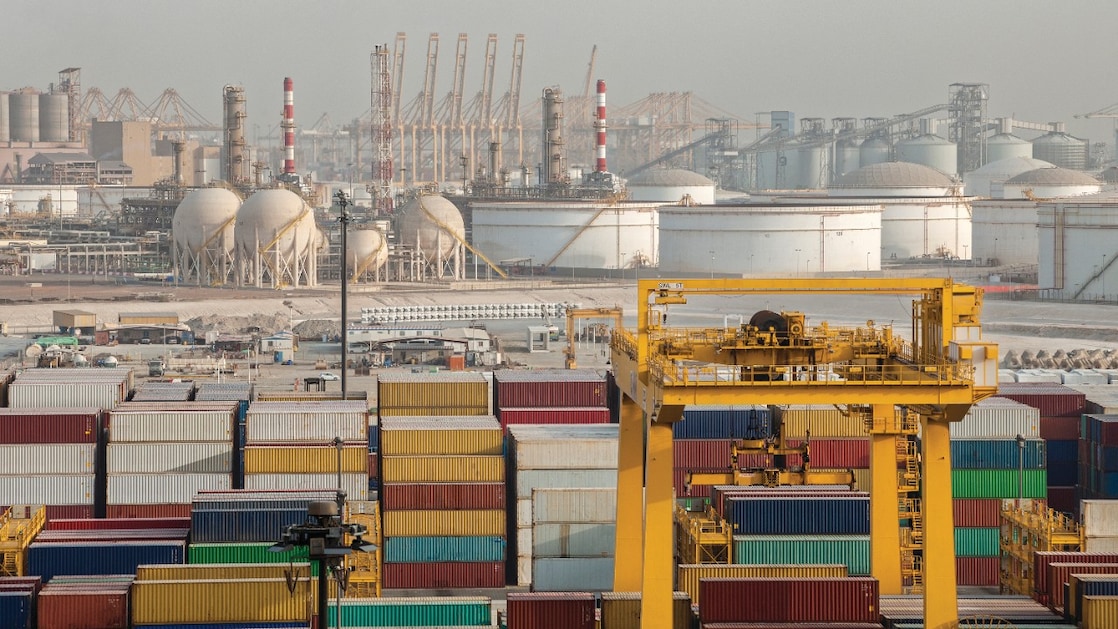
Rise of the OPEC countries
It does not come to that, but globally oil prices do rise sharply. This is mainly due to the actions of OPEC, the state-owned companies of oil-producing countries, which in 1970 together control only 8% of crude oil production. The historically dominant companies (“Seven Sisters”, see box) hold 69%, while relatively new players account for 23%.
Libya, Iran and later the other Arab countries on the Persian Gulf want more control over — and revenue from — their own natural resources, and in 1970 they force the oil companies to hand over not half but 55% of oil revenues. In 1972, they compel shared ownership in operations.
Floodgates open
For Shell, this means a government stake of 25% in its interests in Qatar and Abu Dhabi (United Arab Emirates). A few months later, Ahmed Zaki Yamani, Saudi Arabia’s oil minister, states in a speech that “national oil companies in the producing countries must begin to concern themselves with the sale (of oil)”. A sign of things to come.*
Then comes 8 October 1973 — two days after the start of the Yom Kippur/Ramadan War. The OPEC countries decide that their government share per barrel of crude oil will rise from $1.77 to $3.04. A few days later, the Arab oil-producing countries within OPEC also introduce a 5% monthly reduction in oil production.* This opens the floodgates for rising oil prices.
Shell’s global trading experience
A number of oil companies, including Shell, decide to spread the impact evenly across all customers. For Shell, its trading experience and global network prove invaluable, including for the Netherlands. Thanks to the broad spread of oil sources, Shell is able to swap oil from fields owned by Arab and non-Arab countries and thus continue to supply embargoed countries. For the Netherlands, Shell now sources crude oil from Iran and Nigeria, while some of the Iranian oil destined for Japan is replaced by oil from Qatar.*
The (First) Oil Crisis marks the starting point for oil and gas companies, and countries, to reduce their dependence on oil from "the Gulf”, and leads to the development of offshore oil and gas production.
From: The History of Royal Dutch Shell, by Joost Jonker (2007)For Shell, its trading experience and global network prove invaluable
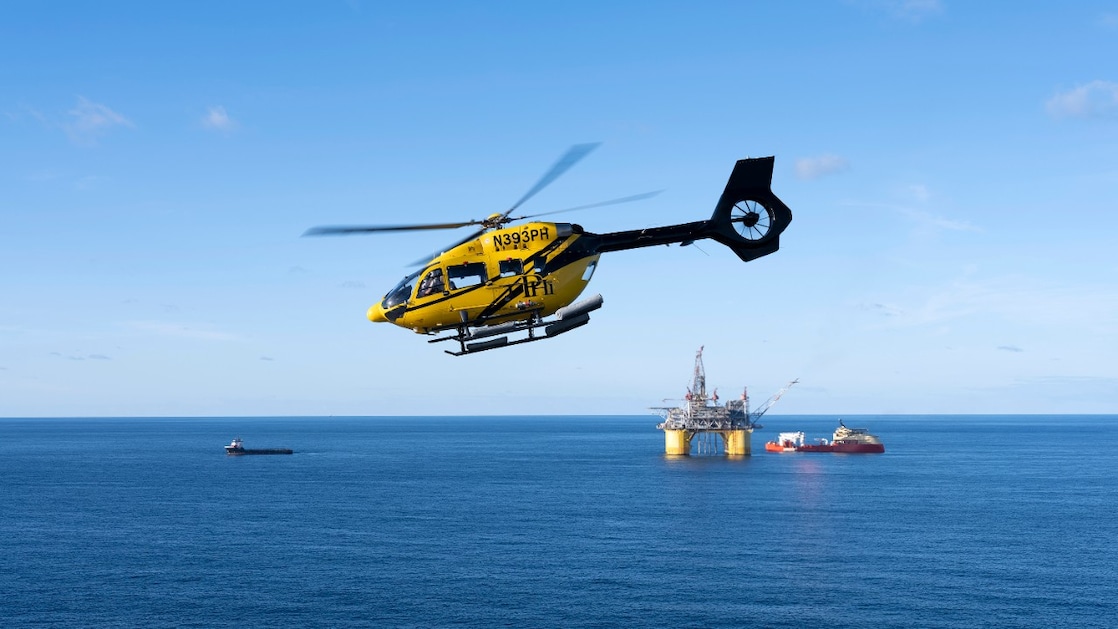
From Ireland to Brazil — and the North Sea
Shell, too, turns its attention offshore. By 1976, its activities are spread over one million square kilometres, with 60% of exploration and production taking place offshore.* From the waters near Ireland, Spain, Turkey and Malaysia to Brazil — and in what common geographic maps of at that time still call the Gulf of Mexico.
Shell proves most successful in the 1970s in the North Sea. With the high-quality oil from the Brent field, the company sets the benchmark, and the Brent standard remains a global reference point for oil prices to this day. Other oil companies also make major investments in the North Sea, a geopolitically stable region.
The Second Oil Crisis
A sharp contrast with the Persian Gulf region, where things soon go haywire again — in Iran. Under the regime of its leader, Shah Mohammad Reza Pahlavi, a small elite enjoys wealth and luxury, while the majority of the population lives in poverty. In 1978, this leads to mass protests — by students, intellectuals and political opponents.
The Shah responds by further restricting freedoms, declaring martial law. This grants the security services sweeping powers to suppress the protests. But the 37,000 workers of the now nationalised oil industry refuse to accept this. In November 1978, they go on strike. Iranian oil production falls from 6 million to 1.5 million barrels.
Just over a year later (December 1979), the anti-Western, radical Islamic Ayatollah Khomeini seizes power. His neighbour, the Iraqi dictator Saddam Hussein, sees an opportunity in the chaos and sends the Iraqi army across the border. After initial success, Iraqi forces become bogged down in Iran’s long mountain ranges about 100 kilometres (60 miles) inland. The conflict ultimately lasts eight years and becomes known as the Tanker War: both Iran and Iraq lay mines in and around the Strait of Hormuz and attack oil tankers with missiles and small boats.
The beginning of offshore exploration activities in the 1970sShell sets the benchmark of high-quality oil from the North Sea with its Brent field
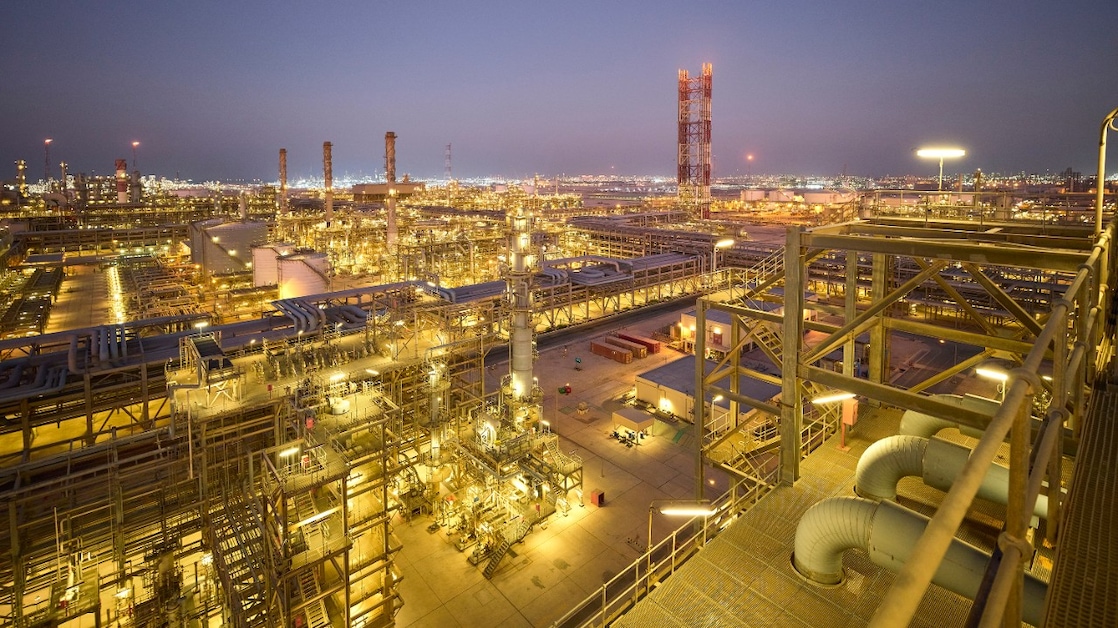
Dutch energy policy during the Second Oil Crisis
The Second Oil Crisis does not lead to actual shortages in the Netherlands, but around 1980 the higher prices and inflation do take their toll. The government raises the price of natural gas and increases taxes on tobacco, alcohol, petrol and passenger cars.* In addition, wages are reduced.
To limit fuel consumption, a maximum speed of 100 kilometres (60 miles) per hour on motorways is more strictly enforced. The government continues the energy policy introduced in 1973: more nuclear power, more coal-fired power stations, more solar electricity and more wind energy. It also calls on the Dutch public to use energy more sparingly.
Third Oil Crisis
Jumping mor than fifty years forwards. Spring 2026: war in the Middle East. Israel and the United States attack Iran; Iran retaliates with strikes on US military bases in the region and attempts to disable energy and water installations in US-allied Arab countries. Iran unilaterally declares the Strait of Hormuz closed. Mines are laid and ships come under attack from drones, small boats and missiles.
The production and export of various oil and gas products in the Persian Gulf region come almost to a standstill. There is a global shortage, and in Europe potential shortages of, among other things, aviation fuel and diesel are predicted. For the average consumer, the scarcity of oil and the sudden rise in fuel prices come as a surprise. The Third Oil Crisis is a fact.
Cautionary note
Cautionary note
The companies in which Shell plc directly and indirectly owns investments are separate legal entities. In this announcement “Shell”, “Shell Group” and “Group” are sometimes used for convenience to reference Shell plc and its subsidiaries in general. Likewise, the words “we”, “us” and “our” are also used to refer to Shell plc and its subsidiaries in general or to those who work for them. These terms are also used where no useful purpose is served by identifying the particular entity or entities. ‘‘Subsidiaries’’, “Shell subsidiaries” and “Shell companies” as used in this announcement refer to entities over which Shell plc either directly or indirectly has control. The terms “joint venture”, “joint operations”, “joint arrangements”, and “associates” may also be used to refer to a commercial arrangement in which Shell has a direct or indirect ownership interest with one or more parties. The term “Shell interest” is used for convenience to indicate the direct and/or indirect ownership interest held by Shell in an entity or unincorporated joint arrangement, after exclusion of all third-party interest.
Forward-Looking statements
This announcement contains forward-looking statements (within the meaning of the U.S. Private Securities Litigation Reform Act of 1995) concerning the financial condition, results of operations and businesses of Shell. All statements other than statements of historical fact are, or may be deemed to be, forward-looking statements. Forward-looking statements are statements of future expectations that are based on management’s current expectations and assumptions and involve known and unknown risks and uncertainties that could cause actual results, performance or events to differ materially from those expressed or implied in these statements. Forward-looking statements include, among other things, statements concerning the potential exposure of Shell to market risks and statements expressing management’s expectations, beliefs, estimates, forecasts, projections and assumptions. These forward-looking statements are identified by their use of terms and phrases such as “aim”; “ambition”; ‘‘anticipate’’; “aspire”, “aspiration”, ‘‘believe’’; “commit”; “commitment”; ‘‘could’’; “desire”; ‘‘estimate’’; ‘‘expect’’; ‘‘goals’’; ‘‘intend’’; ‘‘may’’; “milestones”; ‘‘objectives’’; ‘‘outlook’’; ‘‘plan’’; ‘‘probably’’; ‘‘project’’; ‘‘risks’’; “schedule”; ‘‘seek’’; ‘‘should’’; ‘‘target’’; “vision”; ‘‘will’’; “would” and similar terms and phrases. There are a number of factors that could affect the future operations of Shell and could cause those results to differ materially from those expressed in the forward-looking statements included in this announcement, including (without limitation): (a) price fluctuations in crude oil and natural gas; (b) changes in demand for Shell’s products; (c) currency fluctuations; (d) drilling and production results; (e) reserves estimates; (f) loss of market share and industry competition; (g) environmental and physical risks, including climate change; (h) risks associated with the identification of suitable potential acquisition properties and targets, and successful negotiation and completion of such transactions; (i) the risk of doing business in developing countries and countries subject to international sanctions; (j) legislative, judicial, fiscal and regulatory developments including tariffs and regulatory measures addressing climate change; (k) economic and financial market conditions in various countries and regions; (l) political risks, including the risks of expropriation and renegotiation of the terms of contracts with governmental entities, delays or advancements in the approval of projects and delays in the reimbursement for shared costs; (m) risks associated with the impact of pandemics, regional conflicts, such as the Russia-Ukraine war and the conflict in the Middle East, and a significant cyber security, data privacy or IT incident; (n) the pace of the energy transition; and (o) changes in trading conditions. No assurance is provided that future dividend payments will match or exceed previous dividend payments. All forward-looking statements contained in this announcement are expressly qualified in their entirety by the cautionary statements contained or referred to in this section. Readers should not place undue reliance on forward-looking statements. Additional risk factors that may affect future results are contained in Shell plc’s Form 20-F for the year ended December 31, 2025 (available at www.shell.com/investors/news-and-filings/sec-filings.html and www.sec.gov). These risk factors also expressly qualify all forward-looking statements contained in this announcement and should be considered by the reader. Each forward-looking statement speaks only as of the date of this announcement, May 12, 2026. Neither Shell plc nor any of its subsidiaries undertake any obligation to publicly update or revise any forward-looking statement as a result of new information, future events or other information. In light of these risks, results could differ materially from those stated, implied or inferred from the forward-looking statements contained in this announcement.
Shell’s net carbon intensity
Also, in this announcement we may refer to Shell’s “net carbon intensity” (NCI), which includes Shell’s carbon emissions from the production of our energy products, our suppliers’ carbon emissions in supplying energy for that production and our customers’ carbon emissions associated with their use of the energy products we sell. Shell’s NCI also includes the emissions associated with the production and use of energy products produced by others which Shell purchases for resale. Shell only controls its own emissions. The use of the terms Shell’s “net carbon intensity” or NCI is for convenience only and not intended to suggest these emissions are those of Shell plc or its subsidiaries.
Shell’s net-zero emissions target
Shell’s operating plan and outlook are forecasted for a three-year period and ten-year period, respectively, and are updated every year. They reflect the current economic environment and what we can reasonably expect to see over the next three and ten years. Accordingly, the outlook reflects our combined Scope 1 and 2 target, NCI target and our oil products ambition over the next ten years. However, Shell’s operating plan and outlook cannot reflect our 2050 net-zero emissions target, as this target is outside our planning period. Such future operating plans and outlooks could include changes to our portfolio, efficiency improvements and the use of carbon capture and storage and carbon credits. In the future, as society moves towards net-zero emissions, we expect Shell’s operating plans and outlooks to reflect this movement. However, if society is not net zero in 2050, as of today, there would be significant risk that Shell may not meet this target.
Forward-Looking non-GAAP measures
This announcement may contain certain forward-looking non-GAAP measures. We are unable to provide a reconciliation of these forward-looking non-GAAP measures to the most comparable GAAP financial measures because certain information needed to reconcile those non-GAAP measures to the most comparable GAAP financial measures is dependent on future events some of which are outside the control of Shell, such as oil and gas prices, interest rates and exchange rates. Moreover, estimating such GAAP measures with the required precision necessary to provide meaningful reconciliation is extremely difficult and could not be accomplished without unreasonable effort. Non-GAAP measures in respect of future periods which cannot be reconciled to the most comparable GAAP financial measure are calculated in a manner which is consistent with the accounting policies applied in Shell plc’s consolidated financial statements.
The contents of websites referred to in this announcement do not form part of this announcement.
We may have used certain terms, such as resources, in this announcement that the United States Securities and Exchange Commission (SEC) strictly prohibits us from including in our filings with the SEC. Investors are urged to consider closely the disclosure in our Form 20-F, File No 1-32575, available on the SEC website www.sec.gov.
Sources consulted for this story include: The History of Royal Dutch Shell (Dutch version), by Joost Jonker (* marks quoted paragraphs translated from Dutch to English) (2007); Huzarenvanboreel.nl; 2Vandaag/Reformatorisch Dagblad; Reasons to Revolt: Iranian Oil Workers in the 1970s, by Peyman Jafari; NY Times; Historisch Nieuwsblad; The Power of Geography, byTim Marshall (2021); CNBC; The Kingdom, by Robert Lacey (1981); The Yom Kippur War: The Arab-Israeli War of 1973, by Simon Dunstan (2007); Nickel Grass in Air Force Magazine door Walter J. Boyne (1998) (PDF); Timeline of the 2026 Iran War op Wikipedia; Brittannica.com
Who are the "Seven Sisters"?
69% of crude oil trade
In the run-up to the (First) Oil Crisis of 1973, the major oil companies had already lost part of their market share. Nevertheless, in the early 1970s, as much as 69% of the crude oil trade was still controlled by the so-called “Seven Sisters”: Royal Dutch Shell, the Anglo-Persian Oil Company (later BP), Standard Oil of California (Socal), Standard Oil of New Jersey (Sonj, later Exxon), Standard Oil of New York (Socony, later Mobil), and Texaco.
New players and countries
New players — including Amerada Hess, Sinclair Oil and Occidental — together held 23% of crude oil in 1970. That left just 8% for the state-owned companies of the oil-producing countries. Led by Venezuela, these had organised themselves during the 1950s and 1960s into OPEC (Organization of the Petroleum Exporting Countries).
The world’s largest oil producer
From the mid-1970s onwards, the global energy market has become more diversified. By the end of April 2026, the Saudi state-owned company Saudi Aramco is the world’s largest oil producer. The national oil companies of China (PetroChina and CNOOC) and Brazil (BR) are also among the top ten.
Sources: History of Royal Dutch Shell, by Joost Jonker (2007), Companiesmarketcap.com