Hexwise: start-up die basisindustrie helpt het hoofd koeler te houden
Net als de airconditioner thuis, hebben koelinstallaties van fabrieken of energiecentrales bij steeds warmere en langer zomers moeite om genoeg te koelen. Bij bedrijven moet daarom de productie omlaag, en daarmee vermindert ook effeciënt energiegebruik. De Nederlandse start-up Hexwise heeft daar iets op bedacht, en werd daarmee in april een van de drie winnaars van de Amsterdamse LeapSprong-innovatieprijs.

Tekst: Marcel Burger. Beeld: VonMoos, Hexwise
In dit verhaal:
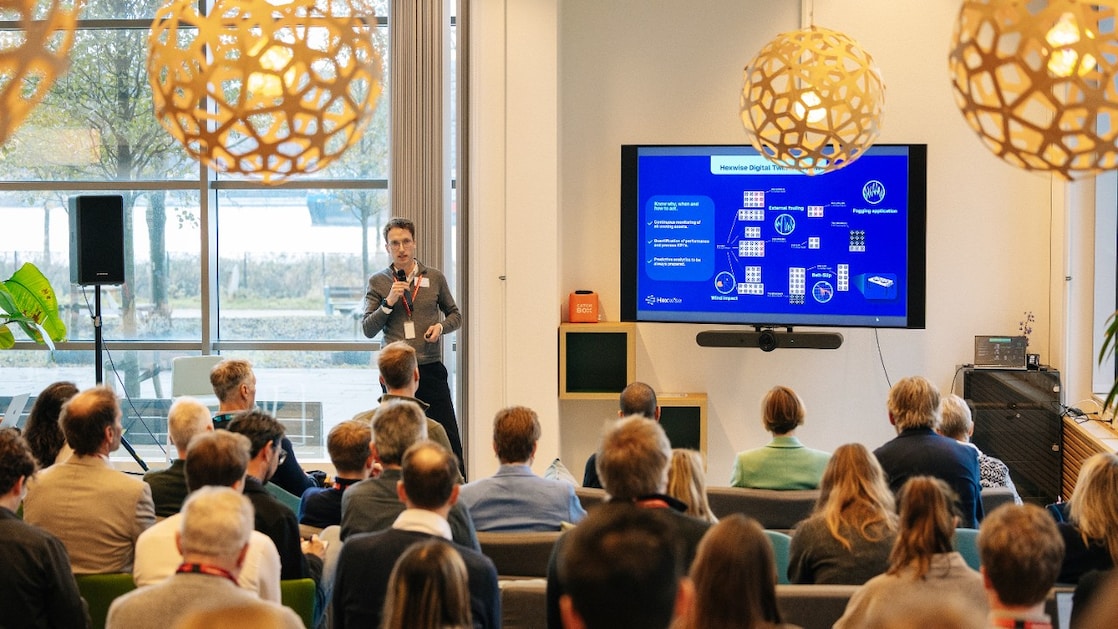
Niels Bergsma (CEO), Pim van Ramshorst en Roy Manting zijn de drie oprichters van Hexwise. Het Barneveldse bedrijf is sinds vorige maand member van de Energy Transition Campus Amsterdam, een open campus waar Shell en inmiddels zo’n 35 kennisinstellingen, start-ups en scale-ups aan versnelling van de energietransitie werken. Dat ETCA-lidmaatschap heeft Hexwise te danken aan haar innovatieve kijk op industriële koelinstallaties.
Op fabrieken zijn de koelinstallaties vaak een soort ondergeschoven kindje, stelt Pim van Ramshorst. “Ze vallen doorgaans zowel onder onderhoud van roterende en niet-bewegende onderdelen, terwijl het optimaliseren van deze koelinstallaties vaak geen deel uitmaakt van de kernactiviteiten en technische expertise van een fabriek.”
Terugdringen energieverbruik
Hexwise ontwikkelde eigen rekenmodellen waarmee industriële luchtgekoelde koelinstallaties beter presteren. Door ook kunstmatige intelligentie (AI) in te zetten, konden die modellen sneller worden uitgewerkt. De Hexwise-algoritmes voor koelinstallaties gebruiken verzamelde realtime data over bijvoorbeeld buitentemperatuur, wind en de procescondities van de installaties. Met die gegevens doet niet alleen de koeling zelf het beter, maar zouden de activiteiten in de fabriek die zo worden gekoeld met minder energie af kunnen. Minder energieverbruik betekent minder CO2-uitstoot.
Van Ramshorst: “Vooral in de zomer zie je productieverlies in industriële processen. Zo weten we van een Nederlandse energiecentrale dat de turbine-output (voor het genereren van stroom; red.) op warme dagen wel 6% tot 7% minder is. Met onze optimalisatie van de koelinstallaties kunnen we dat op warme dagen met ongeveer de helft verbeteren. Bij elkaar leidt dat tot ongeveer 1% tot 2% productieverhoging op jaarbasis.”
Volgens Niels Bergsma kunnen verkeerd afgestelde koelinstallaties tot lagere productie leiden, vooral op warme dagen en bovenal in een grote centrale, chemische fabriek of raffinaderij. Schattingen lopen uiteen, maar het productieverlies kan volgens een Australische investeerdersbank (Macquarie Group) oplopen tot 10%.
Over Leapsprong
LeapSprong Amsterdam is een innovatieprogramma van de gemeente Amsterdam, start-upaccelerator Rockstart en de Energy Transition Campus Amsterdam (ETCA). Op de ETCA werkt Shell met ruim 30 andere partijen aan oplossingen in de energietransitie. LeapSprong Amsterdam richt zich op de energietransitie in de haven en industrie. Start-ups kunnen hun oplossing aandragen en de beste ideeën worden geselecteerd om verder te ontwikkelen. De winnende start-ups krijgen indien relevant toegang tot de laboratoria van de ETCA, begeleiding én kans op een proef in de regio.
De winnaars van de LeapSprong-finale 2026 zijn Hexwise, HyER Power en Upheat. Shell Venster hoopt interviews met de andere twee finalisten een volgende keer te presenteren.
Van Rockstart naar de wereld
Drie jaar geleden zag de internationale early‑stage impactinvesteerder Rockstart al brood in Hexwise. De oprichters begonnen hun bedrijf toen als spin-off van een project bij een middelgrote koelinstallatiefabrikant waarvoor ze toen werkten. Via Rockstart ontdekten Bergsma, Van Ramshorst en Manting de LeapSprong-innovatie-wedstrijd, de Energy Transition Campus Amsterdam en Shell.
“Het partnerschap met ETCA en dus Shell geeft ons nieuwe mogelijkheden om te groeien en ons concept verder uit te rollen”, stelt Bergsma. Het plan was om de algoritmes “los te laten” op de koelinstallaties van de Pearl GTL-gasfabriek van Shell in Qatar, maar door de oorlogssituatie in de Perzische Golf zou het wel eens een locatie dichterbij huis kunnen worden.
“We zien echt veel potentie in het slimmer aansturen en beheren van industriële koelinstallaties. Hiermee kunnen we de bestaande industrie echt helpen met minder productieverlies, minder energieverbruik en zo minder CO2-uitstoot”, aldus Bergsma.
Cautionary note
Cautionary note
The companies in which Shell plc directly and indirectly owns investments are separate legal entities. In this announcement “Shell”, “Shell Group” and “Group” are sometimes used for convenience to reference Shell plc and its subsidiaries in general. Likewise, the words “we”, “us” and “our” are also used to refer to Shell plc and its subsidiaries in general or to those who work for them. These terms are also used where no useful purpose is served by identifying the particular entity or entities. ‘‘Subsidiaries’’, “Shell subsidiaries” and “Shell companies” as used in this announcement refer to entities over which Shell plc either directly or indirectly has control. The terms “joint venture”, “joint operations”, “joint arrangements”, and “associates” may also be used to refer to a commercial arrangement in which Shell has a direct or indirect ownership interest with one or more parties. The term “Shell interest” is used for convenience to indicate the direct and/or indirect ownership interest held by Shell in an entity or unincorporated joint arrangement, after exclusion of all third-party interest.
Forward-Looking statements
This announcement contains forward-looking statements (within the meaning of the U.S. Private Securities Litigation Reform Act of 1995) concerning the financial condition, results of operations and businesses of Shell. All statements other than statements of historical fact are, or may be deemed to be, forward-looking statements. Forward-looking statements are statements of future expectations that are based on management’s current expectations and assumptions and involve known and unknown risks and uncertainties that could cause actual results, performance or events to differ materially from those expressed or implied in these statements. Forward-looking statements include, among other things, statements concerning the potential exposure of Shell to market risks and statements expressing management’s expectations, beliefs, estimates, forecasts, projections and assumptions. These forward-looking statements are identified by their use of terms and phrases such as “aim”; “ambition”; ‘‘anticipate’’; “aspire”, “aspiration”, ‘‘believe’’; “commit”; “commitment”; ‘‘could’’; “desire”; ‘‘estimate’’; ‘‘expect’’; ‘‘goals’’; ‘‘intend’’; ‘‘may’’; “milestones”; ‘‘objectives’’; ‘‘outlook’’; ‘‘plan’’; ‘‘probably’’; ‘‘project’’; ‘‘risks’’; “schedule”; ‘‘seek’’; ‘‘should’’; ‘‘target’’; “vision”; ‘‘will’’; “would” and similar terms and phrases. There are a number of factors that could affect the future operations of Shell and could cause those results to differ materially from those expressed in the forward-looking statements included in this announcement, including (without limitation): (a) price fluctuations in crude oil and natural gas; (b) changes in demand for Shell’s products; (c) currency fluctuations; (d) drilling and production results; (e) reserves estimates; (f) loss of market share and industry competition; (g) environmental and physical risks, including climate change; (h) risks associated with the identification of suitable potential acquisition properties and targets, and successful negotiation and completion of such transactions; (i) the risk of doing business in developing countries and countries subject to international sanctions; (j) legislative, judicial, fiscal and regulatory developments including tariffs and regulatory measures addressing climate change; (k) economic and financial market conditions in various countries and regions; (l) political risks, including the risks of expropriation and renegotiation of the terms of contracts with governmental entities, delays or advancements in the approval of projects and delays in the reimbursement for shared costs; (m) risks associated with the impact of pandemics, regional conflicts, such as the Russia-Ukraine war and the conflict in the Middle East, and a significant cyber security, data privacy or IT incident; (n) the pace of the energy transition; and (o) changes in trading conditions. No assurance is provided that future dividend payments will match or exceed previous dividend payments. All forward-looking statements contained in this announcement are expressly qualified in their entirety by the cautionary statements contained or referred to in this section. Readers should not place undue reliance on forward-looking statements. Additional risk factors that may affect future results are contained in Shell plc’s Form 20-F for the year ended December 31, 2025 (available at www.shell.com/investors/news-and-filings/sec-filings.html and www.sec.gov). These risk factors also expressly qualify all forward-looking statements contained in this announcement and should be considered by the reader. Each forward-looking statement speaks only as of the date of this announcement, May 14, 2026. Neither Shell plc nor any of its subsidiaries undertake any obligation to publicly update or revise any forward-looking statement as a result of new information, future events or other information. In light of these risks, results could differ materially from those stated, implied or inferred from the forward-looking statements contained in this announcement.
Shell’s net carbon intensity
Also, in this announcement we may refer to Shell’s “net carbon intensity” (NCI), which includes Shell’s carbon emissions from the production of our energy products, our suppliers’ carbon emissions in supplying energy for that production and our customers’ carbon emissions associated with their use of the energy products we sell. Shell’s NCI also includes the emissions associated with the production and use of energy products produced by others which Shell purchases for resale. Shell only controls its own emissions. The use of the terms Shell’s “net carbon intensity” or NCI is for convenience only and not intended to suggest these emissions are those of Shell plc or its subsidiaries.
Shell’s net-zero emissions target
Shell’s operating plan and outlook are forecasted for a three-year period and ten-year period, respectively, and are updated every year. They reflect the current economic environment and what we can reasonably expect to see over the next three and ten years. Accordingly, the outlook reflects our combined Scope 1 and 2 target, NCI target and our oil products ambition over the next ten years. However, Shell’s operating plan and outlook cannot reflect our 2050 net-zero emissions target, as this target is outside our planning period. Such future operating plans and outlooks could include changes to our portfolio, efficiency improvements and the use of carbon capture and storage and carbon credits. In the future, as society moves towards net-zero emissions, we expect Shell’s operating plans and outlooks to reflect this movement. However, if society is not net zero in 2050, as of today, there would be significant risk that Shell may not meet this target.
Forward-Looking non-GAAP measures
This announcement may contain certain forward-looking non-GAAP measures. We are unable to provide a reconciliation of these forward-looking non-GAAP measures to the most comparable GAAP financial measures because certain information needed to reconcile those non-GAAP measures to the most comparable GAAP financial measures is dependent on future events some of which are outside the control of Shell, such as oil and gas prices, interest rates and exchange rates. Moreover, estimating such GAAP measures with the required precision necessary to provide meaningful reconciliation is extremely difficult and could not be accomplished without unreasonable effort. Non-GAAP measures in respect of future periods which cannot be reconciled to the most comparable GAAP financial measure are calculated in a manner which is consistent with the accounting policies applied in Shell plc’s consolidated financial statements.
The contents of websites referred to in this announcement do not form part of this announcement.
We may have used certain terms, such as resources, in this announcement that the United States Securities and Exchange Commission (SEC) strictly prohibits us from including in our filings with the SEC. Investors are urged to consider closely the disclosure in our Form 20-F, File No 1-32575, available on the SEC website www.sec.gov.


Hexwise: start-up that keeps industries staying cool
14 May 2026
Like the air conditioner at home, cooling installations in factories or power stations struggle to cool sufficiently as summers become warmer and longer. Companies are therefore forced to scale down production, which also reduces energy efficiency. The Dutch start-up Hexwise has devised a solution to this, and in April it became one of the three winners of Amsterdam’s LeapSprong innovation prize.

Tekst: Marcel Burger. Beeld: VonMoos, Hexwise
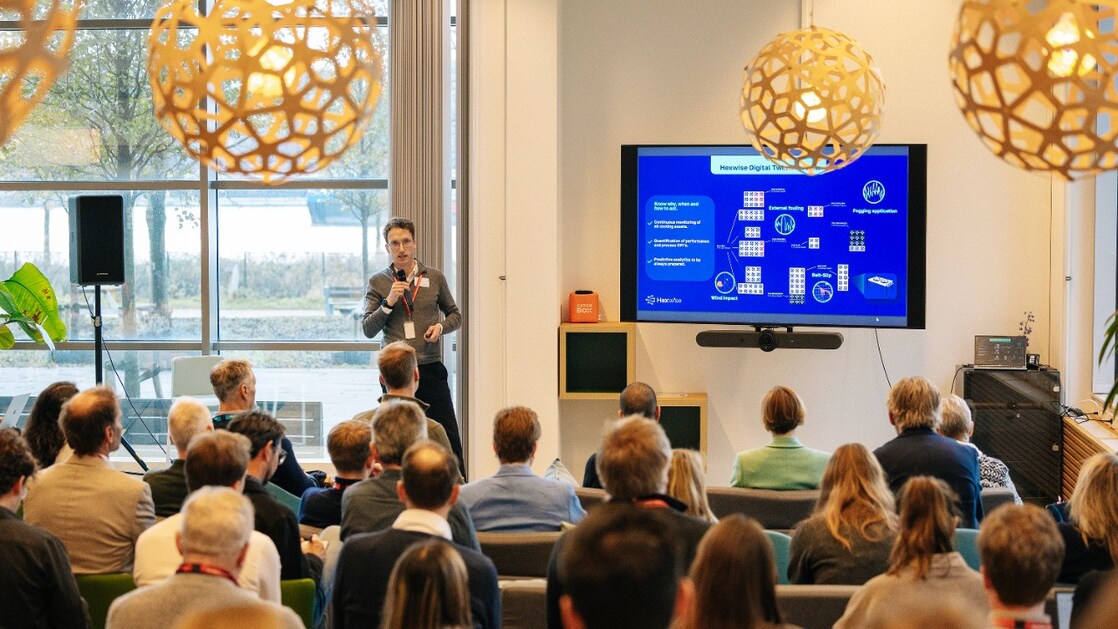
Niels Bergsma (CEO), Pim van Ramshorst and Roy Manting are the three founders of Hexwise. The Barneveld-based company has been a member of the Energy Transition Campus Amsterdam since last month, an open campus where Shell and around 35 knowledge institutions, start-ups and scale-ups are working to accelerate the energy transition. Hexwise owes its ETCA membership to its innovative approach to industrial cooling installations.
At factories, cooling installations are often something of a neglected area of expertise, says Pim van Ramshorst. “They usually fall under both the maintenance of rotating and non-moving components, while optimising these cooling systems is often not part of a factory’s core activities or technical expertise.”
Reducing energy consumption
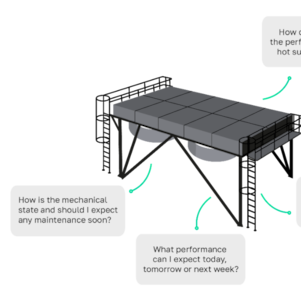
Hexwise has developed its own calculation models that improve the performance of industrial air-cooled cooling systems. By also using artificial intelligence (AI), these models could be developed more quickly. Hexwise’s algorithms for cooling systems use collected real-time data on, for example, outside temperature, wind and the operating conditions of the installations. With these data, not only does the cooling itself perform better, but the factory activities that rely on it could also operate using less energy. Lower energy consumption means reduced CO2 emissions.
Van Ramshorst: “Especially during the summer, production losses in industrial processes are clearly noticeable. For instance, we know of a Dutch power station where turbine output (for generating electricity) is as much as 6% to 7% lower on hot days. With our optimisation of the cooling systems, we can improve this by roughly half on warm days. Altogether, this results in about a 1% to 2% increase in production on an annual basis.”
According to Niels Bergsma, poorly adjusted cooling systems can lead to reduced output, particularly on hot days and especially in large power plants, chemical factories or refineries. Estimates vary, but production losses can reach up to 10%, according to an Australian investment bank (Macquarie Group).
About LeapSprong
LeapSprong Amsterdam is an innovation programme run by the City of Amsterdam, start-up accelerator Rockstart, and the Energy Transition Campus Amsterdam (ETCA). At the ETCA, Shell works alongside more than 30 other parties on solutions for the energy transition. LeapSprong Amsterdam focuses on the energy transition within the port and industrial sectors. Start-ups can submit their solutions, and the best ideas are selected for further development. The winning start-ups, where relevant, gain access to ETCA laboratories, receive support, and have the opportunity to run a pilot in the region.
The winners of the 2026 LeapSprong competion are Hexwise, Upheat and HyERPower. Shell Venster hopes to present interviews with the other two finalists in the near future.
From Rockstart to the world
Three years ago, the international early-stage impact investor Rockstart already saw potential in Hexwise. The founders initially set up their company as a spin-off from a project at a mid-sized cooling equipment manufacturer where they were working at the time. Through Rockstart, Bergsma, Van Ramshorst and Manting discovered the LeapSprong innovation competition, the Energy Transition Campus Amsterdam and Shell.
“The partnership with ETCA, and therefore Shell, gives us new opportunities to grow and further roll out our concept,” says Bergsma. The plan was to “deploy” the algorithms on the cooling installations at Shell’s Pearl GTL gas plant in Qatar, but due to the war situation in the Persian Gulf, it may instead be a location closer to home.
“We see real potential in smarter control and management of industrial cooling systems. This allows us to genuinely support existing industry with reduced production losses, lower energy consumption and therefore lower CO2 emissions,” Bergsma adds.
Cautionary note
Cautionary note
The companies in which Shell plc directly and indirectly owns investments are separate legal entities. In this announcement “Shell”, “Shell Group” and “Group” are sometimes used for convenience to reference Shell plc and its subsidiaries in general. Likewise, the words “we”, “us” and “our” are also used to refer to Shell plc and its subsidiaries in general or to those who work for them. These terms are also used where no useful purpose is served by identifying the particular entity or entities. ‘‘Subsidiaries’’, “Shell subsidiaries” and “Shell companies” as used in this announcement refer to entities over which Shell plc either directly or indirectly has control. The terms “joint venture”, “joint operations”, “joint arrangements”, and “associates” may also be used to refer to a commercial arrangement in which Shell has a direct or indirect ownership interest with one or more parties. The term “Shell interest” is used for convenience to indicate the direct and/or indirect ownership interest held by Shell in an entity or unincorporated joint arrangement, after exclusion of all third-party interest.
Forward-Looking statements
This announcement contains forward-looking statements (within the meaning of the U.S. Private Securities Litigation Reform Act of 1995) concerning the financial condition, results of operations and businesses of Shell. All statements other than statements of historical fact are, or may be deemed to be, forward-looking statements. Forward-looking statements are statements of future expectations that are based on management’s current expectations and assumptions and involve known and unknown risks and uncertainties that could cause actual results, performance or events to differ materially from those expressed or implied in these statements. Forward-looking statements include, among other things, statements concerning the potential exposure of Shell to market risks and statements expressing management’s expectations, beliefs, estimates, forecasts, projections and assumptions. These forward-looking statements are identified by their use of terms and phrases such as “aim”; “ambition”; ‘‘anticipate’’; “aspire”, “aspiration”, ‘‘believe’’; “commit”; “commitment”; ‘‘could’’; “desire”; ‘‘estimate’’; ‘‘expect’’; ‘‘goals’’; ‘‘intend’’; ‘‘may’’; “milestones”; ‘‘objectives’’; ‘‘outlook’’; ‘‘plan’’; ‘‘probably’’; ‘‘project’’; ‘‘risks’’; “schedule”; ‘‘seek’’; ‘‘should’’; ‘‘target’’; “vision”; ‘‘will’’; “would” and similar terms and phrases. There are a number of factors that could affect the future operations of Shell and could cause those results to differ materially from those expressed in the forward-looking statements included in this announcement, including (without limitation): (a) price fluctuations in crude oil and natural gas; (b) changes in demand for Shell’s products; (c) currency fluctuations; (d) drilling and production results; (e) reserves estimates; (f) loss of market share and industry competition; (g) environmental and physical risks, including climate change; (h) risks associated with the identification of suitable potential acquisition properties and targets, and successful negotiation and completion of such transactions; (i) the risk of doing business in developing countries and countries subject to international sanctions; (j) legislative, judicial, fiscal and regulatory developments including tariffs and regulatory measures addressing climate change; (k) economic and financial market conditions in various countries and regions; (l) political risks, including the risks of expropriation and renegotiation of the terms of contracts with governmental entities, delays or advancements in the approval of projects and delays in the reimbursement for shared costs; (m) risks associated with the impact of pandemics, regional conflicts, such as the Russia-Ukraine war and the conflict in the Middle East, and a significant cyber security, data privacy or IT incident; (n) the pace of the energy transition; and (o) changes in trading conditions. No assurance is provided that future dividend payments will match or exceed previous dividend payments. All forward-looking statements contained in this announcement are expressly qualified in their entirety by the cautionary statements contained or referred to in this section. Readers should not place undue reliance on forward-looking statements. Additional risk factors that may affect future results are contained in Shell plc’s Form 20-F for the year ended December 31, 2025 (available at www.shell.com/investors/news-and-filings/sec-filings.html and www.sec.gov). These risk factors also expressly qualify all forward-looking statements contained in this announcement and should be considered by the reader. Each forward-looking statement speaks only as of the date of this announcement, May 14, 2026. Neither Shell plc nor any of its subsidiaries undertake any obligation to publicly update or revise any forward-looking statement as a result of new information, future events or other information. In light of these risks, results could differ materially from those stated, implied or inferred from the forward-looking statements contained in this announcement.
Shell’s net carbon intensity
Also, in this announcement we may refer to Shell’s “net carbon intensity” (NCI), which includes Shell’s carbon emissions from the production of our energy products, our suppliers’ carbon emissions in supplying energy for that production and our customers’ carbon emissions associated with their use of the energy products we sell. Shell’s NCI also includes the emissions associated with the production and use of energy products produced by others which Shell purchases for resale. Shell only controls its own emissions. The use of the terms Shell’s “net carbon intensity” or NCI is for convenience only and not intended to suggest these emissions are those of Shell plc or its subsidiaries.
Shell’s net-zero emissions target
Shell’s operating plan and outlook are forecasted for a three-year period and ten-year period, respectively, and are updated every year. They reflect the current economic environment and what we can reasonably expect to see over the next three and ten years. Accordingly, the outlook reflects our combined Scope 1 and 2 target, NCI target and our oil products ambition over the next ten years. However, Shell’s operating plan and outlook cannot reflect our 2050 net-zero emissions target, as this target is outside our planning period. Such future operating plans and outlooks could include changes to our portfolio, efficiency improvements and the use of carbon capture and storage and carbon credits. In the future, as society moves towards net-zero emissions, we expect Shell’s operating plans and outlooks to reflect this movement. However, if society is not net zero in 2050, as of today, there would be significant risk that Shell may not meet this target.
Forward-Looking non-GAAP measures
This announcement may contain certain forward-looking non-GAAP measures. We are unable to provide a reconciliation of these forward-looking non-GAAP measures to the most comparable GAAP financial measures because certain information needed to reconcile those non-GAAP measures to the most comparable GAAP financial measures is dependent on future events some of which are outside the control of Shell, such as oil and gas prices, interest rates and exchange rates. Moreover, estimating such GAAP measures with the required precision necessary to provide meaningful reconciliation is extremely difficult and could not be accomplished without unreasonable effort. Non-GAAP measures in respect of future periods which cannot be reconciled to the most comparable GAAP financial measure are calculated in a manner which is consistent with the accounting policies applied in Shell plc’s consolidated financial statements.
The contents of websites referred to in this announcement do not form part of this announcement.
We may have used certain terms, such as resources, in this announcement that the United States Securities and Exchange Commission (SEC) strictly prohibits us from including in our filings with the SEC. Investors are urged to consider closely the disclosure in our Form 20-F, File No 1-32575, available on the SEC website www.sec.gov.